
Introduction
A strange chemical smell drifts through a facility, a home, or a wellsite. Someone notices it, shrugs, and moves on. Days later, a headache won't go away, or worse, an inspector flags a violation that's been building for weeks.
That smell was likely a VOC emission. And "invisible" doesn't mean "harmless."
Volatile organic compounds come from thousands of sources, from the paint on your walls to the storage tanks at an oil and gas wellsite. Some VOCs announce themselves with a sharp solvent odor. Others slip past human senses entirely, which is exactly why detection technology matters.
This guide breaks down what VOCs actually are, how detection technology has evolved, and which method fits which use case. It also looks at how industries like upstream oil and gas now lean on continuous monitoring to stay ahead of regulators instead of scrambling to catch up.
Key Takeaways
- VOCs are carbon-based compounds that evaporate at room temperature, emitted by industry, homes, and nature.
- Detection ranges from handheld sensors to AI-driven optical gas imaging systems running continuously.
- Regulators and ESG frameworks are shifting operators from quarterly inspections to continuous, defensible monitoring.
- The right technology depends on sensitivity, environment, and whether you need a safety alert or regulatory-grade data.
What Are VOCs and Why Detection Matters
The EPA defines VOCs as carbon-based compounds with high vapor pressure and low water solubility, meaning they evaporate readily into the air we breathe. "Low boiling point" is a helpful shorthand, but there's no single cutoff that applies across every regulatory or scientific definition.
In plain terms: if a chemical turns from liquid to gas easily at normal temperatures, it's probably a VOC.
Common Sources of VOCs
Everyday sources are everywhere, often in places people never think to check:
- Paints, paint strippers, and varnishes
- Cleaning and disinfecting products
- Adhesives, glues, and permanent markers
- New furniture off-gassing and building materials
- Dry-cleaned clothing and cosmetics
Industrial and energy sources tend to involve higher volumes and more hazardous compounds. In upstream oil and gas, VOCs escape from storage vessels, compressors, pneumatic controllers, and equipment leaks at wellsites and gathering systems.
Many of these releases contain BTEX compounds (benzene, toluene, ethylbenzene, and xylene), which carry documented health risks even at relatively low concentrations.
Health and Environmental Impact
Here's a fact that surprises most people: indoor VOC concentrations run up to 10 times higher than outdoor levels, according to EPA data on indoor air quality.
That gap can persist even after the source activity has ended, depending on ventilation, temperature, and how much the material absorbs into carpets, furniture, and walls.
Short-term VOC exposure causes irritation, headaches, dizziness, and nausea. Long-term exposure to certain compounds, benzene among them, has been linked to liver, kidney, and central nervous system damage.
There's a bigger-picture consequence too. VOCs react with nitrogen oxides in sunlight to form ground-level ozone, the primary ingredient in smog. That connects VOC control directly to public health and ESG reporting obligations. Left undetected, these small leaks compound into big liabilities, which is exactly why continuous, reliable detection matters more than periodic checks.

VOC Detection Technologies and Methods
Every VOC sensor works on one of three basic principles: chemical reaction, optical absorption, or ionization. The technology you choose determines how fast you get an answer, how specific that answer is, and how much it costs.
Metal Oxide Semiconductor (MOS) Sensors
MOS sensors use a heated metal-oxide surface. When VOC molecules hit that surface, they react with adsorbed oxygen and change the material's electrical resistance. That resistance shift gets translated into a reading.
- Best for: low-cost indoor air quality monitors and trend sensing
- Limitation: broad response rather than compound identification, output is often an index rather than a true concentration
Photoionization Detectors (PIDs)
Where MOS sensors give a broad, indexed response, PIDs take a more targeted approach: they use UV light to ionize VOC molecules whose ionization potential falls below the lamp's energy. The resulting ion current is proportional to concentration.
One commonly cited industrial PID model detects 0.5 to 2,000 ppm of isobutylene, though performance varies by manufacturer and calibration gas. PIDs excel at fast, portable screening.
- Best for: industrial hygiene checks, fugitive-emission surveys, field leak localization
- Limitation: broad response to aromatic compounds, sensitive to humidity, and a standard 10.6 eV PID won't detect methane at all
Infrared (IR) and Optical Gas Imaging (OGI)
Beyond reaction-based and ionization-based sensing, IR spectroscopy relies on a third principle: molecules absorb infrared light only at specific, predictable wavelengths. Narrow band-pass filters let a sensor lock onto a gas class with real selectivity.
Optical Gas Imaging takes this a step further, turning that absorption into a visible plume on camera. It's how technicians "see" methane or VOC leaks that are otherwise completely invisible.
Mid-wave infrared (MWIR) cameras, typically operating in the 3-5 micron range, have been the traditional choice for hydrocarbon imaging. Long-wave infrared (LWIR) cameras work in the 8-12 micron range and bring a different cost and performance profile.
This is where the industry is shifting. Well Checked Systems' Zensory.ai™ platform uses LWIR cameras for continuous, day-and-night detection of methane and VOC plumes at roughly one-third the cost of traditional mid-wave IR systems. Well Checked has a USPTO provisional patent filing for Detecting and Quantifying Fugitive Methane and Vapor Emissions Using Infrared Imaging and Machine Learning.
Paired with AI-driven plume analysis, LWIR imaging supports round-the-clock coverage instead of the periodic snapshot most OGI programs rely on.
Lab-Based Methods: GC and Mass Spectrometry
When you need absolute certainty about which compound is present and at what concentration, nothing beats the lab. Gas Chromatography paired with Mass Spectrometry (GC/MS) separates and identifies individual compounds with a level of specificity field sensors can't match.
EPA Method 8260D and ASTM D5466 both rely on GC/MS for compound-specific VOC identification in air, water, and soil samples. It's slow and it's not built for real-time alerting, but it remains the gold standard for regulatory validation.

Choosing the Right VOC Detection Method for Your Application
There's no single "best" VOC sensor. The right choice depends on what question you're trying to answer.
| Method | Speed | Specificity | Best Use Case |
|---|---|---|---|
| Handheld PID/OGI | Immediate | Broad | Spot-checks, worker screening, field surveys |
| Fixed continuous monitors | Real-time, ongoing | Moderate to high (multi-sensor) | Persistent area surveillance, alerting |
| Lab GC/MS | Days | Compound-specific | Regulatory validation, compliance defense |
Key selection factors to weigh:
- Sensitivity needs – Some applications need ppm-level alerts, others require ppb-level precision. Sensitivity varies by sensor model, not just sensor type.
- Specificity – Do you need to know it's "a VOC" or specifically "benzene at 3 ppm"?
- Environmental conditions – Remote wellsites deal with heat, cold, humidity, and dust that indoor sensors never face.
- Regulatory defensibility – Will this data need to hold up in an EPA audit or ESG disclosure?
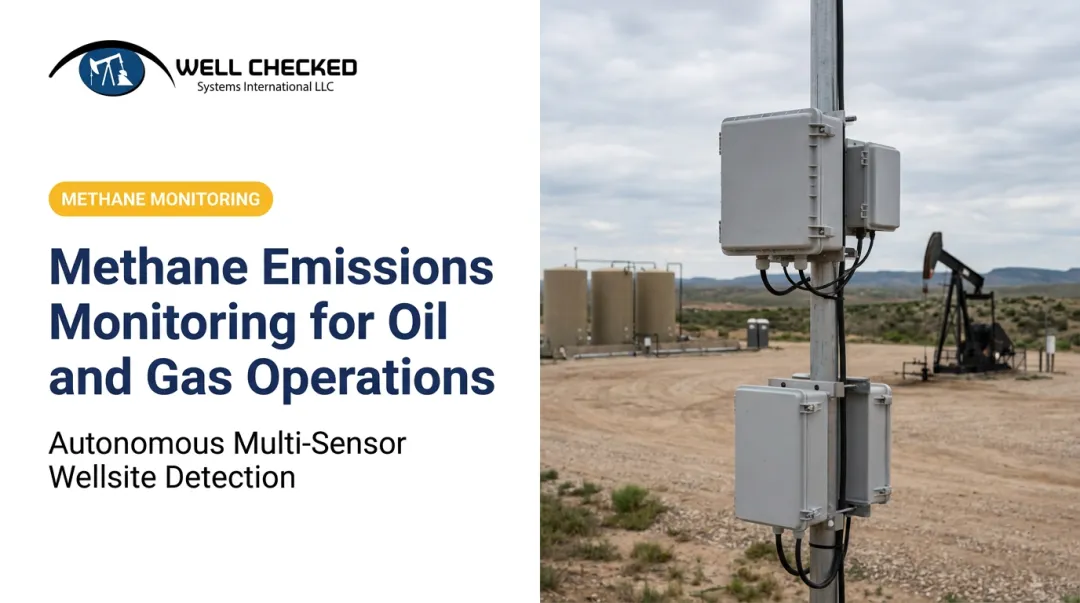
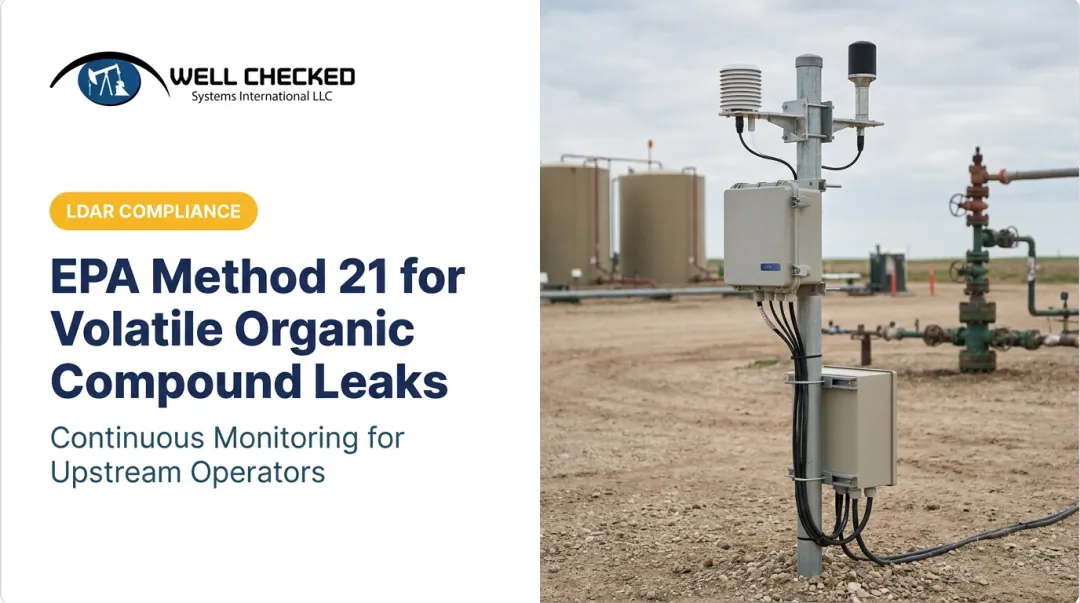
Weighing these factors often points toward the same conclusion: no single-technology solution holds up under real-world wellsite conditions. A lone gas sensor triggers too many false alarms and covers too little ground. Multi-sensor systems, combining video, acoustic equipment monitoring, and OGI, cover more area autonomously and cut down on the noise that overwhelms field teams. Well Checked Systems built its Zensory.ai™ platform around this same multi-sensor approach.
Industrial VOC Monitoring and Regulatory Compliance
Petrochemical plants, manufacturers, and upstream oil and gas operators all face binding obligations to monitor and report VOC and methane emissions. For upstream producers specifically, that pressure has intensified fast.
The Shift Away from Route-Based LDAR
Traditional Leak Detection and Repair programs rely on quarterly, route-based inspections. An independent survey-frequency analysis modeled costs around $600 per site per OGI survey, with EPA rulemaking separately assuming roughly 2.4 hours per survey at a $142 per hour contractor rate, according to published research by Ravikumar and Lyon on survey frequency and emissions.
Multiply that across hundreds of sites and the math gets ugly fast. Quarterly visits still leave gaps where leaks go undetected for months.
Well Checked Systems' internal data puts this cost even higher in practice: mid-sized to large operators often spend $1 million to $5 million or more annually on route-based site visits alone.
Regulatory Frameworks Operators Must Track
- EPA methane rule (40 CFR Part 60 Subpart OOOOb) – effective May 7, 2024, requiring quarterly-to-bimonthly monitoring and repairs within 15-30 days of detection.
- State-agency emissions inventories – requirements vary by jurisdiction but increasingly mirror federal monitoring expectations.
- ESG frameworks – OGMP 2.0 Level 4/5, SASB Oil & Gas E&P, and TCFD/IFRS S2 all demand rigorous, auditable emissions data.
Operating By Exception
This is where continuous monitoring changes the operational model entirely. Well Checked's three-tier architecture illustrates the shift:
- Zentinal Ops™ delivers visual and acoustic equipment intelligence — high-resolution video, object recognition, acoustic anomaly detection, and actionable alerts. Well Checked has a USPTO provisional patent filing covering its acoustic anomaly detection technology.
- Zentinal Core™ runs 24/7 autonomous multi-sensor detection, learning each site's normal operating baseline over roughly two days, then filtering out routine process emissions so only genuine fugitive events trigger an alert; supports OGMP 2.0 Level 3.
- Zentinal IQ™ quantifies validated events, only after Core confirms them, producing regulatory-defensible data formatted for EPA submissions, OGMP 2.0 Level 4/5 reporting, and SASB/TCFD disclosures.
Once Core validates an event, operators acknowledge, dispatch, and mitigate within 24 hours, a window designed specifically to support a documented, timely response tied to methane survey events. This model runs across multi-sites in the Appalachian Basin.

The benefits extend past compliance:
- Cuts unnecessary vehicle miles and the emissions they generate
- Reduces field-personnel exposure to traffic, weather, and hazardous site conditions
- Delivers continuous, gap-free records instead of periodic LDAR snapshots
Common Challenges in VOC Detection
Even the best sensors have blind spots. Understanding these limitations helps set realistic expectations for any monitoring program.
Cross-sensitivity affects many low-cost sensors. MOS sensors, for example, often react to carbon monoxide and hydrogen alongside actual VOCs, so a positive reading doesn't always confirm what triggered it.
Environmental interference poses a real problem in outdoor and remote settings. Temperature swings and humidity changes alter sensor resistance and response time in MOS sensors, while also reducing PID accuracy.
Sensor drift creeps in over time as components age or accumulate contamination. Without regular recalibration under field-representative conditions, readings gradually lose reliability, which is why:
- Multi-sensor fusion (combining gas, visual, and acoustic data) outperforms single-point sensors
- AI-based baseline learning matters more than raw sensor sensitivity alone
- Regulatory-grade reporting requires validation layers, not just a single detection event
Well Checked Systems built its Zensory.ai™ platform on this principle, pairing gas, visual, and acoustic equipment sensors with AI baseline learning to validate true fugitive emissions before they reach a report.
Frequently Asked Questions
How long do VOCs stay in the air?
It depends on the compound, ventilation, and temperature. Some VOCs dissipate within hours in a well-ventilated space, while others linger for days indoors or in stagnant industrial air.
What do VOCs smell like?
Many have solvent-like, sweet, or pungent odors, but plenty are odorless at low concentrations. That's why sensor-based detection, such as the optical gas imaging cameras Well Checked Systems deploys, matters more than relying on your nose.
Are VOCs harmful to humans?
Short-term exposure can cause irritation, headaches, and nausea. Long-term exposure to certain compounds, benzene included, has been linked to organ damage and cancer risk, depending on concentration and duration.
What is considered a safe level of VOC exposure?
There's no single federal indoor limit. The WHO sets compound-specific guidelines, such as 0.1 mg/m³ for formaldehyde over 30 minutes, and states no safe exposure level exists for benzene.
How can VOC exposure be reduced indoors and in industrial settings?
Ventilation, source control (swapping high-VOC products), and continuous monitoring work together. No single strategy covers every scenario, which is why layered approaches perform best.
What is the difference between VOC and TVOC monitoring?
VOC refers to an individual compound, like benzene or toluene. TVOC (Total VOC) aggregates multiple compounds into one screening number, useful for spotting trends but not for identifying which specific chemical is present.