
Detector technology has become critical across oil and gas, industrial, and confined-space work. Regulatory pressure keeps building: OSHA sets strict exposure limits for gases like hydrogen sulfide, and EPA's methane rule now demands rigorous emissions tracking under 40 CFR Part 60 Subpart OOOOb. NIOSH has documented worker deaths tied to hydrocarbon vapor exposure and oxygen-deficient atmospheres at storage tanks — a stark reminder of what's at stake.
This article breaks down the major gas detector types by sensor technology, use case, and how to pick the right one for your operation.
Key Takeaways
- Sensor types (electrochemical, catalytic bead, IR, PID, ultrasonic, semiconductor) suit different gases and sites
- Detectors ship as portable or fixed units, in single-gas or multi-gas configs
- Selection depends on target gas, environment, range, and compliance needs
- Multi-sensor AI platforms are replacing manual point checks at oil & gas wellheads
What Is a Gas Detector?
A gas detector senses and measures gas concentration in air, triggering an alarm when levels cross a set threshold. Every detector combines three core parts:
- Sensor — the element that reacts to the target gas
- Control unit — processes the sensor's signal into a readable measurement
- Alarm/notification system — alerts personnel audibly, visually, or digitally
These aren't lab instruments. They're practical safety tools deployed inside confined spaces, on industrial plant floors, and across oilfield sites for leak detection, exposure monitoring, and compliance recordkeeping.
Why Are Gas Detectors Important in Industrial Safety and Compliance?
Undetected toxic or combustible gas leaks cause explosions, asphyxiation, and long-term health damage.
NIOSH identified at least 9 worker deaths between 2010 and 2015 tied to hydrocarbon vapor exposure at oil and gas storage tanks. Every one of those workers was alone when they collapsed.
Beyond immediate safety, gas detection supports:
- OSHA exposure compliance: H2S ceilings, LEL thresholds, and confined-space entry protocols
- EPA methane rule reporting: Subpart OOOOb requires periodic screening or approved continuous monitoring for fugitive emissions
- ESG and investor reporting: frameworks like OGMP 2.0, SASB, and TCFD increasingly expect measurement-based data
Without reliable detection, operators risk fines, unplanned shutdowns, and reputational fallout from unreported emissions events. Those costs now show up directly in compliance budgets, not only in incident reports.
Types of Gas Detectors by Sensor Technology
Gas detectors aren't one-size-fits-all. The sensor inside determines which gases it can detect, how sensitive it is, and where it can survive.
Electrochemical Sensors
Electrochemical sensors use a chemical reaction between the target gas and an electrode to generate a proportional electrical current.
- Best for: toxic gases like CO, H2S, Cl2, and NH3 in confined spaces and personal monitors
- Strengths: high selectivity, low power draw, compact enough for wearables
- Limitations: cross-sensitivity to other gases and a limited sensor lifespan requiring periodic replacement
Catalytic Bead (Pellistor) Sensors
These measure heat released when combustible gas oxidizes on a catalytic bead. A Wheatstone bridge circuit converts that heat change into a readable signal.
- Best for: flammable gases like methane, propane, and hydrogen, expressed as %LEL
- Strengths: fast response, proven reliability, and hazardous-area options (Class I, Div. 1/2; ATEX/IECEx)
- Limitations: needs oxygen to function and is vulnerable to catalyst poisoning from silicones or lead
Infrared (IR) Sensors
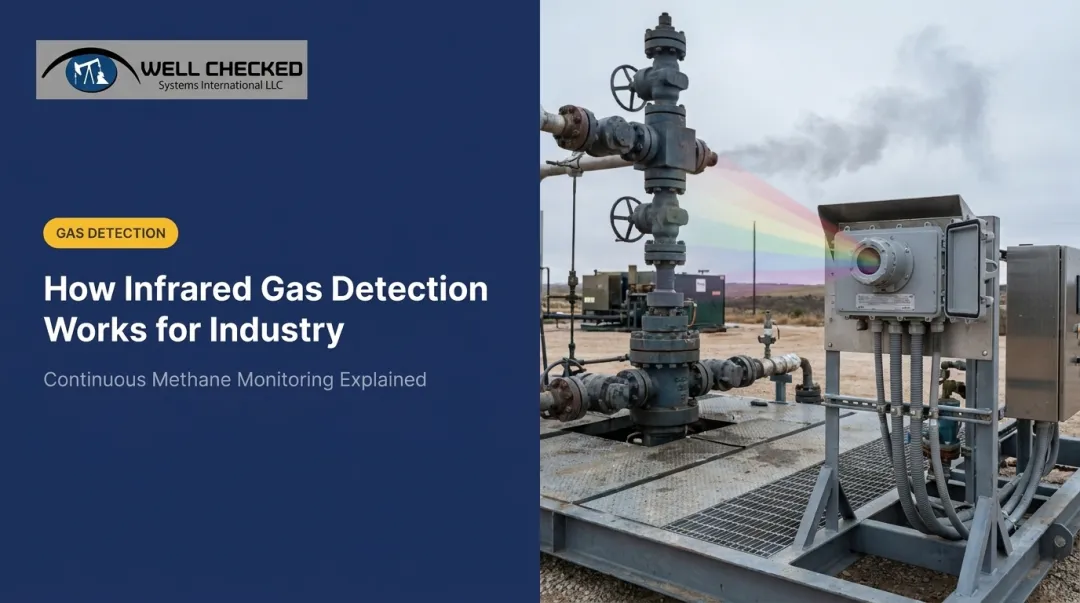
IR sensors measure gas concentration by detecting how specific infrared wavelengths get absorbed as gas passes through the beam. Unlike catalytic types, they need no oxygen to operate—though humidity, temperature, and pressure can still affect readings.
- Best for: hydrocarbon gases, CO2, and methane in oxygen-deficient or remote environments, including open-path and fence-line monitoring
- Strengths: immune to catalyst poisoning, minimal calibration drift, reliable in harsh oilfield conditions
- Limitations: higher upfront cost than catalytic sensors, though optical gas imaging variants now offer more cost-efficient continuous coverage
Photoionization Detectors (PID)
PIDs use UV light to ionize gas molecules, generating a current proportional to VOC concentration.
- Best for: trace volatile organic compounds in environmental assessments, leak surveys, and hazmat response
- Strengths: extremely sensitive to a broad range of VOCs, even at low concentrations
- Limitations: can't distinguish between specific compounds, so complementary sensors are needed for precise identification

Portable vs. Fixed Gas Detectors
Portable detectors are handheld or wearable units built for personal safety. Field technicians use them during inspections, confined-space entry, and maintenance work.
Fixed detectors stay permanently installed for continuous, 24/7 area or process monitoring. Many integrate directly with alarms and shutdown systems.
Beyond form factor, you also choose single-gas or multi-gas configurations:
- Single-gas units track one specific hazard with maximum sensitivity
- Multi-gas units (such as a 4-gas monitor) check oxygen, combustibles, and toxics at once—essential for confined-space entry
OSHA's confined-space standard specifies the testing order: oxygen first, then flammable gases, then toxic contaminants. That sequence shapes how multi-gas units are designed and used.

How to Choose the Right Gas Detector for Your Application
The right detector depends on your specific gas hazard, environment, and monitoring goals, not brand popularity. Key factors:
- Target gas and sensitivity range — what are you actually trying to catch?
- Environmental conditions — temperature, humidity, remoteness, exposure to weather
- Certification needs — UL, CSA, Class I Division, and EPA compliance requirements for your industry
- Portable vs. fixed use case — personal safety checks or continuous area monitoring?
- Maintenance and calibration burden — daily bump tests, periodic calibration, sensor replacement cycles
For large-scale, remote, or multi-site operations, the priorities change. Point sensors and manual operator routes create real coverage gaps. Well Checked's own data shows traditional route-based site visits can cost mid-sized to large operators $1 million to $5 million or more annually, before counting the safety risk of sending people to remote sites in bad weather.
Zensory.ai is built for that gap. Instead of single-point sensors alone, it combines three sensing modalities across a site:
- Visual — high-resolution cameras with AI object detection for continuous 360° coverage
- Acoustic — AI that flags abnormal equipment sound signatures before failures escalate
- Optical gas imaging — Long-Wave Infrared cameras performing continuous methane and VOC detection, day or night
The platform runs a roughly two-day AI Site Learning cycle per location to establish what "normal" looks like. That baseline helps it filter out routine process emissions and alert only on genuine fugitive anomalies. Well Checked has deployed this architecture across remote U.S. onshore sites, including a confirmed program with a large Appalachian operator in the Appalachian Basin.

Once an event is validated, operators can acknowledge, dispatch, and mitigate within 24 hours, a window that produces a dated response record for the validated event. For operators evaluating whether this fits their site portfolio, a fixed-fee pilot program offers a lower-commitment entry point before full deployment.
Match sensor type, placement, and system architecture to the gases you face, the sites you run, and the response time your risk profile actually requires.
Conclusion
Gas detectors protect workers, assets, and the environment from hazardous gas exposure. No single sensor technology or detector format fits every gas, environment, or scale of operation. Electrochemical, catalytic, infrared, and PID sensors each solve different problems. Portable and fixed formats serve different monitoring goals.
Those distinctions help operators pick the right strategy—whether a portable monitor for confined-space entry or a continuous multi-sensor platform watching hundreds of remote wellsites.
Frequently Asked Questions
What are the different types of gas detectors?
Detectors are classified two ways: by sensor technology (electrochemical, catalytic bead, infrared, PID, ultrasonic, semiconductor) and by format (portable or fixed, single-gas or multi-gas).
What is a 4-gas detector?
A 4-gas detector is a portable multi-gas monitor typically measuring oxygen, combustible gases (LEL), carbon monoxide, and hydrogen sulfide. It's the standard tool for confined-space entry checks.
How often should gas detectors be calibrated or bump tested?
Most manufacturers recommend a bump test before each day's use and full calibration on a set schedule—commonly monthly, based on usage. A failed bump test requires calibration before the unit returns to service.
Do gas detectors need oxygen to function?
Catalytic bead and semiconductor sensors require oxygen for combustion-based detection. Infrared sensors don't, which makes them useful in oxygen-deficient environments.
Can one detector monitor multiple gases at once?
Yes. Multi-gas detectors combine several sensor types in one unit, tracking multiple hazards simultaneously. This is standard for confined-space entry and general industrial safety.
How is continuous methane monitoring different from traditional portable gas detection?
Continuous monitoring uses fixed or multi-sensor systems, including AI-enabled platforms, to provide 24/7 site-wide coverage. Portable detectors are built for point-in-time personal safety checks during specific tasks.