
Introduction
Every industrial site and remote field operation now generates more data in a day than a manual team can review in a week. Sensors, cameras, and gas detectors send constant signals, yet most operators still rely on scheduled checks to catch problems.
That gap creates real risk. Manual inspection routes and periodic checks mean incidents go unnoticed for hours or days, and siloed alerts get missed.
Labor costs pile up for site visits that find nothing wrong, while the one visit that mattered comes too late — a pattern that can cost operators $1M to $5M a year in unnecessary route-based inspections.
This guide breaks down what monitoring and automation actually mean, the types of each you need to know, and the tools that power them. We'll also look at how combining the two transforms operations at remote oil and gas wellsites, where the stakes include safety, regulatory compliance, and uptime.
Key Takeaways
- Monitoring detects problems, and automation acts on them; the two work best in tandem, not in isolation.
- Five monitoring types cover infrastructure, apps, security, field/environmental conditions, and workflows.
- Four automation types range from basic task scripts to AI-driven decision-making.
- Route-based manual inspections can cost mid-sized to large operators $1M–$5M+ annually.
- Continuous, timestamped monitoring data holds up better under regulatory audit than periodic snapshots.
What Is Monitoring and Automation?
Monitoring is the continuous observation of systems, assets, or processes to detect unexpected behavior, threshold breaches, or state changes. It's the difference between knowing something happened and knowing it's happening right now.
Automation is technology, whether rules-based or AI-driven, that executes tasks or responses without someone manually triggering each step. On its own, automation just runs scripts, but paired with monitoring, it becomes a reflex.
Here's the part most teams miss: monitoring only becomes useful when it's connected to automation. Without automation, a monitoring alert just sits in a dashboard waiting for someone to notice. With it, that same alert triggers a response before anyone has to check a log file.
Monitoring vs. Logging: Why the Difference Matters
Logging records events, telling you what happened after the fact, if you go looking for it. Monitoring turns that same data into a real-time signal that demands attention. A log file can sit untouched for months. A monitoring alert shows up the moment something crosses a threshold.
From Manual Routes to Operate-by-Exception
Consider a traditional pumper route in oil and gas field operations. A technician drives a scheduled circuit, physically checking each wellsite for leaks, malfunctions, or unusual conditions. It's a manual logging exercise: check, record, move on, with nothing happening between visits except silence.
Continuous sensor-based monitoring changes that: instead of waiting for the next scheduled drive-by, sensors watch the site around the clock and automatically flag genuine anomalies, filtering out routine process activity. Teams shift from visiting every site on a calendar to visiting only the sites that actually need attention. That's what "operating by exception" looks like in practice.
The 5 Types of Monitoring You Should Know
Monitoring isn't limited to IT dashboards. It spans infrastructure, applications, security, physical/environmental conditions, and the automated workflows running underneath everything else.
Infrastructure Monitoring
This tracks the health of servers, networks, and hardware, including uptime, CPU load, and storage capacity, to prevent outages before they happen. A typical setup might trigger an alert when disk usage crosses 85% or when a server stops responding to health checks, giving IT teams time to act before users notice anything.
Application & Performance Monitoring
Application performance monitoring (APM) tracks response times, error rates, and throughput to keep software reliable. Two common approaches exist:
- Agent-based monitoring instruments the actual application code to expose internal transactions and dependencies
- Synthetic monitoring runs scripted tests that simulate real user journeys, catching failures even before real traffic hits them
Security & Anomaly Monitoring
Behavioral and network anomaly detection flags unusual activity by comparing current behavior against learned patterns. Machine learning models analyze unlabeled data for trends and outliers, and false-positive rates typically drop as these models refine on more site-specific data over time.
Environmental & Emissions/Field Monitoring
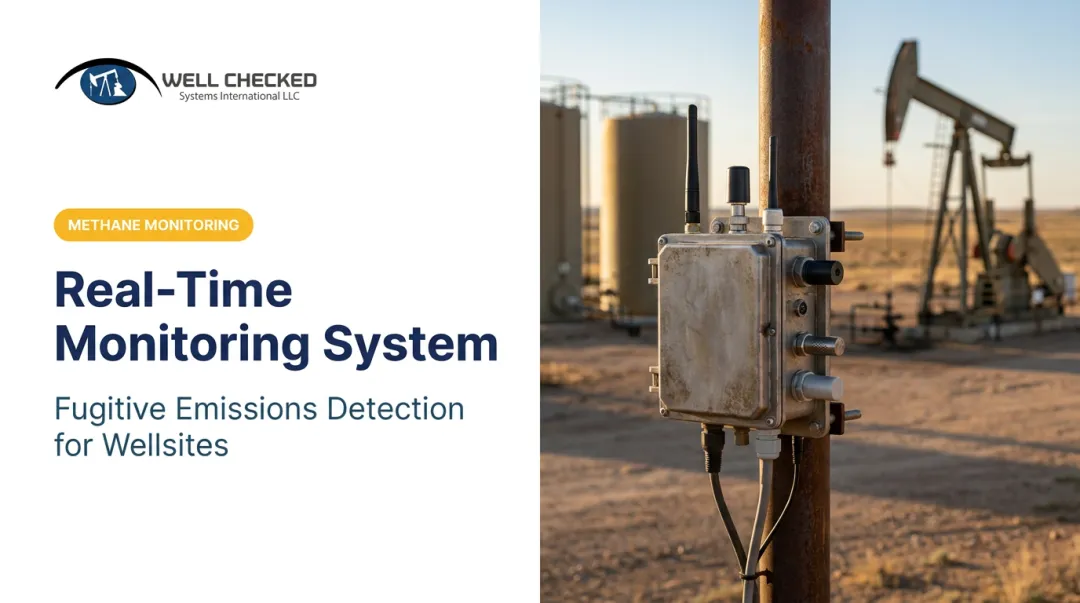
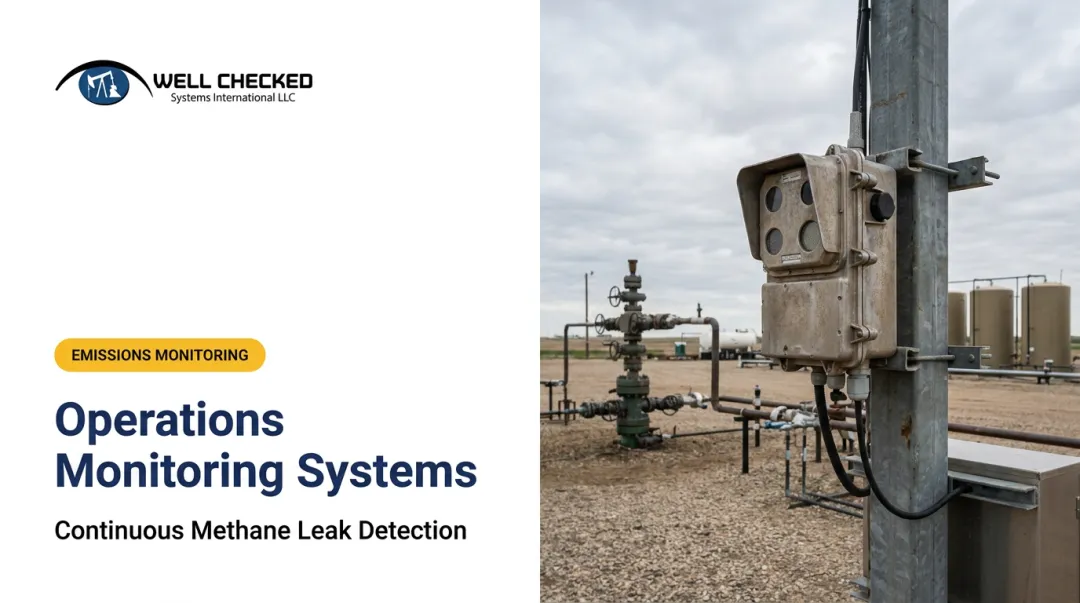
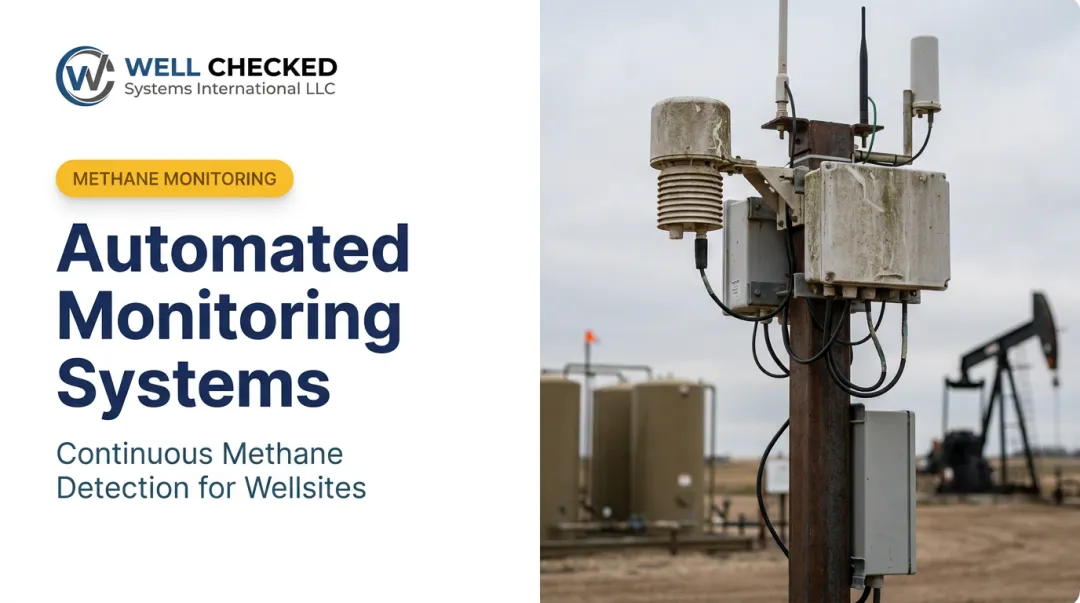
This covers physical monitoring of remote industrial assets using multiple sensor inputs, including video, acoustic abnormal-sound detection, and optical gas imaging, to detect leaks, equipment failure, or safety events — the same multi-sensor combination Well Checked Systems runs across upstream oil and gas sites. This matters most in regulated industries like oil and gas, where a missed leak carries both compliance risk and safety exposure.
Process & Workflow Monitoring
Beyond uptime, automation and RPA monitoring tracks execution status, queue backlogs, and outcome quality across automated workflows. If a batch job silently fails or a queue backs up overnight, this is the layer that catches it.

The 4 Types of Workplace Automation
Automation isn't one thing. It spans a spectrum from simple scripts to systems that make judgment calls on their own.
- Basic or Task Automation: Simple, repetitive, rules-based tasks that need no complex logic. Think scheduled reports, automated data entry, or recurring file transfers.
- Process Automation: Multi-step workflows automated end-to-end across systems, such as approval chains, batch processing jobs, or multi-stage onboarding sequences.
- Integration Automation: Connects disparate systems and APIs so data and triggers flow automatically between platforms, eliminating manual handoffs between tools that don't naturally talk to each other.
- Intelligent or AI-Driven Automation: Layers machine learning or AI on top of automation to interpret unstructured data, learn patterns, and make judgment-based decisions, like distinguishing a true anomaly from normal background noise.
The complexity climbs at each stage, but so does the autonomy. A scheduled report doesn't need human review. A system deciding whether a signal is a real emissions event does, at least until it's proven reliable.
Top Automation & Monitoring Tools and Technologies
The tool landscape breaks into four broad categories:
| Category | What It Does |
|---|---|
| Cloud/AIOps observability | Ingests and correlates metrics, logs, and traces across applications and infrastructure |
| RPA/workflow monitoring | Deploys, schedules, and tracks attended/unattended automations |
| IT automation/orchestration | Defines and monitors end-to-end workflows, including AI-agent-driven steps |
| Physical/industrial IoT sensors | Monitors remote assets and physical conditions in the field |
Choosing between them comes down to a few core criteria:
- Alerting precision: Does it flag real problems, or does it bury teams in noise?
- Dashboard clarity: Can someone glance at it and know what needs attention?
- Scalability: Will it hold up across hundreds of sites or thousands of assets?
- Integration: Does it connect to what you already run, or does it become another silo?
Measured against those four criteria, generic IT monitoring tools fall short in the field — they weren't built for remote, safety-critical environments. They assume reliable connectivity, indoor conditions, and a single data stream. None of that holds true at a wellsite three hours from the nearest fiber line.
That gap is why purpose-built industrial platforms exist. Well Checked's Zensory.ai™ is one example: a multi-sensor AI monitoring platform combining video, Long-Wave Infrared Optical Gas Imaging, and acoustic abnormal-sound detection. It's built specifically to automate detection at remote sites where connectivity is unreliable and hazard exposure makes routine human checks costly.
Why Combining Monitoring + Automation Delivers Real ROI
Cutting the Cost of Manual Inspection Labor
Route-based manual site visits are expensive by design. Personnel drive scheduled circuits, check each site visually, and move on, regardless of whether anything is actually wrong. For mid-sized to large oil and gas operators, that model runs $1M–$5M+ annually in labor, vehicles, and travel time.
Continuous monitoring flips the model. Instead of paying for routine visits that mostly find nothing, teams only dispatch when a validated event demands it.
Shrinking Response Time
Automation shortens the gap between detection and action. IBM's 2024 breach research found that organizations using extensive security AI and automation identified and contained incidents 98 days faster than those without it. That's a security-industry benchmark, not an oilfield guarantee, but the underlying logic holds across domains: faster detection means faster containment.
Well Checked's platform applies that same logic to field operations. Once Zentinal Core™ validates a fugitive gas event, teams receive near real-time alerts and can acknowledge, dispatch, and mitigate within 24 hours. One Director of Operations described that window as critical:
"Rapid response to a timely methane survey event can support a documented, timely response."

Building a Defensible Compliance Record
Continuous, timestamped monitoring data holds up better in an audit than a quarterly snapshot. The EPA's methane rule under 40 CFR Part 60 Subpart OOOOb recognizes alternative continuous-monitoring pathways for compliance submissions under approved alternative test methods and monitoring plans. A periodic inspection can only tell you what a site looked like on the day someone visited. Continuous monitoring builds a full record.
This is where Well Checked's three-tier architecture matters:
- Zentinal Ops™ delivers visual and acoustic equipment intelligence: high-resolution video, object recognition, acoustic anomaly detection, and actionable alerts. Well Checked has a USPTO provisional patent filing covering its acoustic anomaly detection technology.
- Zentinal Core™ validates true anomalies and filters out routine process activity
- Zentinal IQ™ quantifies the volume, duration, and rate of validated events only, producing documentation that regulators and ESG frameworks like OGMP 2.0, SASB, and TCFD actually want to see
Proof at Scale: The Appalachian Basin Deployment
Well Checked's largest confirmed deployment is a multi-site program across the Appalachian Basin, a rollout that replaced route-based site visits with continuous autonomous monitoring at meaningful scale. It's the kind of deployment that only makes financial sense once you account for the $1M–$5M+ annual burden of manual routes across a large multi-site portfolio.
Safety and Environmental Co-Benefits
Fewer routine site visits reduce exposure to the risks tied to constant road travel, plus the fleet emissions those routes generate:
- Safety: NIOSH reports that motor-vehicle crashes account for over 40% of work-related deaths in oil and gas extraction, with long travel to remote wellsites and fatigue cited as contributing factors
- Emissions: The EPA estimates a typical passenger vehicle emits roughly 400 grams of CO2 per mile; fewer routine inspection drives across a multi-site portfolio add up to a measurable reduction in fleet emissions over a year, even before counting labor savings
Best Practices for Implementing an Automated Monitoring Strategy
Getting monitoring and automation right takes more than buying technology; it takes rollout discipline. These four practices help operators build alerts that earn trust instead of getting ignored:
- Start with a baseline period. Let the system learn normal behavior before acting on alerts. Well Checked's platform runs a roughly two-day AI Site Learning cycle per site, cutting false alarms from day one.
- Build a tiered architecture. Layer visual intelligence, detection, and quantification in sequence. This is the logic behind Zentinal Ops™ (visual and acoustic equipment intelligence), Zentinal Core™ (detection), and Zentinal IQ™ (quantification), preventing teams from drowning in signals that don't require action.
- Design dashboards for trends, not noise. Reserve alerts strictly for actionable exceptions. Trend data belongs in reports; alerts belong to real problems. Mixing the two is how alert fatigue starts.
- Assign clear ownership. Someone needs to own reviewing dashboards and responding to alerts. Monitoring without an accountable response path is just an expensive log file.

Frequently Asked Questions
What is an automated monitoring system?
It's a system that continuously observes assets or processes and automatically flags or responds to abnormal conditions without someone manually checking each one. It pairs detection with a rules-based or AI-driven response.
What are the 5 types of monitoring?
In oil & gas operations, the core types are emissions/methane monitoring, equipment and mechanical monitoring, security and site surveillance, environmental and regulatory monitoring, and SCADA/process monitoring. Each tracks a different signal and triggers a different response.
What are the 4 types of workplace automation?
In field operations, automation typically falls into four types: automated alerting, automated dispatch, automated data quantification, and automated compliance reporting. Together, they replace manual, route-based checks with exception-based response.
What are the top 5 automation tools?
There's no single universal list. For upstream oil & gas, focus on multi-sensor field monitoring platforms, SCADA integration tools, automated alert/dispatch software, and emissions quantification tools built for regulatory reporting. Choose based on your specific compliance needs.
What is the difference between monitoring and automation?
Monitoring detects and signals issues; automation acts on those signals to execute a response. One watches, the other responds. You need both to close the loop.
How does automated monitoring improve regulatory compliance?
Continuous, timestamped monitoring data creates a defensible audit trail that periodic manual inspections can't match. Frameworks like the EPA's methane rule and OGMP 2.0 recognize this kind of measurement-based reporting for compliance submissions.