
Introduction
Every leak that escapes before it ever reaches a burner tip is product that was never sold.
Every year, oil operations leak around 45 million tonnes of methane and gas operations add nearly 35 million tonnes more, according to the IEA's 2025 Global Methane Tracker. Much of that volume never gets flared or vented on purpose. It simply leaks.
Fugitive methane emissions are unintentional escapes from valves, seals, and aging pipe. They happen throughout the value chain, from the wellhead to the meter. Unlike venting or flaring, nobody designs these leaks to happen.
For operators, catching them is no longer optional. New EPA rules, OGMP 2.0 reporting tiers, and investor ESG scrutiny have turned leak detection into a business-critical function, not a compliance afterthought.
This piece covers where these leaks originate, why routine inspections miss them, and how continuous monitoring closes the gap.
Key Takeaways
- Fugitive emissions result from equipment failure and aging infrastructure, not intentional design
- Undetected leaks cause EPA fines, lost saleable gas, and safety hazards near equipment
- Quarterly leak detection and repair (LDAR) inspections miss leaks that start and stop between visits
- Effective prevention combines detection technology and equipment upgrades
- EPA Subpart OOOOb and OGMP 2.0 now demand measurement-based, defensible data
Common Causes of Fugitive Methane Emissions
Fugitive methane emissions are unintended releases of gas to the atmosphere from oil and gas infrastructure. That's distinct from flaring or venting, which are intentional and controlled. Pipeline-quality natural gas runs 95-98% methane, so even a small, slow leak represents significant unrecovered product relative to its volume.
Here's the uncomfortable part: most of that punch comes from a handful of locations. A 2022 PNAS study measuring five U.S. basins found that strong point sources — leaks above 10 kg of methane per hour — averaged 40% of total regional methane flux. A small number of "super-emitter" sites do most of the damage. That makes targeted detection far more valuable than blanket, low-resolution surveys.
Equipment and Component Leaks
Valves, flanges, connectors, and threaded fittings degrade over time. Pressure cycling, temperature swings, and corrosion all chip away at seal integrity.
Common failure points include:
- Aging wellsite valves and connectors that have never been swapped out
- Compressor seals worn down by continuous operation
- Threaded and bolted connections that sit untouched between routine visits
Pneumatic Devices and Controllers
High-bleed pneumatic controllers are designed to release small puffs of gas as part of normal pressure and level regulation. That's by design. The problem starts when a controller malfunctions and starts releasing far more gas than it should.
Legacy high-bleed devices remain common at older wellsites, especially in regions without retrofit mandates. Measured device data backs this up: units emitting above 6 standard cubic feet per hour made up only 19% of controllers surveyed but accounted for 95% of measured emissions from the group.
Pipeline, Compressor Station, and Storage Leaks
Downstream infrastructure isn't immune. Aging transmission lines, compressor station seals, and storage tank fittings leak too, and the problem grows as pipeline networks age. Globally, upstream production accounts for roughly 85% of oil-and-gas methane emissions, with transportation and other downstream operations making up the remaining 15%.

What Happens If Fugitive Emissions Go Undetected
An undetected leak doesn't just sit there quietly. It compounds.
- Lost revenue: every cubic foot that escapes is saleable product that never reaches the meter
- EPA fines: validated methane events under the new federal rule carry real financial penalties
- ESG damage: investors and rating agencies increasingly score operators on measured, not estimated, emissions
- Safety risk: combustible gas accumulating near equipment or in confined spaces creates a genuine ignition hazard
The core problem is timing. Quarterly LDAR surveys and pumper routes capture a single snapshot, and a leak that starts the day after an inspector leaves can run undetected for weeks, sometimes months, before the next visit.
The 2018 Science synthesis of the U.S. supply chain estimated actual methane loss at 13 teragrams per year, about 60% higher than the EPA inventory at the time. Periodic bottom-up methods simply miss abnormal operating conditions that don't show up on a schedule.
Warning Signs of a Fugitive Emission Problem
Field teams can catch problems early if they know what to watch for:
- Unexplained volume or pressure drops between the wellhead and the sales point
- Visible frost, discoloration, or bubbling at connection points, valves, or soil near buried lines
- Hissing sounds or abnormal acoustic signatures near valves, flanges, and pneumatic devices
How to Prevent Fugitive Methane Emissions
No single fix solves this. Prevention works as a layered strategy: detection technology and smarter equipment working together.
Leak Detection and Repair (LDAR) Programs
What to do: Run scheduled inspections using handheld Optical Gas Imaging cameras, soil gas sampling, or infrared surveys.
How it helps: LDAR finds existing leaks so crews can repair them before large volumes escape.
When to implement: As a baseline compliance requirement. Its limitation is built into its name: it's periodic, not continuous, and still misses the gap between visits.
Continuous Autonomous Multi-Sensor Monitoring
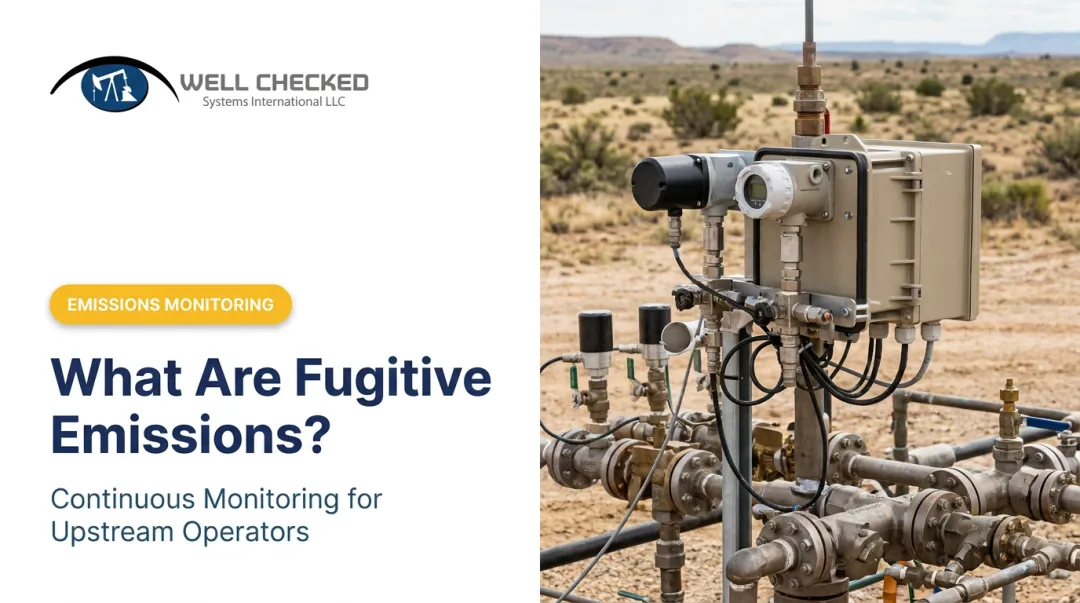
What to do: Deploy always-on monitoring that combines video, acoustic, and infrared sensing at the wellsite. Well Checked Systems' Zensory.ai™ platform does exactly this, pairing high-resolution AI video with acoustic anomaly detection and Long-Wave Infrared Optical Gas Imaging. Well Checked has a USPTO provisional patent filing for Detecting and Quantifying Fugitive Methane and Vapor Emissions Using Infrared Imaging and Machine Learning.
How it helps: The system learns a site's normal operating signature in roughly two days, then filters out routine process emissions to flag only true fugitive anomalies. That triggers an acknowledge-dispatch-mitigate response within 24 hours (a window documented to support a documented, timely response), instead of waiting weeks for the next route visit.
When to implement: For mid-to-large operators running multiple remote sites, where route-based inspection costs (often $1 million to $5 million or more annually) and response lag create financial and regulatory exposure at the same time.
Equipment Upgrades to Low-Bleed/No-Bleed Devices
What to do: Retire legacy high-bleed pneumatic controllers in favor of low-bleed or instrument-air-driven alternatives.
How it helps: Removes a major source tied directly to normal equipment operation, not just malfunction.
When to implement: During scheduled equipment turnovers or as part of broader capital planning for emissions reduction.

Tips for Long-Term Prevention and Control
Sustainable emissions management isn't a one-time project. A few habits separate operators who stay ahead of regulators from those who scramble after every audit:
- Make continuous monitoring the default, not a periodic supplement. Zentinal IQ™ then quantifies confirmed leaks by duration and volume, enabling ROI-based repair decisions instead of guesswork.
- Train field and HSE teams to recognize warning signs and follow standardized response protocols across every site, not just the flagship ones.
- Keep timestamped documentation of every detection, dispatch, and repair action. This is what EPA, state agencies, OGMP 2.0, SASB, and TCFD reviewers want to see.
- Choose edge-computing sensor technology that runs independently of connectivity. Remote wellsites don't always have reliable communications, and monitoring shouldn't depend on them.
Conclusion
Fugitive methane emissions aren't random. They stem from specific, fixable causes:
- Worn equipment that degrades with use
- Aging infrastructure nearing the end of its service life
Each cause has a corresponding fix, and each fix pays for itself through reduced downtime and reduced product loss.
Operators who pair LDAR fundamentals with continuous autonomous monitoring, such as Well Checked Systems' Zensory.ai platform, and disciplined recordkeeping stop treating emissions management as a compliance burden. It becomes a lower-cost, lower-risk way to run a tighter operation.
Frequently Asked Questions
What is the difference between fugitive emissions and vented emissions?
Fugitive emissions are unintentional leaks from equipment or infrastructure. Venting is a deliberate, controlled release of gas built into normal operations or maintenance procedures.
How much methane is lost to fugitive emissions each year?
Global oil and gas operations released roughly 80 million tonnes of methane in 2024, according to the IEA's Global Methane Tracker, though that figure includes intentional venting alongside fugitive losses. A 2018 peer-reviewed study published in Science separately estimated actual U.S. leakage at 60% above older EPA inventory figures.
What technology is used to detect fugitive methane emissions?
Common methods include handheld optical gas imaging (OGI) cameras, aerial and satellite surveys, acoustic equipment sensors, and continuous multi-sensor AI platforms like Well Checked Systems' Zensory.ai™, which combines video, infrared imaging, and sound detection at the wellsite.
Are fugitive methane emissions regulated by the EPA?
Yes. EPA's 40 CFR Part 60 Subpart OOOOb covers new and modified sources and carries monitoring, repair, and reporting obligations.
Can fugitive methane emissions be completely eliminated?
No. Equipment wear and geological factors make zero leakage unrealistic. Continuous monitoring and fast repair can, however, cut emissions to a small fraction of an uncontrolled baseline.
How do super-emitters affect total methane emissions?
A small number of high-volume leak sources can account for roughly 40% of regional methane flux in some basins. Finding these sources early delivers outsized emissions reductions compared to broad, low-resolution surveys.