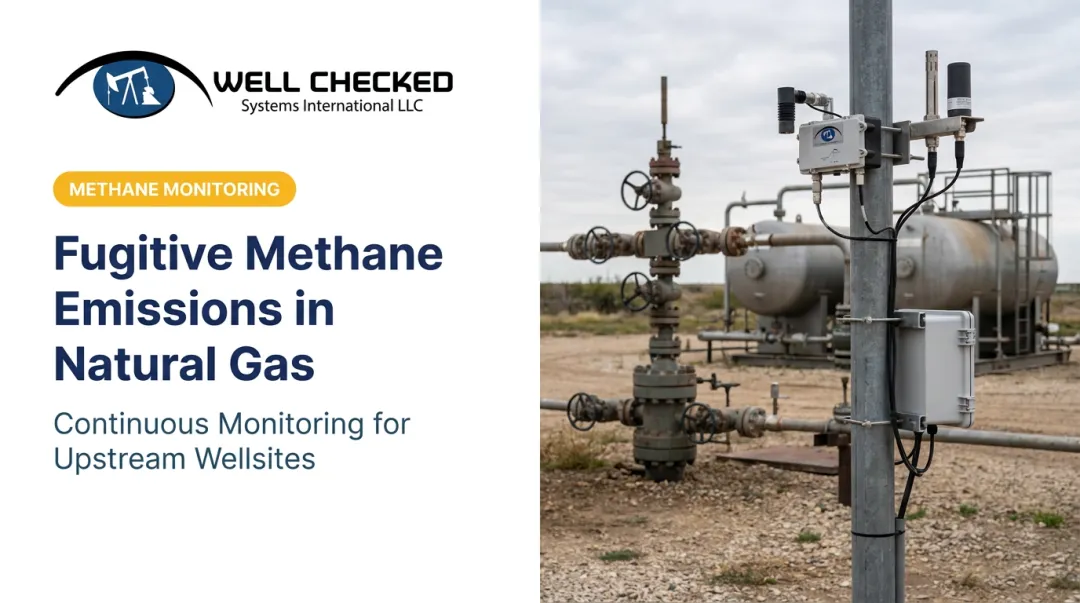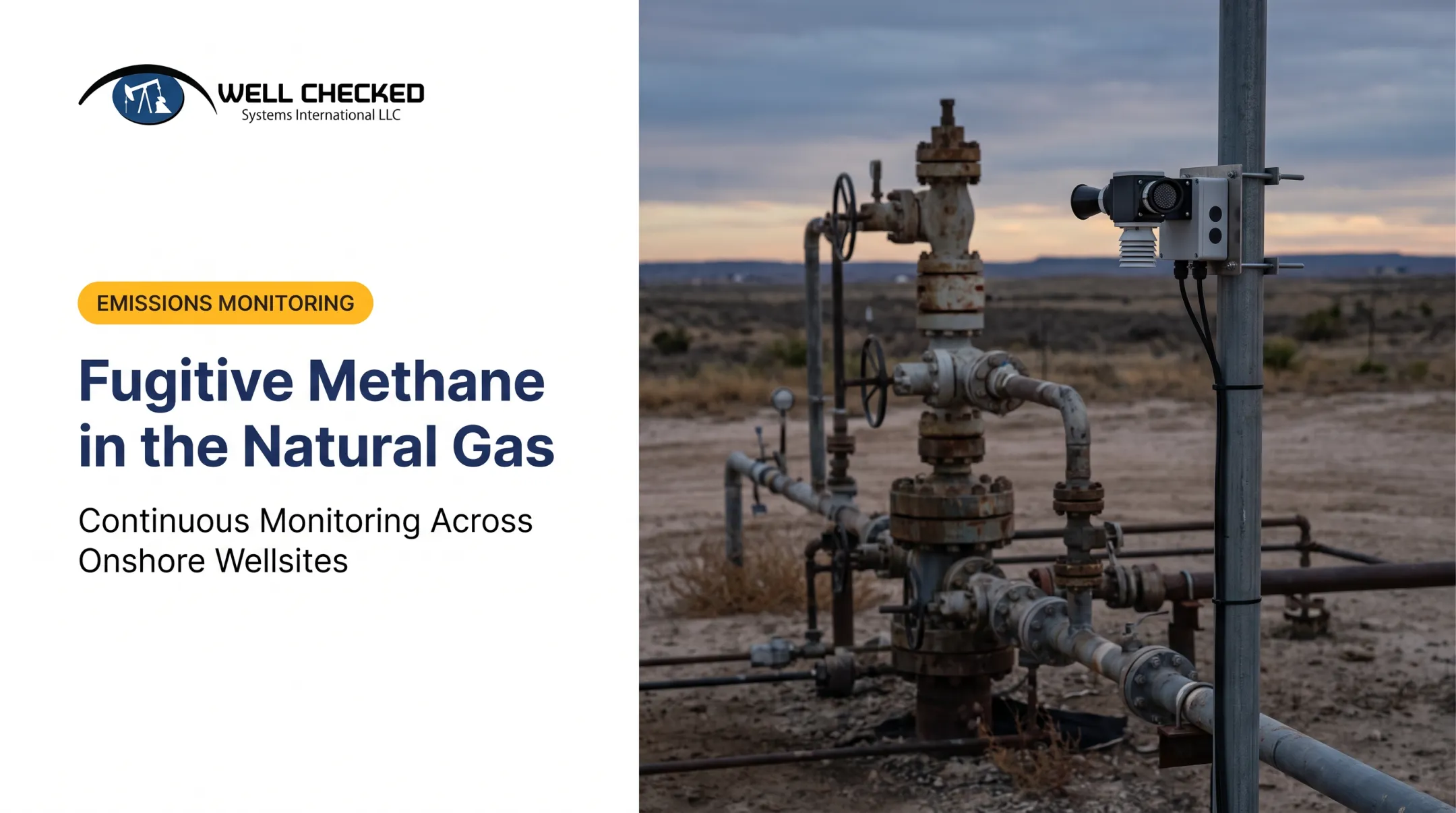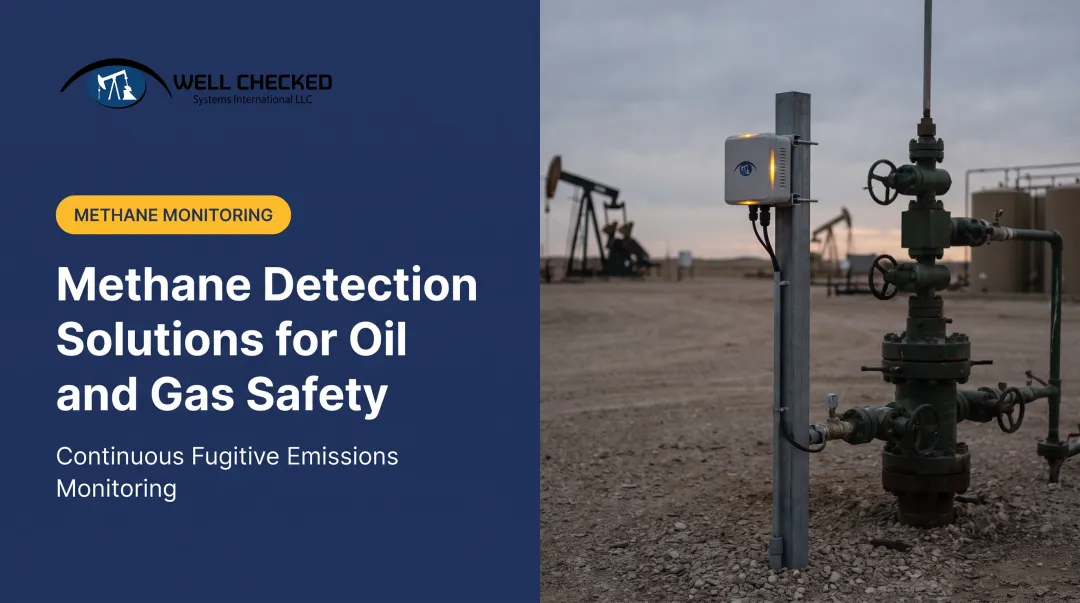

Here's the part that matters for operators: low-production well sites — 81% of active onshore sites in 2019 — generate an outsized share of that problem while producing only about 5.6% of combined output. These aren't random accidents. They're identifiable, preventable failures.
This guide breaks down where leaks come from, what happens when they're ignored, the warning signs to watch for, and the monitoring solutions that are changing how operators manage risk.
Key Takeaways
- Methane leaks stem from equipment failure, corrosion, venting, and human error
- Ignoring leaks risks EPA fines under Subpart OOOOb, safety incidents, and environmental and ESG damage
- Quarterly manual inspections miss the majority of intermittent leak events
- Continuous AI monitoring closes the detection gap left by periodic checks
Common Causes of Methane Leaks
A methane leak is simply an unintended, fugitive release of natural gas from oil and gas equipment or infrastructure, as opposed to gas that's deliberately routed or flared. Most leaks fall into one of four buckets: mechanical failure, maintenance gaps, process venting, or human error.
Equipment Failure and Corrosion
Valves, seals, pipeline joints, and compressors degrade with age. EPA identifies connectors, valves, open-ended lines, pressure-relief valves, and storage-tank thief hatches as the most leak-prone components. Add pneumatic controllers, separators, dehydrators, and hydrocarbon storage vessels, and you've got most of the equipment inventory at a remote wellsite.
Field studies have documented the physical reality on the ground:
- Rusted pump jacks and storage tanks
- Leaking fittings and joints at connection points
- Wellheads and casings obscured by vegetation or debris
- Equipment simply left in disrepair at low-traffic sites
One reconciliation study found equipment leaks ran about 1.4 Tg CH4 higher than official inventory estimates, while tank leaks and venting combined added another 2.3 Tg CH4. Together, those sources made up more than half of all production-segment methane in that analysis.

Poor Maintenance and Inspection Gaps
Quarterly LDAR surveys and operator routes feel thorough on paper. In practice, they leave enormous blind spots.
A 2025 study modeling periodic inspections across 79 US facilities found that first-year detection rates depend heavily on how long each visit lasts. For the study's shorter-visit scenario, even assuming perfect detection while on site (ACS ES&T Air, 2025):
- Monthly checks: 40%
- Quarterly: 26%
- Semiannual: 18%
- Annual: 11%
Longer visits improved things somewhat: 68% detection for monthly, 52% for quarterly. The underlying problem doesn't change: a leak between visits is a leak nobody sees.

Intentional and Process Venting
Not every release is accidental. Pressure relief valves and blowdowns at well pads and compressor stations vent gas by design, as part of normal extraction operations. The issue arises when venting isn't properly managed. Poorly timed blowdowns, malfunctioning relief valves, or unmonitored condensate flashing can turn a routine process into an unaccounted-for emissions source.
Human Error and Operational Oversights
EPA points to a simple, recurring cause: valves or thief hatches accidentally left open after maintenance. Add incomplete shutdown sequences, missed alarms, and incorrect valve line-ups, and you have a category of leaks that has nothing to do with aging hardware.
Remote, unstaffed sites make this worse. Night-shift or infrequent-visit operations mean there's often nobody around to notice a mis-operated valve until the next scheduled check — which, per the maintenance-gap data above, could be weeks away.
What Happens If Methane Leaks Are Ignored
Ignoring a leak isn't a neutral decision. It carries three compounding costs: regulatory, safety, and reputational.
Regulatory exposure: Under Subpart OOOOb (40 CFR Part 60), facilities built or modified after December 6, 2022, face methane standards with defined repair timelines. First repair attempts are due within 30 calendar days of an OGI or Method 21 detection.
EPA's Super Emitter Program defines a super-emitter as a release of at least 100 kg of methane per hour. Once a third party reports one, operators must begin investigating within 5 days and report findings within 15.
Safety and environmental risk: Unmanaged leaks raise explosion and asphyxiation hazards around wellheads, tank batteries, and compressor stations. Crews who only visit on a route schedule may walk into a hazardous atmosphere with no prior alert.
Reputational and ESG damage: Aerial and satellite screening campaigns in major producing basins have identified large numbers of methane plumes, with a small set of persistent sources accounting for a disproportionate share of the volume.
Over five years, that cumulative volume was substantial enough to register in operator-level emissions totals. Volumes at that scale show up in emissions disclosures, investor questions, and public reporting—not as a footnote.
Those costs climb fastest when early indicators go unnoticed because no one is watching the site continuously.
Early Indicators That Get Missed Without Continuous Monitoring
Leaks rarely appear with no precursor. The signs are easy to miss without continuous coverage:
- Unusual hissing near valves, compressors, or connection points
- Frost or ice buildup, or unexplained vegetation dieback near piping
- Unexplained pressure drops or throughput swings in production data
- Visible plume distortion or an oily smell around equipment
Sweet natural gas is colorless and odorless. Absence of smell is not evidence that a leak is absent.
How to Prevent Methane Leaks
Prevention works best as a layered system: inspection routines, better equipment, and technology that doesn't sleep.
Rigorous Inspection and Maintenance
What to do: Schedule regular equipment audits and replace aging seals, valves, and thief hatches before they fail, not after.
Why it works: Catching corrosion and wear early blocks the single largest category of leak causes.
When: Build this into routine site management, not just around compliance deadlines.
Advanced Continuous Monitoring Technology
What to do: Replace periodic manual checks with multi-sensor AI monitoring that combines video, acoustic sensing, and optical gas imaging.
Why it works: Continuous monitoring catches fugitive emissions in near real-time and distinguishes them from normal process activity, cutting the false alarms that plague simpler detection tools.
When: Deploy at wellsites where site-visit costs are high or where Subpart OOOOb exposure creates real fine risk.
This is the gap Well Checked Systems' Zensory.ai™ platform is built to close. Rather than relying on a quarterly snapshot, the system runs a roughly two-day AI site-learning cycle per location, using video, LWIR optical gas imaging, and acoustic AI together to establish what "normal" looks like at that specific site.
Once that baseline exists, Zentinal Core™ filters out routine process noise and escalates only genuine anomalies—finding "the needle in stacks of needles."
The LWIR cameras behind this detection run at roughly one-third the cost of traditional mid-wave infrared solutions. That matters when route-based site visits alone can cost mid-sized and large operators $1 million to $5 million or more annually.

Emergency Response and Shutdown Protocols
What to do: Build a rapid acknowledge-dispatch-mitigate workflow that kicks in the moment a leak is confirmed.
Why it works: Every hour a leak runs unaddressed adds to fine exposure, gas loss, and safety risk.
When: Immediately upon any validated alert, ideally with mitigation complete within 24 hours.
In practice, that looks like this once a system like Zentinal Core™ validates an event:
- Acknowledge — dispatch team confirms the validated alert via dashboard, SMS, email, or SCADA
- Dispatch — response-workflow templates and runbooks direct the right personnel to the site
- Mitigate — corrective action is completed, targeting full resolution inside 24 hours

Operator Training and Standard Procedures
What to do: Train field staff on shutdown sequences, alarm response protocols, and basic leak identification.
Why it works: Reduces the human-error-driven leaks that no amount of hardware can fully eliminate on its own.
When: Onboarding, plus recurring refreshers — not a one-time training checkbox.
Tips for Long-Term Prevention and Control
Long-term control depends on consistency across a portfolio, not a one-time fix:
- Keep continuous, documented monitoring records rather than periodic inspection snapshots that leave gaps between visits
- Standardize sensor and AI deployment across every basin so baselines, alert channels, and audit trails stay consistent from the Permian to the Appalachian Basin
- Use quantified leak data to drive ROI decisions — duration and volume from Zentinal IQ™ (after Zentinal Core™ validates an event) let you weigh gas lost against repair cost
Well Checked's deployment history offers a useful reference point. The platform currently monitors remote sites, including a confirmed program with a large Appalachian operator in the Appalachian Basin.
It processes continuous video, acoustic, and infrared streams through onsite edge computing that keeps working even without a live network connection.
Conclusion
Methane leaks aren't bad luck. They're the predictable result of aging equipment, thin inspection schedules, mismanaged venting, or a valve someone forgot to close. Every one of those causes is addressable.
Operators who get ahead of this problem no longer treat leak detection as a quarterly compliance chore. They treat it as continuous operational awareness.
That shift, from periodic snapshots to always-on monitoring, turns leak prevention from a reactive cost center into a straightforward way to protect margin, safety, and compliance at once.
Frequently Asked Questions
What are the signs of a methane gas leak?
Watch for hissing sounds near valves or connections, dead or discolored vegetation near piping, unexplained pressure drops, and, where odorants are added, an unusual sulfur-like smell. Note that raw, sweet natural gas itself is odorless.
What are symptoms of methane gas exposure?
At high concentrations, methane displaces oxygen rather than acting as a conventional toxin. Symptoms include dizziness, rapid breathing, confusion, and, in severe cases, unconsciousness from oxygen deficiency.
Will a carbon monoxide detector detect methane gas?
No. CO detectors and methane sensors are different instrument categories entirely. Detecting methane requires a dedicated combustible-gas or multi-gas sensor rated for that purpose.
How common are methane leaks?
There's no single national rate, since results depend on detection method and threshold. For context: low-production sites make up 81% of active US onshore wells, and a small number of high-rate super-emitters can account for a disproportionate share of observed regional emissions.
How quickly should a confirmed methane leak be addressed?
As fast as possible. Rapid response, ideally within 24 hours of validation, limits gas loss, reduces safety risk, and creates a documented record of how the event was addressed.
Can methane leaks be prevented entirely?
Not completely: equipment ages and human error happens. But continuous monitoring combined with proactive maintenance dramatically cuts both the frequency and severity of leaks compared to periodic inspection alone.