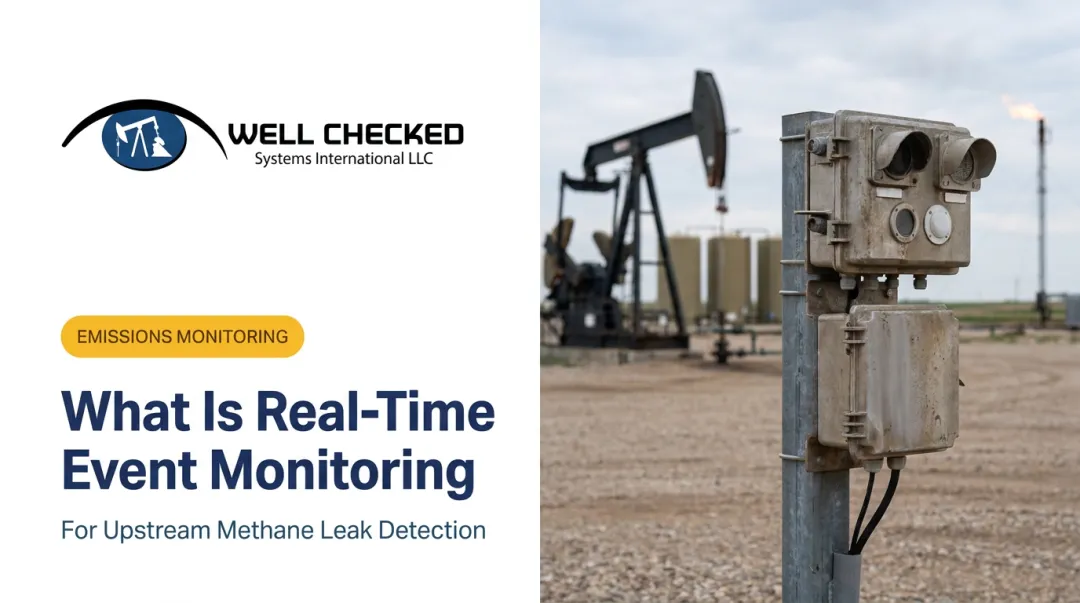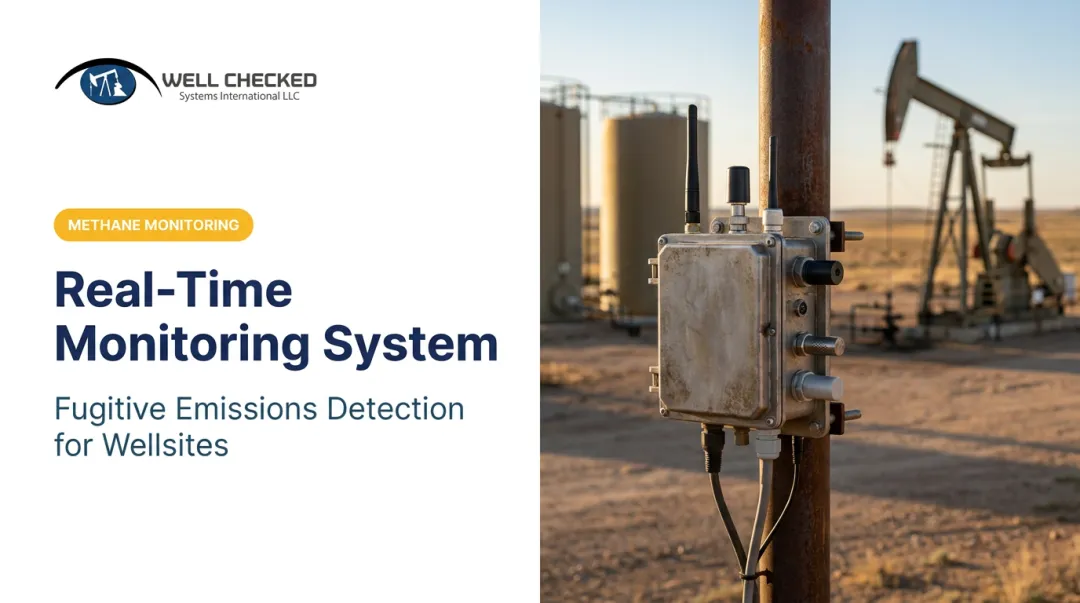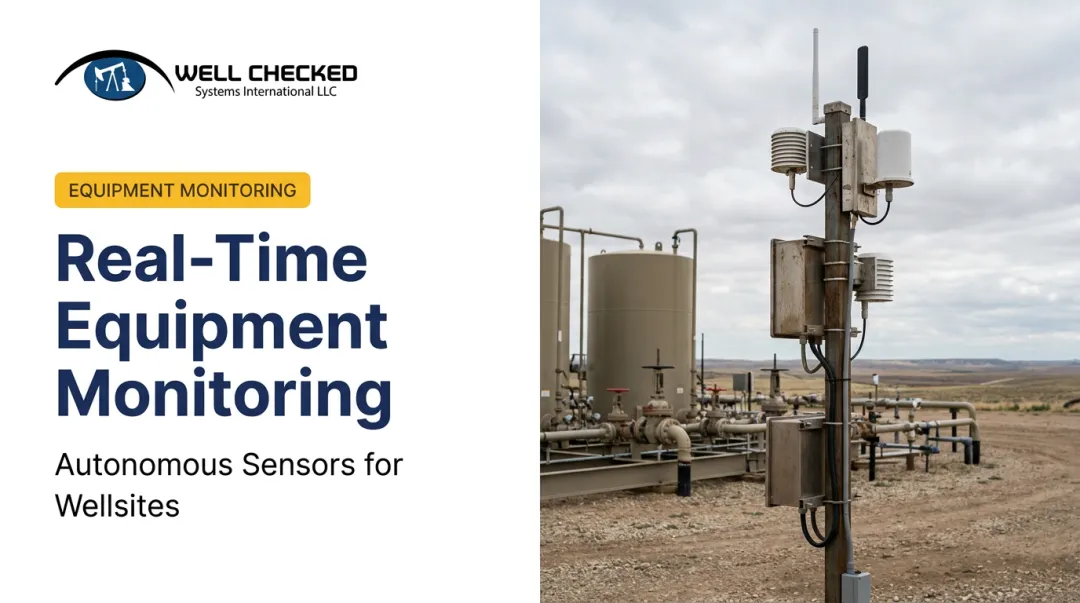

Introduction
Traditional monitoring relies on pumper routes and quarterly leak detection and repair (LDAR) surveys, leaving gaps of days or weeks where leaks, equipment failures, and safety hazards go undetected. Those blind spots cost money and invite regulatory exposure, all while putting field personnel at risk.
This article breaks down what real-time monitoring means for modern upstream operations, why it has shifted from "nice-to-have" to business-critical, and where it delivers measurable ROI. We'll also cover the technology making it possible and how operators are working through common deployment hurdles.
Key Takeaways
- Continuous sensor monitoring is replacing manual checks across production, safety, and emissions
- Anomaly detection now takes minutes instead of days, cutting downtime and safety risk
- AI-based filtering eliminates the alert fatigue that plagued older monitoring systems
- Real-time data now supports regulatory-defensible reporting for EPA, OGMP 2.0, SASB, and TCFD
- Operators are shifting to "operate by exception," dispatching crews only for validated events
What Is Real-Time Monitoring in Oil & Gas Operations?
Real-time monitoring means continuously collecting, transmitting, and analyzing operational data, then generating alerts within seconds to minutes rather than waiting for a scheduled check. The data streams include pressure, flow, temperature, vibration, video, gas concentration, and acoustic signatures.
Compare that to the traditional model:
- Manual gauge readings taken once per shift or once per day
- Route-based pumper checks that visit each well on a fixed schedule, regardless of what's actually happening onsite
- Quarterly LDAR surveys that capture a single snapshot of emissions performance every three months
Between those visits, a stuck valve, a failing compressor bearing, or a fugitive methane leak can run undetected for hours, days, or even weeks. For most legacy field programs, that multi-day blind spot is the standard operating condition.
That blind spot doesn't stop at the wellhead. Real-time monitoring spans the full value chain:
- Upstream (wellsites): pressure, flow, and emissions sensors on individual wells
- Midstream (pipelines): distributed pressure sensors detecting leaks across long transport routes
- Downstream (refineries): process monitoring across fixed-asset facilities
Each segment has different sensor and bandwidth requirements, but the underlying principle stays the same: monitor continuously, and only raise an alert when something actually needs attention.
Why Real-Time Monitoring Is Now Business-Critical
The Safety Case Is Not Theoretical
Oil and gas extraction remains a high-hazard industry. Support activities for oil and gas operations recorded 70 fatalities in 2023 alone, according to BLS fatal occupational injury data. Confined spaces, combustible atmospheres, and remote locations mean that when something goes wrong, response speed determines outcomes.
A CDC study published September 1, 2023, drawing on the Fatalities in Oil and Gas Extraction (FOGEX) Database, identified vehicle accidents as the single largest contributor to fatalities in oil and gas extraction operations. Reducing unnecessary field drives - through remote monitoring that eliminates check-up trips before an event is confirmed - directly addresses the leading cause of worker deaths in the industry.
Continuous monitoring detects hazardous gas presence, unusual equipment sounds, and abnormal site activity without requiring a person to be standing there. That's a meaningful reduction in exposure for field crews who otherwise drive hazardous routes just to check a gauge.
The Cost of Doing It the Old Way
Route-based manual site visits cost mid-sized to large operators $1 million to $5 million or more annually: vehicles, labor, fuel, and time spent visiting wells that, more often than not, have nothing wrong with them. Autonomous monitoring is built specifically to reclaim that spend.
Unplanned downtime compounds the problem. Across industries, it's estimated to cost $50 billion annually, with poor maintenance practices cutting productive capacity by 5% to 20%, according to Deloitte's predictive maintenance research. Continuous sensor trend analysis catches equipment degradation (a bearing running hot, a pump vibrating outside its normal range) before it becomes an emergency shutdown.
The Regulatory Clock Is Ticking
Here's the uncomfortable truth about quarterly LDAR surveys: a leak that starts the day after an inspection can run for nearly three months before anyone notices it.
Research on surveys covering over 3,200 pieces of equipment - including tanks, flares, compressors, and separators - shows that spending just 5 minutes per piece of equipment during periodic surveys detects only 24% of intermittent leaks within a year, while even 2-hour surveys catch just 48%. Median detection times stretch to 100 days for monthly surveys and 297 days for annual ones.
That gap has real financial consequences. In 2024, a U.S. onshore oil and gas operator agreed to a substantial penalty plus required facility upgrades to resolve Clean Air Act violations tied to methane and volatile organic compound (VOC) emissions. A tight acknowledge-dispatch-mitigate response window, say 24 hours from validated detection to mitigation, can support a documented, timely response like that before they happen.
Investors Are Watching Too
Publicly traded E&Ps face mounting pressure to report under OGMP 2.0, SASB Oil & Gas E&P, and TCFD frameworks. Continuous, auditable emissions data isn't just a compliance checkbox anymore. It's becoming a competitive differentiator that separates operators who can prove their numbers from operators still relying on estimation factors. Platforms built for this, like Well Checked Systems' Zentinal IQ™, quantify validated emissions events specifically for OGMP 2.0 Level 4/5, SASB, and TCFD-aligned reporting, giving operators audit-ready numbers instead of estimates.
The net effect: engineers, HSE directors, and executives now make decisions off the same live data feed, instead of waiting on stale weekly or monthly reports.

Core Use Cases: Where Real-Time Monitoring Delivers Value
Production Optimization
Continuous pressure, flow, and temperature data lets field engineers spot deviations from expected well performance immediately. Instead of waiting for the next scheduled check to notice a well is underperforming, adjustments happen the same day, sometimes the same hour.
Pipeline Integrity Management
Distributed sensor networks along pipeline routes detect the minute pressure changes that signal a developing leak or corrosion point. Catching that early means the difference between a maintenance ticket and a full-scale rupture with environmental cleanup costs attached.
Predictive Maintenance
Vibration, acoustic, and thermal sensors on compressors and pumps flag early failure signs long before a breakdown. That shifts maintenance from reactive emergency repairs to planned downtime on the operator's schedule, not the equipment's.
Methane and Fugitive Emissions Detection
This is where continuous monitoring earns its keep against quarterly LDAR (Leak Detection and Repair) surveys. Multi-sensor platforms combining optical gas imaging with acoustic abnormal-sound detection catch fugitive emissions between inspection cycles — the exact gap where traditional surveys fail.
Well Checked Systems' Zensory.ai™ platform is a working example of this at production scale. The system monitors remote wellsites, including a confirmed multi-site program across the Appalachian Basin. Rather than a snapshot every three months, sites get continuous coverage, adding standing emissions visibility between episodic inspections.
Personnel and Site Safety Monitoring
Video and acoustic equipment monitoring detect unauthorized access, equipment malfunction sounds, and hazardous gas presence without personnel needing to be physically onsite. For remote wellsites hours from the nearest crew, that's a direct reduction in unnecessary drive time and exposure.
Across these five use cases, a broader shift is underway. Operators increasingly consolidate onto a single platform that handles production data, integrity checks, maintenance alerts, emissions detection, and site security together, rather than managing five separate point solutions.
The Technology Behind Modern Real-Time Monitoring
Sensors, SCADA, and Edge Computing at the Wellsite
Pressure, temperature, flow, vibration, video, and gas sensors feed into SCADA or edge systems using lightweight communication protocols. At remote wellsites with limited bandwidth, that protocol choice matters: heavy data formats simply don't move reliably over cellular or satellite links in rural basins.
Pure cloud dependency doesn't work well when connectivity drops, and at a remote wellsite, it will drop. Onsite edge processing keeps analysis and alerting running locally, even when communications go down, making local processing the baseline requirement for anything deployed outside a paved road.
AI-Driven Detection and Multi-Sensor Fusion
Machine learning models trained on site-specific baselines separate genuine anomalies from normal operational variation. Without this layer, naive threshold alerts flood operators with false alarms until the whole system gets ignored, defeating the purpose entirely.
The emerging best practice combines three sensing modalities into one stack:
- Sight: AI-enabled video and object detection
- Sound: acoustic anomaly detection for equipment health (an area where Well Checked has a USPTO provisional patent filing covering its acoustic anomaly detection technology)
- Gas imaging: optical gas imaging using long-wave infrared for emissions
Well Checked Systems structures this as a three-tier architecture. Zentinal Ops™ delivers visual and acoustic equipment intelligence through high-resolution video, object recognition, and acoustic anomaly detection. Zentinal Core™ handles multi-sensor detection and false-alarm filtering, cross-referencing all three sensor types before an alert ever reaches an operator. Zentinal IQ™ activates only on Core-validated events, producing regulatory-grade quantification of volume, duration, and rate. That separation matters: nothing gets measured or reported until it's been confirmed real, which protects the integrity of any compliance submission built on top of it.

Data Architecture and Cost Economics
Effective platforms use tiered storage: real-time dashboards for immediate alerting, mid-term storage for operational trend analysis, and long-term archives for regulatory audits. One-size-fits-all storage doesn't support both instant response and multi-year compliance recordkeeping.
Long-wave infrared (LWIR) cameras now enable day-and-night gas detection at roughly one-third the cost of older mid-wave infrared (MWIR) systems. That price shift is a big part of why continuous optical gas imaging (OGI) monitoring across hundreds of sites has become economically realistic instead of a budget-busting proposition reserved for a handful of flagship locations. Well Checked has a USPTO provisional patent filing for Detecting and Quantifying Fugitive Methane and Vapor Emissions Using Infrared Imaging and Machine Learning.
Overcoming Common Deployment Challenges
Legacy system fragmentation. Upstream, midstream, and downstream operations often run on disparate SCADA platforms and proprietary protocols. Without an integration layer that normalizes these disparate feeds, blind spots persist even after sensors go in. Look for platforms with published API integration rather than closed, single-vendor ecosystems.
Alert fatigue and false positives. Threshold-based alerting sounds simple until it buries operators in noise, especially at sites generating thousands of sensor readings daily. AI-based discernment, learning what "normal" looks like at each individual site, has moved from optional add-on to baseline requirement. A system that can't tell a routine process vent from a fugitive leak isn't ready for production use.
Connectivity constraints. Remote basins deal with intermittent satellite and cellular service. Edge-first architectures that buffer and process data locally, rather than depending on constant cloud transmission, keep monitoring functional even when the network isn't cooperating.
Practical steps operators are taking, drawn from deployments like Well Checked Systems' multi-site Appalachian Basin program, include:
- Audit existing SCADA and sensor infrastructure before adding new hardware
- Prioritize edge processing capability for any remote-site deployment
- Demand AI baseline learning, not static thresholds, from any vendor under consideration
- Pilot before scaling, using a fixed-fee, defined-site pilot program to de-risk the decision considerably

Frequently Asked Questions
What is real-time monitoring in the oil and gas industry?
Real-time monitoring is continuous, sensor-based data collection and analysis across wellsites, pipelines, and facilities that generates alerts within seconds to minutes. It supplements periodic manual inspections with standing visibility.
How does real-time monitoring improve safety in oil and gas operations?
Continuous sensor coverage reduces how often personnel need to travel to or remain at hazardous remote sites. Sensors detect and flag hazards faster, cutting response time from hours to minutes.
What technologies are used for real-time monitoring in oil and gas?
IoT sensors, SCADA systems, and edge computing form the backbone. Modern platforms add AI/ML analysis and multi-sensor fusion (video, acoustic, and optical gas imaging) into one stack.
How does real-time monitoring help with EPA methane rule compliance?
Continuous monitoring generates timestamped, defensible emissions data that supports alternative-monitoring compliance pathways under 40 CFR Part 60 Subpart OOOOb. That's a far stronger position than a quarterly LDAR snapshot.
What is the difference between remote monitoring and real-time monitoring?
Remote monitoring means accessing site data from off-site. Real-time monitoring emphasizes speed and continuity of alerting. Most modern platforms combine both.
How much does real-time monitoring cost compared to manual site visits?
Route-based manual inspections run $1 million to $5 million or more annually for mid-to-large operators. Autonomous continuous monitoring is built to cut that figure by minimizing unnecessary site visits.