
That number explains why periodic check-ins no longer cut it. Whether you're running a data center, a hospital floor, or a remote wellsite, waiting for a quarterly inspection or a scheduled report means problems get worse before anyone notices.
This article breaks down what real-time monitoring actually is, walks through how the technology works step by step, and shows how it plays out across industries, including oil and gas emissions detection, where the gap between "quarterly" and "continuous" can mean the difference between a small fix and a federal fine.
Key Takeaways
- Real-time monitoring collects and analyzes data as events happen, with little to no delay.
- The process follows a repeatable loop: collect, transmit, process, analyze, alert, visualize.
- IT, healthcare, finance, manufacturing, and oil & gas rely on it for different outcomes.
- Picking the right system depends on your data goals, AI-filtering needs, and edge-processing requirements.
What Is Real-Time Monitoring?
Real-time monitoring is the continuous, instantaneous observation and analysis of data or events as they occur, with zero-to-low latency between the moment data is generated and the moment it's analyzed. Instead of checking a system once a day or once a quarter, real-time monitoring watches it constantly.
Four characteristics define a genuine real-time system:
- Immediate data acquisition: information is captured the instant it's generated, not batched for later
- Continuous observation: monitoring never stops, day or night
- Automated alerting: the system flags issues on its own, without a human combing through logs
- Data visualization: dashboards translate raw signals into something a person can act on
None of this works without sensors and connectivity. Real-time monitoring depends on sensors, agents, cameras, or IoT devices transmitting data over a network to a central system or an edge-based unit on-site. Take away the sensor layer, and there's nothing to monitor in real time.
Real-Time Monitoring vs. Periodic or Batch Monitoring
Periodic monitoring works on a schedule: a quarterly inspection, a monthly report, a weekly walkthrough. It's a snapshot of a single moment. Real-time monitoring is a continuous stream.
Consider a manual inspection route that visits a wellsite once every quarter. It "sees" that site for maybe an hour, four times a year. Everything that happens in between (a slow leak, a failing valve, a fugitive emission) goes unrecorded until the next visit.
A continuous monitoring system, by contrast, observes conditions every minute of every day. It doesn't need to guess what happened between visits, because there is no gap to fill.
NIST's own guidance on continuous monitoring makes a useful distinction here: continuous programs can still sample at discrete intervals, as long as the frequency matches the risk. Real-time monitoring pushes that frequency as close to instantaneous as the use case demands.
How Does Real-Time Monitoring Work?
Every real-time monitoring system, regardless of industry, runs on the same basic cycle. The steps stay consistent; only the sensors and thresholds change.
- Data collection: Sensors, agents, cameras, or acoustic and optical devices capture raw data continuously at the source, whether that's server CPU load or gas concentration at a wellhead.
- Data transmission: Collected data travels over a network, cellular connection, or edge link to a central monitoring system, or it's processed directly on-site.
- Processing and normalization: Raw data gets filtered, parsed, and standardized so it can be compared consistently over time and across sites.
- Analysis: Algorithms, increasingly AI- or machine-learning-based, scan the processed data for anomalies, patterns, or threshold breaches.
- Alerting: When the analysis flags a genuine issue, automated notifications route to the right team or system, not a generic inbox nobody checks.
- Visualization and refinement: Dashboards present findings for human review, and the system gets tuned over time as conditions and feedback evolve.

Where Edge Computing Comes In
Edge computing changes step two in an important way. In remote or low-connectivity environments, waiting for a network connection before analyzing data isn't practical.
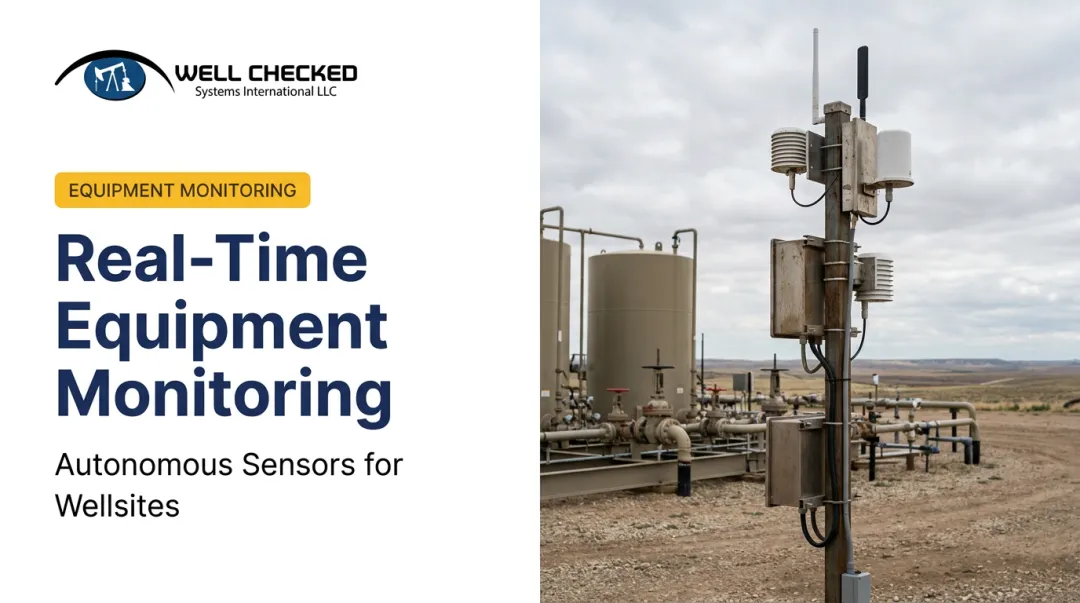
Edge processing lets analysis happen locally, on-site, before anything gets transmitted. That's the difference between a system that pauses when the connection drops and one that keeps working regardless. Well Checked Systems built this into Zensory.ai™, running edge computing directly at the wellhead so monitoring continues even in basins with limited cellular coverage.
Real-World Examples of Real-Time Monitoring Systems
Real-time monitoring looks different depending on what's being watched, but the underlying logic is the same everywhere: catch the problem while it's still small.
- IT and network monitoring — Tracks CPU usage, server health, and network traffic to catch performance issues before they escalate into outages. New Relic's 2024 Observability Forecast found that full-stack observability cuts annual outages by 71% and downtime by 79%.
- Healthcare — Continuous monitoring of patient vitals like heart rate and oxygen levels alerts clinicians to deterioration between scheduled checks, when early intervention matters most.
- Financial services — Real-time transaction monitoring flags fraud as it happens, while algorithmic trading systems react to market shifts within milliseconds.
- Manufacturing — Sensor-based monitoring of machinery supports predictive maintenance, catching early signs of failure before a breakdown halts a production line.
Oil & Gas Emissions Monitoring
Upstream operators face a version of this problem that's especially costly: traditional leak detection and repair (LDAR) programs and pumper routes only check a wellsite a handful of times a year, leaving long windows where a leak can go undetected.
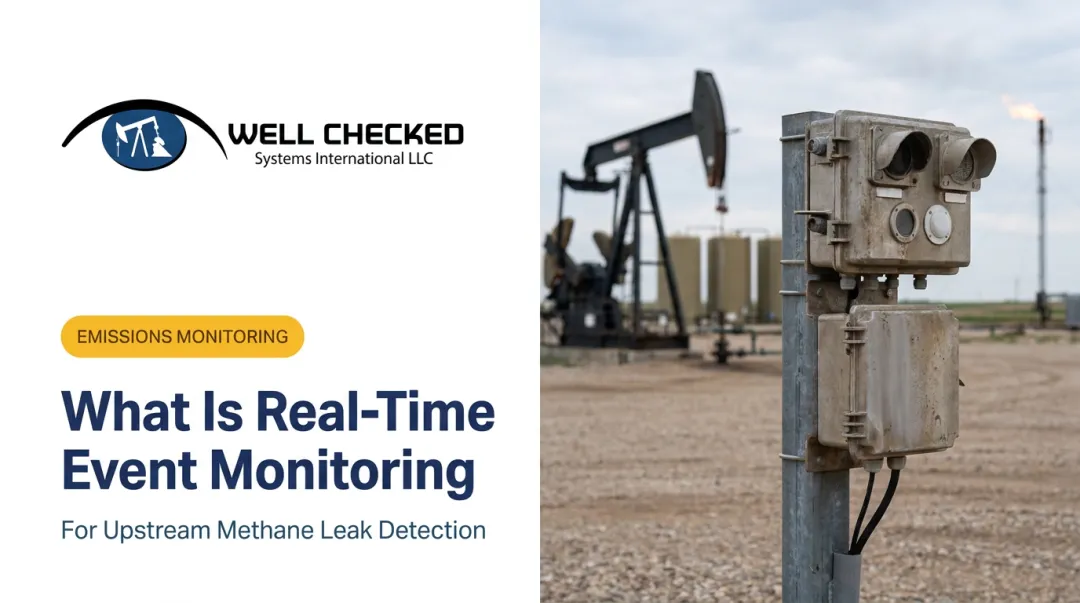
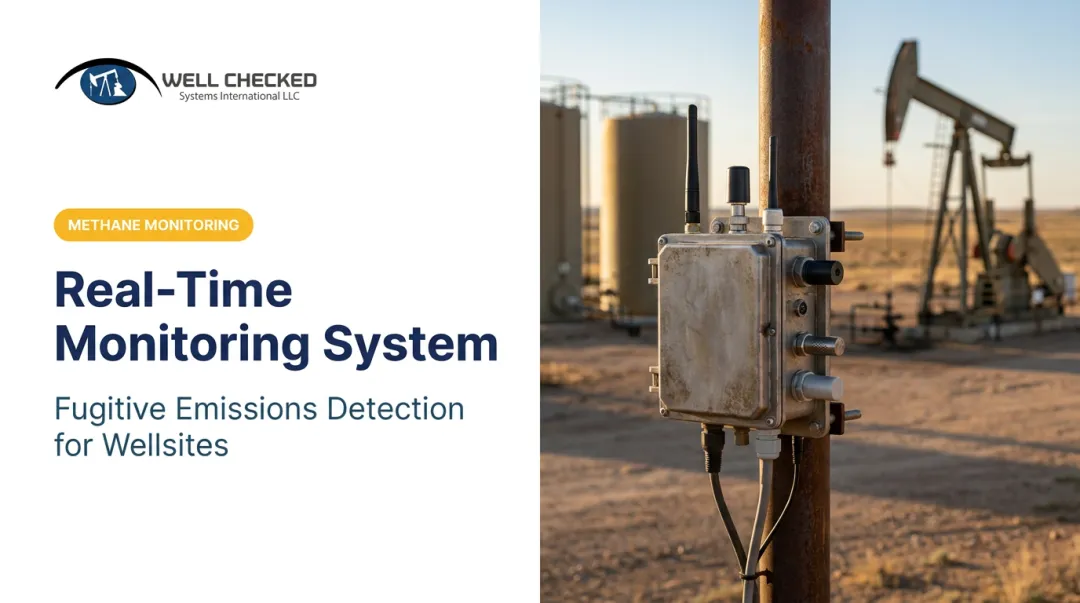
Well Checked Systems' Zensory.ai™ platform takes a different approach, combining high-resolution video, Long-Wave Infrared Optical Gas Imaging, and acoustic abnormal-sound detection into a single deployment. Each site effectively gains video, infrared, and acoustic abnormal-sound detection.
The platform analyzes more than 1,500 videos per site per day, roughly one every minute. It also runs an AI Site Learning cycle over about two days to establish what "normal" looks like at that specific location.
That baseline matters. A Zentinal Core™ layer uses it to filter out routine process emissions and flag only true fugitive events, cross-validating signals across all three sensor types before anything escalates.
Once an event is confirmed, the response moves fast:
- Operators acknowledge, dispatch, and mitigate within 24 hours — far faster than waiting on the next quarterly LDAR inspection or scheduled pumper visit.
- Onsite edge computing keeps detection running even where cellular or network connectivity is unreliable.
- Data syncs automatically as soon as a connection becomes available.

This architecture is running today across continuous monitoring in the Appalachian Basin.
Key Benefits of Real-Time Monitoring
The value of real-time monitoring comes down to three things: speed, visibility, and defensibility.
- Faster detection and response — Shrinking the gap between an event and its resolution lowers mean time to detect (MTTD) and resolve (MTTR), directly cutting downtime costs.
- Better decision-making — Continuous, up-to-date data replaces guesswork. Instead of acting on last quarter's report, teams act on what's happening right now.
- Stronger compliance posture — Continuous records hold up better than periodic snapshots, particularly under frameworks like EPA methane rules (Subpart OOOOb), OGMP 2.0, and SASB/TCFD disclosure.
Well Checked's Zentinal IQ™ layer, for example, quantifies validated emissions by volume, duration, and rate, so the output supports regulatory-defensible reporting rather than relying on estimated figures.
For upstream operators, this also has a cost dimension. Route-based pumper visits alone can run $1 million to $5 million or more annually for mid-sized to large operators, driven by fuel, labor, and the safety exposure of routine site travel. That figure doesn't even include the lost profit from leaks that go undetected between visits.
How to Choose the Right Real-Time Monitoring Solution
Not every monitoring system fits every operation. Before comparing vendors, define what you actually need to know.
Start with your goals. Identify the specific metrics or conditions that matter most, whether that's server response times, a patient's heart rate, or methane concentration at a wellsite, so the system isn't drowning you in irrelevant noise.
Evaluate core features:
- Automated alerting that reaches the right person, not a shared inbox
- Scalability across multiple sites or systems without a redesign
- Integration with existing infrastructure, such as SCADA or your current dashboard
- AI-driven analysis that can tell a real anomaly from a false positive
Consider your deployment environment. Cloud-based systems work well for centralized operations with reliable connectivity. Edge or on-site processing becomes critical in remote or connectivity-limited environments, like field or wellsite locations, where waiting on a network connection isn't an option.
Zensory.ai™'s three-tier structure reflects this logic directly: Zentinal Ops™ delivers visual and acoustic equipment intelligence, Zentinal Core™ handles first-line detection and false-alarm filtering, and Zentinal IQ™ adds quantification for regulatory reporting once an operator needs that level of defensibility. Operators can start with a fixed-fee pilot on a defined site count before scaling to a full portfolio.

Frequently Asked Questions
How does real-time monitoring work?
It follows a repeatable cycle: collect data from sensors, transmit it to a central or edge system, process and normalize it, analyze it for anomalies, alert the right team, and visualize the results on a dashboard.
What is an example of a real-time monitoring system?
Network monitoring tools that track server CPU and traffic in IT environments are one example. In oil and gas, Well Checked's Zensory.ai™ platform monitors remote wellsites using video, infrared gas imaging, and acoustic equipment sensors together.
What is the difference between real-time monitoring and continuous monitoring?
Continuous monitoring means observation never stops, though data can still be sampled at intervals. Real-time monitoring specifically emphasizes near-zero latency between when data is captured and when it's analyzed or alerted on.
Is real-time monitoring the same as real-time analytics?
Not quite. Monitoring focuses on observing data and alerting when something happens. Analytics goes a step further, generating deeper insight or predictions from that same real-time data.
What industries rely most on real-time monitoring?
IT and observability, healthcare, finance, manufacturing, and energy (particularly oil and gas emissions compliance) are the leading adopters, each using it to catch problems before they escalate.
What are the main benefits of real-time monitoring?
Response times improve, decisions rely on current data instead of guesswork, and compliance reporting holds up far better under regulatory scrutiny than periodic-snapshot audits.