
This is the operational reality for thousands of upstream sites across U.S. basins. Route-based visits, rising EPA methane rule exposure under 40 CFR Part 60 Subpart OOOOb, and the safety risk of sending staff to unstaffed locations on a fixed schedule are colliding at once.
This article breaks down what remote and off-site monitoring actually means, how the underlying technology works, and why it's becoming standard infrastructure rather than an optional upgrade for modern upstream operations.
Key Takeaways
- Continuous AI sensors monitor wellsites around the clock without on-site staff
- Visual, acoustic, and gas-imaging sensors detect and quantify emissions in real time
- Smart filtering reduces alert fatigue while producing EPA, OGMP 2.0, SASB, and TCFD-ready data
- Zensory.ai™ monitors Appalachian Basin monitoring
What Is Remote and Off-Site Monitoring?
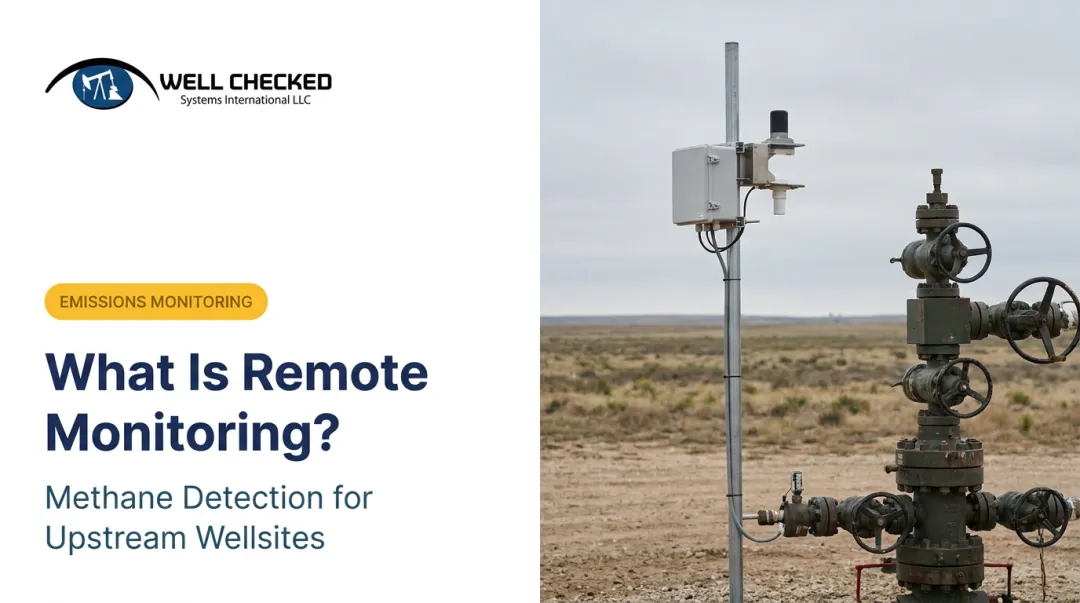
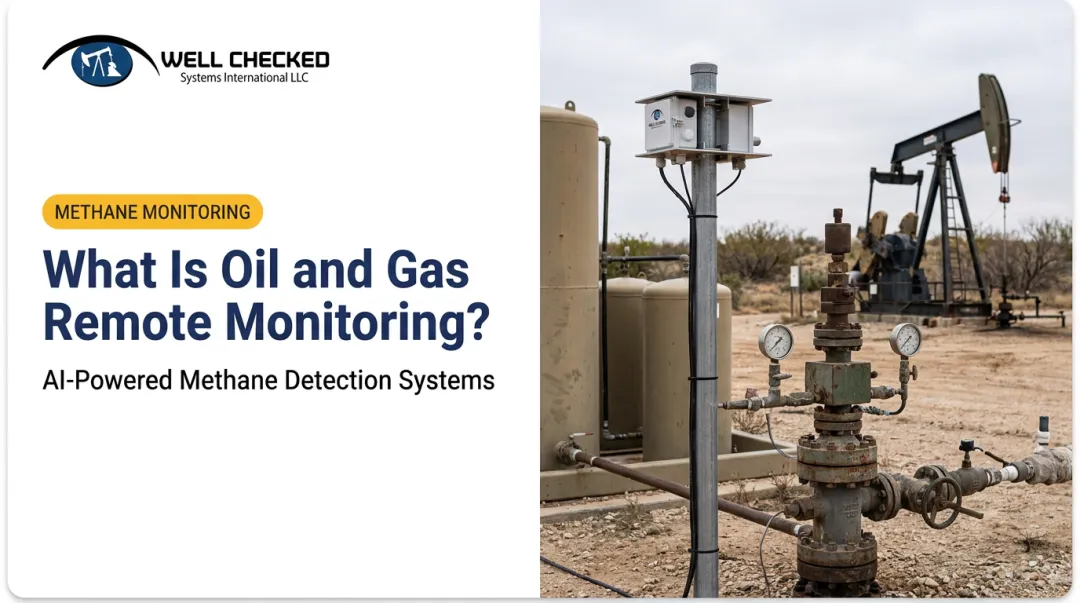
Remote and off-site monitoring is a method of overseeing a facility from a distance using cameras, sensors, and data transmission instead of relying on personnel physically present at the location. Field-deployed sensors capture data (video, audio, gas imaging) and send it to a system or team that can review and act on events as they happen.
This isn't the same as CCTV. Traditional recording stores footage for someone to review after the fact, while remote monitoring detects, verifies, and responds to conditions in near real time. Here's the difference:
| Traditional CCTV | Remote & Off-Site Monitoring |
|---|---|
| Stores footage for later review | Detects events in near real time |
| Requires manual review after an incident | Verifies and alerts automatically |
The concept spans plenty of industries, including:
- Retail loss prevention
- Construction site security
- Healthcare facility oversight
- Property management
In industrial and energy environments, though, the concept looks different: "off-site" doesn't just mean unattended. It means hazardous, geographically scattered, and often miles from cell coverage.
In oil and gas specifically, this has meant a shift away from staff driving fixed pumper routes to physically inspect equipment. Autonomous multi-sensor systems now provide continuous visibility that supports operating by exception. That means responding only when something genuinely needs attention, rather than visiting every site on a fixed routine whether it needs one or not.

How Remote and Off-Site Monitoring Works in Oil & Gas Operations
Multi-Sensor Detection: video, acoustic, and infrared sensing
Field-grade remote monitoring at a wellsite typically combines three sensing modalities working together, not in isolation:
- Sight — High-resolution cameras with AI object detection provide continuous visual coverage of equipment and site activity
- Sound — Acoustic anomaly AI listens for abnormal patterns that suggest leaks, valve failures, or compressor faults, catching issues that never produce a visible signal. Well Checked has a USPTO provisional patent filing covering its acoustic anomaly detection technology.
- Gas imaging — Optical Gas Imaging (OGI) using Long-Wave Infrared (LWIR) cameras detects methane and volatile organic compound (VOC) emissions day or night
That last point matters more than it sounds. LWIR-based imaging enables continuous day/night detection at roughly one-third the cost of traditional mid-wave IR solutions, according to Well Checked's product documentation. That cost difference is what makes 24/7 coverage economically viable across dozens or hundreds of sites, rather than a handful of flagship locations.
AI Learning, Filtering, and Three-Tier Response Architecture
A system that hasn't learned a site's normal rhythm will drown its users in false alarms. Flaring, venting during routine maintenance, and steam plumes on a cold morning can all look like a leak to an untrained sensor.
Well Checked's Zensory.ai™ addresses this with a roughly 2-day AI Site Learning cycle per site, during which the platform studies normal visual, acoustic, and gas-emission patterns before it starts flagging anything as abnormal.
The architecture then spans three tiers:
- Zentinal Ops™ (visual and acoustic equipment intelligence) — High-resolution video, object recognition, acoustic anomaly detection, and actionable alerts
- Zentinal Core™ (detection layer) — Filters out false alarms and flags only genuine anomalies, distinguishing normal process emissions from fugitive ones
- Zentinal IQ™ (quantification layer) — Measures the duration and volume of confirmed events only after Core has validated them, producing regulatory-grade data
From there, the response workflow follows an acknowledge-dispatch-mitigate cycle:
- Acknowledge — the alert reaches the dispatch team through the dashboard, email, SMS, and SCADA simultaneously
- Dispatch — a runbook guides field mobilization
- Mitigate — field personnel resolve the issue on site
Well Checked's internal documentation ties this cycle to a 24-hour response window, designed to support a documented, timely response on validated methane events.

Onsite edge computing keeps detection and analysis running even when connectivity drops. For a wellsite with intermittent cell service, this isn't a nice-to-have. Cloud-only systems simply stop working the moment the connection does; edge-based systems store data locally and sync automatically once service returns.
Why Off-Site and Remote Assets Are Especially Vulnerable Without Continuous Monitoring
Unstaffed or infrequently visited sites can carry undetected problems for hours or days between scheduled visits. Common issues include:
- Equipment malfunctions that go unnoticed until failure
- Fugitive emissions releasing undetected between visits
- Theft targeting unmonitored equipment
- Safety hazards with nobody around to catch them
The data backs this up. Intermittent emissions are, by definition, easy to miss with periodic surveys. Research published in ACS ES&T Air found that monthly leak detection surveys catch only about 40% of intermittent emission events, and detection probability drops sharply with less frequent inspection cycles.
A quarterly leak detection and repair (LDAR) check simply isn't built to catch a leak that starts and stops between visits.
Safety risk compounds the problem. Routine visual checks send field personnel out on fixed routes to perform work a continuous sensor network could otherwise handle, putting staff on the road and on hazardous sites more often than necessary.
CDC data on the U.S. oil and gas extraction industry recorded 471 worker fatalities between 2014 and 2019, with 40.3% classified as transportation-related. Every unnecessary trip to a remote pad is exposure that didn't need to happen.
Key Benefits of Remote and Off-Site Monitoring for Upstream Operators
Cost reduction. Route-based site visits cost mid-sized to large operators an estimated $1M–$5M+ annually, according to industry cost models. Continuous autonomous monitoring replaces most of that routine travel with sensors that only trigger a dispatch when something real is happening.
Safety improvement. Fewer pumper-route trips mean less staff exposure to vehicle accidents, severe weather, and hazardous site conditions. Cameras and gas imaging can now handle these checks remotely.
Regulatory defensibility. Continuous, timestamped monitoring data builds a stronger compliance record than periodic-snapshot LDAR inspections. Continuous data also supports OGMP 2.0 Level 4/5, SASB, and TCFD reporting far better than a quarterly snapshot ever could.
ROI-driven maintenance. Quantifying the duration and volume of a confirmed emissions event lets operators prioritize repairs based on actual financial and environmental impact, not a guess.
Proven at scale. Well Checked's multi-site deployment across the Appalachian Basin shows this working across a large multi-site portfolio.
Operational benefit. Fewer route-based visits also mean fewer vehicle miles, directly reducing fuel costs and driving exposure across field operations.

Remote Monitoring vs. Traditional Site Visits and Periodic LDAR Inspections
Quarterly or scheduled LDAR inspections capture a single moment in time. A leak that starts the day after an inspection can run undetected for weeks. Remote sensor networks, by contrast, never stop watching.
| Metric | Traditional LDAR / Site Visits | Remote & Off-Site Monitoring |
|---|---|---|
| Coverage | Periodic snapshots (quarterly/scheduled) | Continuous, 24/7 |
| Detection of intermittent leaks | Weak: easy to miss between visits | Strong: always watching |
| False alarm handling | Manual review, high staff burden | AI-filtered, alerts only on true anomalies |
| Staff exposure | Routine travel to every site | Dispatch only on confirmed events |
| Compliance record | Point-in-time reports | Ongoing, timestamped data |
Older monitoring approaches also suffer from a false-alarm problem: too many alerts, and teams start ignoring them. Systems like Well Checked's Zentinal Core™ solve this by learning what's normal for a given site — typically over a two-day AI learning cycle — and alerting only when something deviates from that baseline, letting teams operate by exception instead of chasing every blip.
The net effect is a change in the operator's role. Instead of reactive, routine inspection, teams shift to proactive, data-driven response, supporting both compliance goals and day-to-day operational efficiency at the same time.
Frequently Asked Questions
What is remote off site monitoring?
It's the practice of monitoring a facility or asset from a distance using cameras, sensors, and AI. Detection and response happen without personnel physically on-site.
How does remote monitoring detect methane emissions at a wellsite?
Optical Gas Imaging combined with Long-Wave Infrared cameras detects fugitive emissions day or night. AI then verifies the event and quantifies its duration and volume for reporting.
Can remote monitoring help meet EPA methane rule compliance requirements?
Structured, continuous emissions data can support alternative-monitoring compliance submissions where recognized by the applicable state SIP/FIP (State or Federal Implementation Plan) pathway. It builds a defensible record that periodic inspections can't match.
How does remote monitoring reduce operational costs compared to pumper routes?
It replaces routine, staffed site visits with autonomous detection that only requires dispatch when a true anomaly is confirmed. That cuts the routine travel that drives most route-based costs.
Does remote monitoring replace the need for any on-site personnel?
No. It reduces routine visits, but field teams still respond to confirmed events. Labor shifts from routine checks to targeted response.
What's the difference between remote monitoring and traditional LDAR inspections?
LDAR inspections are periodic and snapshot-based, capturing conditions only at the moment of the visit. Remote monitoring runs continuously, producing an ongoing compliance record instead of a point-in-time report.