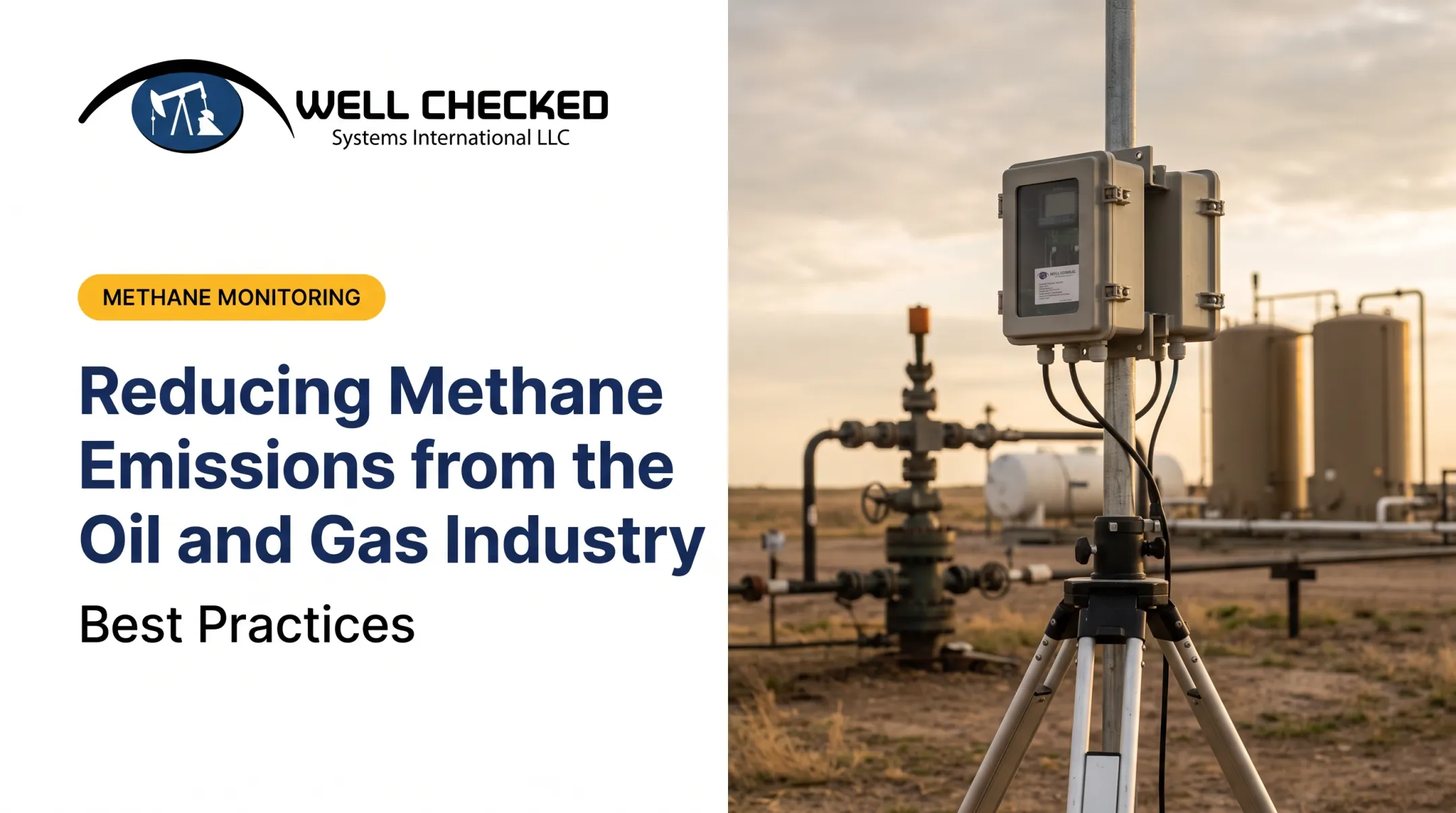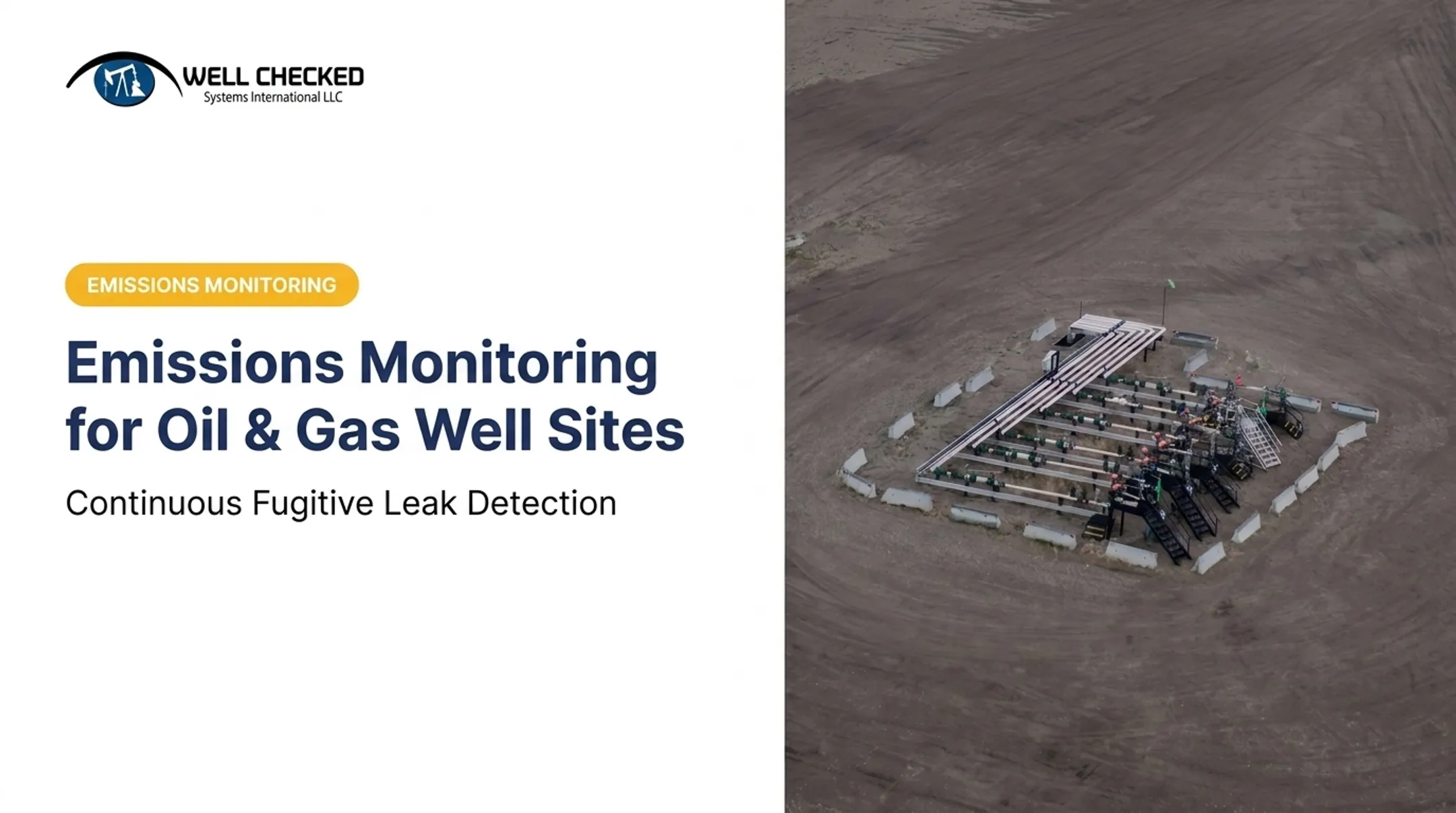

For US upstream operators, this isn't just an atmospheric problem. It's an operational one. EPA's new methane rule, tightening ESG disclosure expectations, and the plain financial cost of unsold gas escaping into the air all point the same direction: undetected leaks are now a business liability, not just an environmental one.
This guide walks through where methane emissions actually come from in oil and gas operations, why they build up unnoticed, what drives them at the wellsite level, and what practical steps operators can take to get ahead of the problem.
Key Takeaways
- Methane is the product itself, so cutting emissions recovers saleable gas as well as satisfying reporting obligations
- Fugitive leaks, venting, and flaring are the biggest controllable sources for upstream operators
- Continuous monitoring catches leaks before they become compliance or cost problems; periodic inspections cannot
- Strong reduction programs cover procurement, continuous monitoring, and site factors such as remoteness and aging infrastructure
Understanding Methane Emissions in Oil & Gas Operations
Most upstream methane emissions trace back to three sources: fugitive leaks, venting, and flaring. These occur across wellheads, compressors, and centralized production facilities, the same equipment categories EPA targets in its fugitive-monitoring rules.
Where Emissions Typically Originate
- Fugitive leaks occur at valves, connectors, and aging seals; small alone, they add up across sites with hundreds of components
- Venting releases gas intentionally from pneumatic devices or tanks—a known, plannable source and one of the easiest to cut with better equipment
- Flaring is meant to destroy methane efficiently, but the common 98% destruction assumption does not match field data
A 2022 Science study using airborne sampling across three major US basins (more than 80% of US flaring) found pooled effective destruction of just 91.1%. Unlit flares and incomplete combustion contributed roughly equally to that gap.

How Emissions Build Up Over Time
Most LDAR programs still rely on quarterly site visits. Between inspections, leaks run unchecked.
A 2024 Nature study analyzing nearly one million aerial site measurements across six US regions found that in most campaigns, fewer than 2% of well sites accounted for 50–77% of total well-site emissions.
These "super-emitter" events can spike suddenly. A quarterly check is not built to catch them in time.

Key Drivers of Methane Emissions at Wellsites
Four factors consistently shape wellsite emission risk:
- Equipment age and maintenance quality: Older seals and valves fail more often
- Site remoteness: Harder to inspect frequently, so issues go unnoticed longer
- Detection method: Periodic checks versus continuous monitoring determine how much volume is lost before repair
- Regulatory framework: EPA's 40 CFR Part 60 Subpart OOOOb, OGMP 2.0, and state programs increasingly dictate tracking and disclosure
Drivers vary by basin, site type, and equipment inventory. A Permian pad with dense infrastructure faces different challenges than a remote Appalachian wellhead. Standardized monitoring adapted to local conditions beats a rigid, calendar-only inspection schedule.

Strategies to Reduce Methane Emissions
Effective reduction happens across three layers: decisions made before operations begin, active management once a site is running, and awareness of the operational context surrounding it.
Pre-Operations Design and Procurement
- Specify low-emission equipment during procurement: low-bleed pneumatic devices instead of high-bleed defaults
- Design closed-loop or vapor recovery systems rather than routine venting
- Build automatic re-ignition into flare systems to prevent unlit flare events
- Set internal emissions targets aligned with OGMP 2.0 Level 4/5 or SASB/TCFD disclosure expectations These upfront choices are usually cheaper than retrofits later.
Ongoing Detection and Management
Quarterly LDAR visits leave gaps. Continuous, multi-sensor monitoring closes them. Combining visual, acoustic, and optical gas imaging is what makes continuous monitoring reliable. A single sensor can't tell a genuine fugitive leak apart from normal operational noise, like a compressor running as expected. Well Checked's Zensory.ai™ platform uses this multi-sensor fusion to filter false alarms and flag only true anomalies, so operators chase less noise. Once a leak is validated, the next question is how much, and for how long? Quantifying duration and volume supports two things:
- Rank repair-and-maintenance work by ROI once you know which leaks matter most
- Build defensible EPA or state-audit reporting with continuous records instead of periodic snapshots

Portfolio-Wide Operational Context
Multi-basin operators often manage emissions site-by-site, with inconsistent methods across their portfolio. Standardizing on the same monitoring framework in every basin, from the Permian to the Denver-Julesburg, closes gaps that ad hoc management creates. Reducing unnecessary operator-route travel also helps. Fewer vehicle miles means lower vehicle-emission exposure and less time field personnel spend on the road in remote, sometimes hazardous conditions. In remote or high-well-count regions, the barrier often isn't detection technology. It's communications and infrastructure. Systems built for these environments need to operate independently of continuous connectivity, processing data on-site and syncing when a signal is available.
Regulatory and ESG Reporting Considerations
EPA's methane rule (40 CFR Part 60 Subpart OOOOb) applies to crude oil and natural gas facilities constructed or modified after December 6, 2022. Survey requirements vary by facility type and size.
State programs add another layer. Colorado, for instance, is phasing out gas-driven pneumatic devices statewide by March 2029.
Disclosure frameworks are shifting toward measurement, not estimates:
- OGMP 2.0 Level 4/5 requires source-level measurement reconciled with site-level data
- SASB and TCFD increasingly expect quantified, not modeled, methane figures in ESG reporting
- EPA alternative monitoring pathways favor continuous, defensible emissions records over periodic estimates alone
Operators who move early toward continuous, quantifiable monitoring cut fine exposure and build a stronger case with investors who treat methane performance as a material ESG factor.
Conclusion
Reducing methane emissions starts with knowing where and when leaks originate. Explaining them after an audit or a fine is already too late.
Smarter procurement and continuous multi-sensor monitoring help. So does strategy that accounts for site remoteness, basin differences, and infrastructure limits. That combination is what separates operators managing this risk from those still exposed to it.
Frequently Asked Questions
What is the most effective way to reduce methane emissions from oil and gas operations?
Continuous multi-sensor monitoring paired with rapid leak repair generally outperforms periodic inspections. It catches emissions before they accumulate into larger compliance or financial problems.
How much of global methane emissions come from oil and gas?
The fossil fuel sector — oil, gas, and coal combined — accounts for nearly one-third of global anthropogenic methane emissions, according to the IEA's 2025 Global Methane Tracker.
What is the EPA methane rule and who does it apply to?
40 CFR Part 60 Subpart OOOOb applies to crude oil and natural gas facilities constructed, modified, or reconstructed after December 6, 2022. It sets fugitive-monitoring survey requirements that vary by facility type and size.
Can reducing methane emissions save operators money?
Often, yes. The IEA estimates around 30% of fossil-fuel methane emissions could be avoided at no net cost, since captured gas can be sold instead of lost. Actual savings depend on gas prices, repair costs, and volumes recovered.
What is OGMP 2.0 and why does it matter for reporting?
OGMP 2.0 Level 4/5 requires measurement-based, not estimate-based, methane reporting. Investors and regulators increasingly expect this level of rigor over traditional emissions-factor calculations.
Why is methane reported separately from other emissions?
Methane is the principal component of natural gas, so it is tracked both as a reportable emission under EPA rules and as lost saleable product. That dual character is why operators account for it separately from other gases.