
Key Takeaways
- Detection technology spans handheld cameras to satellites, each suited to different monitoring needs
- EPA's Subpart OOOOb rules default to scheduled inspections but explicitly permit continuous-monitoring alternatives
- Continuous, multi-sensor monitoring closes the blind spots and false alarms of periodic LDAR programs
Why Methane Emissions Detection Matters
In upstream operations, releases generally fall into three buckets:
- Intentional releases: venting from pneumatic devices, well completions, and storage tank breathing losses
- Unintentional leaks: fugitive emissions from valves, connectors, thief hatches, and other equipment components
- Flaring losses: associated-gas flares that convert most methane to CO2 but still emit unburned methane through incomplete combustion or unlit flares

Every molecule of methane that escapes is gas you can't sell. Layer on top of that the growing financial exposure from EPA enforcement, state agency penalties, and increasingly skeptical ESG investors. The math on detection technology starts to look less like a cost center and more like risk management with a revenue upside.
How Methane Emissions Are Detected: Technologies and Methods
Detection approaches generally split into three tiers: ground-based, airborne, and spaceborne. Each trades sensitivity for coverage, and none of them alone gives you the full picture.
Ground-Based Detection
Handheld optical gas imaging (OGI) cameras let inspectors scan components visually during LDAR walks, spotting hydrocarbon plumes invisible to the naked eye. EPA Method 21 instruments complement this by measuring volatile organic compound (VOC) concentration directly at individual components, with 500 ppm typically defining a leak under the rule.
Both methods work well, but only at the moment someone is standing there with the instrument.
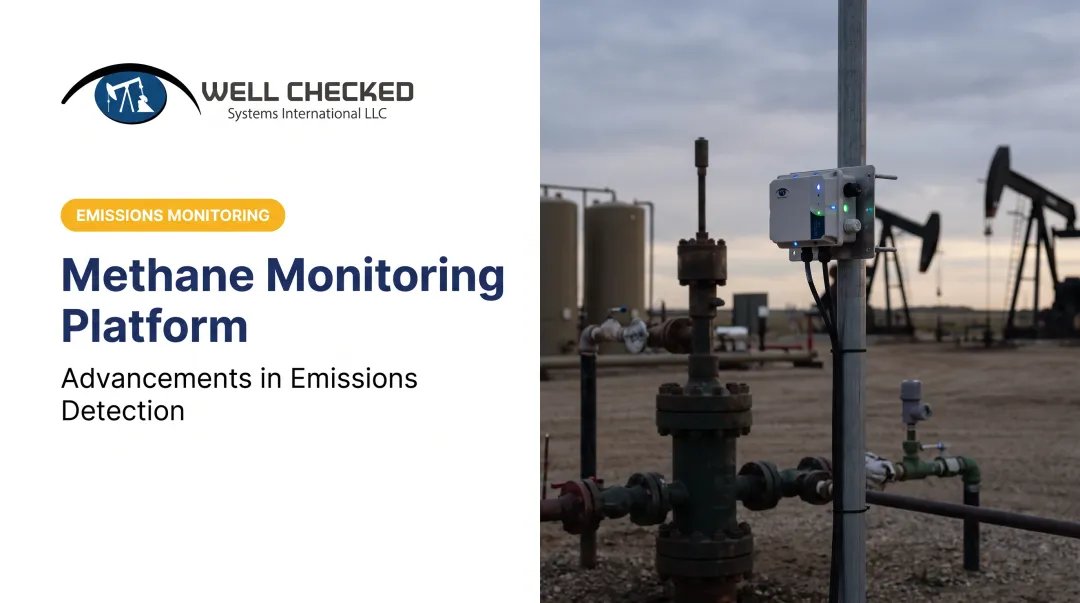
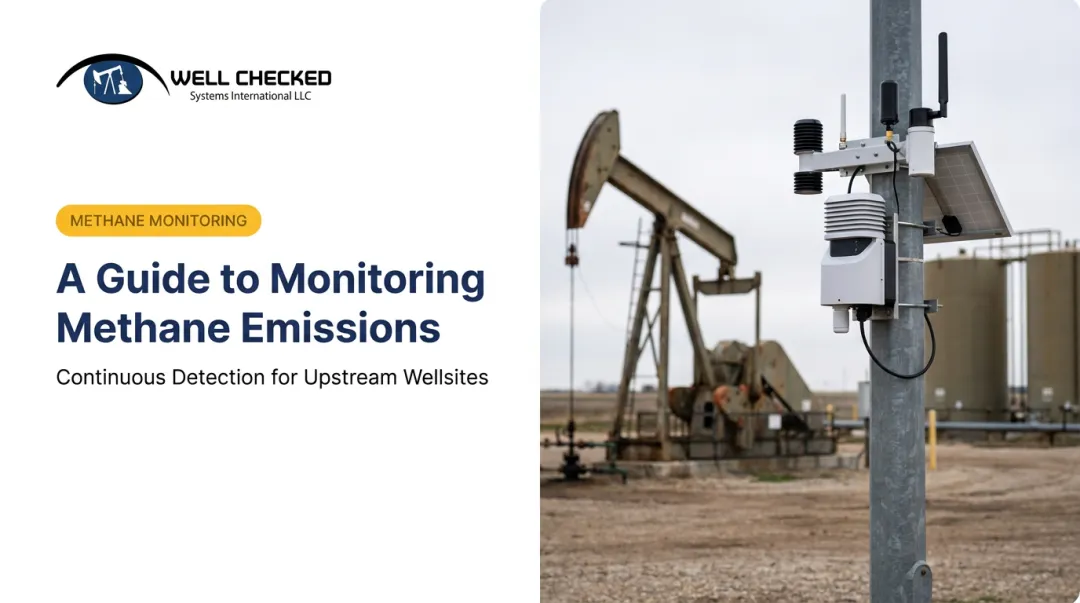
Fixed, continuous multi-sensor platforms take a different approach entirely. Instead of a single point-in-time reading, they monitor 24/7, combining:
- High-resolution video with AI object detection
- Acoustic anomaly detection for equipment sound signatures (Well Checked has a USPTO provisional patent filing covering its acoustic anomaly detection technology)
- Long-Wave Infrared (LWIR) optical gas imaging for round-the-clock methane and VOC detection
This is the model Well Checked Systems built into its Zensory.ai™ platform. During deployment, the system spends roughly two days per site running an AI "site learning" cycle, establishing what normal looks like: routine venting, typical equipment sounds, expected visual patterns.
That baseline is what lets the system tell a controlled vent apart from a genuine fugitive leak, rather than flagging every thermal signature as an emergency.
Airborne and Drone-Based Detection
Aircraft- and drone-mounted spectroscopic sensors are built for regional flyovers and basin-wide screening. A single-blind controlled test of one airborne hyperspectral system found roughly 50% detection probability at 4.7 kg CH4/hour, climbing to 90% at 10.4 kg/hour.
That's useful for catching large releases across many sites in one campaign, but it's episodic: you get a snapshot, not a stream, and results depend heavily on weather and flight conditions.
Satellite-Based Detection
Satellites excel at spotting large "super-emitter" events across huge areas. Broad-area public satellite instruments offer near-daily global coverage but detect emissions only above roughly 25,000 kg/hour, meaning small leaks simply won't register.
Targeted commercial satellites do better, with thresholds as low as 100 kg/hour under favorable conditions, but they still can't see at night, through cloud cover, or across difficult terrain.
No single method covers everything. A defensible compliance program typically layers continuous ground-based sensing with periodic aerial or satellite verification, using each tier for what it does best.

US Methane Regulations You Need to Know
The regulatory picture has shifted more than once in the past year, and operators tracking outdated deadlines are working from bad information.
EPA's 40 CFR Part 60 Subpart OOOOb covers new and modified sources. It applies to well sites, centralized production facilities, and compressor stations, targeting fugitive components like valves, connectors, and thief hatches. The presumptive inspection schedule is risk-tiered:
| Site type | Monitoring frequency |
|---|---|
| Single-wellhead-only sites | Quarterly audio, visual, olfactory (AVO) |
| Multi-wellhead sites | Semiannual OGI added |
| Centralized production facilities | Bimonthly AVO plus quarterly OGI |
| Compressor stations | Monthly AVO plus quarterly OGI |
The rules also include a pathway (Section 60.5398b) for EPA-approved advanced technologies to serve as periodic screening or continuous monitoring alternatives, though this is an optional path rather than a blanket mandate replacing scheduled surveys.
Beyond federal rules, three frameworks are reshaping how operators report:
- OGMP 2.0: a voluntary but increasingly expected framework where Level 4 requires source-level measured data (not generic emission factors), and Level 5 reconciles that data against independent site-level measurements
- SASB Oil & Gas E&P: investor-facing metrics requiring gross Scope 1 emissions and the percentage that's methane
- TCFD/IFRS S2: disclosure framework requiring Scope 1/2 emissions reporting tied to material risk management
Operators should confirm directly with their state agency which alternative-monitoring pathways are formally recognized before relying on them for compliance.
The overall trend is unmistakable. Regulators and investors alike are pushing toward continuous, measurement-based data, away from quarterly snapshots and calculated estimates.
Common Compliance Challenges with Traditional Monitoring
Quarterly LDAR and pumper-route inspections create a structural blind spot. A leak that begins right after an inspection can run for weeks, sometimes up to 89 days, before anyone catches it. That's lost product and unmitigated risk sitting in plain sight, just not anyone's sight at the time.
Frequent route travel to compensate adds its own costs: vehicle wear, staff hours, and real safety exposure from driving remote roads in bad weather.
The second major problem is alert fatigue. Basic sensors can't tell routine process emissions, like a normal flare or an expected vent, apart from actual fugitive leaks. That confusion generates a flood of false alarms.
A controlled evaluation of continuous monitoring systems found false-positive rates ranging from 0% to 79% across tested platforms, a spread wide enough to make operators distrust the alerts entirely, or worse, start ignoring them.
Then there's a third problem: the quantification gap. Detecting that a leak exists is one thing.
Defensibly measuring how long it lasted and how much gas escaped is a different technical problem, one that regulators require and repair-ROI decisions depend on. Detection without quantification tells you there's a problem, not how big it is.
The numbers tell the story:
- Leaks run undetected for up to 89 days between inspections
- False-positive rates span 0% to 79% across tested monitoring platforms
- Duration and volume data go unmeasured, leaving repair-ROI decisions unsupported

Best Practices: Moving to Continuous, Defensible Monitoring
The shift underway among leading operators is simple to describe, harder to execute: move from monitor by routine to operate by exception. Field teams get dispatched only when a validated anomaly is confirmed, not on a fixed calendar regardless of whether anything's wrong. That cuts vehicle miles, reduces site-visit safety exposure, and speeds up response when something actually needs attention.
A three-tier architecture makes this work. Visual and acoustic equipment intelligence feeds into continuous detection, which filters out false alarms before anything reaches a human. Only validated events move to regulatory-grade quantification. This is the model behind Well Checked Systems' Zensory.ai™ platform — Zentinal Ops™ for visual and acoustic equipment intelligence, Zentinal Core™ for detection, and Zentinal IQ™ for quantification:
- Zentinal Core™ detects and filters: fusing video AI, acoustic anomaly detection, and LWIR OGI to flag true fugitive events while suppressing known process emissions
- Zentinal IQ™ quantifies only validated events: measuring volume, duration, and rate to produce EPA-format logs and OGMP 2.0 Level 4/5-aligned data
This layered detection depends on more than one sensor type working together, since each technology has its own blind spot:
- Cameras can't see invisible gas
- Gas imaging can't hear an early mechanical failure
- Acoustic equipment sensors can't quantify a leak's volume
Combining sight, sound, and gas detection closes the gaps no single sensor covers alone.
Continuous records also carry more weight than periodic snapshots when submitting to EPA, state agencies, OGMP 2.0, SASB, or TCFD. Auditors and regulators generally prefer a documented history over a handful of point-in-time readings.
Speed of response matters just as much as detection quality. A 24-hour acknowledge-dispatch-mitigate workflow (acknowledge the alert, dispatch field teams, mitigate the source) is the window one operations director credited with helping "support a documented, timely response" on validated methane events.
Cost tells a similarly compelling story. Traditional route-based site-visit programs run mid-sized to large operators $1 million to $5 million-plus annually, and autonomous continuous monitoring changes that structure entirely.
Well Checked's multi-site Appalachian Basin deployment is a useful reference point for operators building their own ROI case before committing to a multi-site rollout. A fixed-fee pilot program offers a lower-risk way to generate that data firsthand.

Frequently Asked Questions
How do you detect methane emissions?
Ground-based OGI cameras and Method 21 instruments pinpoint individual leaks during inspections, while aerial and drone surveys screen wider areas periodically. Satellites catch large super-emitter events, and continuous multi-sensor AI platforms monitor sites around the clock.
What is the EPA methane rule for 2026?
EPA's 40 CFR Part 60 Subpart OOOOb (new sources) sets scheduled AVO/OGI inspection requirements and allows advanced continuous-monitoring alternatives.
Is 2.5% methane 50% LEL?
Yes. Methane's Lower Explosive Limit is approximately 5% by volume in air, so a 2.5% reading equals exactly 50% of the LEL, a common safety alarm threshold used in confined-space and combustible-gas monitoring.
What is OGMP 2.0 and do I need to comply?
OGMP 2.0 is a voluntary international framework for measurement-based methane reporting, with Level 4 requiring source-level measured data and Level 5 reconciling it against site-level totals. It's not legally mandatory, but investor and industry expectations are pushing more operators to adopt it.
How much does methane monitoring compliance cost?
Costs depend on site count, component density, and method chosen. Traditional route-based inspection programs run $1 million to $5 million-plus annually for mid-sized to large operators, while continuous monitoring shifts spending toward technology and away from recurring field labor.
What's the difference between leak detection and emissions quantification?
Detection confirms a leak exists and locates its source. Quantification measures how much gas escaped and for how long — the data regulators and repair-decision economics both require.