
Introduction
A cyberattack can spread through a network in minutes. A market shock can wipe out a trading position before lunch. A wellhead leak can release methane for hours before anyone notices. Risk doesn't wait for the next scheduled review.
Yet many organizations still lean on quarterly audits, annual assessments, or route-based site inspections. Between those checkpoints sits a blind spot — and that's exactly where costly incidents tend to happen.
The market is responding. Risk analytics spending is projected to jump from $28.13 billion in 2024 to $51.34 billion by 2030, according to a 2024 report from MarketsandMarkets, a 9.7% annual growth rate.
This article breaks down what real-time risk monitoring actually is, how it works, and how it compares to periodic review. It also covers where the approach delivers the most value, including remote, high-consequence settings like upstream oil and gas.
Key Takeaways
- Real-time risk monitoring tracks risk indicators continuously, not on a fixed schedule.
- It closes the gap between when a risk emerges and when someone catches it.
- Continuous data feeds, AI anomaly detection, automated alerts, and dashboards form the core architecture.
- Faster response, lower compliance exposure, and better resource use are the payoff.
- Finance, cybersecurity, and operations like oil and gas all follow the same model.
What Is Real-Time Risk Monitoring?
Real-time risk monitoring is the continuous collection, analysis, and action on risk-relevant data as events happen, not through scheduled or batch-based review. Instead of checking in on a system once a quarter, you're watching it constantly.
Think of it as the "always-on" step that follows risk identification and assessment in the broader risk management lifecycle. Formal reviews still matter for strategy and governance, but real-time monitoring keeps the picture current in between them. NIST's guidance on continuous monitoring frames this as an ongoing loop: collect, analyze, report, respond, and automate wherever practical.
Why Organizations Are Moving This Direction
A few forces are pushing adoption forward:
- Data volume and velocity: Systems now generate more signals, faster, than any manual review process can absorb.
- Market and operational volatility: Conditions shift by the hour in finance and by the minute on an industrial site.
- Regulatory expectations: Frameworks increasingly favor current, timestamped evidence over periodic snapshots.
- Escalating threats: Cyber intrusions and safety incidents don't respect review calendars.
The Same Principle, Different Domains
Here's the part that surprises people: real-time risk monitoring isn't industry-specific. A bank watches for anomalous trading behavior. A security team monitors network logs. An operator tracks a fugitive methane leak at a remote wellsite. Each is running the same core process: continuous detection instead of a periodic snapshot. Only the sensors and the data change.
How Real-Time Risk Monitoring Works: Core Components
Four building blocks make continuous monitoring possible. Miss one, and the system either misses risks or drowns teams in noise.
Continuous Data Collection and Sensing
Real-time systems ingest live data streams from multiple sources simultaneously. The sources vary by industry:
- Finance: market feeds and transaction logs
- Cybersecurity: network logs, configuration data, and threat intelligence
- Industrial settings: IoT and sensor data, including video, acoustic signals, and optical gas imaging feeding in readings around the clock
AI-Powered Analytics and Anomaly Detection
Raw data alone doesn't help anyone. Machine learning models are trained on what "normal" looks like for a given system or site, then flag genuine deviations from that baseline. This is what separates real monitoring from simple always-on logging.
Without tuning, always-on systems generate too many alerts to act on. NIST notes that tuning reduces false-positive alerts and background noise, an approach sometimes called "operate by exception," where teams only engage when something truly deviates from baseline.
Automated Alerting and Escalation
Threshold-based triggers, often visualized as green, amber, or red status, route validated alerts to the right owner automatically. Unresolved issues escalate according to predefined rules, so nothing sits unaddressed because a person forgot to check a dashboard.
Real-Time Dashboards and Defensible Reporting
Continuous monitoring produces an ongoing, auditable record rather than a single point-in-time snapshot. That record supports day-to-day operational decisions and gives compliance teams timestamped evidence when regulators come asking.

Real-Time vs. Periodic Risk Monitoring: What's the Difference?
Periodic assessment isn't obsolete — it still has a place for lower-priority, slow-moving risks. But for anything fast-changing, high-impact, or safety-sensitive, continuous monitoring is the only approach that closes the detection gap.
| Factor | Periodic Assessment | Real-Time Monitoring |
|---|---|---|
| Frequency | Scheduled intervals (quarterly, annual) | Continuous, always-on |
| Coverage | Sample-based checks | Full-population, ongoing coverage |
| Detection speed | Delayed until next review cycle | Near-instant, as events occur |
| Resource model | Manual, labor-intensive inspections | Automated, exception-based response |
| Best suited for | Stable, low-priority risks | High-impact, fast-moving, or regulated risks |
Regulators are pushing toward the right column. Three frameworks make the shift explicit:
- Basel Committee's BCBS 239 requires banks to produce accurate risk data rapidly, including intraday reporting during periods of stress
- NIST's Cybersecurity Framework 2.0 builds continuous monitoring outcomes directly into its core structure
- EPA's OOOOb rule permits continuous-monitoring pathways as an alternative to standard periodic surveys in oil and gas
Each points to the same conclusion: regulators increasingly view periodic snapshots as insufficient on their own.
Key Benefits of Real-Time Risk Monitoring
Faster Detection and Response
This is the headline benefit, and the data backs it up. Organizations that made extensive use of security AI and automation identified and contained data breaches in 234 days, compared to 332 days for organizations using none, according to IBM's Cost of a Data Breach Report.
That's a 98-day difference — nearly three months of extra exposure for organizations still relying on slower, less automated detection.
The same report found average breach costs of $3.84 million for heavy automation users versus $5.72 million for non-users. Speed translates directly into cost savings.

Additional Operational Advantages
Real-time monitoring delivers benefits beyond detection speed:
- Cost efficiency: Automation reduces dependence on expensive manual, route-based, or sample-based inspection cycles, freeing resources to focus on validated issues only.
- Stronger regulatory defensibility: Continuous, timestamped records eliminate the gaps that periodic-snapshot reports leave, the same gaps regulators question during an audit or enforcement review.
- Optimized resource allocation: Filtering out normal activity lets teams focus on validated anomalies instead of chasing false alarms, addressing the alert fatigue that high false-alarm rates cause in many monitoring operations.
- Improved decision-making: Leadership acts on current data instead of month-old numbers, building trust with regulators, investors, and customers who expect transparency.
Real-Time Risk Monitoring in High-Consequence Operating Environments
Few settings make the case for continuous monitoring as clearly as remote upstream oil and gas sites. Safety hazards, environmental exposure, and regulatory scrutiny around methane and volatile organic compound (VOC) emissions all converge in one place, often hundreds of miles from the nearest office.
The scale of the problem is real. Global energy-related methane emissions reached 124 million tonnes in 2025, with oil and gas responsible for roughly 81 million tonnes of that total, according to the IEA's Global Methane Tracker. Traditional pumper-route inspections, run quarterly or monthly, leave long windows where a leak can go undetected.
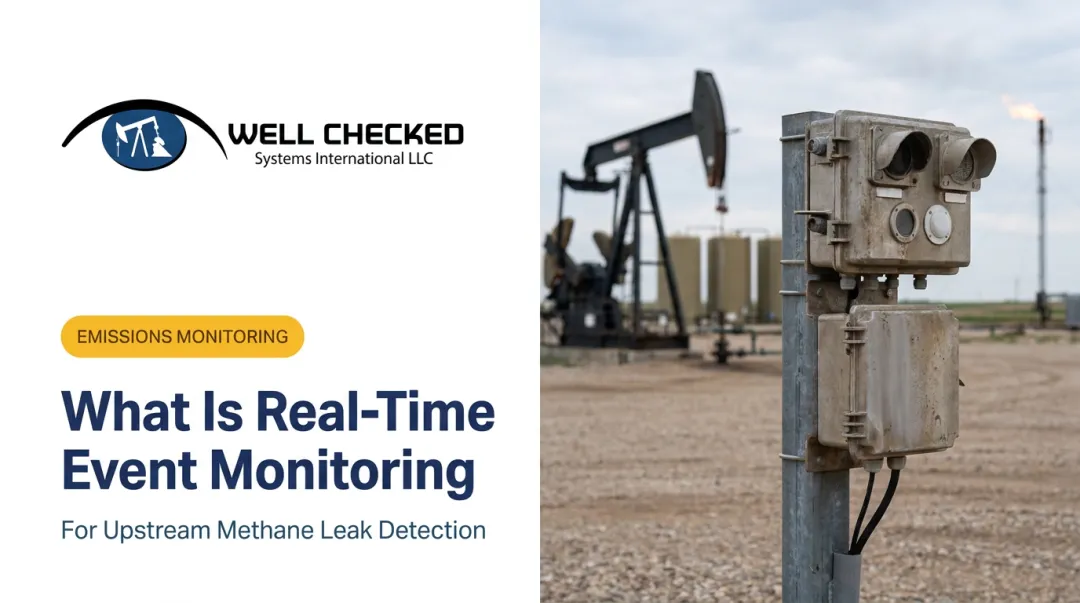
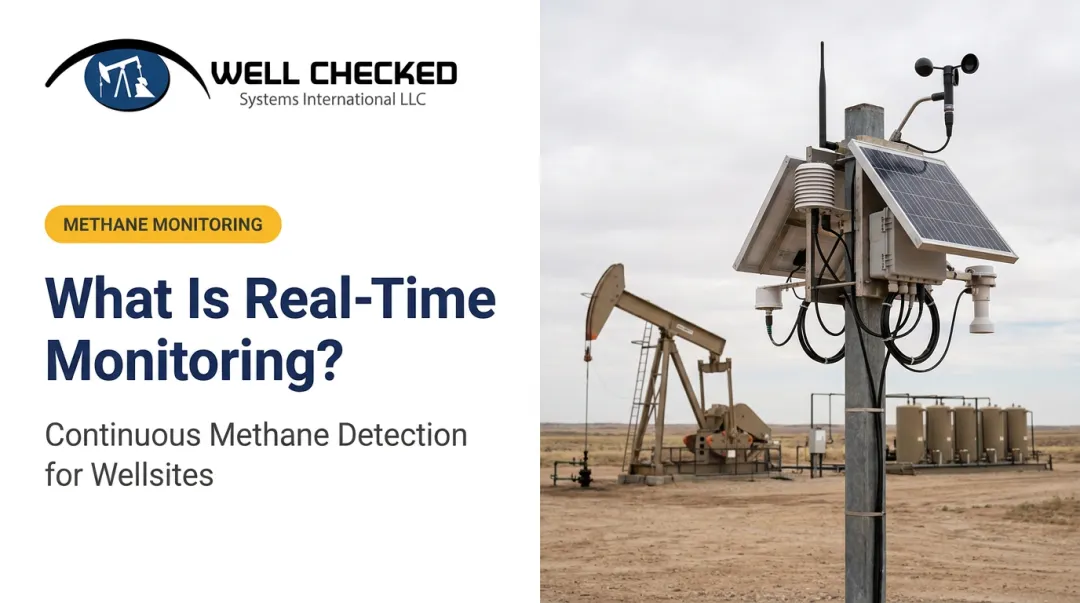
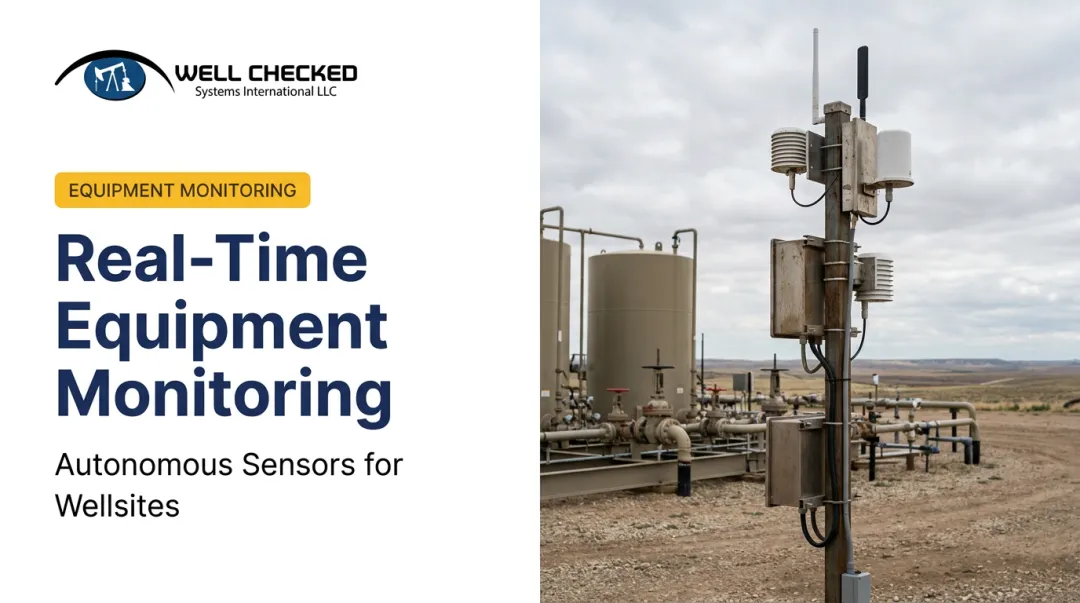
This is where multi-sensor autonomous monitoring applies the same principles covered above (continuous data collection, anomaly detection, and automated alerting) to a physical wellsite instead of a trading desk or network.
Well Checked Systems' Zensory.ai™ platform is a working example of this model in the field. Its architecture operates across three tiers:
- Zentinal Ops™ delivers visual and acoustic equipment intelligence: high-resolution video, object recognition, acoustic anomaly detection, and actionable alerts.
- Zentinal Core™ provides multi-sensor detection, combining Long-Wave Infrared optical gas imaging, video, and acoustic anomaly AI to watch a site continuously, learning each site's baseline in about two days before alerting only on validated fugitive emissions. Well Checked has a USPTO provisional patent filing for Detecting and Quantifying Fugitive Methane and Vapor Emissions Using Infrared Imaging and Machine Learning.
- Zentinal IQ™ activates only after Core validates an event, quantifying volume, duration, and rate for regulatory-defensible reporting aligned with EPA Subpart OOOOb, OGMP 2.0, SASB, and TCFD.
That three-tier structure lets field teams acknowledge, dispatch, and mitigate validated events within a 24-hour window, a response speed operators report as helping support a documented, timely response. The platform currently monitors remote wellsites, including a confirmed multi-site deployment across the Appalachian Basin.

Whether the risk is a financial exposure, a network intrusion, or a fugitive gas leak, the fix is the same: swap the periodic snapshot for continuous monitoring that can tell normal activity apart from a real threat.
Frequently Asked Questions
What is real-time risk monitoring?
It's the continuous, automated tracking and evaluation of risk indicators as they occur. Unlike periodic assessment, it doesn't wait for a scheduled review to catch a developing problem.
How is real-time risk monitoring different from periodic risk assessment?
Periodic assessment is a point-in-time snapshot, typically run quarterly or annually. Real-time monitoring tracks risk continuously between those cycles, closing the detection gap that periodic reviews leave open.
What technologies make real-time risk monitoring possible?
IoT and sensor data feeds supply the raw input. AI and machine learning models then flag true anomalies against a normal baseline, while automated alerting and live dashboards handle notification and reporting.
Which industries rely most heavily on real-time risk monitoring?
Financial services and cybersecurity have led adoption, given how fast risks move in both fields. Operational and environmental sectors, including oil and gas methane monitoring, are increasingly following the same model.
Can real-time risk monitoring help with regulatory compliance and reporting?
Yes. Continuous monitoring generates defensible, timestamped records that hold up better under regulatory review than periodic-snapshot reports, which inherently leave gaps between inspection dates.
Does real-time risk monitoring eliminate the need for manual site inspections or human oversight?
It reduces reliance on routine manual checks by enabling an "operate by exception" model. Human review and response still matter — they just get directed at validated anomalies instead of every scheduled visit.