
Operators today manage thousands of geographically scattered assets without driving a single route. Instead of a pumper checking a tank level in person, a screen in the control room already shows it. A 2017 JPT/SPE article found that some production staff spent up to 50% of their time manually extracting, verifying, and manipulating field data before better SCADA systems took over that burden.
Here's the problem: many operators sign off on SCADA purchases, or inherit legacy systems from an acquisition, without ever understanding how the layers work together. That gap leads to poor scoping, alarm floods that get muted within days, and blind spots — like emissions — that SCADA was never built to catch in the first place.
This guide breaks SCADA down stage by stage: what it does, where it fits in real operations, and exactly where its coverage stops.
Key Takeaways
- Four layers form SCADA: field devices, RTUs/PLCs, communications, and a host HMI
- Core functions are data collection, alarming, remote control, and historical trending
- Facility type shapes monitoring scope: wellheads need less than compressor stations or gas plants
- SCADA tracks pressure and flow but cannot detect a methane leak directly
What Is SCADA?
SCADA stands for Supervisory Control and Data Acquisition, a combination of hardware and software that collects, displays, logs, and acts on real-time data from remote field equipment. That's the ISA's own definition: a system built to send commands and acquire data across distributed assets.
Before SCADA, operators relied on manual pumper rounds. A high tank, a tripped compressor, or a slow pressure drop might not get caught for hours, sometimes days. SCADA closed that gap by putting a live feed of field conditions on a screen instead of a clipboard.
What SCADA Is Not
Two common mix-ups worth clearing up:
- SCADA isn't a single PLC. A Programmable Logic Controller is one component inside a SCADA system, handling local logic at a single site, while SCADA is the broader architecture supervising many PLCs and RTUs across a wide area.
- SCADA isn't a Building Management System (BMS). A BMS controls HVAC, lighting, and access for a single building. SCADA manages process variables across dispersed field assets (wells, pipelines, tank batteries) spread over hundreds of square miles.
Why It's Still the Standard
Cloud-first IoT platforms have flooded the market, but SCADA remains the proven backbone for closed-loop alarm and shutdown logic at scale. Most operators run one of four recognized categories:
- Full-stack enterprise SCADA: owned and hosted on operator infrastructure
- Hosted or cloud SCADA-as-a-service: vendor-managed, subscription-based
- Purpose-built upstream software: tailored for well and pad-level operations
- Legacy or on-prem systems: older architecture, often inherited through M&A
The underlying process (sense, transmit, supervise, act) stays the same across all four. What changes is who owns it, where it's hosted, and how it's priced.

How Does SCADA Work?
SCADA operates as a repeating four-stage loop: sensing, transmission, supervision, and action. Each stage depends entirely on the one before it. Break one link, and everything downstream goes dark.
Initiation: Field-Level Sensing
The loop starts continuously at the field level. Pressure gauges, level switches, and flow meters constantly measure real-world conditions: pressure in a flowline, fluid level in a tank, discharge rate on a compressor.
This stage is condition-based and automatic. It doesn't wait for anyone to check; it runs whether a human is watching or not.
That creates a quiet but common failure point: a dead battery or a failed sensor silently breaks the entire chain. If a field device never captures the reading, nothing downstream (not the RTU, not the host, not the operator's screen) can report data that was never generated.
Core Operation: From Wellsite to Screen
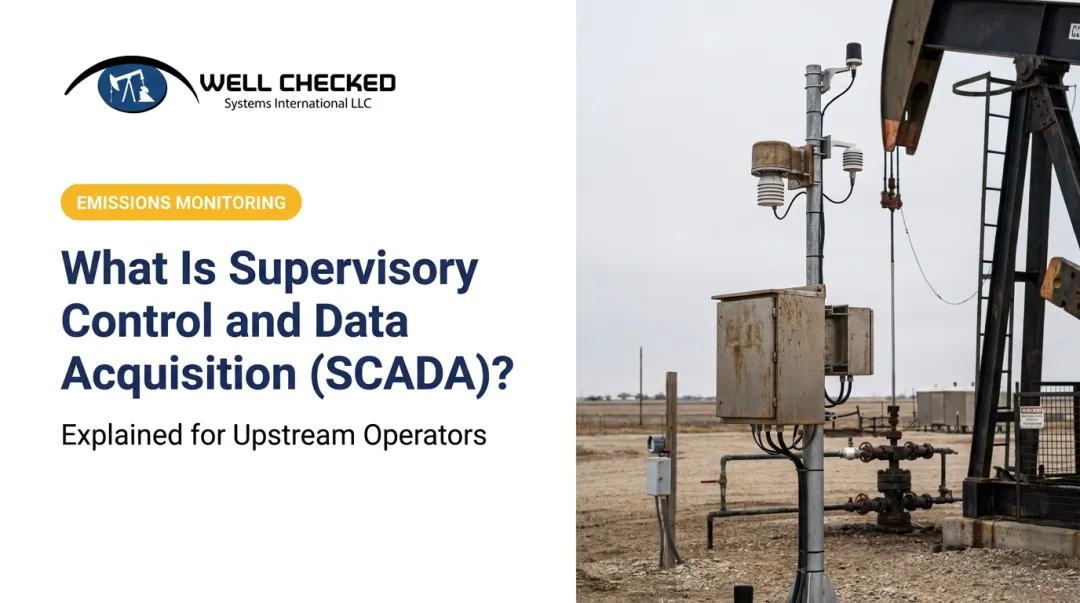
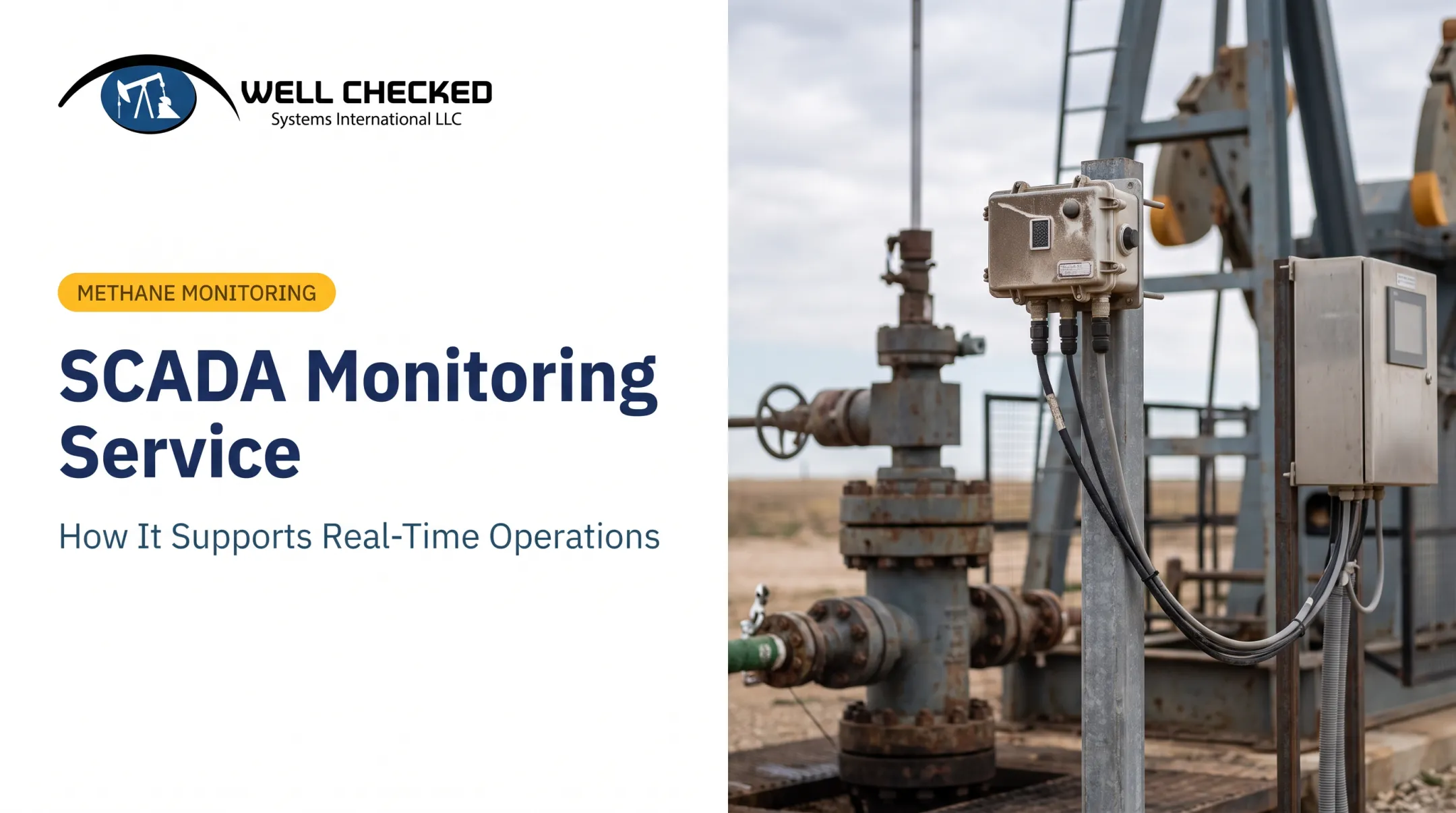
RTUs or PLCs installed at the site collect raw sensor signals, apply basic logic, and package that data for transmission. From there, it travels over whatever communications link is available (cellular, radio, or satellite) to a central server.
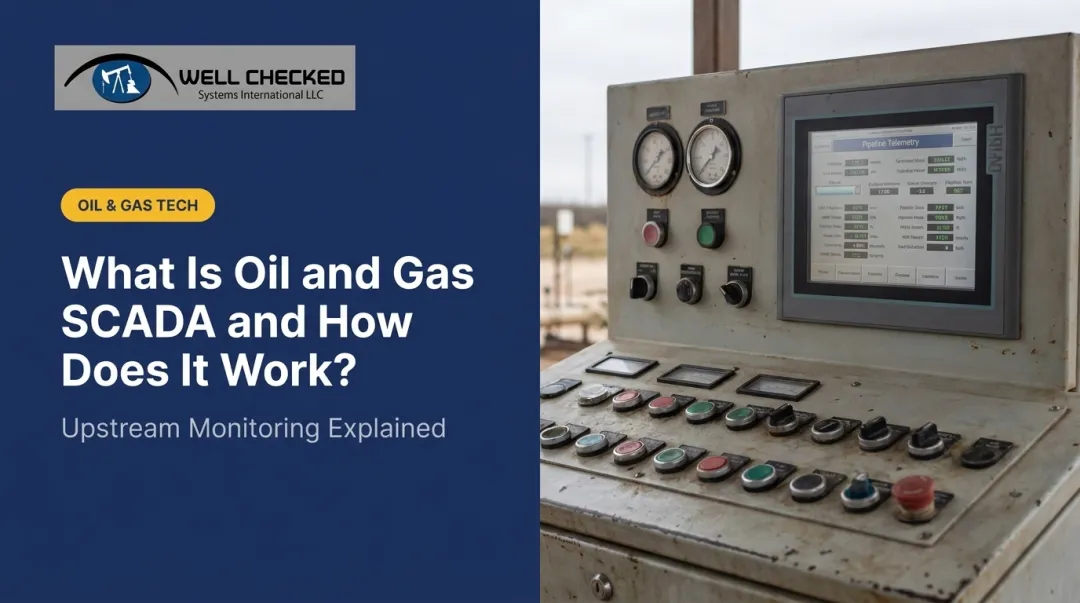
Picture a remote wellsite with no grid power and no Wi-Fi. The data still has to move. Once it lands at the host system, that system ingests it, timestamps it, and renders it on the HMI (human-machine interface) an operator actually looks at.
Two variables determine how current that view really is: polling frequency (how often the field device reports, from seconds to minutes on strong links) and connectivity reliability (a weak signal or missed poll leaves the operator looking at stale data without knowing it).
Where only serial radio or dial-up connections exist, published vendor integration documentation notes that collection can drop to once per day or on-demand only. Link quality is a direct constraint on how "real-time" real-time actually is.
Regulation and Control: Two-Way Communication
SCADA isn't just a display. It supports two-way communication, meaning the office can send commands back to the field (starting a pump, closing a valve, resetting a trip) without anyone driving out.
Alarming is the core regulating mechanism here. Setpoints trigger alerts when a measurement crosses a defined threshold. Well-tuned deadbands separate a real problem from normal noise.
This is where most SCADA rollouts fail. Poorly tuned alarms are the single most common reason operators start ignoring their own system. ISA's alarm-management standard recommends a priority distribution of roughly 5% high, 15% medium, and 80% low priority alarms.
One industrial case in that same report had operators facing three or four alarm-summary pages of stale alerts; rationalization cut alarm load by 84%, down to just 10-12 active alarms at any time. Over-alarmed consoles get muted within days of go-live, and once muted, the entire supervisory layer stops functioning as designed.
Output and Result: The Consolidated Record
The end product of the loop is a continuously updated record of well and facility performance, available on a screen or a phone rather than a paper route sheet filed at the end of a shift.
That output feeds downstream systems too. Historians store the data for trend analysis, production reporting, and failure diagnosis over time, turning individual readings into a pattern operators can act on.
The payoff is measurable. In an published case covering 11 wells across three offshore Indonesian platforms, automated remote monitoring and gas-lift control delivered a 17.8% production gain (roughly 694.8 BOPD) while eliminating trips made solely to collect data or nudge a lift setting. That's the loop working as intended: sense, transmit, supervise, act, repeat.

Where SCADA Is Used
SCADA coverage isn't uniform across an operation. It fits differently depending on the asset:
- Wellhead production monitoring: pressure, temperature, and runtime on individual wells
- Tank battery level tracking: catching a high tank before it becomes an overflow
- Compressor station control: start/stop logic, discharge pressure, vibration trips
- Pipeline pressure and flow monitoring: required under PHMSA control-room regulations
- Gas plant processing: supervisory control across multiple interconnected process units
SCADA performs best in high-value, high-complexity facilities where downtime carries a real hourly cost, and in safety-critical settings like H2S detection or emergency shutdown systems. Well Checked Systems integrates with SCADA for alert delivery and does not provide H2S detection.
Scale matters too. A single wellhead might only need basic telemetry: level and pressure readings sent a few times an hour. A compressor station or gas plant typically runs full supervisory control with layered, prioritized alarms, because the cost of missing a trip condition is exponentially higher.
SCADA's Blind Spot: Why Emissions Monitoring Needs a Different Layer
SCADA was engineered to track process variables: pressure, flow, temperature, runtime. It was never built to see, hear, or smell a fugitive methane leak or a volatile organic compound (VOC) release escaping from a flange, valve, or seal.
Think about what a pressure sensor actually tells you. A drop might suggest a leak. It can't confirm one, locate it, or measure how much gas has escaped. That's a different job than the one SCADA sensors were designed for.
The Regulatory Gap Widening This Problem
Regulatory pressure is only increasing the size of this blind spot:
- The EPA methane rule (40 CFR Part 60 Subpart OOOOb) continues expanding monitoring and reporting obligations for new oil and gas facilities
- OGMP 2.0 Level 4/5 frameworks now require measurement-based emissions reporting, not engineering estimates
- Operators relying solely on SCADA process data have no defensible way to satisfy either requirement
This is exactly the gap our platform at Well Checked Systems was built to close. Zensory.ai™ is a multi-sensor AI stack combining high-resolution video, Long-Wave Infrared Optical Gas Imaging, and acoustic abnormal-sound detection, continuously watching for the exact events SCADA process sensors were never designed to catch. Well Checked has a USPTO provisional patent filing for Detecting and Quantifying Fugitive Methane and Vapor Emissions Using Infrared Imaging and Machine Learning.
The architecture mirrors sound SCADA alarm philosophy, just applied to emissions instead of process trips:
- Zentinal Core™ learns a site's normal operating signature over roughly a two-day AI learning cycle, then filters out routine process venting to detect only true fugitive anomalies — the same discipline behind a well-tuned alarm deadband
- Zentinal IQ™ only quantifies an event once Core has validated it, producing regulatory-defensible volume and duration data for EPA and OGMP 2.0 reporting
Zentinal Core™ integrates with existing SCADA infrastructure through a read-only API, delivering validated alerts and emissions data into control room workflows operators already use, without touching the control loop itself. It's one more channel alongside the dashboard, email, and SMS alerts, not a replacement for anything already in place.

Conclusion
SCADA's working logic is a continuous loop: sensing, transmitting, supervising, acting, and starting over. Understanding those four stages helps operators scope rollouts around real facility needs instead of a vendor's slide deck.
That understanding also draws a clear line. SCADA does process control extremely well, but it was never built to catch emissions, and expecting it to is where compliance gaps form.
Knowing where that line sits helps operators budget for the right layered technology stack — SCADA for process, and a dedicated multi-sensor platform like Well Checked Systems' Zensory.ai™ for the leaks it can't see.
Frequently Asked Questions
What is SCADA in simple terms?
SCADA is the combined hardware and software system that lets operators see and control remote wellsite equipment from a central screen instead of driving to every location. It's the eyes and hands for scattered field assets, cutting down on unnecessary site visits.
Is SCADA a PLC system?
No. A PLC (Programmable Logic Controller) is just one component inside a larger SCADA system. SCADA also includes field sensors, a communications network, and the host/HMI software layer that ties it all together.
What is SCADA vs BMS?
SCADA is built for geographically distributed field assets like wells, tank batteries, and pipelines spread across a basin. A BMS (Building Management System) is built for facility-level HVAC, lighting, and access control inside a single building.
What are the four types of SCADA systems?
The commonly recognized categories are monolithic/legacy, distributed, networked, and modern IoT/cloud-hybrid setups. Most oil and gas operators today run some form of hybrid architecture rather than a single pure type.
Does SCADA detect methane leaks or emissions?
Standard SCADA sensors measure process variables like pressure and flow, not gas leaks or emissions. Dedicated multi-sensor platforms, like Well Checked Systems' Zensory.ai™, are built specifically for defensible emissions detection.
Is SCADA the same as automation?
Not exactly. SCADA is one tool inside the broader category of oil and gas automation, focused specifically on supervisory monitoring and control rather than the full scope of automated field operations.