
That's where Continuous Emissions Monitoring Systems (CEMS) come in. These systems give plant operators and EHS managers real-time, defensible data on what's actually leaving the stack.
This guide breaks down what CEMS are, how they work, and where the EPA requires them. We'll also cover a gap traditional CEMS can't close: fugitive methane emissions from wellsite equipment. Newer AI-based monitoring platforms are stepping in to fill that blind spot.
If you're an EHS manager, plant operator, or an E&P company evaluating monitoring technology, this one's for you.
Key Takeaways
- Continuous, real-time pollutant data under EPA air programs is what CEMS deliver
- Core stack hardware spans a sample probe, line, filter, analyzer, calibration system, and DAHS
- Power plants, refineries, and industrial stacks nationwide must run CEMS
- AI-sensor platforms now cover fugitive methane sources that stack CEMS never reached
What Is a Continuous Emissions Monitoring System (CEMS)?
According to the EPA, a CEMS is "the total equipment necessary for the determination of a gas or particulate matter concentration or emission rate using pollutant analyzer measurements and a conversion equation, graph, or computer program to produce results in units of the applicable emission limitation or standard."
That definition covers more than a single sensor. A CEMS is a full measurement and reporting system.
CEMS typically tracks:
- Sulfur dioxide (SO2)
- Nitrogen oxides (NOx)
- Carbon monoxide (CO)
- Carbon dioxide (CO2)
- Oxygen (O2)
- Particulate matter (PM)
- Volatile organic compounds (VOCs)
CEMS vs. PEMS: Not Interchangeable
CEMS uses hardware to physically sample and analyze stack gas. Predictive Emissions Monitoring Systems (PEMS), by contrast, estimate emissions using process/operating data and a validated model rather than a direct sensor reading. EPA's Performance Specification 16 governs PEMS approval.
CEMS is the legal default for most affected sources. PEMS is only accepted where the applicable rule allows it and the model has been validated against reference-method testing.
40 CFR Part 60 Appendix B sets performance specifications for CEMS hardware (PS-2 for SO2/NOx, PS-11 for PM, and so on), while Part 75 layers on utility-specific monitoring and reporting duties for power generators. If your facility crosses the emissions threshold defined in your applicable rule, CEMS is mandatory.
How Do Continuous Emissions Monitoring Systems Work?
CEMS follows a defined engineering chain from stack to report:
- Sample probe extracts flue gas directly from the stack or duct
- Sample line (heated or unheated) transports the gas to the analyzer
- Filter removes particulates that would foul the sensor
- Gas analyzer measures pollutant concentration
- Calibration system injects reference gases to verify accuracy
- DAHS (Data Acquisition and Handling System) records, validates, and flags results

Handling Hot, Wet, or Dirty Gas Streams
Not every stack produces clean, dry sample gas. Depending on moisture, particulate load, and stack conditions, systems use different architectures:
- Cold-dry extractive: removes moisture before analysis
- Hot-wet extractive: transports gas above its dew point
- Dilution-extractive: dilutes the sample near the probe with clean air
- In-situ: measures directly in the stack, skipping a long transport line
No single design wins across every application. Selection depends on the pollutant, moisture content, and whether the applicable limit is expressed on a wet or dry basis. EPA's guidance on gaseous CEMS covers this in detail.
After the architecture is chosen, continuous operation is non-negotiable. CEMS run through shutdowns and startups because regulators need valid operating-hour data whether the unit is at full load, idling, or down. The DAHS turns raw analyzer output into averaged, flagged, compliance-ready records the moment an inspector or EPA auditor asks for them.
Regulatory Guidelines and Standards for CEMS
CEMS deployment isn't "install and forget." The EPA layers ongoing quality assurance requirements on top of the hardware rules.
Part 60 Appendix F requires:
- Daily calibration-drift checks at two concentrations
- Quarterly audits (cylinder-gas audits allowed in three of four quarters)
- A Relative Accuracy Test Audit (RATA) at least once every four calendar quarters
- Calibration accuracy within ±15% of the average audit value in most cases

The full Appendix F QA requirements define what "out of control" data means and why it can't be used for compliance.
Part 75 Appendix B (for power-sector units) adds:
- Daily calibration-error tests
- Quarterly linearity checks
- Semiannual RATAs in most cases (annual if relative accuracy stays under 7.5%)
A RATA differs from a routine calibration check. It compares your CEMS output against simultaneous EPA reference-method measurements under real operating conditions. Skip it, and your data loses legal standing.
CEMS records function as evidence. When EPA sends a deviation inquiry or a permit renewal hinges on demonstrated compliance, minute-by-minute CEMS logs are what protect the facility.
Where Are CEMS Used Across Industries?
Federal CEMS requirements show up across multiple sectors, but the specific unit, pollutant, and rule vary:
| Industry | Governing Rule | What's Monitored |
|---|---|---|
| Electric power | 40 CFR Part 75 | CO2, NOx, SO2 |
| Petroleum refineries | Part 60 Subpart Ja | FCCU/sulfur-recovery pollutants |
| Portland cement | Part 63 Subpart LLL | THC, mercury |
| Incineration | Part 60 Subpart Eb | O2, CO2, SO2, CO, NOx |
| Chemical manufacturing | Part 63 Subpart FFFF | Conditional, unit-specific |

The Power Plant Use Case
Power generation is the clearest example. Under the Acid Rain Program and New Source Performance Standards, affected units continuously track SO2, NOx, and CO2 from the boiler stack. This isn't just compliance box-checking. The data also helps operators catch combustion inefficiencies and equipment drift before they become bigger maintenance issues.
Beyond compliance, CEMS data supports:
- Malfunction detection during abnormal combustion events
- Process troubleshooting when emissions trend upward unexpectedly
- Operational efficiency benchmarking across similar units
One limitation matters for upstream operators: traditional CEMS only see the stack. They don't detect fugitive leaks from valves, tanks, connectors, or compressors — the exact equipment that dominates upstream oil & gas emissions profiles.
Beyond the Stack: Continuous Monitoring for Fugitive Emissions in Oil & Gas
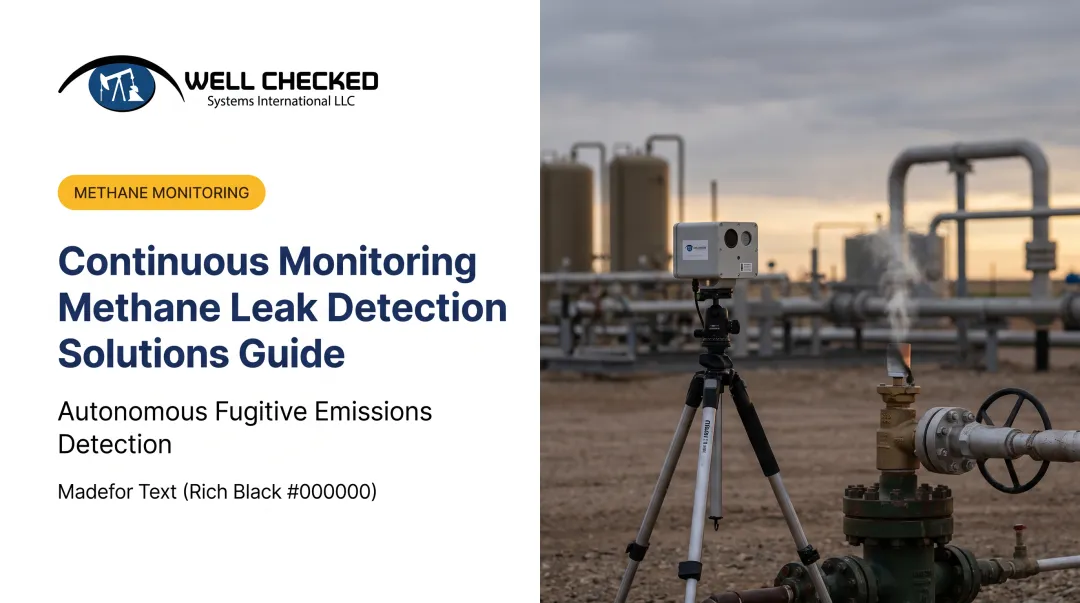
Upstream oil & gas facilities face a different monitoring problem. There's no single stack to sample. Methane escapes from dozens of components spread across a wellsite — valves, connectors, tanks, compressor seals — and it moves with the wind. A fixed stack CEMS can't cover that. Neither can a technician visiting once a quarter.
How AI-Enabled Multi-Sensor Platforms Fill the Gap
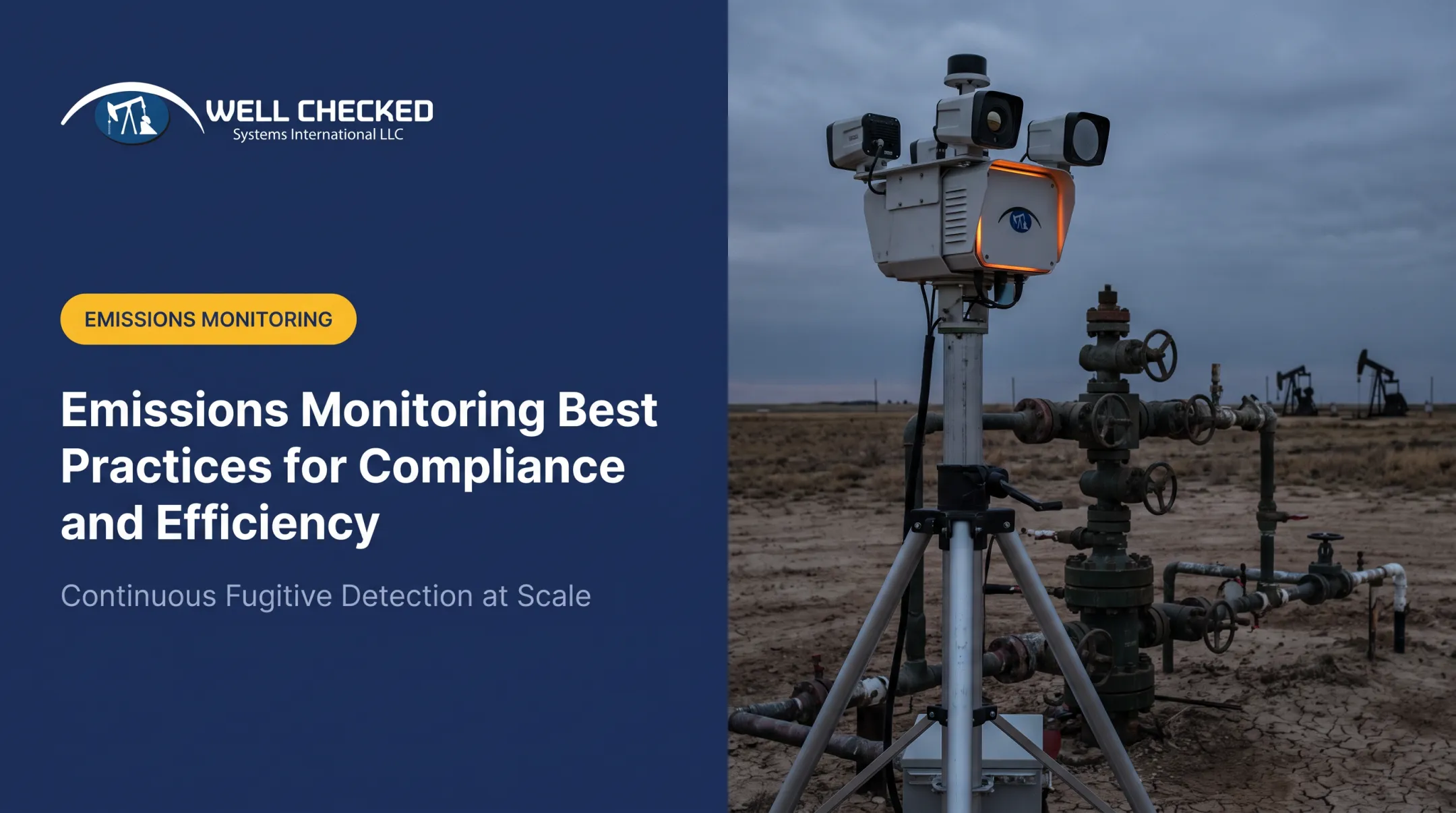
Instead of one analyzer sampling one duct, field-level monitoring combines multiple sensor types across a whole site:
- High-resolution video for 360° object detection and site security
- Long-Wave Infrared (LWIR) Optical Gas Imaging for day/night methane and VOC detection
- Acoustic AI to catch abnormal equipment sounds signaling malfunction Well Checked Systems' Zensory.ai™ platform illustrates how this works in practice. It runs a three-tier architecture:
- Zentinal Ops™ — delivers the visual and acoustic intelligence layer, processing over 1,500 videos per site per day
- Zentinal Core™ — fuses sensor data, builds a site-specific baseline in about two days, and alerts only on true fugitive anomalies
- Zentinal IQ™ — quantifies Core-validated events (volume, duration, rate) and generates EPA-format compliance logs suitable for regulatory submission That sequence—detection, discernment, then quantification—matters because raw sensor data isn't compliance-ready on its own. An event must be validated before it's worth reporting, and quantified before it's defensible. Data structured this way supports EPA's methane rule (40 CFR Part 60 Subpart OOOOb), OGMP 2.0 Level 4/5 measurement-based reporting, and SASB/TCFD ESG disclosure formats. OGMP 2.0 is a voluntary UN framework, not a U.S. legal mandate. A fixed sensor network only substitutes for prescribed LDAR work practices when EPA has approved that specific alternative method. Operate-by-exception vs. periodic inspections:
- Traditional pumper routes and quarterly LDAR surveys give you a snapshot — a leak that starts the day after inspection goes unnoticed for months
- Continuous multi-sensor monitoring flags anomalies as they happen, letting teams acknowledge, dispatch, and mitigate within 24 hours
- Continuous records replace periodic snapshots, giving operators defensible duration, volume, and rate data for repair ROI and agency submissions

For mid-sized to large operators spending $1M–$5M+ annually on route-based site visits, that shift cuts unproductive site-visit spend and puts mitigation—and the compliance log—inside a 24-hour window.
Benefits of Continuous Emissions Monitoring
Continuous monitoring (whether stack-based CEMS or field-level AI sensing) delivers value beyond simply satisfying a permit condition.
Faster detection, faster correction. Periodic testing leaves blind spots between visits. Continuous data catches malfunctions or leaks as they develop, shrinking the time between "something's wrong" and "we fixed it."
Legal defensibility. Minute-by-minute records hold up during EPA inquiries and permit reviews. A documented history protects a facility far better than a single point-in-time inspection report.
Strategic decision-making. Emissions data now supports operational and investor decisions. It feeds into:
- Cost analysis for repair-and-maintenance prioritization
- ESG reporting for investors and regulators
- Risk management planning across a multi-site portfolio
For upstream operators specifically, quantified emissions data (like what Zentinal IQ™ produces) turns a vague "we had a leak" into a defensible record. You see exactly how much methane was lost, for how long, and which fix to prioritize first.
Frequently Asked Questions
What is continuous emissions monitoring (CEMS)?
CEMS is EPA-mandated equipment that continuously measures pollutant concentrations, such as SO2, NOx, CO, and particulate matter, from industrial stacks. It's a legal requirement for facilities that exceed specific emissions thresholds, not an optional upgrade.
How do continuous emissions monitoring systems (CEMS) work?
A sample probe extracts flue gas, a sample line transports it, a filter removes contaminants, and an analyzer measures pollutant concentration. The DAHS then validates, records, and formats this data into compliance-ready reports.
What are the guidelines for continuous emissions monitoring systems (CEMS)?
Key rules include 40 CFR Part 60 (Appendices B and F) and Part 75 for power-sector units. Operators must run daily calibration checks, quarterly audits, and RATAs at least every four calendar quarters.
What can continuous emissions monitoring systems (CEMS) be used for?
Beyond compliance reporting, CEMS data supports malfunction detection, process troubleshooting, and operational efficiency benchmarking. It also serves as evidence during EPA deviation inquiries and permit reviews.
What is the role of continuous emissions monitoring systems (CEMS) in power plants?
Power plants use CEMS to track SO2, NOx, and CO2 from boiler stacks, satisfying Acid Rain Program and New Source Performance Standards requirements under 40 CFR Part 75.
How is fugitive emissions monitoring different from traditional CEMS?
Fugitive monitoring targets field-level leaks from valves, tanks, and compressors using AI-enabled sensors like video, optical gas imaging, and acoustic detection, rather than a single stack-mounted analyzer.