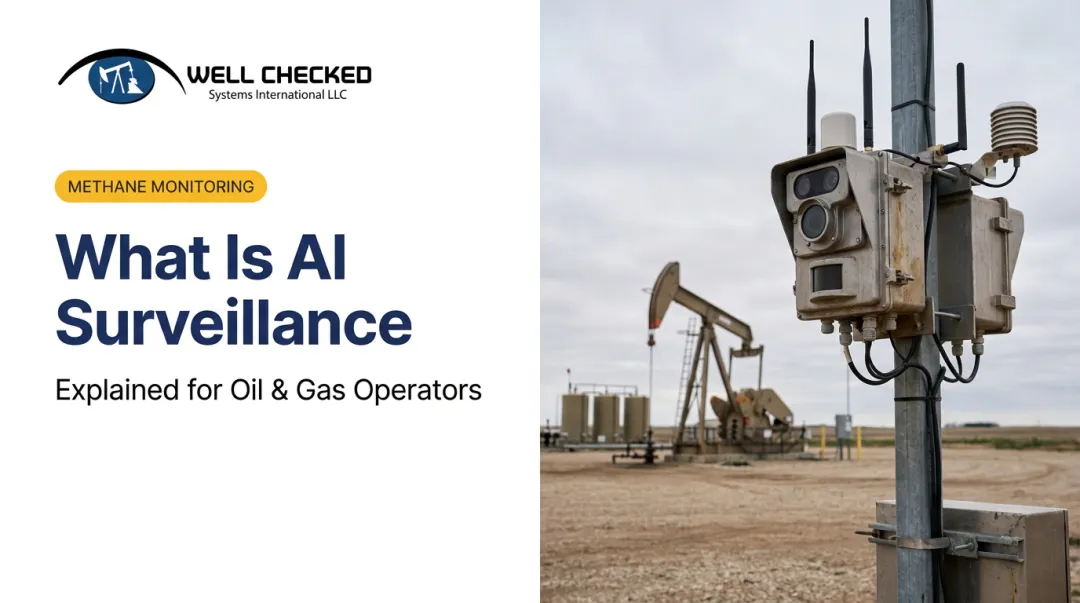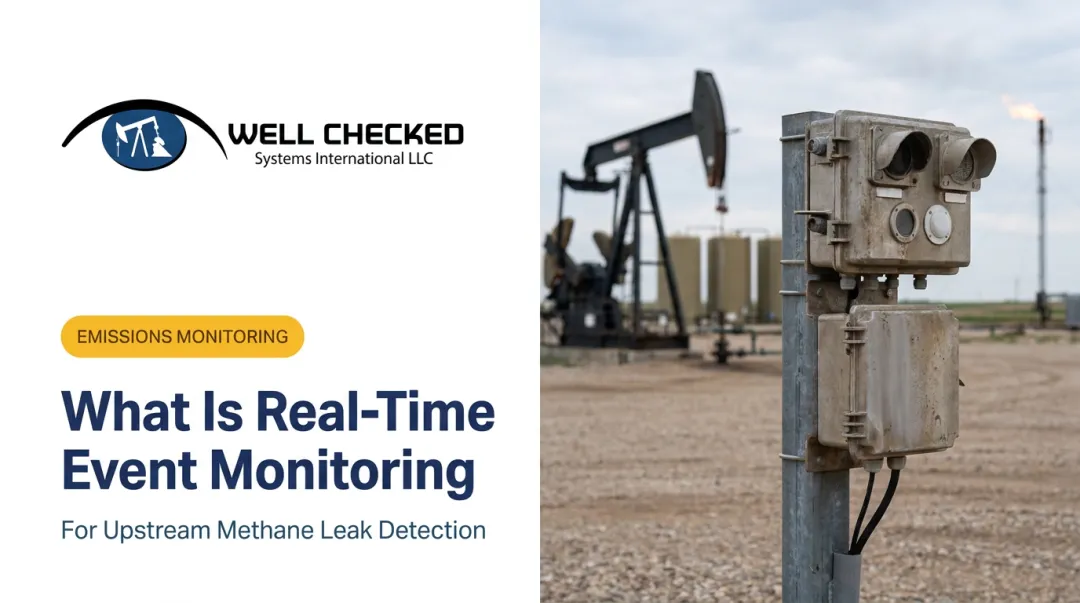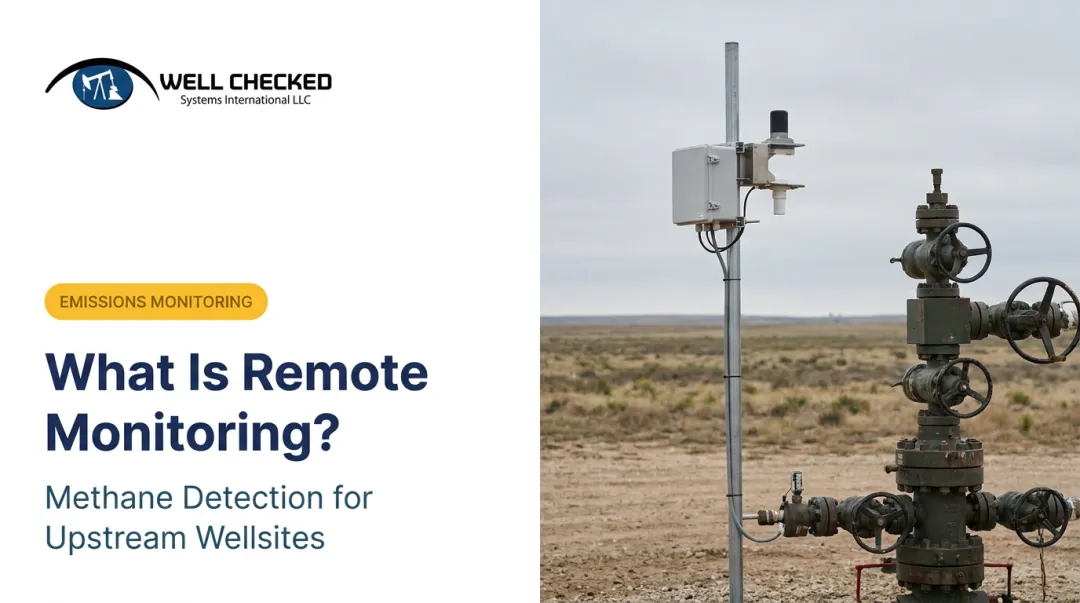

Real-time video surveillance flips that model. Cameras and sensors watch a site continuously, and AI-driven analytics flag problems the moment they happen, not after someone reviews a recording.
The stakes are real. U.S. retailers lost $112.1 billion to shrink in FY2022 alone, or 1.6% of total sales, according to the National Retail Federation's 2023 security survey. Industrial operators face a different version of the same problem: a missed leak or equipment failure at a remote wellsite can mean regulatory fines and safety risk before anyone even knows there's an issue.
This article covers what real-time surveillance actually means, how it works, its core benefits, and where it's being used today — from retail floors to remote oil and gas sites.
Key Takeaways
- Real-time surveillance analyzes footage as it happens, not after the fact.
- AI analytics learn normal site activity, cutting false alerts and flagging real threats.
- Benefits include faster response, stronger documentation, lower labor costs, and improved site safety.
- Applications now extend to environmental monitoring, including methane detection at oil and gas wellsites.
What Is Real-Time Video Surveillance?
Real-time video surveillance is the continuous observation and immediate analysis of live video as it's captured, not footage stored for later review. The system watches and interprets what's happening, then triggers a response while the event is still in progress.
Three characteristics define "real time" in this context:
- Immediate data acquisition: feeds are captured and transmitted without delay
- Continuous observation: monitoring doesn't stop between scheduled checks
- Actionable insight: the system (or a human operator) can act on what it sees, not just log it

Recorded CCTV vs. Real-Time Systems
Traditional CCTV and DVR setups record everything but analyze nothing until someone reviews the tape. That's fine for building a case after a theft. It's useless for stopping the theft while it's happening.
Real-time systems close that gap. An operator or automated system can intervene while the event is still in progress: sounding an alert, dispatching a response team, or issuing a verbal warning.
This same principle applies well beyond security cameras. Any continuous sensor-based observation used for immediate decision-making qualifies, including industrial process monitoring, environmental sensing, and safety systems. Making it work at scale takes reliable connectivity, computing power at the edge or in the cloud, and AI-driven analytics, all operating together.
How Does Real-Time Video Surveillance Work?
A functioning real-time surveillance system depends on three layers working in sync: capture, transmission, and analysis. Miss one, and the "real-time" part breaks down.
Core Components of a Real-Time Surveillance System
Cameras and sensors form the front line. High-resolution, day/night-capable cameras cover the physical space, while specialized use cases add thermal, infrared, or acoustic equipment sensors for conditions standard cameras can't handle.
Connectivity and network infrastructure move that footage instantly to wherever it gets analyzed. Depending on the site, this might be cellular, cloud, or an on-site edge network. Most modern architectures are hybrid: cameras handle encoding and analytics at the edge, while cloud services manage orchestration, updates, and retention.
Monitoring dashboards give human operators, automated systems, or both a live view: feeds, visualizations, and alert queues in one place.
The Role of AI and Video Analytics
Here's where real-time surveillance stops being just "cameras that stream" and becomes genuinely useful. An AI analytics engine reviews footage as it comes in, detecting motion, objects, and behavior patterns instead of relying on a person staring at a monitor wall for eight hours straight.
The trick to making this reliable is teaching the AI what "normal" looks like before it starts flagging anomalies. Without that step, every system generates constant false alarms.
Well Checked Systems' Zensory.ai™ platform illustrates this well. Before Zentinal Core™ starts alerting on anything, it runs a 2-day AI Site Learning period at each wellsite, using video, acoustic, and Long-Wave Infrared Optical Gas Imaging data to build a site-specific baseline.
Only genuine deviations from that baseline (not routine flaring, venting, or equipment noise) trigger an alert. At production scale, the platform analyzes 1,500+ videos per site per day to sustain that level of accuracy.
The automated workflow follows this sequence:
- Anomaly detected: sensor data deviates from the established baseline
- Alert routed: notification sent to an operator or response team via dashboard, SMS, email, or SCADA integration
- Verification and dispatch: the anomaly is confirmed and a response is triggered

That compression, turning detection into dispatch in seconds rather than hours, is what makes real-time surveillance valuable.
Key Benefits of Real-Time Video Surveillance
The case for real-time monitoring comes down to speed, accuracy, and cost. Here's how each plays out in practice.
Faster incident detection and response. Continuous monitoring identifies threats as they develop, not after the fact. The UK College of Policing found that actively monitored CCTV schemes produced a statistically significant 15% reduction in crime, while passive, unmonitored schemes showed no significant effect. That real-time visibility, not passive recording, drives the reduction.
Fewer false alarms, lower operational costs. Unverified alarm signals are a massive drain on resources. A Department of Justice review found that 94% to 98% of police burglar-alarm calls turned out to be false. Each one consumes roughly 20 minutes of officer time, costing municipalities up to $1.5 billion annually.
AI-driven verification, like the baseline-learning approach Zensory.ai™ uses, filters out non-threat activity before it ever reaches a human responder.
Cost savings versus guard-based security. For oil and gas operators, traditional route-based pumper visits can cost $1 million to $5 million or more annually for mid-sized to large operators. Shifting to autonomous, condition-driven monitoring turns that fixed cost into a targeted, need-based one.
Additional benefits worth noting:
- Stronger evidentiary documentation: continuous, time-stamped footage supports investigations, insurance claims, and compliance audits
- Improved personnel safety: fewer physical patrols needed in hazardous or remote environments
- Scalability: a single platform can monitor hundreds of sites at once, which matters for multi-region operators managing distributed assets
Real-Time Video Surveillance vs. Traditional CCTV and Alarm Systems
Traditional CCTV/DVR systems record continuously but analyze nothing in real time. Someone has to actively watch or review the footage for it to be useful. Alarm-only systems are even more limited: they react to a single trigger event with minimal context, which is exactly why false-alarm rates run so high.
Real-time systems shift the entire posture from reactive to proactive. Instead of waiting for a triggered alarm or a post-incident review, continuous live analysis allows intervention while the event is still unfolding: a verbal warning, an automated alert, or dispatching a response team.
| Factor | Real-Time Monitoring | Recorded CCTV | Alarm-Only |
|---|---|---|---|
| Response time | Immediate, during the event | After review, often hours or days later | After trigger, often delayed by false-alarm screening |
| Coverage scope | Continuous, cross-referenced across sensors | Continuous but passive | Limited to sensor zones |
| Cost structure | Cameras, analytics, monitoring, connectivity | Cameras, storage, review labor | Sensors, panel, monitoring, false-dispatch costs |
Platforms like Well Checked Systems' Zensory.ai™ apply this proactive posture to wellsite monitoring, correlating video, acoustic, and gas sensors so operators catch a real leak in minutes, not at the next quarterly inspection.
Recorded footage tells you what happened. Real-time surveillance tells you what's happening, while there's still time to act.
Real-World Applications of Real-Time Video Surveillance
Real-time surveillance shows up differently depending on the environment, but the underlying logic stays the same: continuous watching, immediate analysis.
- Commercial and retail: Live monitoring deters theft, supports loss prevention teams, and provides operational insight into foot traffic and store layout.
- Remote industrial facilities: Continuous monitoring of unmanned sites helps deter trespassing and vandalism while improving resident safety, without stationing guards on-site around the clock.
- Industrial, construction, and critical infrastructure: Large, often unfenced sites use real-time systems for perimeter security, equipment-theft prevention, and safety-regulation compliance.
Remote Industrial and Emissions Monitoring
The same real-time principle extends well past conventional security cameras. Upstream oil and gas operators face a version of this problem that's uniquely hard to solve with people alone. Hundreds of remote wellsites are spread across basins, where a route-based pumper visit might happen once a week or less.
Well Checked Systems' Zensory.ai™ platform addresses this by combining video, Long-Wave Infrared optical gas imaging, and acoustic abnormal-sound detection into one continuous monitoring layer. The system currently covers remote wellsites, including a confirmed multi-site deployment across the Appalachian Basin.
The workflow splits into two stages. Zentinal Core™ detects and validates true fugitive emissions, filtering out routine process noise before anything reaches a human operator. Zentinal IQ™ then quantifies the confirmed event's volume, duration, and rate, producing data structured for EPA, OGMP 2.0, SASB, and TCFD reporting.

Because the system runs on on-site edge computing, it keeps functioning even when connectivity drops — a common reality at remote wellsites. Validated events trigger an acknowledge-dispatch-mitigate response within 24 hours, which operators cite as a key factor in supporting a documented, timely response.
It's a practical example of real-time monitoring doing a job that route-based site visits simply can't do fast enough.
Frequently Asked Questions
Is digital surveillance illegal?
Digital surveillance is generally legal when monitoring owned or authorized property with proper notice. It becomes illegal when it violates privacy laws, records in protected spaces without consent, or is used for unauthorized tracking.
What is an example of real-time monitoring?
Common examples include live security camera feeds with instant alerts, fleet GPS tracking, patient vital-sign monitors, and continuous industrial emissions sensors like those used at oil and gas wellsites.
What are the four types of surveillance?
These are typically grouped as active (live-monitored), passive (recorded only), covert (subject unaware), and overt (visible and known). Active and covert monitoring often require more resources but yield faster or more discreet results.
How is real-time video surveillance different from traditional CCTV?
Traditional CCTV records footage for after-the-fact review. Real-time surveillance analyzes and acts on footage as it happens, enabling intervention while an event is still unfolding.
Does real-time video surveillance require constant internet connectivity?
Many systems rely on cellular or cloud connectivity, but advanced platforms use on-site edge computing to keep functioning during limited or intermittent connectivity — common at remote industrial sites.
How much does real-time video surveillance cost?
Costs vary based on camera/sensor count, monitoring level (self-monitored vs. professionally staffed), and site complexity. ROI often stems from reduced labor, theft, and incident-related losses over time.