
Introduction
Operators aren't adopting AI because it's trendy. They're adopting it because EPA's methane rules keep tightening, commodity prices keep swinging, and half the industry's experienced workforce is eyeing retirement.
According to the U.S. Energy Information Administration, Brent crude averaged $82/bbl in 2023 and dropped to $69/bbl in 2025, while natural gas prices swung from $2.65 to $9.86/MMBtu in a single year. That kind of volatility punishes inefficiency.
AI gets tossed around as a buzzword in energy circles, but its real payoff is boring in the best way: fewer unplanned shutdowns, lower compliance risk, and safer field operations. This article breaks down what AI actually delivers across upstream, midstream, and downstream operations, not the theoretical version.
Key Takeaways
- Predictive maintenance flags equipment failure before it happens, cutting unplanned downtime
- Continuous emissions monitoring complements costly quarterly leak detection and repair (LDAR) walks and supports EPA OOOOb compliance
- AI-driven seismic analysis speeds up drilling decisions and reduces dry-hole risk
- Automated systems capture institutional knowledge, helping bridge the industry's aging-workforce gap
What Is AI in Oil & Gas?
AI in oil and gas means machine learning, computer vision, and sensor-fusion systems that analyze operational data (seismic, equipment, visual, acoustic, gas) to catch patterns humans can't process at that scale or speed.
It shows up across the whole value chain:
- Upstream: exploration, drilling, and production optimization
- Midstream: pipeline and facility monitoring
- Downstream: refining operations and fuel retail forecasting
The real goal isn't having AI for its own sake. It's lower operating costs, fewer incidents, and compliance data that holds up under regulatory scrutiny.
Key Advantages of AI in the Oil & Gas Industry
The advantages below are measured in metrics operators already track: cost per barrel, downtime hours, incident rates, and regulatory exposure. Nobody's grading this on innovation points.
One pattern worth noting upfront: the highest-value deployments combine multiple data streams (sensor, visual, acoustic) rather than betting on a single-point solution.
Advantage 1: Predictive Maintenance & Asset Reliability
Instead of servicing a compressor every 90 days whether it needs it or not, AI models analyze vibration, temperature, and pressure data continuously and flag degradation before failure occurs. That's the shift from calendar-based maintenance to condition-based maintenance.
The numbers back this up. McKinsey found that predictive maintenance typically reduces machine downtime by 30%-50% and extends machine life by 20%-40% in industrial settings.
One offshore operator running predictive maintenance across nine platforms cut downtime by 20% and gained over 500,000 barrels/year in production. Another case saw compressor downtime drop from 14 days per occurrence to 6.
KPIs impacted:
- Unplanned downtime hours
- Mean time between failures (MTBF)
- Maintenance spend
- Equipment lifespan
This matters most on remote or high-value assets, where a failure is expensive to diagnose and slow to fix. Well Checked Systems' Zensory.ai™ platform extends this concept beyond vibration sensors. Its acoustic anomaly AI layer listens for abnormal pump and compressor sounds against a site-specific baseline, flagging equipment issues before they escalate into a full failure.

Advantage 2: Continuous Emissions Monitoring, Methane Detection & Regulatory Compliance
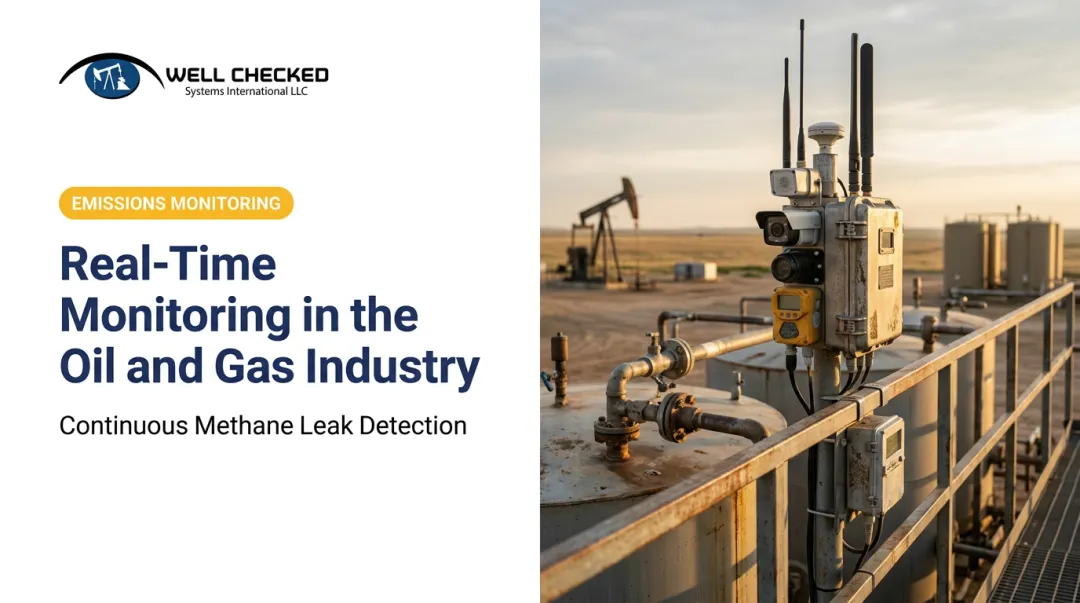
Quarterly LDAR walks give operators four inspection opportunities a year, per site. A leak that starts the day after an inspection can run undetected for up to 90 days. AI-powered multi-sensor systems (video, Long-Wave Infrared Optical Gas Imaging, and acoustic abnormal-sound detection) close that gap by monitoring continuously and distinguishing true fugitive emissions from routine process venting in real time. Well Checked has a USPTO provisional patent filing for Detecting and Quantifying Fugitive Methane and Vapor Emissions Using Infrared Imaging and Machine Learning.
EPA's OOOOb rule, finalized in March 2024, allows operators to use approved advanced methane-detection technologies for continuous monitoring in place of standard OGI/Method 21 walks under 40 CFR 60.5398b(d). The requirement for defensible, measurement-based data isn't going away.
This is exactly where Well Checked Systems' Zensory.ai™ platform operates. Its architecture separates two tasks: Zentinal Core™ detects emissions, filters normal process venting from true anomalies, and alerts only on real events. Zentinal IQ™ then quantifies those validated events with regulatory-grade accuracy for EPA and OGMP 2.0 reporting.
The platform is running across remote wellsites, including a confirmed multi-site deployment in the Appalachian Basin, processing 1,500+ videos analyzed per site per day. Compare that to four annual LDAR walks, and the coverage difference isn't subtle.
KPIs impacted:
| Metric | Traditional LDAR | Continuous AI Monitoring |
|---|---|---|
| Inspection frequency | Quarterly | Near real-time, 24/7 |
| Detection opportunities/year | ~4 | Hundreds of thousands |
| Response window | Weeks to months | Within 24 hours |
Route-based site visits alone cost mid-sized to large operators $1M–$5M+ annually. For operators facing that bill or OGMP 2.0 Level 4/5 reporting obligations, continuous monitoring has become a cost decision rather than an optional upgrade.
Advantage 3: Exploration, Drilling & Production Optimization
Manual seismic interpretation takes weeks. AI/ML models process the same geological datasets in a fraction of that time, narrowing down promising drilling locations faster and with fewer dry holes. During drilling itself, real-time AI analytics adjust parameters on the fly, reducing non-productive time.
BCG estimates that scaled AI and data-driven production optimization delivers a 5%-10% production uplift, often within weeks or months rather than years. One North Sea riser-slugging application increased production by 5%, worth an estimated $120M in annual cash flow. Separately, EY reports one major operator improved drilling times by 3.5% through AI-driven optimization.
KPIs impacted:
- Time-to-first-oil
- Cost per well
- Dry-hole rate
- Drilling downtime
This advantage compounds fastest in complex or unconventional plays, where geological uncertainty runs high and every drilling day is expensive.
Advantage 4: Safety, Workforce Efficiency & Value-Chain-Wide Gains
Highway crashes are the leading cause of oil and gas extraction worker deaths, accounting for roughly 4 in 10 fatalities, according to OSHA. Every unnecessary pumper-route trip is exposure to traffic, weather, and hazardous site conditions that AI-driven remote monitoring simply removes from the equation.
There's also a talent problem underneath all this. Deloitte projected in 2020 that nearly 50% of the oil, gas, and chemicals workforce would retire within five to seven years. AI systems that encode institutional operational knowledge into automated detection and response workflows help bridge that gap as experienced staff leave and fewer new engineers enter the field.

The benefits don't stop upstream. In refining, BCG notes AI can turn static turnaround schedules into continuously reoptimized plans balancing time, cost, and risk. In fuel retail, McKinsey describes AI applied to rack-to-retail micromarket trends improving supply decisions and margins.
KPIs impacted: incident/injury rates, vehicle miles traveled, workforce productivity, refinery and retail downtime.
What Happens When AI Adoption Is Missing or Ignored
Skipping AI adoption rarely causes sudden failures. Instead, it creates steadily rising costs and slower response times. Operators relying on manual, periodic-only monitoring end up with:
- Inconsistent inspection coverage — gaps between quarterly LDAR walks where leaks go undetected
- Higher unplanned downtime — reactive firefighting instead of planned maintenance
- Rising costs over time — route-based pumper visits scale linearly with site count, with no economies of scale
McKinsey's research on maintenance maturity found that lower-maturity predictive systems typically capture 10% or less of the benefit a fully scaled system delivers. That gap represents most of the value left on the table.
Beyond the value gap, scaling creates a separate challenge. Operators standardizing monitoring across a single basin manually can usually make it work. portfolios are a different story entirely. Standardizing manual processes across dozens of sites and multiple state regulators becomes its own operational headache.
How to Get the Most Value from AI in Oil & Gas Operations
AI delivers the most value when adopted in stages, not as a single big-bang rollout. BCG's Deploy-Reshape-Invent framework describes this progression well:
- Deploy: Put AI into the hands of field and operations teams for immediate wins
- Reshape: Redesign workflows around AI rather than bolting it onto old processes
- Invent: Build new capabilities once the foundation is proven
Progressing through these stages matters only if outcomes get reviewed and acted on, not archived. A validated AI alert is only valuable if it drives an actual repair-and-maintenance decision.
The three-tier approach behind Well Checked Systems' own platforms — Zentinal Ops™, Zentinal Core™, and Zentinal IQ™ — reflects this staging logic directly. Operators typically start with a fixed-fee pilot on a defined site count, running Zentinal Core™ for detection and false-alarm filtering.
Once that value is proven, Zentinal IQ™ activates on the same sites to add regulatory-defensible quantification, without re-deploying hardware or starting over. It's a practical way to scale toward full compliance reporting as EPA and ESG demands increase, rather than committing to a full build before proving anything works.
Conclusion
AI's real value in oil and gas lies in operational control and cost clarity, backed by data that holds up when a regulator or investor asks hard questions.
These advantages compound over time. Fewer equipment failures mean more uptime. Continuous emissions data lowers compliance exposure, and safer field operations cut incidents year over year. The Zensory.ai™ platform from Well Checked shows what this looks like in practice: these gains build from treating AI as an ongoing operating discipline, not a one-time purchase.
Frequently Asked Questions
What is the biggest benefit of AI in the oil and gas industry?
Benefits vary by segment, but continuous monitoring, predictive maintenance and emissions detection typically deliver the fastest, most measurable ROI by catching costly failures and compliance events before they escalate.
How is AI used in oil and gas exploration?
AI and machine learning models analyze seismic and geological datasets to identify promising drilling locations faster and with fewer dry holes than manual interpretation alone.
Can AI help oil and gas companies meet EPA methane regulations?
Yes. AI-based continuous monitoring generates the measurement-based data needed for EPA 40 CFR Part 60 OOOOb alternative-monitoring pathways and OGMP 2.0 reporting.
Does AI replace field workers in oil and gas operations?
No. AI reduces unnecessary routine site visits and alert fatigue, but it doesn't eliminate field staff. Teams shift toward responding to validated, high-priority events instead of running fixed routes.
Is continuous AI monitoring more accurate than traditional manual LDAR inspections?
Continuous multi-sensor AI monitoring catches emissions events between inspection cycles that periodic quarterly LDAR walks would miss entirely, since those walks only offer four detection opportunities a year.
What is the typical ROI timeline for AI adoption in oil and gas operations?
ROI varies by use case, but replacing route-based site visits with autonomous monitoring is one area where cost savings become measurable relatively quickly for mid-sized to large operators.