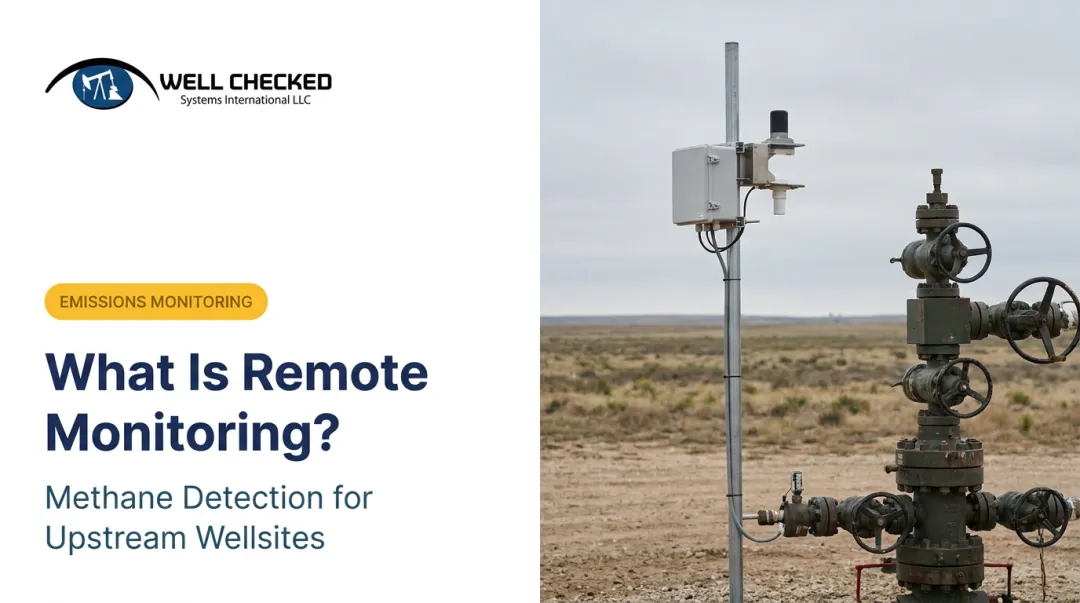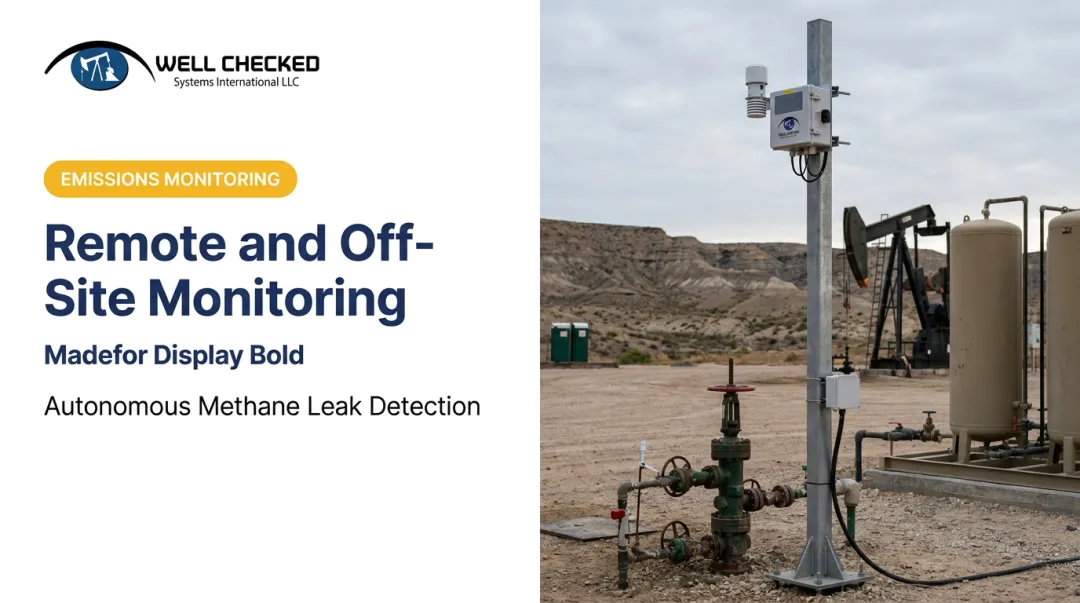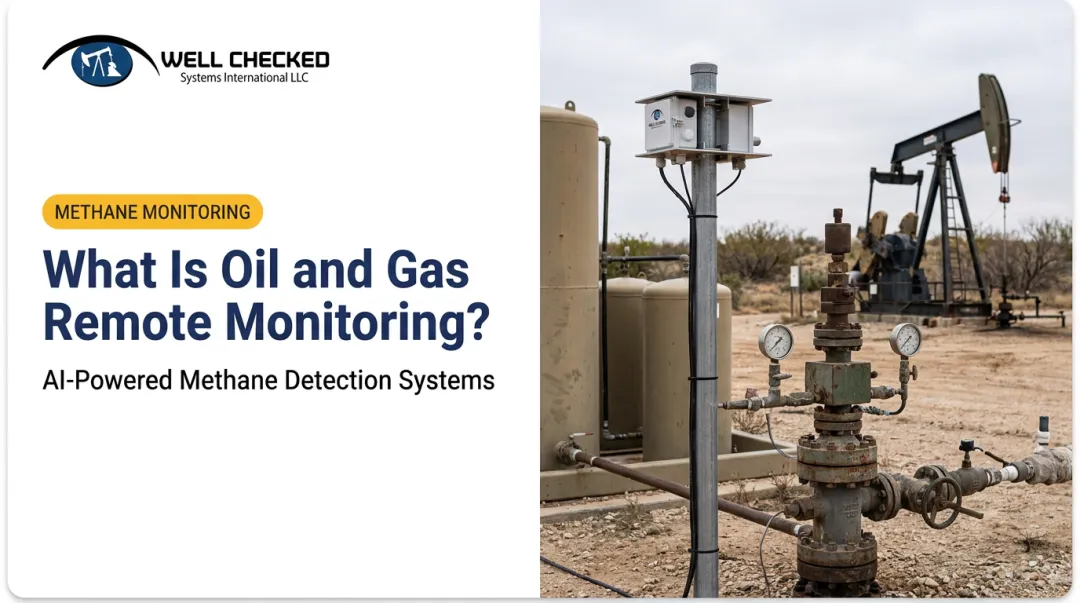

Yet plenty of businesses still send people out to check on things a sensor could catch instantly. Oil and gas operators drive pumper routes. Utilities dispatch crews to read meters. Facilities teams walk floors looking for problems that started hours earlier.
This article breaks down what remote monitoring and control (RMC) means, how it works, and how it differs from related terms like RMM and SCADA. Then we'll look at its highest-stakes modern application: continuous emissions monitoring at oil and gas wellsites.
Key Takeaways
- RMC combines sensors, telemetry, and telecommands to observe distant facilities.
- Control adds the ability to intervene, not just monitor from afar.
- Smart grids and pipelines now replace manual inspections with continuous oversight.
- AI-driven filtering cuts noise, letting teams act on true anomalies and lower risk.
What Is Remote Monitoring and Control?
Remote monitoring and control describes systems built to observe, and in some cases automatically manage, large or distributed facilities: power plants, factories, network operations centers, airports, spacecraft.
The National Institute of Standards and Technology frames this territory as operational technology (OT), defined as programmable systems that detect or cause direct change in the physical world through sensors, controllers, actuators, and operator interfaces.
Every RMC system runs on three inputs:
- Sensor and telemetry data — continuous streams reporting pressure, temperature, vibration, gas concentration, or equipment status
- User inputs — manual commands or overrides entered by a person watching a dashboard
- Pre-programmed procedures — logic defining what "normal" looks like and what to do when it isn't
On the output side, software translates that information into telecommands — instructions sent to actuators, valves, breakers, or other connected devices. This is what separates RMC from simple data logging. The system doesn't just record what happened; in some architectures, it can do something about it.
Monitoring vs. Control: Why the Distinction Matters
Monitoring and control sound like one phrase. They perform very different jobs.
Monitoring means observing and reporting. Sensors transmit values, dashboards display them, and a person decides what happens next. Nothing changes automatically.
Control adds the ability to intervene remotely by adjusting a setpoint, resetting a breaker, or shutting down a pump, without anyone physically on-site. Because a remote command can alter physical equipment, control demands stronger security safeguards than monitoring alone.
Some systems go further with closed-loop control: the system detects a deviation and corrects it automatically, without waiting on a human decision. A thermostat is a simple example. A wellsite pressure-relief valve is a higher-stakes one. Closed-loop control suits fast, well-understood problems, but it's usually the wrong fit where nuance or regulatory review needs to happen first.
RMC already runs across a wide range of sectors:
- Smart grids balancing electricity load in real time
- Positive train control preventing collisions and derailments
- Structural health monitoring on bridges, flagging stress before failure
- Pipeline SCADA systems tracking flow and pressure
- Patient monitoring devices transmitting vitals to care teams
- IT network monitoring watching servers for downtime
That breadth matters: RMC is a discipline, applied differently depending on what's being watched and what's at stake.
How Do Remote Monitoring and Control Systems Work?
Every RMC deployment, regardless of industry, follows roughly the same sequence : data moves from the physical world to a decision, and sometimes back out again as an action.
- Sense: Sensors, cameras, or edge devices sit at the source, continuously measuring pressure, temperature, gas concentration, video, or acoustic signals.
- Transmit: Data moves to a centralized platform for aggregation. Where connectivity is unreliable, edge computing processes data locally first, so monitoring never goes dark during a network outage.
- Analyze: Software or AI compares incoming data against expected baselines in real time, flagging anything outside normal range.
- Alert or act: Validated anomalies route to an operator dashboard. In closed-loop systems, software can also trigger a control command automatically.
- Respond: Teams review the alert and dispatch action only when necessary, a shift from routine checking to what's often called "management by exception."

That last step is where the value shows up. A company with 200 sites doesn't need someone driving to each one weekly if the system can say, with confidence, which sites actually need a visit today.
The "analyze" step is where AI has changed the discipline most:
- Static-threshold systems flag anything above one fixed number, regardless of context.
- Modern AI platforms build a behavioral baseline for each individual asset, then flag deviations from that specific baseline rather than a generic rule.
Well Checked Systems' Zensory.ai™ platform illustrates this. Rather than applying one fixed rule across every wellsite, it runs an AI Site Learning cycle, roughly two days, at each new location. During that cycle, it learns what normal process activity looks and sounds like before flagging anomalies. That's the difference between a system that alerts constantly and one operators actually trust.
Remote Monitoring and Control vs. RMM, SCADA, and Condition Monitoring
RMC is a broad discipline, often confused with three narrower terms.
| Term | Scope | Best fit for |
|---|---|---|
| RMM (Remote Monitoring and Management) | IT-specific: servers, endpoints, networks | Managed service providers, IT departments |
| SCADA | Industrial control for dispersed physical assets, traditionally on-premises | Pipelines, electric grids, water systems |
| Condition monitoring | Tracks asset health indicators (vibration, temperature, wear) | Feeding maintenance decisions, not full control |
| RMC | Umbrella discipline combining observation with human or automated control | Any facility needing remote oversight and intervention |
Each term breaks down differently:
- RMM narrows RMC to IT infrastructure, covering MSPs that watch client servers. It's a subset of RMC, not a synonym.
- SCADA is the traditional industrial model for centralized data acquisition across dispersed assets like pipelines. Modern RMC platforms typically integrate with SCADA via API, feeding alerts and quantification data into existing control room workflows rather than replacing it.
- Condition monitoring tracks specific health indicators, such as vibration or temperature, without necessarily including the control or intervention piece.
One more distinction worth flagging: remote access, meaning logging in and directly manipulating a system, is related but distinct from monitoring. It demands stronger authentication, since a compromised login can damage physical equipment, not just leak data.
Remote Monitoring and Control in Oil & Gas: From Pumper Routes to Autonomous Wellsite Intelligence
For decades, upstream operators have relied on physical "pumper routes": a technician driving from wellsite to wellsite, checking gauges and looking for leaks by eye. Quarterly leak detection and repair (LDAR) inspections add another layer, but they still only produce a snapshot. A leak that starts the day after an inspection can run undetected for months.
The manual model carries costs well beyond compliance risk. A peer-reviewed study of 363 U.S. oil and gas extraction workers found that nearly 30% drove more than 50,000 work miles annually, and transportation incidents account for more than half of fatal occupational injuries in the sector.
Well Checked Systems' own client data puts route-based site-visit costs at $1 million to $5 million or more annually for mid-sized to large operators. That's money spent driving to sites that, most days, have nothing wrong.
Multi-Sensor Monitoring: video, acoustic, and infrared sensing
Modern RMC platforms replace that drive with continuous, multi-sensor awareness:
- Sight: high-resolution cameras with AI object detection provide 360-degree coverage
- Sound: acoustic anomaly AI listens for abnormal equipment noise signaling mechanical stress or impending failure. Well Checked has a USPTO provisional patent filing covering its acoustic anomaly detection technology.
- Gas imaging: Optical Gas Imaging using Long-Wave Infrared (LWIR) cameras detects methane and volatile organic compound (VOC) emissions day and night, at roughly one-third the cost of traditional mid-wave IR systems. Well Checked has a USPTO provisional patent filing for Detecting and Quantifying Fugitive Methane and Vapor Emissions Using Infrared Imaging and Machine Learning.

Well Checked Systems' Zensory.ai™ platform is built around this exact model, with a three-tier architecture:
- Zentinal Ops™ delivers visual and acoustic equipment intelligence: high-resolution video, object recognition, acoustic anomaly detection, and actionable alerts
- Zentinal Core™ runs multi-sensor detection, learning each site's normal baseline in about two days, then filtering out routine activity so only genuine fugitive events trigger an alert
- Zentinal IQ™ activates only after Core validates an event, then quantifies volume, duration, and rate for regulatory-defensible reporting
That sequencing matters: IQ never processes an unvalidated signal, so compliance data reflects confirmed events only, not noise. This architecture already runs at scale across multi-sites in the Appalachian Basin, part of a broader footprint spanning the Permian, Anadarko, Bakken, Eagle Ford, and San Juan basins.
Connecting RMC to Compliance
Continuous, defensible data is increasingly a regulatory requirement, not just an operational nice-to-have. EPA's methane rule under 40 CFR Part 60 Subpart OOOOb requires fugitive-emissions monitoring plans that periodic inspections alone struggle to satisfy. The same data stream supports OGMP 2.0 Level 4/5 measurement-based reporting, SASB Oil & Gas E&P disclosures, and TCFD reporting.
Benefits and Challenges of Remote Monitoring and Control
RMC platforms deliver real operational upside, alongside tradeoffs worth planning for.
Benefits:
- Reduced downtime through earlier issue detection
- Lower labor and travel costs from fewer unnecessary site visits
- Improved safety by keeping field crews off the road
- Faster resolution, since a 24-hour window from validated alert to mitigation can support a documented, timely response on methane events
- Stronger regulatory defensibility through continuous, timestamped records instead of periodic snapshots
Challenges:
- Cybersecurity exposure, since any remote access privilege becomes a potential attack surface
- Integration difficulty across legacy equipment and newer sensor platforms
- Alert fatigue, where too many false positives train operators to ignore notifications altogether
Alert fatigue deserves its own callout because it's the challenge most likely to undermine an RMC investment. Industry alarm-management guidance recommends roughly 80% of alarms stay low priority, with only 5% rising to high priority, a target that's easy to state and hard to hit without genuine AI filtering.

The fix is baseline-driven detection: instead of alerting on any deviation, the system learns what's normal for that specific asset and flags only true anomalies. Fewer, higher-quality alerts rebuild operator trust more effectively than a larger volume ever could.
Frequently Asked Questions
What is remote monitoring and control?
Remote monitoring and control (RMC) combines sensors, telemetry, and software to observe distant equipment or facilities, and in some systems, remotely act on them. It replaces manual, on-site checks with continuous digital oversight.
How much does remote monitoring cost?
Cost varies widely by industry, number of monitored assets, and sensor complexity, so there's no universal price point. The better comparison is cost against the manual process it replaces, such as route-based site visits running into the millions annually.
Is remote monitoring covered by Medicare?
This typically refers to Remote Patient Monitoring (RPM) in healthcare, which Medicare covers under specific CPT billing codes (99453, 99454, 99457, 99458) when requirements are met. It's a distinct application from industrial or oil and gas RMC.
What is the difference between remote monitoring and remote control?
Monitoring only observes and reports data to a human operator. Control, or remote access, allows direct intervention (adjusting, resetting, or shutting down equipment) without anyone on-site.
What industries use remote monitoring and control systems?
Utilities and smart grids, transportation and rail, structural and civil engineering, healthcare, IT, and oil and gas all rely on RMC, each applying it to different assets and risk profiles.
How is remote monitoring and control used in oil and gas operations?
Multi-sensor AI platforms like Zensory.ai™ replace manual pumper routes with continuous sight, sound, and gas detection, generating regulatory-grade emissions data for EPA and ESG compliance.