
Introduction
Remote monitoring devices show up everywhere now — in hospital rooms, on factory floors, and out at power substations. But nowhere is the shift more urgent than in oil and gas field operations, where sending a person to check a wellsite is expensive, slow, and sometimes dangerous.
For decades, operators relied on pumper routes and quarterly leak detection and repair (LDAR) inspections. That means gaps of days or weeks between checks. A valve can leak methane for two weeks before anyone notices.
This guide breaks down what remote monitoring devices actually are and the main sensor types operators use today. It also covers the business and compliance benefits, plus how to choose a system that fits your field operations.
Key Takeaways
- Video, acoustic, optical gas imaging, and IoT sensors monitor sites continuously without on-site staff
- Continuous monitoring catches problems faster than periodic manual checks, cutting both safety risk and cost
- AI-enabled systems filter false alarms so teams only respond to validated anomalies
- The right system depends on site connectivity, regulatory requirements, and integration needs
- Monitoring data increasingly supports EPA and investor-grade ESG reporting
What Are Remote Monitoring Devices?
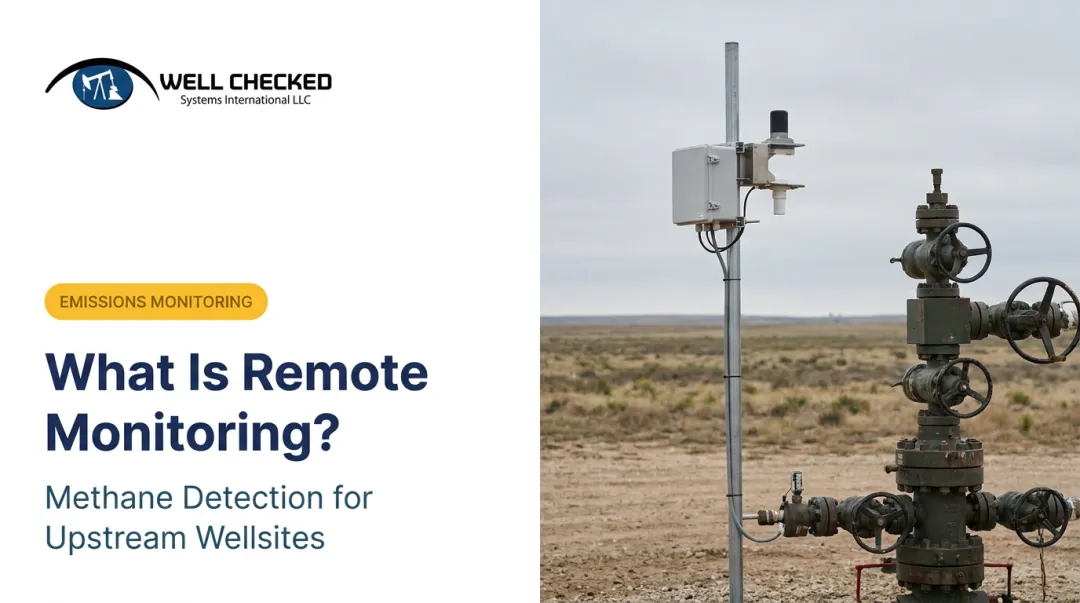
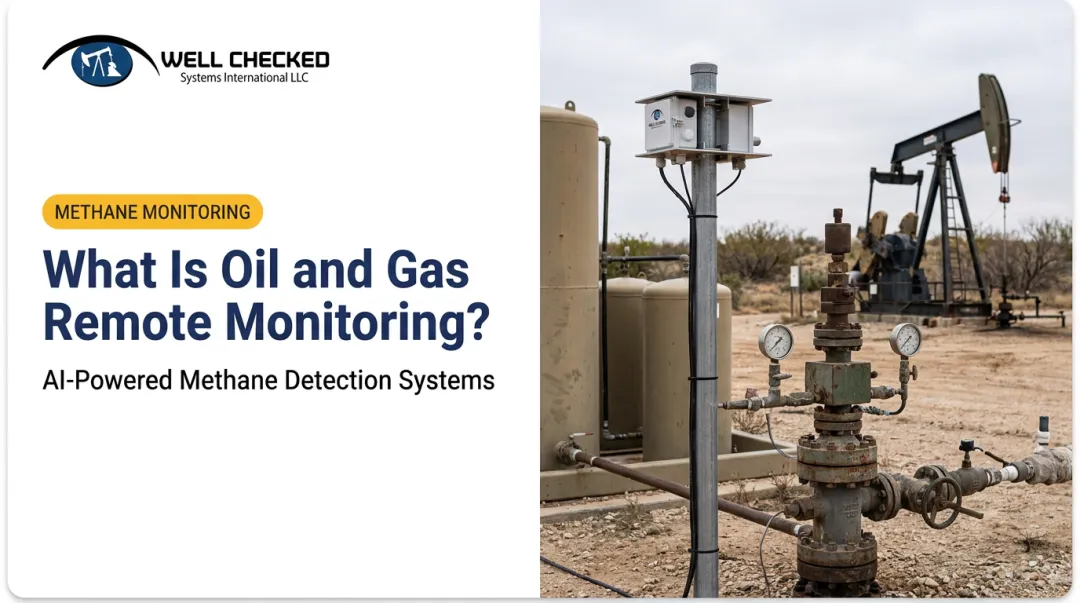
Remote monitoring devices are sensor-equipped hardware (cameras, microphones or acoustic equipment sensors, gas imaging optics, IoT sensors) that capture data at a location and send it, or process it locally, for review by a team elsewhere. The applications span far more industries than most people realize:
- Hospitals use them to track patient vitals
- Manufacturers use them to watch machinery
- Energy companies use them to keep an eye on equipment miles from the nearest office
The technology has moved fast. Older remote monitoring setups were simple: a camera that recorded footage for someone to review later, or a sensor that logged readings for a monthly download.
Today's systems are continuous and autonomous. AI flags anomalies as they happen rather than waiting for a human to scroll through hours of footage.
Why Edge Computing Matters at Remote Sites
One detail separates systems that work at remote wellsites from systems that don't: onsite edge computing. Many rural and semi-rural well pads have spotty cellular coverage at best. A system that depends entirely on constant cloud connectivity will fail exactly when it's needed most.
Edge computing processes sensor data directly at the site, then syncs to the cloud whenever a connection is available. Nothing gets lost during an outage; it just queues up until the link comes back.
Applied to oil and gas operations, remote monitoring devices become wellsite-specific platforms built to watch continuously for:
- Fugitive emissions and gas leaks
- Equipment malfunctions signaling mechanical failure
- Safety hazards that put field crews at risk
This kind of continuous coverage supplements or replaces the routine physical inspections that used to be the only option.
Types of Remote Monitoring Devices Used in Field Operations
No single sensor catches every risk. A camera won't hear a compressor bearing starting to fail. An acoustic sensor won't see a methane plume. That's why modern platforms increasingly combine several sensing modalities into one system rather than asking operators to stitch together point solutions from different vendors.
Video & AI Object Detection Cameras
High-resolution cameras paired with AI object detection can spot equipment status changes, unauthorized site access, spills, or fires in real time. A 2024 SPE Journal study on wellsite video monitoring during workover operations found its scale-adaptive detection network improved mean average precision by 9.22% over YOLOv8. That's a meaningful jump in a field where missed detections mean missed hazards.
Optical Gas Imaging (OGI) and Long-Wave Infrared Cameras
OGI and LWIR cameras make invisible methane and volatile organic compound (VOC) plumes visible, day or night. According to EPA's Appendix K guidance, these cameras work by limiting received infrared radiation to a spectral band where the target gas absorbs radiation. The absorption difference against the background then shows up as a visible plume.
Detection isn't guaranteed under every condition. Wind speed, viewing distance, and the temperature difference between gas and background all affect what the camera can see. Uncooled LWIR technology also tends to cost meaningfully less than cooled mid-wave IR alternatives, though it trades off some sensitivity. That trade-off matters when choosing between camera types for a given site. Well Checked has a USPTO provisional patent filing for Detecting and Quantifying Fugitive Methane and Vapor Emissions Using Infrared Imaging and Machine Learning.
Acoustic Sensors
Cameras can't hear a valve leak or a compressor starting to strain. Acoustic anomaly AI fills that gap by learning what a site's equipment normally sounds like, then flagging deviations: a low hiss that shouldn't be there, a grinding noise from a pump. This sensing complements visual and gas-imaging data rather than replacing it. Well Checked has a USPTO provisional patent filing covering its acoustic anomaly detection technology.

Edge Computing and Onsite Processing Units
Edge units process sensor data directly at the wellsite rather than shipping raw feeds to the cloud for analysis. At production scale, this is a serious data-handling job: Well Checked's Zensory.ai™ platform, for example, analyzes 1,500+ videos per site, per day, entirely at the edge. That volume simply isn't practical to stream continuously over a rural cellular connection. Local processing is the only reliable option at that scale.
Integrated Multi-Sensor AI Platforms
Combining sight, sound, and gas-sensing into one platform removes the headache of managing separate vendor tools that don't talk to each other. Well Checked's Zensory.ai™ platform uses a three-tier structure to do this:
- Zentinal Ops™: the visual and acoustic equipment intelligence layer — high-resolution video, object recognition, acoustic anomaly detection, and actionable alerts
- Zentinal Core™: the multi-sensor detection layer, filtering out false alarms and flagging only true fugitive anomalies
- Zentinal IQ™: the quantification layer, activating only after Core validates an event to produce regulatory-grade emissions data
This separation matters. Quantifying every raw sensor blip would flood a compliance report with noise. Quantifying only validated events keeps the data clean enough to defend in an audit.
Key Benefits of Remote Monitoring Devices for Operators
Cost Reduction
Route-based site visits are not cheap. A well-documented historical case is instructive here: in 1992, a major upstream operator in South Texas automated production monitoring across 271 gas wells, 32 oil wells, and 150 liquid stock tanks in South Texas. The result was $1.1M in first-year operating savings and 31% fewer vehicle miles on a $1.7M installed cost.
That's one operator's case, not a universal benchmark, but the direction hasn't changed. Mid-sized to large operators today often spend $1M to $5M+ annually on route-based site visits, a figure that should be weighed directly against the cost of a monitoring deployment.
Improved Safety
Fewer trips to remote sites means less time exposed to the road, which happens to be one of the industry's leading hazards. OSHA reports that highway vehicle crashes cause roughly 4 in every 10 fatalities among oil and gas extraction workers, the single largest cause of death in the sector. A separate NIOSH study tracked 202 motor-vehicle deaths among these workers between 2003 and 2009. Cutting unnecessary routine driving targets a documented, persistent risk.
Faster Incident Response
An acknowledge-dispatch-mitigate workflow lets teams respond to a validated anomaly fast:
- Acknowledge: near-real-time alerts hit the dashboard, email, SMS, and SCADA simultaneously
- Dispatch: pre-built runbooks tell the field crew exactly where to go and what to do
- Mitigate: the crew resolves the issue, typically within a 24-hour window
That 24-hour benchmark isn't arbitrary. Rapid response to a validated methane event can support a documented, timely response tied to that event.

Regulatory-Grade Continuous Records
A quarterly LDAR inspection tells you what a site looked like on one specific day. It can't tell you when a leak actually started or how much gas escaped before someone noticed. Continuous monitoring builds an unbroken record (event onset, duration, volume, rate) that holds up far better in an agency audit than a stack of periodic snapshots.
Lower Fuel and Mileage Costs
Fewer truck miles means fewer emissions from the vehicles themselves. EPA's 2025 emission factors put light-duty trucks at 0.394 kg CO2 per vehicle-mile and medium/heavy-duty trucks at 1.298 kg CO2 per vehicle-mile. Applied to actual avoided mileage across a large route program, that adds up, supporting broader ESG goals beyond the wellsite methane numbers.
How to Choose the Right Remote Monitoring Device or System
Picking a system isn't just about sensor specs. A few practical filters matter more:
- False-alarm filtering: Look for AI that separates routine noise, like a vent cycle or passing vehicle, from true anomalies. Without it, crews start ignoring alerts, defeating the system's purpose.
- Connectivity requirements: Confirm the device processes data onsite via edge computing rather than relying solely on cloud or cellular access, which patchy wellsite signal can easily disrupt.
- Data output compatibility: Check that the platform formats data for your compliance needs (EPA logs, OGMP 2.0, SASB, TCFD) and integrates with your SCADA systems. Without usable exports, it's just an expensive camera.
These three filters separate a genuinely autonomous system, like Well Checked's Zensory.ai™ platform, from one that simply collects data.
Remote Monitoring Devices and Regulatory Compliance
Continuous monitoring data increasingly feeds into formal compliance and disclosure pathways, but not every use case counts as compliance on its own.
- EPA Methane Rule (40 CFR Part 60 Subpart OOOOb): OOOOb covers sources built, modified, or reconstructed after December 6, 2022. Continuous monitoring qualifies as an optional alternative-monitoring pathway, but only when paired with the required data-availability, investigation, and recordkeeping steps.
- OGMP 2.0 Level 4/5: These are the highest reporting tiers in the Oil & Gas Methane Partnership framework, requiring measured emissions data rather than generic emission factors. Sensor-based continuous measurement fits this requirement directly.
- SASB and TCFD ESG disclosures: Publicly traded operators reporting under SASB Oil & Gas E&P metrics (like EM-EP-110a.1) or TCFD's Metrics and Targets pillar need structured, defensible emissions data. Continuous monitoring supplies that data more consistently than periodic snapshots.

Well Checked's three-tier architecture closes this gap directly. Zentinal Ops™ delivers visual and acoustic equipment intelligence, Zentinal Core™ handles detection and false-alarm filtering, while Zentinal IQ™ only fires quantification after Core validates a real event.
The result: EPA-format logs, OGMP 2.0 Level 4/5 formatted reports, and SASB/TCFD source data, all exportable as CSV, JSON, or through a SCADA API. That separation between detection and quantification is what keeps the compliance data clean enough to defend under agency review.
Frequently Asked Questions
What is remote monitoring equipment?
Remote monitoring equipment is sensor-based hardware, such as cameras, acoustic equipment sensors, gas imaging optics, and IoT devices, that captures and transmits field data without requiring a person on-site. It's used across industrial and energy settings, most notably for continuous oil and gas wellsite monitoring.
How much does remote monitoring cost?
Cost varies by sensor type, site count, and data requirements, and pricing models range from purchase to lease to subscription. Compare any quote against what you currently spend on the manual inspection routes it would replace.
Is remote monitoring worth it?
For mid-sized to large operators, reduced site-visit costs, faster incident response, improved safety, and stronger regulatory defensibility typically outweigh the investment. The ROI case gets stronger the larger your site portfolio.
What is the difference between remote monitoring devices and traditional site inspections like LDAR?
Remote monitoring runs continuously, building an unbroken data trail. LDAR inspections capture a single point in time, usually quarterly, leaving gaps where leaks can go undetected for weeks.
Do remote monitoring devices need internet or cellular connectivity to function?
Many advanced systems use onsite edge computing to process data locally, so they keep working even with limited or no connectivity. Data syncs to the cloud automatically once a connection becomes available.
How quickly can remote monitoring devices detect an issue like a methane leak?
AI-enabled continuous monitoring can flag a validated anomaly within hours, compared to the days or weeks typical of periodic manual inspection cycles. That speed enables a same-day or next-day response instead of waiting until the next scheduled visit.