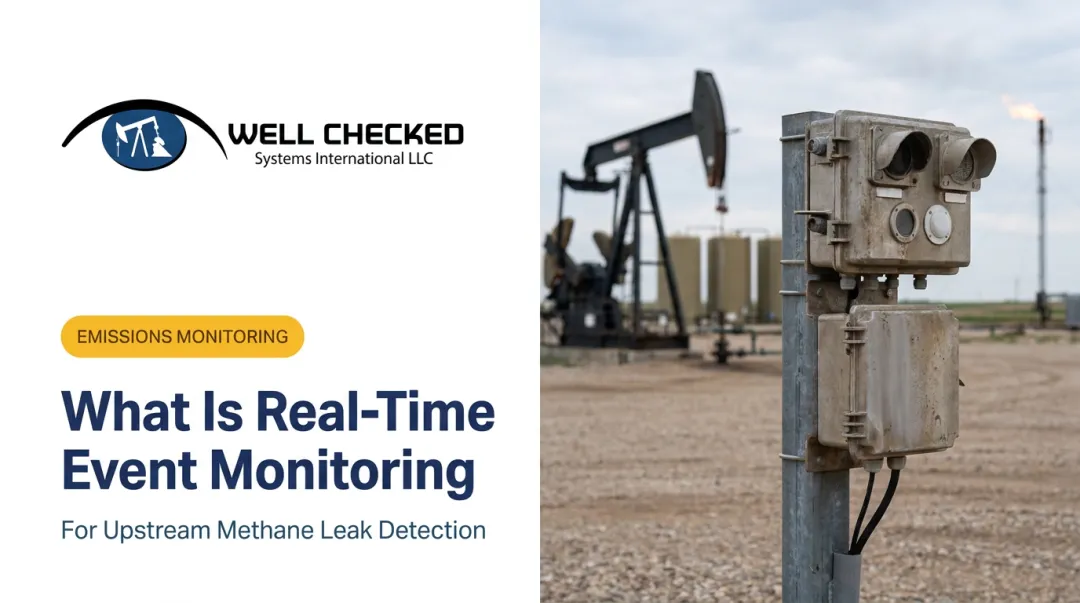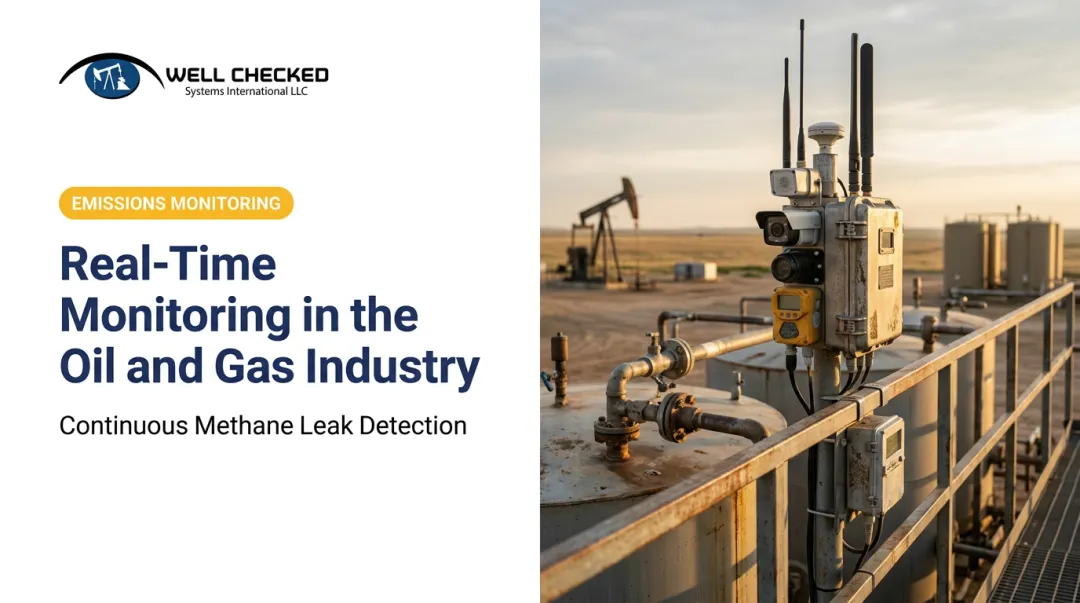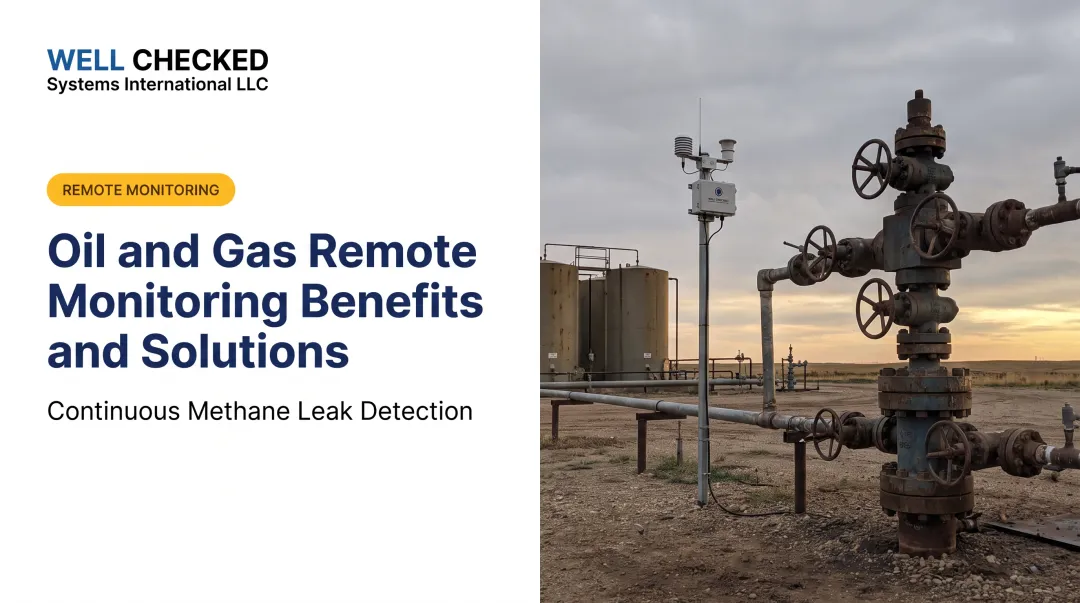

The problem: routine visits are slow to catch what actually matters. A leak that starts Tuesday and stops Thursday never shows up on a Friday inspection. As portfolios grow to hundreds of sites, this model doesn't scale — you either add headcount and trucks, or accept blind spots.
Real-time monitoring changes the equation. Instead of checking everything on a schedule, operators can shift to operating by exception — acting only when something abnormal actually happens.
Key Takeaways
- Operating by exception means directing human attention only to validated anomalies, not routine checks
- Multi-sensor real-time monitoring (visual, acoustic, gas) is the technology that makes this shift possible
- Operating by exception reduces cost, cuts safety exposure, and strengthens regulatory recordkeeping
- Filtering false alarms, not just collecting more data, is what makes alerts actionable
What Does "Operating by Exception" Mean in Oil & Gas?
Management by exception is a simple control principle: staff attention goes to deviations from normal, not to re-checking conditions that are already steady. A 1987 study describes it as one of the oldest, most widely used business-control methods.
Standing procedure handles routine conditions. Only meaningful variances escalate to decision-makers.
Applied to wellsites, this means moving away from scheduled operator routes and toward continuous automated surveillance, with a human stepping in only when the system flags something.
Route-based vs. exception-based, side by side:
| Traditional Route-Based | Exception-Based |
|---|---|
| Fixed schedule (weekly, monthly, quarterly) | Continuous, 24/7 coverage |
| Snapshot visibility at time of visit | Real-time visibility at all times |
| Human drives, looks, records | Machine observes; human responds only to flags |
| Misses anything between visits | Catches intermittent events as they happen |

Manufacturing and process industries adopted exception-based monitoring decades ago. Oil and gas is catching up now, largely because IIoT sensors and edge AI have finally made continuous site-level observation affordable.
Why Traditional Route-Based Monitoring Falls Short
Periodic inspections capture a single moment in time. If a leak is intermittent (starts, stops, starts again), the odds of catching it during a scheduled visit are low. A 2025 peer-reviewed study modeling intermittent emissions found the median probability of detecting one within a year was:
- 23% with monthly surveys
- 9% with quarterly surveys
- 4% with semiannual surveys
- 2% with annual surveys The same study reported a median annual emitted quantity of 160 kg per equipment cluster for these missed events. Continuous monitoring is likely to catch intermittent leaks within days rather than months (ACS ES&T Air, 2025). There's also a safety cost to routine driving. OSHA identifies highway vehicle crashes as the leading cause of fatalities in oil and gas extraction: roughly 4 in 10 worker deaths on the job happen in vehicle incidents. CDC/NIOSH data covering 2014–2019 found vehicle incidents accounted for 26.8% of the 470 recorded upstream fatalities, the single largest category (CDC/NIOSH, 2023). Every mile driven on a route where nothing is wrong carries real risk with zero operational upside.

How Real-Time Monitoring Makes Exception-Based Operations Possible
Exception-based operations require replacing periodic human observation with continuous machine observation across sight, sound, and gas detection.
Learning What "Normal" Looks Like
Before an AI system can flag an anomaly, it must learn what routine operation sounds and looks like at that specific site. Compressor hum, routine venting, and standard visual patterns all vary from site to site.
Well Checked Systems' Zensory.ai™ platform runs a roughly 2-day AI Site Learning cycle per site to establish this baseline before autonomous alerting goes live.
The False-Alarm Problem
Continuous monitoring without discernment just creates noise. A 2016 study of natural gas processing plants found that alarm management delivered clear gains (ScienceDirect, 2016):
- Alarm activation dropped by 74% after alarm management was applied
- "Chattering" nuisance alarms accounted for up to 70% of occurrences
Without filtering, more sensors only mean more fatigue, which is the opposite of the goal.
The Acknowledge-Dispatch-Mitigate Workflow
- A sensor stream flags a deviation from the learned baseline
- Cross-sensor data confirms whether the flag is a true anomaly
- Field response is dispatched only after the flag is validated as real
Zensory.ai™ runs this workflow across a three-tier architecture:
- Zentinal Ops™ delivers visual and acoustic site intelligence
- Zentinal Core™ detects emissions across video, LWIR optical gas imaging, and acoustic sensors, then alerts only on true fugitive anomalies
- Zentinal IQ™ quantifies validated events for regulatory-defensible reporting

Independent benchmarking shows why that discernment layer matters. A 2024 Stanford single-blind controlled-release study of continuous methane monitors found all tested systems kept false-positive rates under 10%, yet reliability when reporting "no event" ranged from 29.4% to 96.2% across systems (Stanford EAO, 2024).
Not all continuous monitoring is equally trustworthy. The filtering layer is what separates useful alerts from noise.
Business and Operational Benefits of Working By Exception
Replacing route-based visits with autonomous monitoring changes the cost structure of field operations. Route-based programs for mid-sized to large operators commonly run $1M–$5M+ annually, driven by labor, vehicles, mileage, and lodging across a large site portfolio.
Key benefits of the shift:
- Cuts routine driving costs by replacing most site runs with continuous digital coverage
- Enables a 24-hour acknowledge-dispatch-mitigate cycle designed to minimize or eliminate EPA fines on validated methane events
- Reduces safety exposure by limiting unnecessary trips in traffic, weather, and hazardous site conditions
- Improves repair-and-maintenance decisions with continuous records of leak duration and volume, not a single-day snapshot
That last point matters more than it sounds. A quarterly LDAR check tells you a leak exists on the day of inspection. It says nothing about how long it's been running or how much gas has already been lost. Continuous records fill that gap, giving operators the data to prioritize repairs by actual volume impact rather than guesswork.
Regulatory Defensibility in an Exception-Based Model
Continuous, validated monitoring data is a compliance asset operators can take to regulators, not only an operational convenience.
- EPA OOOOb alternative monitoring: Under 40 CFR 60.5398b, operators may use an approved continuous-monitoring system in place of periodic screening (eCFR). The system must:
- Determine a valid methane emissions rate at least once per 12-hour block
- Detect at least 0.40 kg/hour
- Transmit data at least every 24 hours
- OGMP 2.0 Level 4/5: Structured measurement-based data supports the site-level reconciliation required for Gold Standard reporting timelines.
- SASB and TCFD: Continuous emissions data supports SASB Oil & Gas E&P metrics and TCFD Scope 1 disclosure requirements.
The distinction regulators care about is quantification only after validated detection, not raw sensor output. Zentinal IQ™ quantifies only events Zentinal Core™ has already confirmed as real.
That workflow produces EPA-format compliance logs, state-agency inventory formats, and CSV/JSON exports built for submission — so the record stands on validated, quantified events rather than raw sensor noise.

Getting Started: Moving Your Operation to Exception-Based Monitoring
Operators don't need to adopt full quantification on day one. Most operators phase in continuous monitoring like this:
- Start with detection-only monitoring to establish continuous visibility and reduce route dependency
- Layer in regulatory-grade quantification as OOOOb exposure or ESG reporting obligations grow
- Scale across the portfolio once the model proves out on a subset of sites
Well Checked has run this model as a continuous monitoring deployment in the Appalachian Basin at production scale.
If your operation is spending $1M–$5M+ annually on route-based site visits, carries OOOOb exposure, or faces ESG reporting obligations, a multi-sensor autonomous monitoring pilot is worth evaluating before the next budget cycle.
Frequently Asked Questions
What does "operate by exception" (management by exception) mean in oil and gas?
It means directing human attention only to validated deviations from normal site conditions, rather than routinely re-checking everything. Continuous automated monitoring makes this possible by handling routine surveillance without human involvement.
What are the advantages of operating by exception in oil and gas?
Operators gain lower field-visit costs and faster incident response through 24-hour acknowledge-dispatch-mitigate workflows. They also cut driving-related safety risk and build continuous records that support stronger regulatory reporting.
What is a working interest in an oil and gas lease?
A working interest is an ownership share in a lease that bears a proportional share of drilling and operating costs in exchange for a share of production revenue. It differs from a royalty interest, which receives revenue without bearing operating costs.
What is a non-operating working interest in oil and gas?
This is a working interest where the owner shares proportionally in costs and revenue but doesn't conduct day-to-day operations. The operating partner manages field activity on behalf of all working interest holders.
How does real-time monitoring reduce false alarms compared to traditional sensors?
AI systems first learn a site's normal operating baseline (typical equipment sounds, expected visual patterns, routine venting) over a set learning period. Cross-referencing multiple sensor types then filters out signals that don't match true anomaly patterns.
Is continuous monitoring accepted for EPA compliance reporting?
Yes, when structured correctly. Under 40 CFR 60.5398b, approved continuous-monitoring systems can support alternative-monitoring compliance submissions in place of periodic screening, provided they meet specific data-frequency and detection-threshold requirements.