
Natural gas systems alone supplied 24.6% of US anthropogenic methane in 2022, according to EPA's 2024 GHG Inventory. Quarterly LDAR surveys and scheduled site visits were never built to catch leaks between checks — and that gap is exactly what regulators are now targeting.
This guide breaks down the monitoring technologies available, what EPA's OOOOb rule and OGMP 2.0 actually require, and why continuous, AI-enabled monitoring is becoming the practical answer for upstream operators managing hundreds of remote sites.
Key Takeaways
- Methane is the principal component of natural gas, so leak reduction recovers saleable product and cuts reportable emissions
- EPA Subpart OOOOb is shifting operators from periodic LDAR toward continuous monitoring
- Multi-sensor systems (visual, acoustic, OGI) cut false alarms and yield regulatory-defensible data
- Match your monitoring mix to site count, budget, and target frameworks (OGMP 2.0, SASB, TCFD)
Why Methane Management Is a Priority for US Oil & Gas Operators
Methane is the principal component of natural gas, so every fugitive release is product that was produced but never sold, and it is the gas EPA Subpart OOOOb and OGMP 2.0 target for detection and reporting. That combination is why methane leak reduction is one of the most cost-effective operational levers available today.
For upstream operators, emissions come from three main sources:
- Fugitive leaks — unintended releases from valves, connectors, and equipment seals
- Venting — intentional releases from pneumatic controllers, tanks, and other equipment
- Flaring — combustion of associated gas that isn't captured for sale
Petroleum production accounted for 97% of petroleum-system methane in 2022 (EPA), with pneumatic controllers, tanks, and equipment leaks doing most of the damage.
Every molecule of vented or leaked methane is gas that never made it to the sales meter. Unmitigated methane loss is lost revenue as well as an environmental liability. That financial stake turns emissions monitoring into an operational decision, not only a compliance one.
Regulatory Drivers Reshaping Emissions Monitoring Strategy
EPA Methane Rule (40 CFR Part 60 Subpart OOOOb)
EPA's final methane rule, published in March 2024, sets the compliance floor for new, modified, and reconstructed sources. Standard monitoring requirements vary by site type:
| Site Category | Standard Monitoring | Repair Timeline |
|---|---|---|
| Single-wellhead sites | Quarterly AVO inspections | 15 days + 15 days |
| Multi-wellhead sites | Quarterly AVO + semiannual OGI | 30 + 30 days |
| Compressor stations | Monthly AVO + quarterly OGI | 30 + 30 days |

The rule also opens an alternative-monitoring pathway under 40 CFR 60.5398b for continuous systems. To qualify, systems must:
- Detect at least 0.40 kg CH4/h
- Run device health checks twice per six-hour block
- Transmit valid data at least once every 24 hours
That 24-hour figure is specific to continuous-monitor data transmission, not a mandated response deadline. Still, operators using continuous systems build response workflows (acknowledge, dispatch, and mitigate confirmed events) around that same window because it minimizes exposure under the Super-Emitter Response Program.
Super-emitters are events at or near a facility quantified at 100 kg CH4/h or more. Once EPA issues notice, operators must initiate investigation within 5 days and report within 15. Missing those windows carries real financial risk: Clean Air Act penalties for covered violations can reach $472,901 per violation as of January 2025 (EPA).
OGMP 2.0, SASB, and TCFD Reporting Frameworks
Beyond mandatory US rules, voluntary and investor-driven frameworks are raising the bar for measurement quality:
- OGMP 2.0 Level 4/5 requires source-specific, measurement-based emissions data — reconciling bottom-up estimates with actual site-level measurement. This is quickly becoming the credibility benchmark for corporate methane disclosure.
- SASB Oil & Gas E&P and TCFD frameworks push publicly traded E&Ps toward disclosing gross Scope 1 emissions, methane as a percentage of that total, and how much falls under emissions-limiting regulation.
Neither framework replaces EPA compliance. But both reward the same thing EPA increasingly demands: measured data over estimated data.
Core Emissions Monitoring Technologies for Methane Management
No single technology covers every need. Here's how the main options stack up.
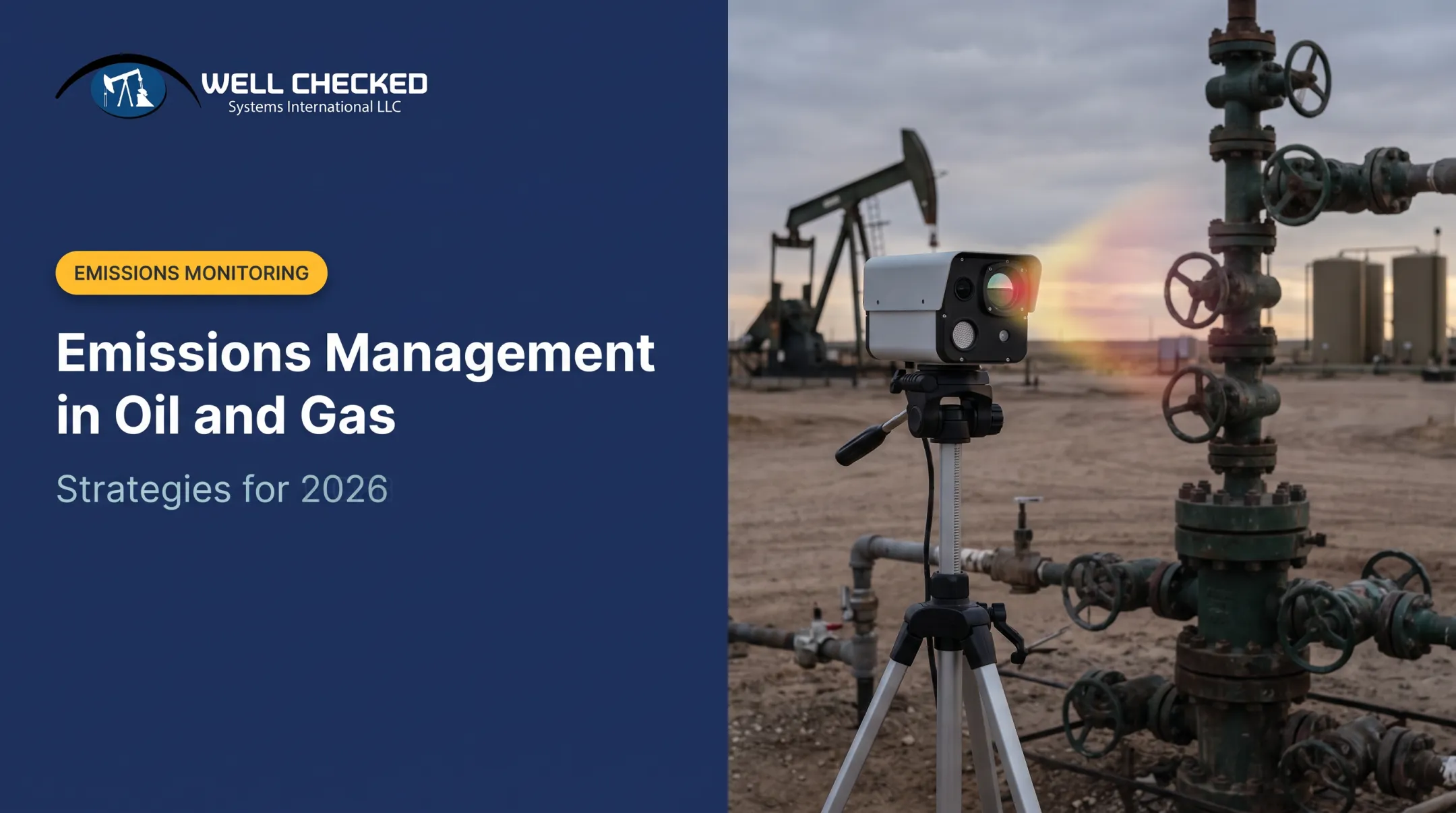
Optical Gas Imaging (OGI) uses infrared cameras to visualize methane plumes invisible to the naked eye. Long-Wave IR (LWIR) cameras enable day/night detection at roughly one-third the cost of traditional mid-wave IR (MWIR) solutions, as seen in Well Checked's own deployments.
Acoustic sensing picks up what cameras can't. Pressurized gas releases and failing equipment produce distinct sound signatures. A compressor developing a mechanical fault sounds different well before it becomes a visible leak. Acoustic AI trained on these signatures catches malfunctions that optical methods miss.
Aerial and satellite monitoring are useful for basin-wide screening and catching large point-source "super-emitters." Commercial satellite systems can detect down to roughly 100 kg/h (2025 review), but revisit frequency and weather dependence limit their use for site-level compliance. They tell you something happened at a facility last week, not what's happening right now.
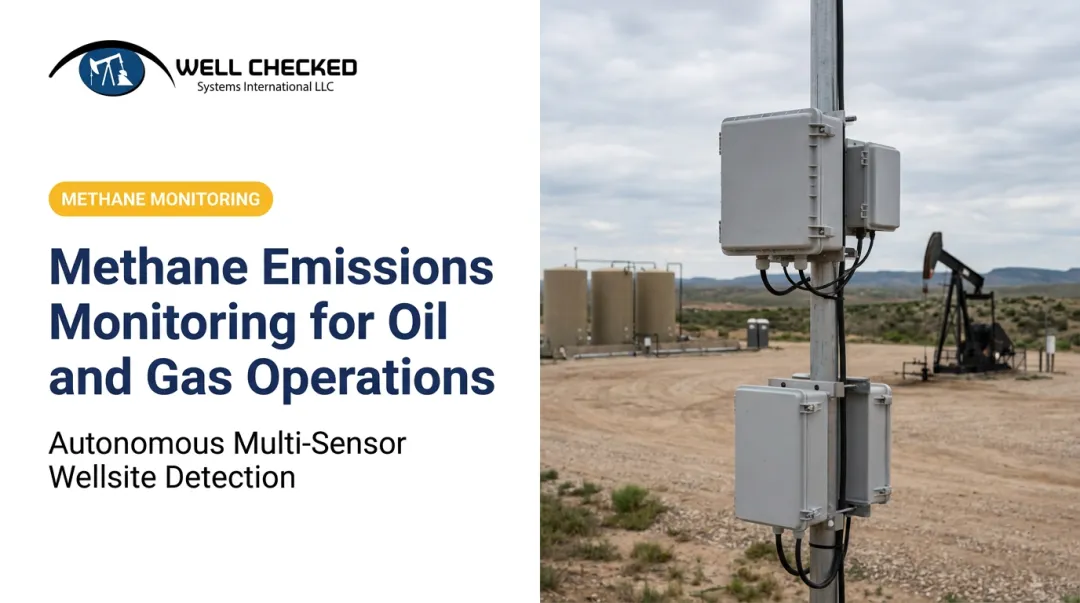
Continuous ground-based sensor networks solve the "snapshot" problem inherent to scheduled flyovers and quarterly LDAR. Instead of catching a leak on its next scheduled inspection, always-on sensors flag it as it starts.
A 2021 study found measured production-segment methane at 6.6 Tg/year versus the EPA inventory's 3.6 Tg/year — nearly double. The gap concentrated in tank leaks and equipment leaks that periodic bottom-up estimates routinely undercount (Rutherford et al., 2021). Continuous, measured monitoring closes that gap. Estimates don't.

From Detection to Defensible Data: The Case for Autonomous Multi-Sensor Monitoring
Traditional single-sensor systems have a trust problem. High false-positive rates mean field teams eventually start ignoring alerts, a phenomenon known as alarm fatigue. If every alert turns out to be a routine flare event or normal tank breathing, teams stop responding fast to the ones that matter.
Combining sensor types fixes this. When sight, sound, and gas detection feed into the same AI system, it can distinguish normal process activity from a genuine fugitive event with far more confidence than any single sensor working alone.
This is the architecture behind Well Checked Systems' Zensory.ai™ platform, built around three tiers:
- Zentinal Ops™: visual and acoustic intelligence layer, delivering 360° high-resolution video with object detection plus acoustic anomaly detection
- Zentinal Core™: fuses video, LWIR/OGI, and acoustic data to detect emissions, filter false alarms, and alert only on validated fugitive anomalies
- Zentinal IQ™: quantifies confirmed events using LWIR OGI-based volumetric estimation, producing regulatory-defensible logs for EPA, OGMP 2.0, SASB, and TCFD reporting

The platform runs an AI Site Learning cycle of roughly two days per site, establishing a normal operating baseline before it starts filtering alerts. That baseline is what lets Core distinguish routine process emissions from the "needle in a stack of needles": a true leak.
At production scale, the system analyzes 1,500+ videos per site per day across remote sites.
This "operate by exception" model changes field economics. Teams stop running fixed pumper routes to every site and dispatch only when something is actually wrong:
- Cuts unnecessary vehicle miles and related emissions
- Reduces exposure to traffic, weather, and hazardous site conditions
- Reclaims route-based labor spend that mid-sized to large operators often carry at $1 million to $5 million or more annually

Detection is only half the story. Zentinal IQ™ activates only after Core validates an event, then quantifies volume, duration, and rate. That turns a leak alert into a maintenance decision: whether a fix pays for itself in a week or a year.
Building a Methane Management Strategy: Practical Steps for Operators
Build your methane monitoring strategy around the reporting obligation you need to meet. Sensor choice comes after you know what data quality, frequency, and defensibility that obligation requires.
Define your monitoring goals first. Map the work to EPA Subpart OOOOb compliance, OGMP 2.0 Level 4/5, or investor-facing SASB/TCFD disclosures. Each path sets different bars for data quality, frequency, and audit defensibility—and your monitoring stack should match that bar.
Take a tiered approach. Start with detection-only monitoring to establish site visibility and cut false alarms. Add quantification as compliance and reporting demands rise. Most operators do not need full volumetric reporting on day one.
Prioritize continuous data over periodic snapshots. When an auditor or investor asks how you know your numbers are accurate, "we checked quarterly" is weaker than "we have continuous records." Measurement-backed data stands up to scrutiny; estimated or interpolated figures draw follow-up questions.
Frequently Asked Questions
What is the purpose of CEMS?
Continuous Emissions Monitoring Systems provide real-time, ongoing measurement of pollutants like methane, rather than periodic testing. They support both compliance verification and day-to-day operational awareness of emission levels.
What is the difference between LDAR and continuous monitoring?
LDAR relies on scheduled inspections at set intervals, such as quarterly OGI surveys. Continuous monitoring provides 24/7 coverage, catching leaks that start and stop between inspection windows.
How often should oil and gas sites be monitored for methane leaks?
Regulatory minimums vary by site type under OOOOb, ranging from monthly to quarterly depending on equipment. Continuous or near-continuous monitoring is gaining preference because it catches short-duration, high-volume leaks that periodic checks miss entirely.
What technologies are used to detect methane emissions?
Common methods include OGI cameras, acoustic sensors, aerial and satellite platforms, and continuous ground-based sensor networks. Operators increasingly combine several of these for better accuracy and fewer blind spots.
How does OGMP 2.0 differ from EPA regulations?
OGMP 2.0 is a voluntary international framework focused on measurement-based reporting, while EPA rules like OOOOb are mandatory US regulations. Both frameworks increasingly reward operators who use measured, rather than estimated, emissions data.
What is a super-emitter and why does it matter for compliance?
A super-emitter is a large point-source leak, defined as 100 kg CH4/h or more, responsible for a disproportionate share of total emissions. EPA's Super-Emitter Response Program specifically targets these events with strict investigation and reporting deadlines.