
Unscheduled oilfield downtime runs about $260,000 per hour, according to Hart Energy. Add to that a harder truth from OSHA: highway vehicle crashes are the leading cause of death in oil and gas extraction, with roughly 4 in 10 worker fatalities tied to driving between sites.
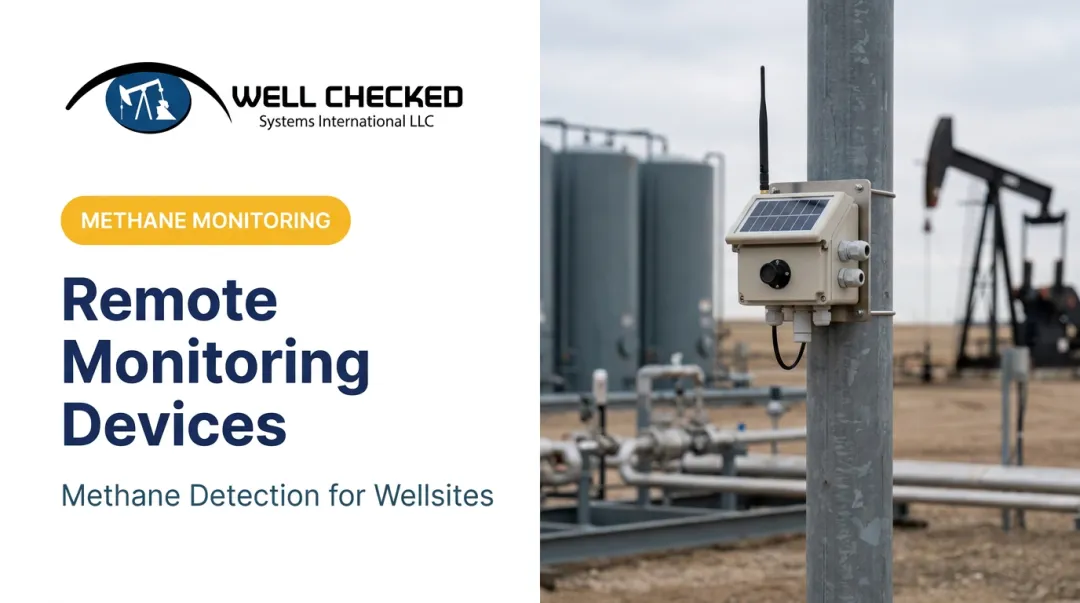
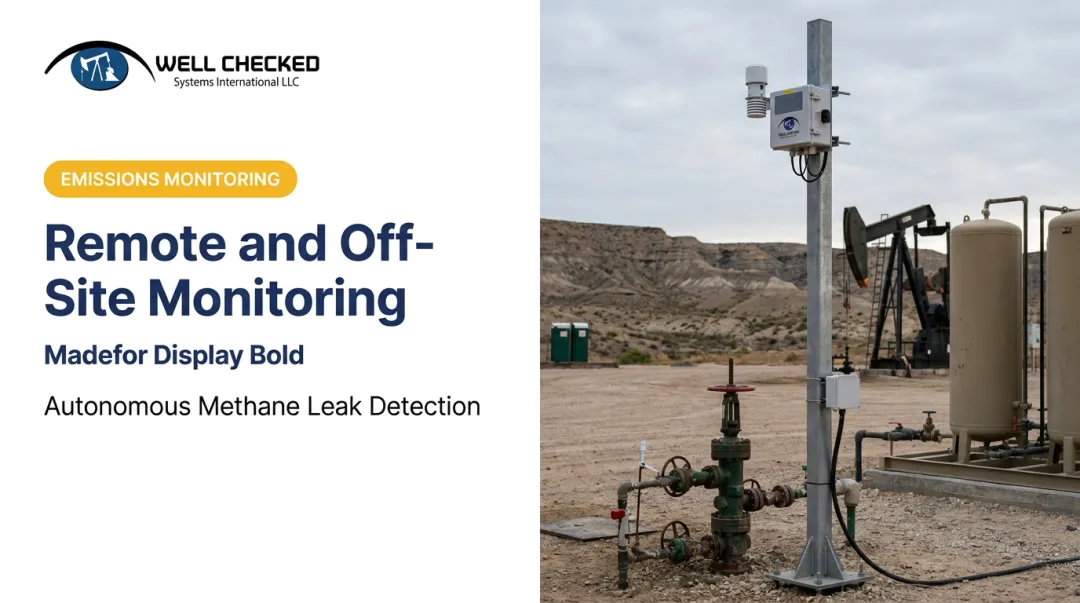
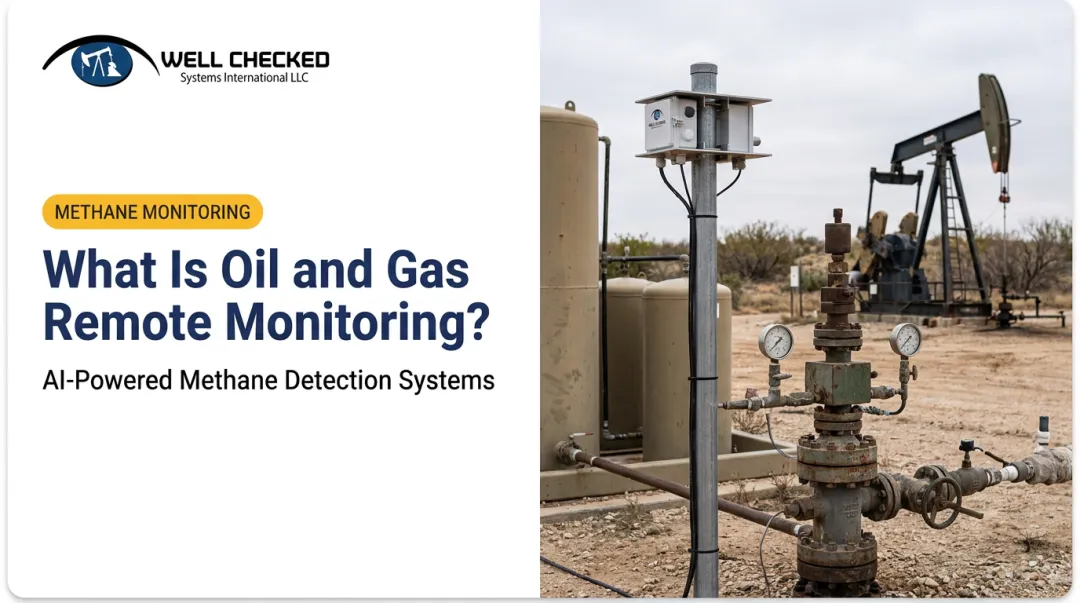
Remote asset monitoring changes the model. Sensors, edge AI, and cloud dashboards give operators continuous visibility into equipment health and emissions, without a truck making the trip. This article breaks down how it works, what it delivers, how to evaluate a platform, and how AI-driven systems like those from Well Checked Systems are reshaping oilfield monitoring.
Key Takeaways
- Continuous sensor monitoring replaces periodic manual checks with 24/7 visibility
- Multi-sensor fusion (visual, acoustic, gas imaging) cuts false alarms so teams work "by exception"
- Timestamped continuous data supports EPA, OGMP 2.0, SASB, and TCFD compliance better than snapshot inspections
- Match the platform to asset type, site connectivity, and your compliance obligations
What Is Asset Remote Monitoring?
Asset remote monitoring uses connected sensors, edge hardware, and cloud-based AI software to track equipment condition and emissions without personnel physically present. That goes well beyond basic asset tracking.
- Asset tracking answers "where is it?" — GPS, RFID, inventory location
- Asset remote monitoring answers "how is it performing, and is something wrong?" — health status, anomaly detection, emissions levels
For wellsites scattered across hundreds of square miles, this distinction matters. A tracked asset that's quietly leaking methane doesn't help anyone. A monitored asset flags the leak before it becomes a compliance problem.
Industries with hazardous, widely distributed assets — oil and gas wellsites chief among them — are shifting away from reactive, periodic inspection models. The old approach means an operator drives a route, checks a handful of sites, and moves on. Anything that goes wrong between visits goes undetected until the next drive-by.
That gap is expensive. With unscheduled downtime estimated at $260,000 per hour, the cost of not knowing adds up fast.

How Remote Asset Monitoring Systems Work
These systems operate in three layers.
The Sensor Layer
Cameras, acoustic sensors, and gas/thermal imaging collect continuous data right at the asset. A 2024 peer-reviewed review of crude-oil operations describes this as an interconnected sensor network delivering real-time production data around the clock, rather than a snapshot taken once a week.
Edge Processing
Raw sensor data isn't useful if it just floods a dashboard with noise. Edge computing processes data on-site, filtering signal from noise and flagging anomalies without depending on constant connectivity. That independence matters at wellsites where signal is often spotty.
Cloud Dashboard and the Detection-to-Action Workflow
Validated alerts and historical data flow up to operations, HSE, and compliance teams. From there, the workflow typically follows a simple sequence:
- Detect — sensors and edge AI flag a potential anomaly
- Acknowledge — a designated team member reviews the alert
- Dispatch — field personnel are sent only when action is warranted
- Mitigate — the issue is resolved within a defined response window
Well Checked Systems' three-tier architecture maps onto this stack:
- Zentinal Ops™ handles visual and acoustic detection at the site
- Zentinal Core™ fuses those sensor streams with Long-Wave Infrared gas imaging against a site-specific baseline built during a two-day AI Site Learning cycle, then escalates only validated fugitive events
- Zentinal IQ™ quantifies each validated emission's volume, duration, and rate for regulatory-grade reporting
That validated-event alert reaches dispatch teams within a 24-hour acknowledge-dispatch-mitigate window, delivered through dashboard, email, SMS, or SCADA integration.

Key Benefits of Asset Remote Monitoring
Cost Reduction
Route-based site visits cost mid-sized to large operators an estimated $1 million to $5 million or more annually. Autonomous monitoring cuts that cost by replacing routine drive-bys with continuous, exception-based oversight.
Safety Improvement
OSHA data is blunt: highway crashes are the top cause of oil and gas worker deaths. Roughly 3 in 5 on-site fatalities involve struck-by or caught-in hazards. Fewer unnecessary trips means less exposure to:
- Traffic incidents on remote roads
- Adverse weather conditions
- Hazardous on-site equipment interactions
Faster Issue Response
Continuous alerting shrinks the gap between "something's wrong" and "someone's fixing it." Instead of waiting for the next scheduled route, teams can acknowledge, dispatch, and mitigate within 24 hours once an anomaly is validated.
Environmental and Compliance Value
Continuous, timestamped records hold up better under regulatory scrutiny than periodic snapshots. That matters more each year as EPA's Subpart OOOOb tightens continuous-monitoring standards. Operators must detect methane emissions as low as 0.40 kg/hour and keep rolling 12-month operational downtime under 10%.

How to Choose the Right Remote Asset Monitoring Solution
Not all monitoring platforms are built the same. Match your evaluation to these criteria:
1. Sensor compatibility for your asset type Vibration, thermal, optical gas imaging, and acoustic sensors each serve different failure modes. A generic GPS tracker won't catch a fugitive methane leak.
2. Connectivity resilience Look for edge processing with local data buffering. Sites with intermittent signal need systems that keep working (and sync later) when connectivity drops.
3. Alert customization False positives kill trust in a system fast. A 2023 controlled study of 11 continuous-emissions-monitoring solutions found false-positive rates ranging from 0% to 79%. Mean relative errors at low emission rates varied widely across those systems. Choose a platform tuned to your specific site conditions, not a one-size-fits-all threshold.
4. Audit-ready compliance reporting Confirm the platform can produce documentation aligned with 40 CFR 60.5398b, OGMP 2.0, SASB, or TCFD, whichever frameworks apply to your operation.
5. Scalability and support Multi-site operators need a platform that scales cleanly across basins, with support that can reach remote wellsites when field hardware needs attention.
Autonomous Wellsite Intelligence: The Well Checked Systems Approach
Well Checked Systems has spent 13+ years monitoring remote oil and gas sites, including a confirmed continuous monitoring deployment across the Appalachian Basin.
Its Zensory.ai™ platform combines three senses (sight, sound, and gas detection) to tell the difference between normal operations and a real fugitive emission event. That distinction is the whole point.
A compressor running loud isn't necessarily a problem. A compressor running loud and showing an infrared gas signature and deviating from its acoustic baseline probably is.
What production scale looks like in the field:
- ~2-day AI Site Learning cycle establishes a site-specific normal baseline before autonomous monitoring begins
- Continuous video analysis at full production volume across live deployments
- Onsite edge computing keeps the system working even when network connectivity drops

Once Zentinal Core™ validates an anomaly, Zentinal IQ™ quantifies the emission's volume, duration, and rate. Outputs are formatted for EPA Subpart OOOOb alternative-monitoring submissions, OGMP 2.0 Level 4/5 measurement-based reporting, and SASB or TCFD disclosures.
For operators still running route-based site visits, this represents a structural shift: from checking every site on a schedule to responding only when something genuinely needs attention.
Frequently Asked Questions
How do you do asset tracking?
Asset tracking typically combines GPS or RFID identification with a centralized inventory system to locate equipment. Remote monitoring extends this by adding condition and performance data, not just location.
What is the best asset tracking software?
It depends on your asset type and industry. General IT or fleet-tracking tools work for inventory purposes, but industrial operations with emissions or equipment-health requirements need specialized condition-monitoring platforms.
What is an asset tracking system?
An asset tracking system combines hardware and software to identify and locate physical assets across sites, yards, or routes. Most setups pair tags or GPS with a central inventory record so teams can find equipment quickly.
What industries benefit most from asset remote monitoring?
Upstream oil and gas is the strongest fit: wellsites are remote, failures are costly, and methane rules raise the stakes on continuous visibility. Operators with dispersed, high-consequence equipment gain the most when downtime or undetected leaks hit safety and compliance hard.
How does remote asset monitoring support regulatory compliance?
Continuous, timestamped sensor data builds a defensible record for EPA methane submissions and ESG frameworks such as OGMP 2.0, SASB, and TCFD. That holds up better than periodic inspection snapshots that only capture one moment in time.
What's the difference between asset tracking and condition monitoring?
Asset tracking covers location and inventory: where the asset is and what you own. Condition monitoring covers real-time health, performance, and anomaly detection so you know whether equipment is working correctly.