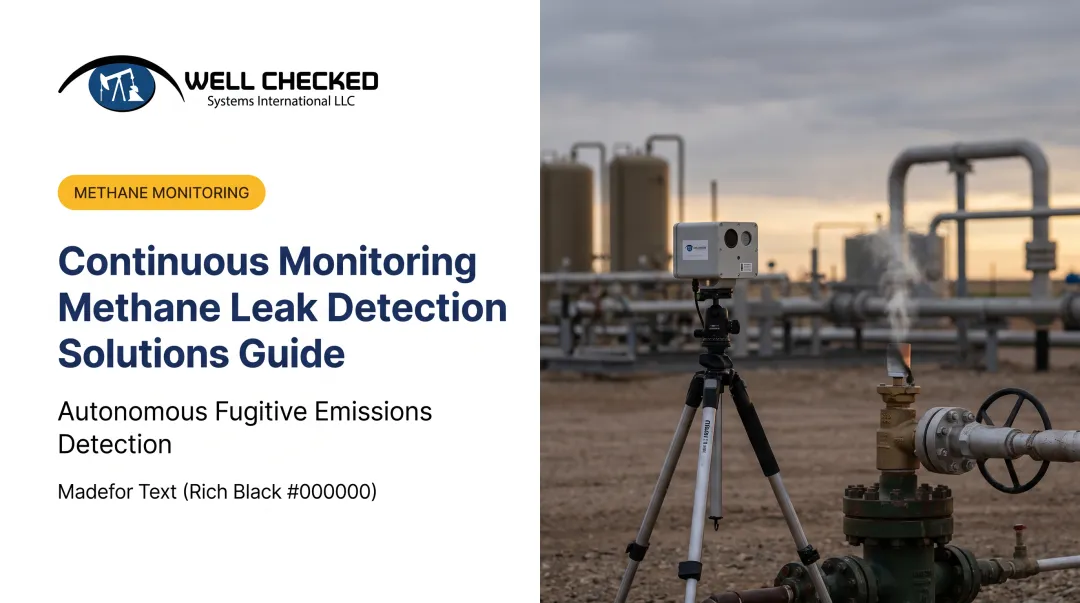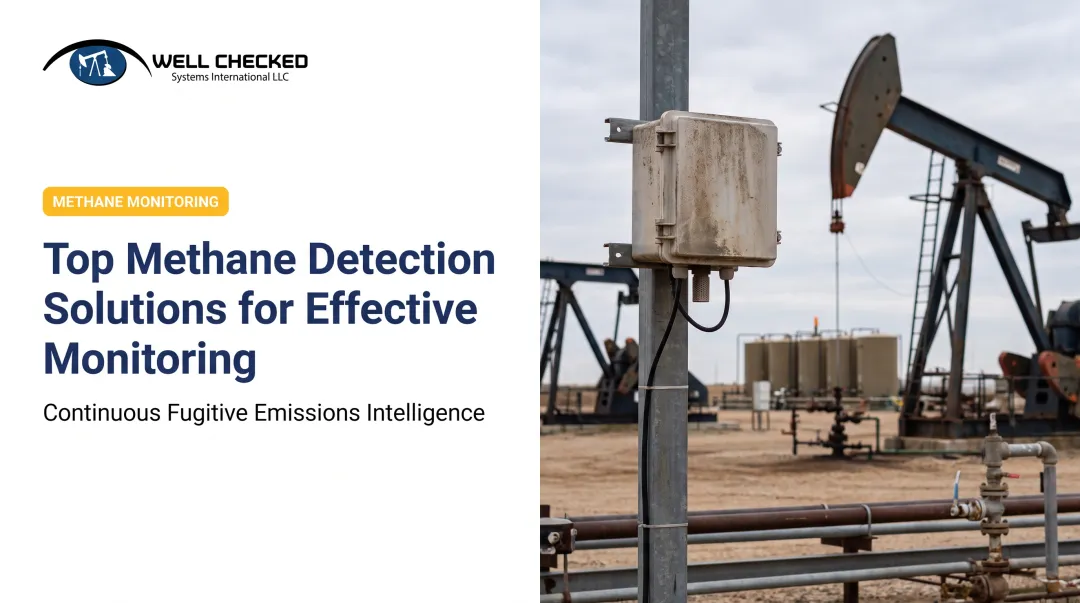

EPA's tightening methane rule, 40 CFR Part 60 Subpart OOOOb, is raising the bar on what "acceptable monitoring" looks like. Operators still running quarterly pumper routes and manual LDAR inspections are finding those methods increasingly inadequate.
This guide covers the detection technologies available today, why continuous monitoring beats periodic checks, and what compliance frameworks demand now. We'll also look at how autonomous, multi-sensor monitoring is reshaping field operations.
Key Takeaways
- Methane is odorless and flammable, posing both safety and environmental risks at wellsites
- Match detection tech to scale—from handheld sniffers for local checks to satellite surveys for basin-wide screening
- EPA OOOOb and OGMP 2.0 require operators to move from estimates to measurement-based reporting
- Continuous, AI-driven monitoring cuts safety exposure and operational costs versus route-based site visits
- Multi-sensor fusion (sight, sound, gas) reduces false alarms and improves detection accuracy
Why Methane Detection Is Critical for Oil & Gas Safety
Methane is highly flammable and can ignite at concentrations as low as 5% in air. At compressor stations, tank batteries, and wellheads, a slow leak in an enclosed or poorly ventilated space can become an explosion hazard quickly. Associated VOCs raise a separate risk: prolonged exposure can harm worker health.
Oil and gas systems account for about 30% of US anthropogenic methane emissions, based on EPA inventory estimates, making the sector the second-largest source category after agriculture.
Traditional pumper routes carry their own risk profile:
- Traffic accidents during long drives to remote sites
- Exposure to extreme weather during manual inspections
- Hazardous site conditions encountered during routine checks
None of these risks are hypothetical. A 2023 study found that transportation incidents cause over half of fatal occupational injuries in oil and gas extraction. Every unnecessary site visit is a mile of avoidable exposure.
Left unaddressed, small leaks compound. Research on low-production wells found these sites can produce 37% to 75% of well-site methane emissions, with a 6.2% production-normalized loss rate. Even "small" leaks at dispersed, low-output pads add up to real gas loss and real revenue loss over time.
Types of Methane Detection Technologies Used in Oil & Gas
No single technology covers every need. Most effective programs layer several approaches.
Optical Gas Imaging (OGI) and Infrared Cameras
OGI cameras use thermal imaging to visualize methane plumes invisible to the naked eye, working day or night. EPA's Appendix K certification standard requires OGI cameras to detect a methane image at 19 grams/hour under test conditions, though real-world field sensitivity varies with wind, distance, and temperature contrast.
Most OGI systems use cooled mid-wave infrared (MWIR) cameras. Long-wave infrared (LWIR) cameras offer a practical alternative for fixed, continuous deployment: LWIR costs roughly one-third of traditional MWIR solutions, making 24/7 monitoring economically viable across dozens or hundreds of sites rather than a handful.

Point, Acoustic, and Sniffer Sensors
Handheld and fixed sniffer sensors (TDLAS, catalytic, semiconductor) offer high accuracy for pinpointing a specific leak once you know roughly where to look. They're excellent for localization, less useful for basin-wide screening.
Acoustic anomaly detection takes a different approach. Instead of measuring gas concentration, it listens for the ultrasonic signature of a pressurized release or abnormal equipment sound. This works day or night and doesn't require a clean line of sight, though performance depends on pressure levels and competing mechanical noise nearby.
Airborne and Satellite Monitoring
Drones, aircraft, and satellites excel at basin-wide and regional screening, finding the biggest emitters across large geographic areas quickly. Limitations include:
- Cloud cover and low light restrict satellite passes
- Detection thresholds miss smaller, chronic leaks
- Revisit frequency means episodic snapshots, not continuous coverage
Some prominent satellite programs make no nighttime measurements and face weather-driven detection gaps; one lost satellite contact in mid-2025. Airborne and satellite tools work best to prioritize where ground-based follow-up should happen next, not as a stand-alone monitoring solution.
How Continuous, Multi-Sensor Monitoring Improves Detection Accuracy
Single-sensor continuous monitors have a reliability problem. A 2023 controlled study found false-positive rates across commercial continuous monitoring systems ranging from 0% to 79%. That spread is wide enough to make "continuous" meaningless without proper sensor fusion and validation.
Fusing multiple signal types (sight, sound, gas concentration) filters out the noise that trips up single-sensor systems. AI models learn what "normal" looks like at a specific site, then flag deviations rather than treating every signal spike as an emergency.
A Three-Tier Approach to Detection
Well Checked Systems' Zensory.ai™ platform illustrates how this works in practice, using a three-tier architecture:
- Zentinal Ops™ — Captures visual and acoustic intelligence: high-resolution video with object detection, plus acoustic AI listening for abnormal equipment sounds.
- Zentinal Core™ — Fuses video, long-wave infrared optical gas imaging (LWIR OGI), and acoustic data; runs a ~2-day AI site-learning cycle to establish a normal baseline; then filters false alarms and validates true fugitive events.
- Zentinal IQ™ — Takes only Core-validated events and quantifies volume, duration, and rate for regulatory-defensible reporting.
This sequencing matters. Nothing gets quantified until Core has confirmed it's a real anomaly, which keeps false positives out of your compliance record entirely.
The result is an "operate by exception" model. Field teams respond to validated anomalies instead of driving out for routine checks on sites that are running fine.
At production scale, that means 1,500+ videos analyzed per site per day across remote sites, including a confirmed program with a large Appalachian operator in the Appalachian Basin.

Regulatory Compliance and Reporting Requirements
The compliance landscape is shifting faster than most field procedures can keep up with.
EPA 40 CFR Part 60 Subpart OOOOb applies to crude oil and natural gas facilities that began construction, modification, or reconstruction after December 6, 2022. The rule took effect May 7, 2024. Monitoring frequency varies by site classification:
- Quarterly AVO checks
- Semiannual or quarterly OGI surveys for applicable categories
OGMP 2.0 is becoming the industry benchmark for credible reporting. Level 4 requires source-level measurement-based reporting. Level 5 reconciles that data with site-level measurements, raising the bar above the estimate-based inventories most operators used a decade ago.
Publicly traded E&Ps face added disclosure obligations:
- SASB Oil & Gas E&P metric EM-EP-110a.1: Scope 1 emissions and methane-related disclosures
- TCFD (now under IFRS S1/S2): governance, risk, and metrics reporting on climate exposure
Continuous monitoring supplies what periodic LDAR snapshots cannot: a defensible, audit-ready record. Zentinal IQ™ structures Core-validated events into quantified logs, EPA-format compliance reports, and OGMP 2.0 Level 4/5-ready outputs, with configurable retention for multi-year audit response.

Choosing the Right Methane Detection Solution for Your Operations
Not every monitoring solution fits every operation. Weigh these factors before committing:
- Detection sensitivity — Can it catch small, chronic leaks, not just major releases?
- False-alarm filtering — Does it distinguish routine process emissions from true anomalies?
- Day/night capability — LWIR OGI and acoustic sensing both work in darkness; not every technology does.
- Edge computing reliability — Remote sites often lack consistent connectivity, so onsite processing matters more than cloud dependency.
- Response workflow — Look for an acknowledge-dispatch-mitigate process that closes the loop within 24 hours of a validated alert.
The cost math matters too. Traditional route-based LDAR inspections can run $1 million to $5 million or more annually for mid-to-large operators, once you account for drive time, labor, calibration, and repeat visits. Autonomous, continuous monitoring shifts that spend toward technology and away from truck rolls, while catching more leaks between quarterly visits.

Speed of response is the other half of that equation. A validated methane event left unaddressed for days, rather than hours, creates real EPA fine exposure.
Frequently Asked Questions
How much does a methane detector cost?
Costs range widely, from a few hundred dollars for a handheld sniffer to substantial investment for fixed, continuous multi-sensor systems. Continuous AI monitoring often offsets its cost by reducing site-visit expenses and avoiding fines.
What type of sensor can detect methane?
Infrared/OGI cameras, catalytic sensors, semiconductor sensors, laser-based TDLAS units, and acoustic sensors are all used across the industry. Most robust programs combine several sensor types rather than relying on one.
What is the EPA methane rule and who does it apply to?
Subpart OOOOb applies to crude oil and natural gas facilities that began construction, modification, or reconstruction after December 6, 2022.
How often should oil and gas sites be monitored for methane leaks?
Federal LDAR rules typically require quarterly AVO checks, with OGI surveys ranging from none to quarterly depending on site classification. Continuous monitoring, by contrast, checks conditions constantly rather than on a fixed schedule.
Can AI reduce false methane alarms at wellsites?
Yes. AI site-learning establishes a normal operational baseline for each site, then multi-sensor fusion cross-checks video, gas, and acoustic signals to filter out routine process emissions from genuine fugitive leaks.
What is OGMP 2.0 and why does it matter for operators?
OGMP 2.0 is a reporting framework where Level 4 requires source-level measurement-based data and Level 5 reconciles it with site-level measurements. It's becoming the industry standard for credible, defensible emissions reporting.