
Many operators still treat remote monitoring as a buzzword. But its real value shows up in specific, measurable places: fewer site visits, faster leak response, and compliance data that actually holds up under scrutiny.
This article breaks down what remote monitoring is, its core advantages, what happens when operators skip it, and how to get the most out of a deployed system.
Key Takeaways
- Cut route-based pumper visits by shifting to continuous, autonomous wellsite oversight
- Work by exception when multi-sensor platforms filter false alarms instead of chasing every alert
- Strengthen EPA, OGMP 2.0, SASB, and TCFD reporting with continuous data over quarterly LDAR snapshots
- Pair AI detection with regulatory-ready outputs on platforms such as Well Checked Systems' Zensory.ai™
What Is Oil and Gas Remote Monitoring?
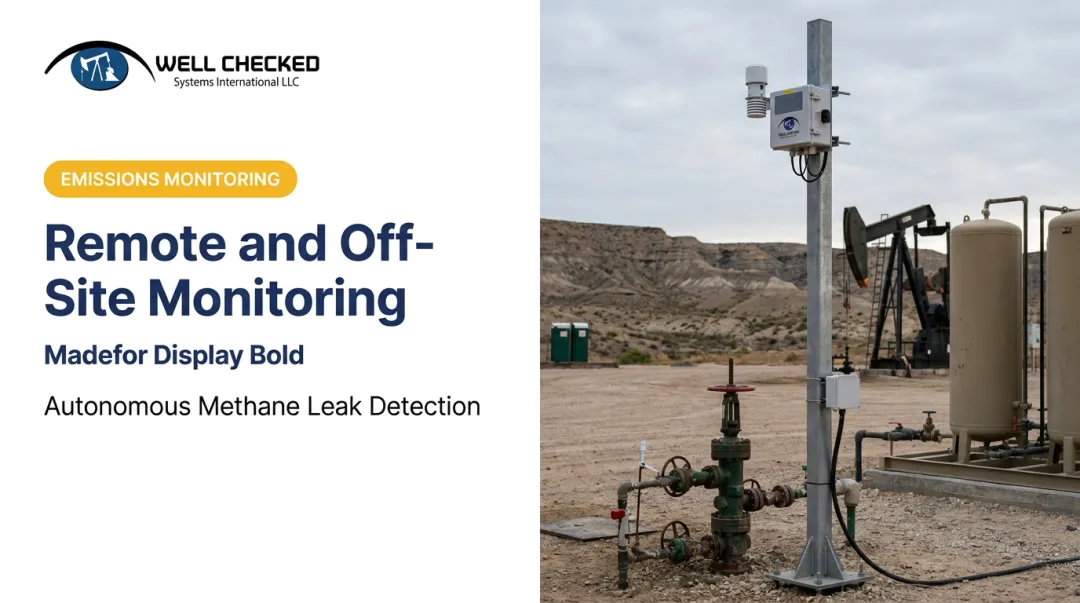
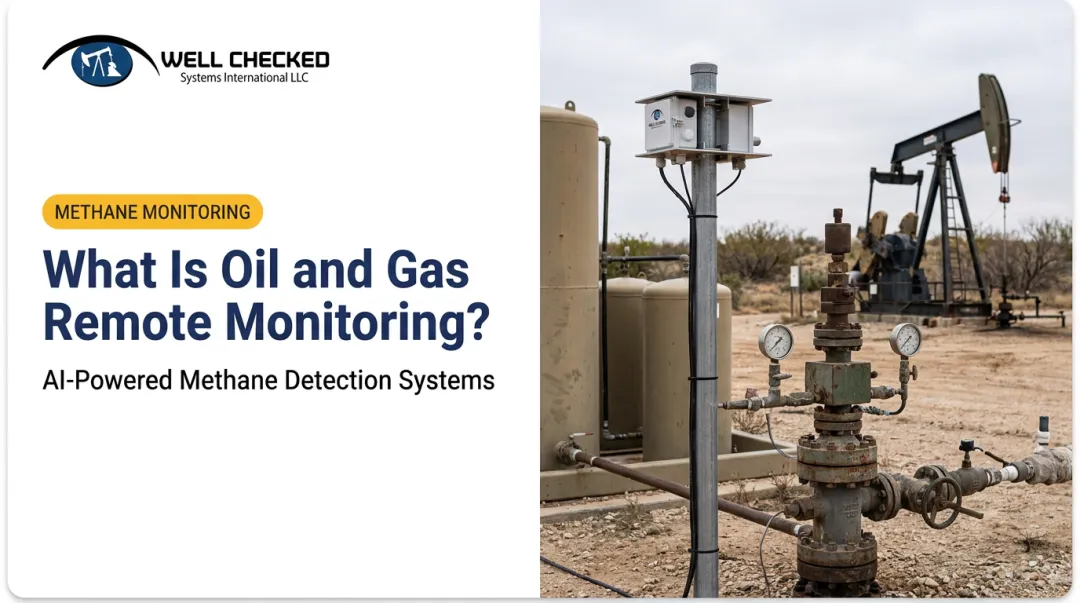
Remote monitoring uses sensors, cameras, and connected software to observe wellsite conditions without requiring someone to physically stand at the site. It is a multi-sensor system, not a single gadget.
Common applications include:
- Tank level and pump status tracking
- Methane and VOC leak detection
- Acoustic monitoring for equipment anomalies (compressors, pumps, valves)
- Site security and unauthorized activity alerts
The real shift is operational: risk and cost move off routine drive-outs and onto continuous coverage. Instead of a technician driving out to check whether something is wrong, sensors flag the anomaly and crews respond only when action is needed.

Key Advantages of Oil and Gas Remote Monitoring
These advantages tie directly into budget lines operators already track: route costs, EPA fines, insurance premiums, and ESG reporting obligations. Below are the three that matter most.
Advantage 1: Reduced Operational Costs
Autonomous monitoring eliminates the need for routine pumper-route drives to remote sites. Continuous sensor data replaces manual physical checks, cutting both labor hours and vehicle costs at the same time.
Why this matters:
- Route-based visits can cost mid-to-large operators $1M to $5M+ annually
- Fewer routine trips mean fewer vehicle maintenance cycles and less fuel spend
- Freed-up field staff can focus on repairs and high-value work instead of routine drive-and-check rounds
KPIs impacted: cost per site visit, labor hours, vehicle maintenance/fuel spend, operating margin
This matters most for operators running dozens or hundreds of remote sites with long drive times between locations. When a site sits two hours from the nearest office, every unnecessary trip adds up fast.

Advantage 2: Faster Emissions Detection and Regulatory Defensibility
Traditional LDAR inspections give you a snapshot. Depending on facility type, OOOOb requires routine checks ranging from monthly AVO surveys at compressor stations to quarterly OGI at multi-wellhead sites under 40 CFR 60.5397b.
Those schedules leave gaps of weeks or months between looks. A lot can leak in that gap.
Continuous multi-sensor monitoring changes the timeline entirely. Platforms combining video, acoustic, and optical gas imaging detect fugitive emissions in near real time, rather than waiting for the next scheduled inspection.
How this plays out operationally:
- Zentinal Core™ filters out false alarms so operators only act on validated fugitive anomalies, not every process noise or heat signature
- Zentinal IQ™ quantifies the duration and volume of a validated event once Core confirms it's real, producing data suited for regulatory submission
- An acknowledge-dispatch-mitigate response within 24 hours produces a dated record of how each validated methane event was handled
Under OOOOb's alternative-monitoring pathway, a qualifying continuous system must produce a valid methane rate at least once every 12 hours and transmit data within 24 hours, with rolling downtime capped at 10% annually per 40 CFR 60.5398b. That's a different evidence trail than a quarterly OGI report.
KPIs impacted: time-to-detection, time-to-mitigation, fines avoided, reporting accuracy
This matters most for operators with direct EPA methane rule exposure or public ESG disclosure obligations. Think OGMP 2.0 Level 4/5, SASB Oil & Gas E&P, and TCFD reporting, where investors expect measurement-based data, not estimates.

Advantage 3: Improved Field Safety and Reduced Environmental Footprint
Fewer unnecessary site visits means less time on remote, often unpaved roads in unpredictable weather. That's not a minor point.
A peer-reviewed analysis of BLS data found oil-and-gas-extraction workers had a motor-vehicle fatality rate 8.5 times higher than the average private-sector worker between 2003 and 2009, with pickup trucks involved in over half of those fatalities per a peer-reviewed BLS fatality analysis.
Fewer trips also means fewer vehicle miles and less associated carbon output from field operations, a detail that increasingly shows up in corporate ESG reporting.
Why this matters:
- Reduced windshield time correlates with lower incident exposure for field personnel
- Fewer routine trips lower fuel consumption and fleet-related emissions
- Safer field conditions support workforce retention and can influence insurance premiums
KPIs impacted: incident rate, vehicle miles driven, fuel spend, insurance premiums
This matters most for operators in geographically dispersed basins such as the Permian, Bakken, and San Juan, where harsh weather and long unpaved routes to remote wellsites are the norm, not the exception.

What Happens When Remote Monitoring Is Missing or Ignored
Relying solely on manual pumper routes and periodic LDAR inspections creates predictable gaps:
- Delayed leak detection leaves fugitive emissions running for weeks between inspection cycles, turning small events into costly, prolonged releases
- Rising route costs follow as labor and vehicle expenses scale poorly when site counts grow across portfolios
- Increased safety exposure comes with every routine trip to a remote site—traffic, weather, and equipment risk included
- Incomplete compliance records from snapshot-only data rarely hold up under regulatory review or investor scrutiny
- Scaling difficulty sets in when manual routes alone must standardize monitoring quality across dozens of sites
The consequences aren't hypothetical. In 2024, two oil and gas operators paid $4M and $1.275M, respectively, to settle allegations of failing to capture and control emissions at Pennsylvania production facilities, according to a DOJ settlement announcement.
Unresolved alarms and missing repair documentation become real financial liabilities, not just operational inconveniences.
How to Get the Most Value from Remote Monitoring Solutions
Remote monitoring delivers its full value only when a few things are in place:
- Combine multiple sensor types: visual, acoustic, and gas imaging together reduce false alarms and build trust in the alerts your team actually acts on.
- Define an acknowledge-dispatch-mitigate workflow: alerts should trigger action, not just get logged in a dashboard nobody checks.
- Structure data for direct regulatory use: output formatted for EPA, OGMP 2.0, SASB, and TCFD submissions saves teams from manual reformatting later.
A tiered architecture helps operators scale without overcommitting upfront. Well Checked Systems' three-tier Zentinal approach reflects this:
- Zentinal Ops™ starts with visual and acoustic site intelligence
- Zentinal Core™ adds multi-sensor emissions detection with false-alarm filtering
- Zentinal IQ™ layers in quantification for regulatory-defensible reporting
Operators can start with basic monitoring and add capacity as compliance demands grow, without ripping out and replacing the whole system.

Conclusion
Remote monitoring delivers real value through cost control, faster response, and compliance data that holds up when regulators or investors come asking. These advantages compound as site counts grow and regulatory scrutiny tightens.
Treat remote monitoring as an operating model shift toward "by exception" management, not a one-time technology install. Operators who build field operations around it get far more value than those who bolt it onto unchanged routines.
Frequently Asked Questions
What is oil and gas remote monitoring and how does it work?
Oil and gas remote monitoring uses sensors, cameras, and AI software to continuously observe wellsite conditions and emissions. The system sends alerts only on validated anomalies, instead of requiring routine manual checks at every site.
Who pays for oil and gas remote monitoring solutions?
Operators typically cover costs as an operating expense, often offset by savings from reduced route-based visits and avoided regulatory fines. Purchase, lease, and subscription models are all common.
Is oil and gas remote monitoring worth the investment?
For mid-sized to large operators with significant route costs and EPA/ESG exposure, the combined savings and compliance benefits typically outweigh platform costs. Smaller operators with fewer remote sites may see a longer payback period.
How does remote monitoring help with EPA methane rule compliance?
Continuous monitoring supports alternative-monitoring compliance submissions under 40 CFR Part 60 Subpart OOOOb by providing timestamped detection and quantification data. That continuous record is evidence periodic LDAR snapshots can't match.
What sensors are used in modern oil and gas remote monitoring systems?
Modern systems combine high-resolution video, acoustic anomaly detection, and optical gas imaging (LWIR) to catch visual, sound-based, and emissions-based anomalies from a single platform.
How is remote monitoring different from traditional LDAR inspections?
LDAR provides periodic snapshots, often weeks or months apart. Remote monitoring provides continuous, near-real-time detection with a full historical record, supporting stronger, more defensible reporting.