
That shift is exactly what's fueling the debate. The same technology that helps stop shoplifting, catch stolen vehicles, or spot a methane leak before it becomes a fine is also raising real questions about privacy, bias, and how much monitoring is too much.
This guide breaks down what AI surveillance actually is, where it's being deployed (including some industrial and environmental uses that rarely make headlines), the risks documented by researchers and regulators, and what responsible deployment looks like in practice.
Key Takeaways
- AI surveillance pairs sensors with machine learning to detect and classify events, not just record footage
- Use cases span law enforcement, corporate offices, and industrial sites monitoring equipment rather than people
- Documented risks include privacy erosion and algorithmic bias, plus "function creep" — data repurposed beyond its original intent
- Responsible deployment relies on purpose limitation and human oversight rather than blanket monitoring
What Is AI Surveillance and How Does It Actually Work?
Traditional CCTV records footage and waits for a human to review it. AI surveillance is different: it combines camera, microphone, or biometric hardware with machine learning models that interpret what's happening as it happens, then flag events worth a human's attention.
That distinction matters because humans are bad at watching screens for hours. A 2019 review of vigilance research found that target-detection performance drops 15% after just 30 minutes of monotonous monitoring.
Security-camera watching is exactly the kind of task that triggers this decline. That's a big part of why automated detection has replaced manual monitoring in so many settings.
Rule-Based vs. Behavioral AI Analytics
Not all AI surveillance works the same way. Two main approaches dominate:
- Rule-based analytics run on pre-programmed conditions, such as "alert if someone enters this zone after 10 p.m." These work well in static, low-traffic environments like a warehouse loading dock overnight.
- Behavioral (self-learning) analytics build a baseline of "normal" over time, then flag deviations from it. This suits complex, busy environments — a crowded retail floor, for instance, where someone standing still isn't inherently suspicious.
The Shift Toward Multi-Sensor, Real-Time Detection
Single-sensor systems miss things. That's why modern platforms increasingly fuse visual, audio, and thermal or infrared data to cross-check each other before triggering an alert. A 2024 railway-security study testing this kind of fusion found that combining radar with other sensor types raised detection accuracy from 39% to 54% and cut false positives nearly in half.
Most systems now follow a similar pipeline:
- Capture — sensors continuously collect raw data
- Classify — AI models identify what's in the data (a person, a gas plume, an unusual sound)
- Verify — the system cross-checks against baseline behavior or other sensors
- Escalate — only confirmed anomalies get pushed to a human for action

This "alert on exception" model is the whole point. It saves human attention for events that actually need it, instead of burning it on hours of nothing.
Where AI Surveillance Is Used Today
Government and Law Enforcement Surveillance
Police departments now use facial recognition, automatic license plate readers, and predictive policing software as standard tools. The problem is these systems aren't infallible, and the consequences of error fall on real people.
In February 2023, Detroit police arrested Porcha Woodruff, eight months pregnant at the time, after a facial-recognition match placed her photo in a lineup. She was held for 10 hours before officers acknowledged they had the wrong person. Detroit has since banned arrests based solely on facial-recognition results.
Beyond individual tools, many police departments now feed camera networks, license plate readers, and gunshot-detection systems into centralized real-time crime centers. Civil liberties researchers have counted more than 80 of these centers across 29 states, raising concerns about how much tracking capability gets concentrated in one place.
Corporate and Workplace Surveillance
Employers have built out monitoring far beyond the old "are they at their desk" check. Government researchers have documented employer tools that track keystrokes, mouse movement, screenshots, browser history, location, and even facial expressions during video calls.
Here's the uncomfortable part: most U.S. states have no comprehensive privacy law limiting this practice. Employers can deploy it broadly with minimal restriction.
The consequences of getting it wrong were made public in the FTC's action against Rite Aid, which used facial recognition in hundreds of stores for eight years. The agency alleged false-positive matches led employees to search, publicly accuse, or call police on innocent customers, with false positives disproportionately affecting stores in Black and Asian communities.
Rite Aid received a five-year ban on facial recognition as part of its settlement.
Industrial and Environmental Monitoring
There's a category of AI surveillance that gets far less attention: monitoring equipment and environmental conditions instead of people. This is where the technology's promise looks a lot less controversial.
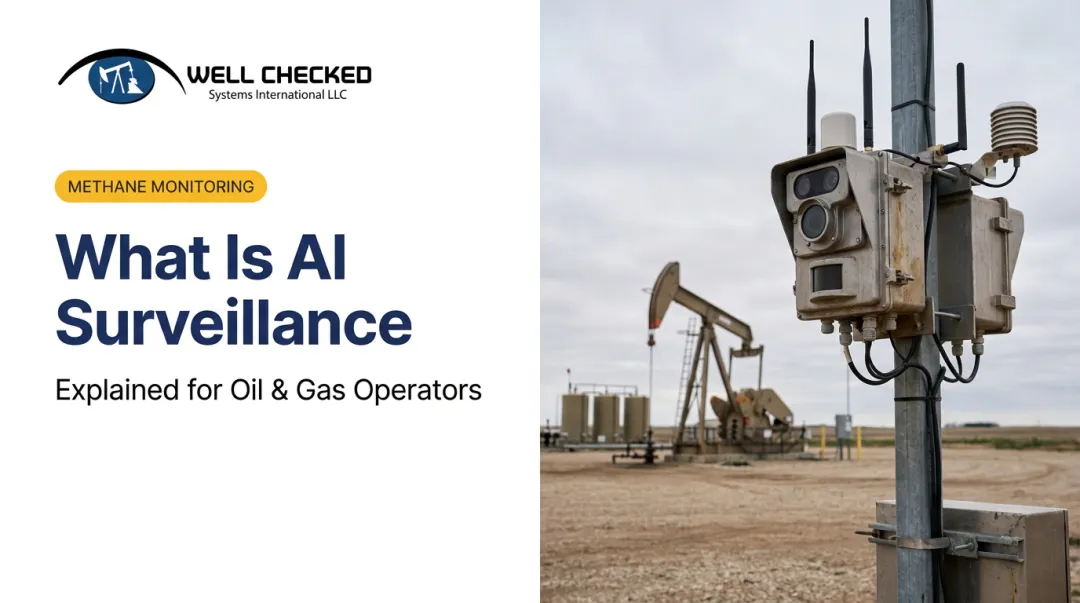
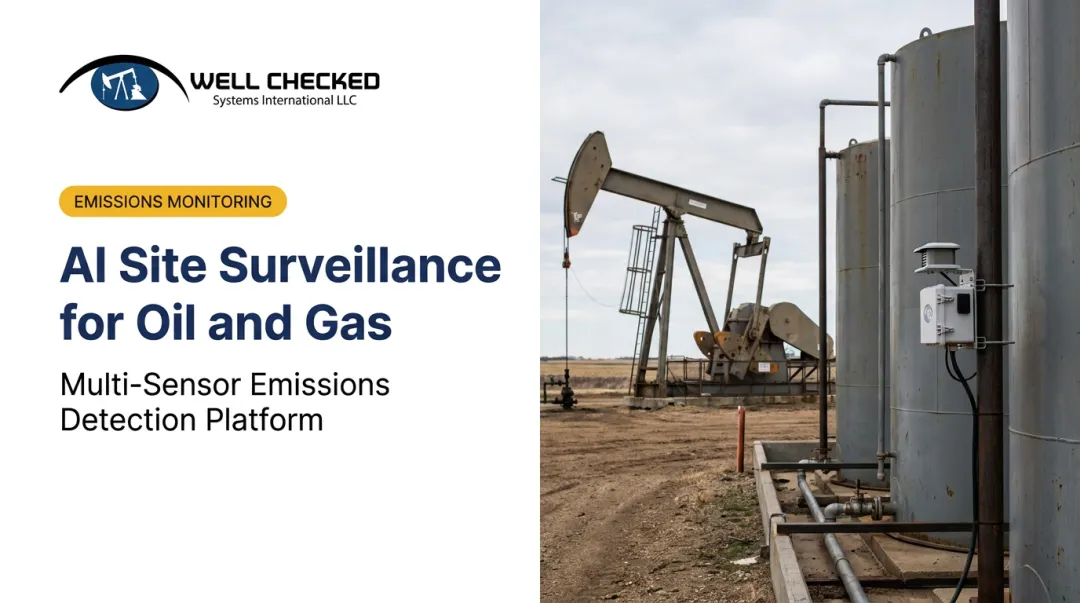
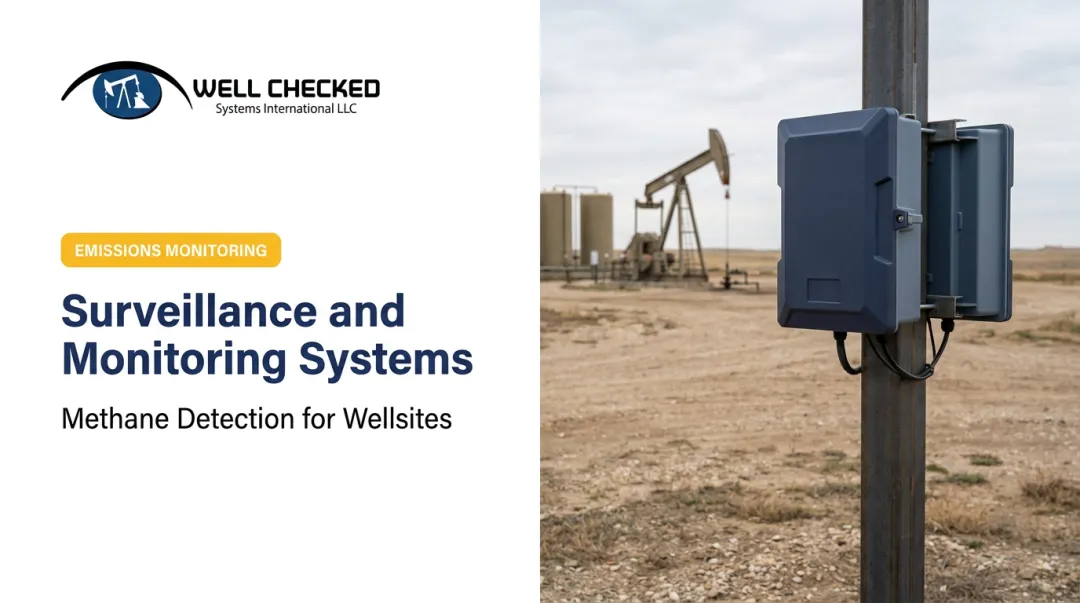
Well Checked Systems runs a version of this through its Zensory.ai™ platform, deployed across continuous monitoring in the Appalachian Basin. The system fuses three sensor types:
- High-resolution video for continuous visual coverage
- Long-Wave Infrared Optical Gas Imaging to detect methane and VOCs invisible to the naked eye
- Acoustic abnormal-sound detection to catch equipment failure signatures through sound
After installation, the platform runs an AI Site Learning cycle of roughly two days. During this period, it analyzes over 1,500 videos per site per day to learn what normal operations look like at that specific location. Once that baseline is set, the system (called Zentinal Core™) alerts only on genuine anomalies like fugitive methane emissions, filtering out routine process emissions that would otherwise flood operators with noise.
A second tier, Zentinal IQ™, only activates once Core has validated a real event. It then quantifies the volume, duration, and rate of the leak for regulatory-defensible reporting aligned with EPA methane rules, OGMP 2.0, SASB, and TCFD frameworks. This detect-then-quantify sequence follows the same behavioral-analytics principle used across AI surveillance generally, just applied to gas instead of people.

Benefits of AI Surveillance When Deployed Well
The upside case for AI surveillance isn't hypothetical. It shows up in three concrete ways.
Faster, more reliable response. Historically, the International Association of Chiefs of Police noted that more than 98% of alarm calls turned out to be false. AI-verified alerts change that math by confirming an event before it reaches a human responder, so verified alerts get prioritized over raw, unconfirmed triggers.
Coverage beyond human limits. A single AI system can watch hundreds of feeds simultaneously without the 30-minute attention decay that plagues human monitors. That's the difference between watching one camera and watching two hundred wellsites.
Operational and compliance efficiency. Continuous monitoring replaces expensive periodic checks, and the numbers make the case:
- Mid-sized to large operators spend $1 million to $5 million or more annually on route-based pumper site visits, according to Well Checked's own data
- Continuous monitoring cuts those costs while producing a fuller compliance record than any quarterly snapshot
- Operators using this model report acknowledging, dispatching, and mitigating validated methane events within 24 hours — a window documented to support a documented, timely response
Risks and Controversies Surrounding AI Surveillance
None of this comes without real costs. Five issues keep surfacing in research and litigation.
Privacy erosion. Civil liberties researchers have flagged government contracts, including one exceeding $101 million, aimed at analyzing social media, location data, and public statements for immigration vetting. Critics argue vague categories like "derogatory information" risk sweeping in ordinary political speech.
Algorithmic bias. A landmark NIST study evaluating 189 facial recognition algorithms found false-positive rates varying by factors of 10 to more than 100 across demographic groups. Women generally experienced 2 to 5 times higher false-positive rates than men.
Robert Williams' wrongful 2020 arrest in Detroit, tied directly to a facial-recognition misidentification, is one of more than a dozen documented cases where this bias led to real harm.
Regulatory patchwork. Illinois's Biometric Information Privacy Act is one of the few strong state laws, requiring written consent before biometric collection and imposing damages up to $5,000 per violation. But most states have nothing comparable, leaving surveillance largely unregulated outside a handful of city ordinances like Portland's ban on facial recognition.
Function creep. An out-of-state sheriff investigating a woman who had obtained an abortion queried license plate readers that Illinois had deployed for stolen-vehicle cases, a use that violated state law. Illinois officials later identified 262 similar immigration-related searches from a single jurisdiction in just a few months.
Alert fatigue. Adding sensors without careful tuning increases total false alarms rather than reducing them. Research on multi-sensor security systems warns that in the worst cases, operators simply stop responding to alarms altogether, undermining the entire point of automated monitoring.

Approaching AI Surveillance Responsibly
Given these risks, a handful of principles separate defensible deployments from reckless ones.
- Purpose limitation and transparency. Define a specific, legitimate purpose, such as safety, compliance, or security, and publish clear data retention policies rather than collecting broadly "just in case."
- Human oversight for high-stakes decisions. No AI-flagged event should trigger an arrest, termination, or enforcement action without a human confirming it first.
- Defensible accuracy over blanket monitoring. Systems that filter noise before a human reviews footage create audit trails regulators can trust, while blanket recorders just shift that burden downstream.
That last principle is exactly what separates Well Checked's Core-then-IQ architecture from a "flag everything" approach. Zentinal Core™ only passes validated events forward; Zentinal IQ™ only quantifies what Core has already confirmed.
The result is a curated record where every entry traces back to a real, validated event, not a haystack of unverified signals for someone to sort through later.
Frequently Asked Questions
What is AI surveillance?
AI surveillance combines sensors like cameras, microphones, or gas detectors with machine learning that analyzes data in real time. Unlike passive recording, it actively detects, classifies, and flags events as they happen.
Is AI surveillance legal in the United States?
Legality varies by state and use case since there's no comprehensive federal privacy law. Some cities, like Portland, have passed local ordinances restricting specific technologies such as facial recognition.
What are common examples of AI surveillance technology?
Facial recognition, automatic license plate readers, workplace monitoring software, and industrial multi-sensor systems that track equipment and emissions are among the most widely deployed examples today.
How is AI surveillance different from traditional CCTV?
Traditional CCTV only records footage for later human review. AI surveillance actively analyzes and classifies activity in real time, alerting operators to relevant events as they occur.
What are the biggest risks associated with AI surveillance?
The main risks are privacy erosion, algorithmic bias leading to misidentification, and a lack of consistent regulatory oversight across most U.S. states. Function creep and alert fatigue compound these problems further.
Can AI surveillance be used responsibly, such as for industrial safety or environmental monitoring?
Yes. Purpose-built systems that monitor equipment and environmental conditions rather than people, like Well Checked's methane emissions monitoring, represent a narrowly-scoped, defensible application of the technology.