
Most operators treat emissions monitoring as a compliance checkbox: schedule the quarterly leak detection and repair (LDAR) inspection, document the results, file the report. That gap between inspection cycles is exactly where the real costs accumulate — in undetected product loss, regulatory exposure, and maintenance decisions made without knowing how long a leak actually ran.
This article explains why real-time, continuous emission monitoring delivers measurable advantages in regulatory standing, cost control, and operational clarity — and what operators stand to lose by relying on periodic inspections alone.
Key Takeaways
- Real-time monitoring detects fugitive emissions within hours, not weeks, dramatically compressing response time vs. quarterly LDAR cycles
- Continuous timestamped records support EPA OOOOb compliance and measurement-based ESG frameworks like OGMP 2.0 Level 4/5
- Knowing leak duration and volume enables data-driven repair prioritization instead of reactive guesswork
- Route-based pumper programs cost mid-to-large operators an estimated $1M–$5M+ annually, based on business-case modeling — autonomous monitoring targets that cost directly
- A 24-hour acknowledge-dispatch-mitigate response to a validated event carries materially lower regulatory exposure than discovering the same leak at the next scheduled inspection
What Is Real-Time Emission Monitoring?
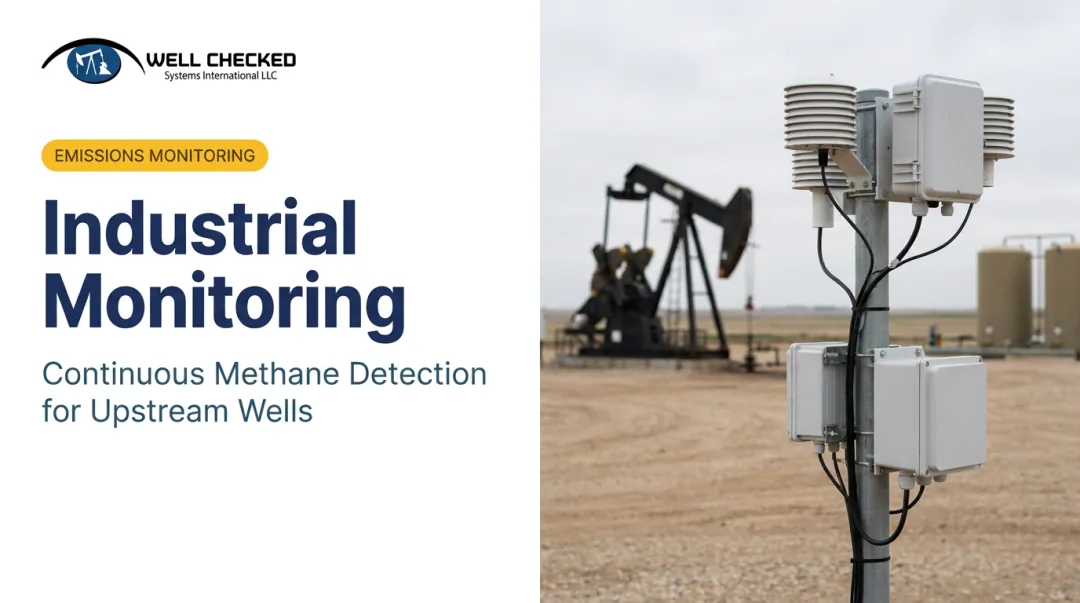
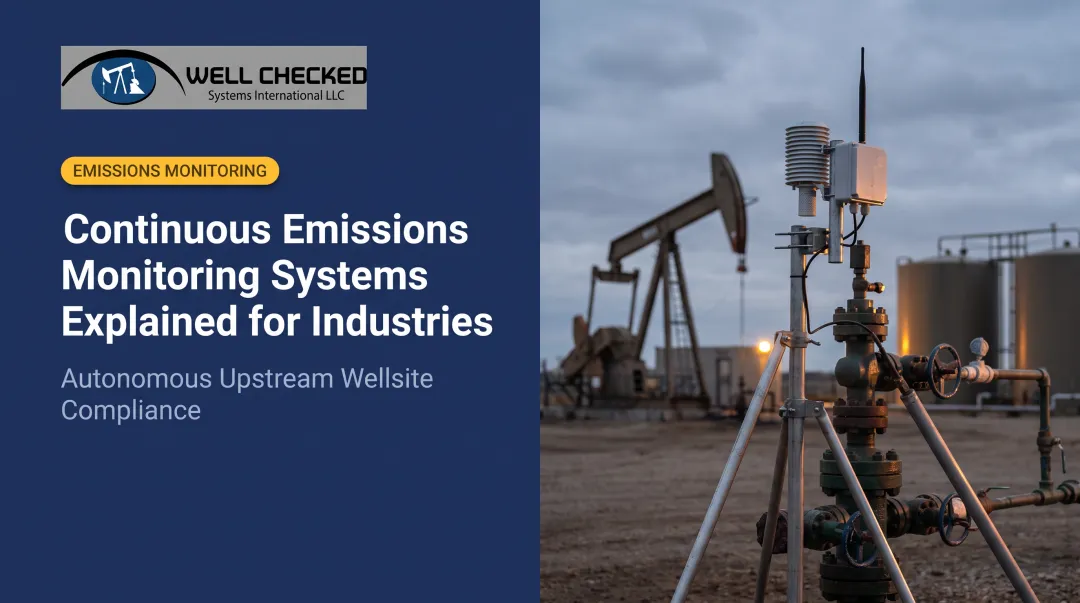
Real-time emission monitoring means continuous, automated measurement of gas-phase emissions — methane, volatile organic compounds (VOCs), and related operational signals — at the source, rather than during scheduled manual inspections.
In upstream oil and gas, this applies to:
- Remote wellsites — typically unattended and visited only on fixed schedules
- Production pads and compressor stations — high equipment density with significant fugitive emission potential
- Storage and separation equipment — where unintentional tank venting and equipment leaks are a persistent and often under-measured source of unrecovered product
The distinction matters: periodic LDAR inspections capture conditions at the moment of a visit. Real-time monitoring captures what happens between those visits — which is where most emission volume accumulates undetected. An undetected tank leak running for 60 days between inspections isn't a compliance footnote; it's a quantifiable loss event with EPA fine exposure attached.

Key Advantages of Real-Time Emission Monitoring
For HSE directors, operations VPs, and ESG teams, the case for continuous monitoring comes down to three operational outcomes: faster leak response, defensible compliance records, and measurable cost reduction.
Faster Detection and Response to Fugitive Emission Events
The core advantage is time compression. Real-time monitoring collapses the gap between when a leak starts and when an operator knows about it — from weeks under quarterly inspection schedules to hours or less.
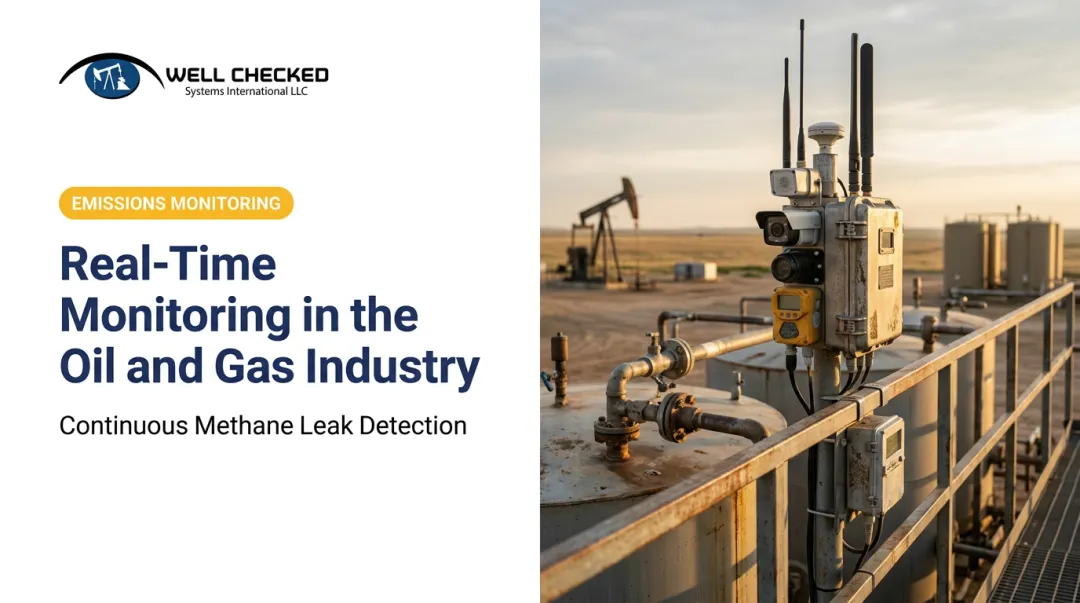
How this works in practice: sensors detect anomalies the moment they cross a threshold, triggering automated alerts that dispatch a response team to a specific piece of equipment, not an entire site tour. Platforms like Zensory.ai™ from Well Checked Systems process 1,500+ videos per site per day using multi-sensor fusion — combining Long-Wave Infrared (LWIR) Optical Gas Imaging, high-resolution video AI, and acoustic equipment monitoring — to identify system-validated fugitive anomalies against a learned baseline of normal operations.
Why this matters operationally:
Methane events can vary in duration and rate. EPA's advanced methane technology program provides a pathway for evaluating technologies that improve visibility between scheduled surveys. Compliance use depends on an EPA-approved method and the operator's applicable monitoring plan.
Event timing and duration influence product loss and response priorities, reinforcing the value of faster operator awareness between scheduled surveys.
A documented acknowledge-dispatch-mitigate response within an operator-defined 24-hour target can provide a more complete operational record than discovering the event at the next scheduled inspection.

KPIs impacted:
- Mean time to detection (MTTD) and mean time to response (MTTR)
- Total emission volume per event
- EPA penalty exposure
- Product loss volume per incident
When this matters most: Sites with high equipment density (compressors, separators, tanks), sites in EPA-designated non-attainment areas, and operators with large portfolios where the interval between manual visits is inherently long.
Regulatory Compliance Defensibility
Real-time monitoring transforms compliance from a periodic reporting exercise into a continuous, auditable record.
Under 40 CFR Part 60 Subpart OOOOb, operators must retain fugitive-monitoring records — including survey dates, start/end times, leak location, component type, repair status, and verification results — for at least five years. A properly configured continuous monitoring workflow can help collect timestamps and operator-reviewed duration and volume estimates; the operator remains responsible for verifying, formatting, retaining, and submitting required records.
That provides additional event history beyond a periodic LDAR report, which documents conditions observed during the scheduled inspection.
The enforcement context:
Regulatory programs increasingly emphasize timely investigation, documented follow-up, and complete operator records. EPA's current national enforcement initiative specifically prioritizes oil-and-gas methane, with 353 inspections and 43 offsite compliance-monitoring activities in FY2024 alone. Two 2024 settlements illustrate the scale of enforcement exposure operators face: one producer agreed to a substantial civil penalty, and an operator in New Mexico reached its own settlement.

Continuous records can help an operator document detection, investigation, and corrective action between scheduled visits, subject to the applicable rule and approved monitoring plan.
ESG reporting connection:
OGMP 2.0 Level 5 requires site-level measurement and reconciliation — direct measurement, not emission factors or engineering estimates. SASB Oil & Gas E&P (EM-EP-110a.1) permits continuous monitoring as the data methodology. Zentinal IQ™ provides operator-configured exports designed to support EPA, OGMP 2.0, and SASB reporting workflows, reducing manual data preparation while leaving final review and submission with the operator.
KPIs impacted:
- Compliance audit pass rate
- Notices of Violation (NOVs) received
- OGMP reporting tier achieved
- Time spent on manual compliance documentation
When this matters most: Publicly traded E&Ps with SASB obligations, operators with OGMP 2.0 Level 4/5 commitments, and producers where maintaining consistent compliance records across sites is a logistical challenge.
Operational Cost Reduction and Maintenance ROI
Real-time monitoring directly reduces the operational overhead of staffed pumper-route site visits — the recurring cost of driving personnel to every site on a fixed schedule regardless of whether anything has changed.
Continuous autonomous monitoring enables an "operate by exception" model: human attention and site visits are dispatched only when a validated alert indicates something actually needs action.
Why this matters economically:
Route-based site-visit programs for mid-to-large upstream operators cost an estimated $1M–$5M+ annually, depending on portfolio size and geography. Well Checked Systems uses this range in business-case modeling for operators evaluating autonomous monitoring — drawn from its deployment across a multi-site Appalachian Basin program. The larger the portfolio, the higher the savings potential.
Beyond eliminating unproductive visit miles, real-time monitoring enables a second-order benefit: because the system captures when a leak started and how much gas was lost, operators can calculate actual repair ROI before dispatching a maintenance crew. Repair prioritization shifts from reactive scheduling to decisions grounded in quantified loss volume and verified repair cost.

KPIs impacted:
- Annual site-visit cost per well
- Unproductive vehicle miles driven
- Maintenance dispatch accuracy and repair-to-ROI ratio
- Personnel safety exposure (fewer unnecessary field visits reduces traffic and hazardous conditions exposure)
When this matters most: Operators with 50+ remote sites feel compressive cost pressure from route-based programs that continuous monitoring directly solves. The advantage is highest in geographically dispersed basins — Appalachian, Permian, Anadarko — where drive time per visit is significant.
What Happens When Real-Time Monitoring Is Absent
Without continuous monitoring, the default state is straightforward: emissions events occur between inspection cycles, accumulate undetected, and are discovered either at the next scheduled visit or through a regulatory complaint.
The compounding cost of delayed detection is where operators underestimate the exposure:
- A methane leak running 30–60 days before the next quarterly inspection means unrecovered product loss, unquantified regulatory exposure, and no duration or volume data to support a sound repair ROI decision
- Emission factors and periodic estimates cannot represent an event that starts and stops between surveys, which is why EPA methane rules and OGMP 2.0 Level 4/5 both move reporting toward direct measurement — and unintentional tank and equipment leaks are exactly the category periodic LDAR is least equipped to capture
- As EPA methane rules tighten and OGMP 2.0 moves toward measurement-based reporting, operators relying on periodic snapshots face a structural disadvantage in regulatory audits, investor inquiries, and ESG benchmarking
The safety exposure compounds these operational costs. Without autonomous site visibility, operators default to more frequent manual visits — increasing driver exposure to remote road hazards, weather, and on-site equipment risks.
NIOSH recorded 126 vehicle-incident deaths among 470 oil-and-gas-extraction fatalities from 2014 to 2019, accounting for more than a quarter of industry fatalities during that period. Substituting travel frequency for site intelligence doesn't close the monitoring gap — it adds a measurable fatality risk in place of one.

How to Get the Most Value from Real-Time Emission Monitoring
Real-time monitoring delivers compounding value when treated as an operational system — not a compliance box to check. The data it generates must trigger action, not just fill a dashboard.
Three conditions for maximum ROI:
Filter system-validated fugitive anomalies from process-normal variations before dispatch — Zentinal Core™ completes a site-specific AI learning cycle in ~2 days per site, establishing a normal operational baseline. Operator response workflows prioritize system-validated anomalies, helping limit alert fatigue from the start.
Use emission duration and volume data to drive maintenance decisions — operators can calculate actual repair ROI before rolling a truck, replacing the common practice of treating every leak as equal-urgency.
Capture records in reviewable formats at collection time, not retrofitted later — Zentinal IQ™ provides operator-configured exports designed to support EPA, OGMP 2.0, and SASB reporting workflows; final formatting and submission remain the operator's responsibility.
The "operate by exception" mindset is the practical outcome: human attention and field resources deployed only when the data confirms they're genuinely needed — not as a calendar-driven routine.
That shift starts with a defined entry point. Well Checked Systems offers a fixed-fee pilot program deploying both Zentinal Core™ and Zentinal IQ™ across a subset of sites. Deliverables include a methane leak detection log, a false-alarm-rate comparison, and a scale-up business case structured for internal capital approval.
Conclusion
Real-time emission monitoring matters in practice because it compresses detection time, produces defensible compliance records, and replaces the blunt instrument of calendar-driven site visits with precision-dispatched action. Those advantages sharpen as EPA methane rule enforcement tightens and ESG disclosures shift from estimated to measurement-based reporting.
Operators who treat continuous monitoring as an active operational discipline — reviewing data, acting on alerts, and feeding quantified results back into maintenance and reporting workflows — stay ahead of both regulatory and market demands. Periodic inspection gives you a snapshot; continuous monitoring gives you a record. For operators moving toward measurement-based accountability, that distinction is the difference between defensible compliance and an exposure they won't see coming.
Frequently Asked Questions
What is the difference between real-time emission monitoring and periodic LDAR inspections?
Periodic LDAR inspections capture a point-in-time snapshot during scheduled visits, while real-time monitoring provides continuous coverage: leaks are detected the moment they occur, not weeks later. Any event that starts and resolves between inspection cycles is invisible under a periodic-only program.
How does real-time emission monitoring help upstream operators comply with EPA methane rules?
Continuous monitoring can provide timestamped, operator-reviewed event data that supports applicable recordkeeping. Use in place of a prescribed survey method requires an EPA-approved alternative test method, an applicable operator monitoring plan, and compliance with relevant state-plan requirements.
What types of emissions can real-time monitoring systems detect at oil and gas wellsites?
Modern platforms like Zensory.ai™ detect methane using Long-Wave Infrared Optical Gas Imaging, with acoustic equipment sensors adding detection of equipment malfunction signatures that often precede or accompany a gas release. The multi-sensor approach catches leaks that single-modality point sensors commonly miss.
How does real-time emission monitoring support OGMP 2.0 and ESG reporting frameworks?
OGMP 2.0 Level 5 includes site-level measurement and reconciliation requirements. Continuous monitoring can contribute event data to that broader workflow, but operators must complete the additional measurement, quality-assurance, reconciliation, and disclosure steps required by the applicable framework.
What is the financial cost of not having real-time emission monitoring at remote wellsites?
Unmonitored sites expose operators to undetected product loss, EPA penalty risk for events between inspection cycles, overstaffed pumper routes compensating for the visibility gap, and reactive maintenance decisions made without knowing leak duration or volume.
Can real-time emission monitoring replace all manual site visits?
Continuous monitoring enables an "operate by exception" model, dispatching crews only when validated alerts confirm a genuine event. It does not eliminate all site visits, but replaces calendar-driven scheduling with data-driven precision.