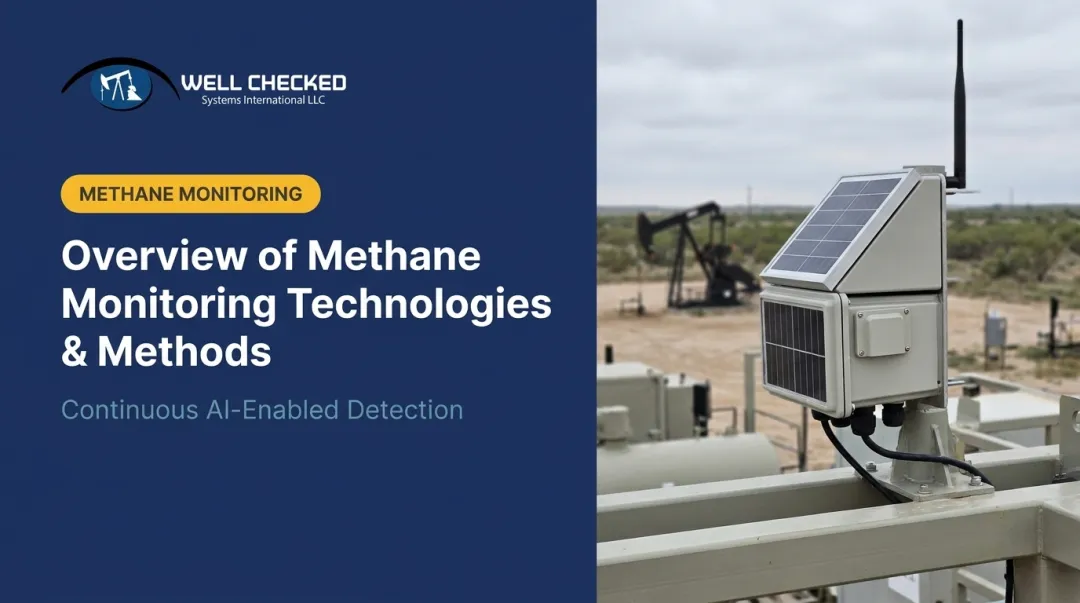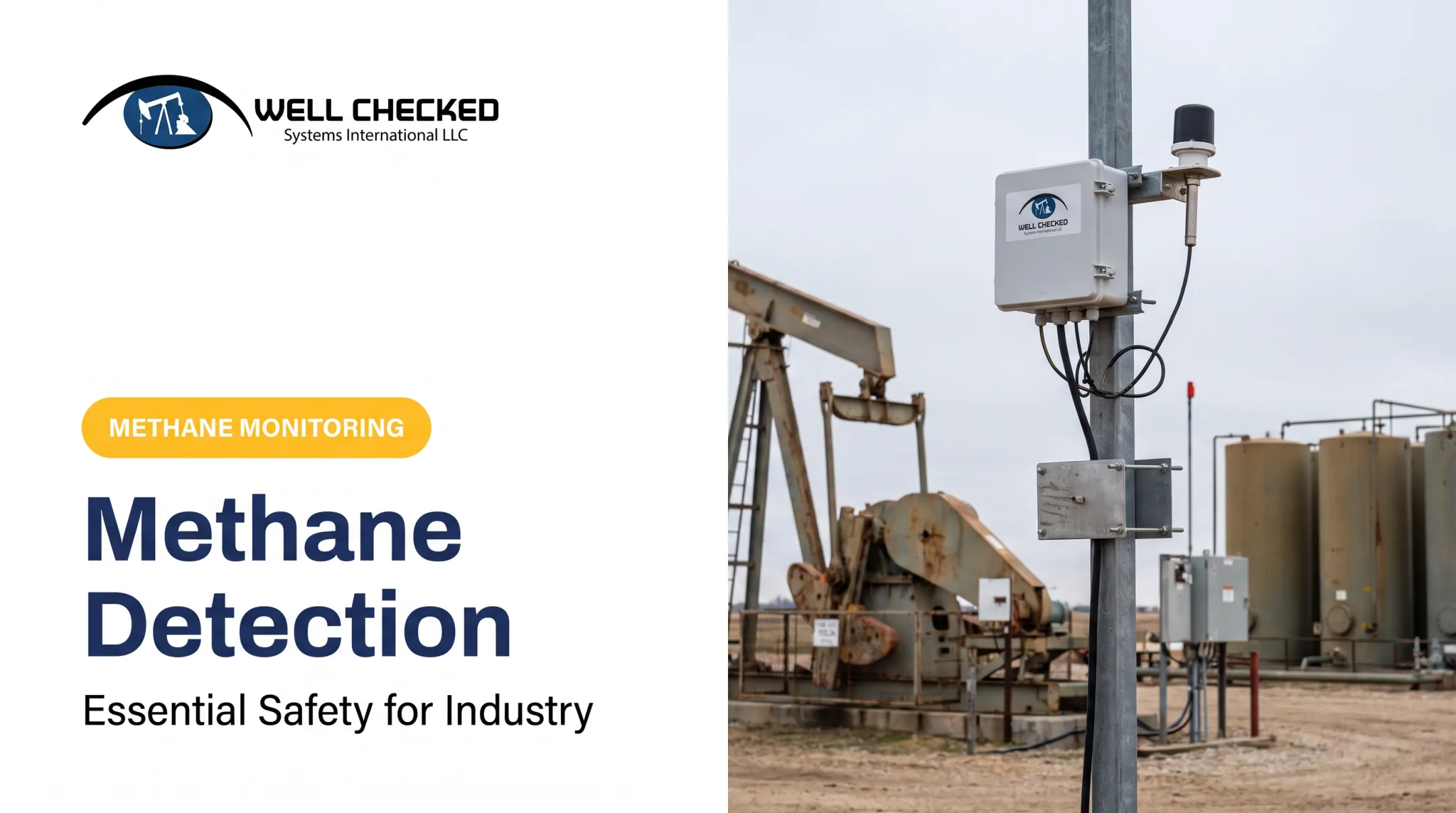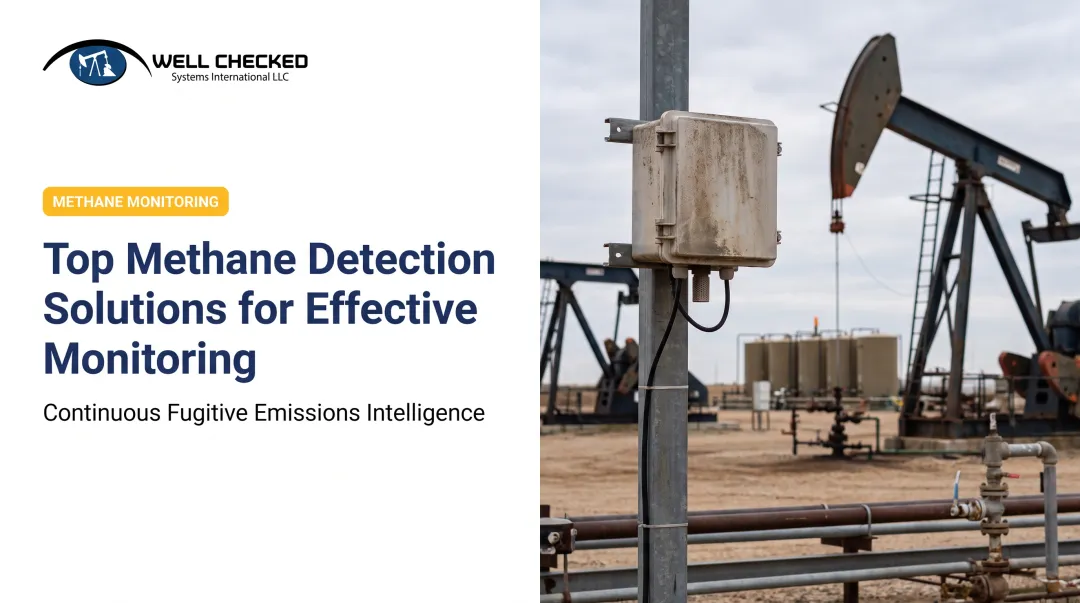

Manual LDAR inspections and operator routes were built for a slower regulatory era. AI-enabled multi-sensor platforms are now replacing them, catching leaks continuously instead of during a quarterly drive-by. With EPA's methane rule (40 CFR Part 60 Subpart OOOOb) and OGMP 2.0 pressure both tightening, continuous monitoring has shifted from "nice to have" to operational necessity across US onshore basins.
Key Takeaways
- Platforms fuse optical, acoustic, laser, and satellite sensors with AI to detect, quantify, and report fugitive emissions
- Continuous monitoring is replacing periodic LDAR as EPA Subpart OOOOb and OGMP 2.0 requirements tighten
- Shortlist on detection method, false-alarm filtering, and regulatory reporting fit
- Five detection approaches compared, including Well Checked Systems' continuous multi-sensor platform
- Total cost of ownership beats hardware sticker price when continuous coverage replaces route-based inspections
Overview of Methane Detection Platforms in Industrial Monitoring
Methane detection platforms are integrated hardware-and-software systems. They pair sensors—optical gas imaging, acoustic, laser, or satellite—with AI analytics that detect, quantify, and report fugitive emissions.
The US oil & gas industry is moving away from quarterly Optical Gas Imaging (OGI) surveys and Method 21 inspections. EPA's OOOOb rule requires monitoring surveys spaced 4-7 months apart at minimum, but that cadence leaves long gaps where a leak can run undetected.
EPA provides alternative pathways for periodic screening and continuous monitoring under section 60.5398b. Continuous operation alone does not guarantee compliance approval; vendors still need Administrator sign-off for their specific method.
Below are five platforms shaping how US operators approach methane monitoring today.
Top Methane Detection Platforms for Industrial Monitoring
Selection should weigh five factors:
- Detection technology
- Sensor fusion
- Regulatory alignment
- Scalability
- False-alarm filtering accuracy
Hardware alone rarely covers all five.
Well Checked Systems (Zensory.ai™)
Well Checked Systems is an Oklahoma-based company with 13+ years of experience delivering autonomous wellsite intelligence. The platform currently monitors remote US oil & gas sites, including a confirmed deployment with a large Appalachian operator in the Appalachian Basin.
The differentiator is sensor fusion. Zensory.ai™ combines high-resolution video, Long-Wave Infrared (LWIR) optical gas imaging, and acoustic AI across a three-tier architecture:
- Zentinal Ops™ – visual and acoustic site intelligence
- Zentinal Core™ – multi-sensor emissions detection with false-alarm filtering
- Zentinal IQ™ – regulatory-defensible quantification for EPA, OGMP 2.0, SASB, and TCFD reporting
Zentinal Core™ establishes a site-specific normal baseline through an AI Site Learning cycle, roughly two days per site, then analyzes continuous multi-sensor streams to separate routine process emissions from genuine fugitive events.
| Attribute | Detail |
|---|---|
| Detection Technology | Multi-sensor: LWIR optical gas imaging, acoustic anomaly detection, AI video analytics |
| Key Differentiator | AI Site Learning cycle filters false alarms by distinguishing normal operations from true leaks |
| Best For | Mid-to-large US upstream operators seeking to replace $1M-$5M+ annual route-based site visits |

Aerial Gas Mapping LiDAR
Aerial survey providers fly methane surveys using Gas Mapping LiDAR, mapping emissions at equipment-level resolution across upstream, midstream, and LNG facilities. Published sensitivity testing for this approach reports average detection thresholds in the low single-digit kg/h range at high probability of detection across North American production basins.
Results feed into emissions-management software for tracking and follow-up.
| Attribute | Detail |
|---|---|
| Detection Technology | Airborne LiDAR-based gas mapping |
| Key Differentiator | Catches super-emitters and small leaks in a single aerial pass |
| Best For | Operators needing periodic, wide-area basin surveys rather than continuous site-level monitoring |
Portable and
Fixed Detection Hardware Established manufacturers have produced gas detection hardware for decades, with portfolios spanning portable and stationary detectors used across oil & gas, landfill, and utility markets.
Fixed units can run 24/7 pump-drawn laser-based monitoring with real-time reporting, while handheld TDLAS devices are built for spot surveys rather than continuous coverage.
| Attribute | Detail |
|---|---|
| Detection Technology | Tunable diode laser (TDL), NDIR, and catalytic sensors |
| Key Differentiator | Wide hardware range, from portable surveys to fixed continuous units |
| Best For | Facilities needing point-source hardware rather than an integrated AI platform |
Drone-Based
Measurement and Quantification Drone-based providers use UAVs for top-down methane measurement and quantification, supported by accredited testing laboratories for site-level quantification. This approach can support OGMP 2.0 Level 5 reporting by combining top-down and bottom-up methods.
| Attribute | Detail |
|---|---|
| Detection Technology | UAV-mounted sniffers and optical gas imaging |
| Key Differentiator | Combines top-down and bottom-up quantification for site-level accuracy |
| Best For | Periodic drone-based site surveys supporting OGMP 2.0 compliance |
Ground-Based Coherent Lightwave Imaging
Coherent lightwave imaging delivers high-resolution, ground-based gas imaging. Systems of this type cover detection ranges of roughly 7-30 meters with approximately 1 cm resolution and sensitivity down to about 17 g/h, with IP-rated enclosures for harsh field conditions.
| Attribute | Detail |
|---|---|
| Detection Technology | Coherent lightwave imaging |
| Key Differentiator | High-resolution, high-sensitivity ground-based imaging across a wide temperature range |
| Best For | Facilities requiring precise, source-level fixed or handheld imaging |

What Type of Sensor Detects Methane? (Core Technologies Explained)
Every platform above relies on one or more of these four sensor families.
Infrared/NDIR sensors measure how much infrared light methane absorbs at its specific wavelength. Related IR methods such as optical gas imaging (OGI) use infrared cameras to visualize plumes instead of a single-point reading. NDIR strengths include:
- Selective response to methane
- Resistance to sensor poisoning
- Point and open-path configurations
Tunable diode laser (TDL) spectroscopy tunes a laser through a gas path and calculates concentration from wavelength-specific light loss. It is non-contact, highly sensitive, and strong for remote or open-path detection—reasons several hardware providers lean on laser-based approaches.
Acoustic sensors listen for the ultrasound a pressurized gas leak generates. They detect pressure and sound, not chemistry, so they cannot name which gas is escaping. They excel at catching equipment anomalies before a leak becomes visible.
Well Checked's acoustic AI layer in Zentinal Ops™ applies that approach, flagging abnormal equipment sounds alongside visual and optical gas data.
Catalytic (pellistor) sensors oxidize combustible gas on a heated bead and measure the resulting temperature change. They're common in older fixed detectors but have real limits:
- Require oxygen to function
- Lower selectivity than laser or infrared methods
- Can be poisoned by sulfur, lead, or silicone compounds

How to Choose the Best Methane Detection Platform
The most common mistake operators make is buying hardware without AI-based false-alarm filtering, then drowning field teams in nuisance alerts. The second is picking a sensor that's technically accurate but produces data no regulator will accept.
Weigh these factors before committing:
- Detection technology fit – does the sensor type match your equipment and terrain?
- Scalability – can the platform grow across multiple basins without a new vendor each time?
- Regulatory integration – does output map cleanly to EPA OOOOb and OGMP 2.0 Level 4/5 reporting?
- Total cost of ownership – how does multi-year platform pricing compare with periodic surveys and camera capital?
EPA's 2014 review put contract OGI surveys at roughly $400 per well site, with OGI cameras running $85,000–$124,000. Run that comparison over several years, not just year one.
Conclusion
Choose a methane detection platform based on whether it holds up when a regulator or auditor asks you to prove your emissions data.
Before committing, test scalability across your basin footprint and check how well the platform filters false alarms without missing real leaks. Well Checked Systems' Zensory.ai™ platform was built around that tradeoff: autonomous, multi-sensor wellsite monitoring for operators who need both coverage and accuracy.
Frequently Asked Questions
What type of sensor can detect methane?
Infrared/NDIR, tunable diode laser (TDL), catalytic (pellistor), and acoustic sensors are the main approaches. Infrared and TDL offer the highest selectivity for methane specifically, while acoustic sensors detect pressurized leaks rather than gas chemistry.
How much does a methane detection system cost?
Cost varies widely by technology: portable units, fixed continuous monitors, and AI-driven platforms all sit at different price points. EPA's 2014 review cited OGI cameras at $85,000-$124,000 versus roughly $400 per site for contract survey visits.
What is the difference between continuous and periodic methane monitoring?
Periodic monitoring, like quarterly LDAR/OGI inspections, surveys sites every 4-7 months per EPA rules. Continuous monitoring operates while the source runs, catching leaks in real time rather than during scheduled visits.
How does OGMP 2.0 relate to methane detection platforms?
OGMP 2.0's Level 4 requires source-level quantification, while Level 5 adds independent site-level measurement and reconciliation. Platforms offering both top-down and bottom-up data, like drone-based quantification services and Well Checked's Zentinal IQ™, support this measurement-based reporting tier.
Can methane detection platforms reduce false alarms?
Yes. AI-driven platforms that fuse video, acoustic, and optical gas imaging learn a site's normal baseline and flag only genuine anomalies, cutting nuisance alerts significantly.
Are methane detection platforms required by EPA regulations?
EPA's OOOOb rule allows alternative monitoring methods under section 60.5398b, including both periodic screening and continuous monitoring. Each method still needs specific Administrator approval before it counts toward compliance.