
Introduction
A pump jack stops cycling at 2 a.m. A valve starts leaking on a remote wellsite nobody visits until Thursday.
By 2026, automated alerting has moved far beyond "send an email if X happens." It now spans AI-driven, context-aware systems that watch physical industrial sites around the clock.
The pain point hasn't changed much: manual monitoring and delayed notifications still cause expensive downtime, missed safety incidents, compliance headaches, and reputational damage. More than half of significant outages now cost organizations over $100,000, according to Uptime Institute's 2024 outage analysis.
This article breaks down what automated alerting actually means today, how it works under the hood, and why it's expanding well past server dashboards into physical environments like oil and gas emissions monitoring.
Key Takeaways
- Automated alerting now combines detection, notification, and action into one closed loop.
- Downtime remains costly: over half of major outages exceed $100,000 in losses.
- Alert fatigue is nearly as dangerous as missed alerts, driving demand for smarter filtering.
- Multi-sensor fusion (video, acoustic, gas imaging) is extending alerting into physical, remote-site operations.
- Well Checked Systems applies these principles directly to methane and fugitive emissions detection.
What Is Automated Alerting and How Does It Work?
Automated alerts are system-generated notifications triggered by predefined rules, thresholds, or AI models, without a person watching a screen and deciding to act. That's the direct answer to "what are automated alerts," though most organizations still confuse this with a dashboard.
A dashboard is passive. Someone has to look at it. True automated alerting flips that: the system detects a condition, decides it matters, and pushes a notification to a human or another system. Google's Site Reliability Engineering team puts it plainly: every page should be actionable, and robotic responses shouldn't be assigned to people at all.
The Four Layers That Make It Work
Modern automated alerting relies on four components working together, not a single tool:
- Monitoring/sensing layer: Continuously watches systems, equipment, or environments for defined signals, such as CPU load, temperature, or gas concentration at a wellsite.
- Rule or AI engine: Evaluates incoming data against thresholds, anomaly models, or business logic to decide whether a condition is actually alert-worthy.
- Notification and escalation layer: Routes the alert to the right person or channel (SMS, push, email, voice) based on severity and who's on call.
- Closed-loop tracking: Logs acknowledgment, tracks resolution, and documents the event automatically for audits or future reference.

Skip any one of these layers and the system breaks down. A rule engine with no escalation path just generates noise nobody sees. A notification layer with no closed loop means nobody can prove the incident was actually resolved.
Why Automated Alerting Matters in 2026
The financial case for automated alerting isn't theoretical. A 2024 Forrester Total Economic Impact study commissioned by PagerDuty found that organizations using automated incident response saw 59% less downtime per month, 50% fewer incidents, and a 91% reduction in signal noise, which translates into a meaningful drop in mean time to resolution.
Manual, alert-without-automation workflows tend to fail in the same predictable ways:
- Slow prioritization — someone has to manually decide what's urgent
- Unclear ownership — alerts land in a shared inbox nobody owns
- Wrong recipient — notifications go to whoever's on the distribution list, not whoever's on call
- Missing context — a bare "error detected" message with no location or cause
- Duplicated effort — three people investigate the same issue independently
- Poor documentation — no record of what happened or how it was fixed
Automation removes each bottleneck by routing, prioritizing, and logging automatically instead of relying on someone to notice.
This risk isn't confined to IT. Safety incidents, environmental violations, and customer-facing outages all carry costs that compound the longer they go unaddressed. A fugitive methane leak left unchecked for weeks, for example, is a very different problem than one caught within 24 hours.
There's a counterweight here, too: too many low-value alerts is nearly as damaging as too few. Teams that get flooded with noise start ignoring notifications altogether, which defeats the entire purpose of automating in the first place. Intelligent filtering keeps that trust intact. Skip it, and teams stop reading alerts altogether.
Types of Automated Alerts
Not all automated alerts work the same way. Answering "what are the types of automated alerts" means understanding four core patterns, each suited to different situations.
| Type | How It Works | Best For |
|---|---|---|
| Threshold-based | Fires when a metric crosses a fixed boundary (such as an error rate over 5%) | Stable systems with known safe ranges |
| Anomaly detection | Uses statistical or ML models to flag unusual patterns without a fixed threshold | Environments where "normal" shifts over time |
| Composite/correlated | Combines signals across multiple systems or sensors to catch multi-factor incidents | Complex environments where one signal alone is unreliable |
| Automated action | Triggers a predefined response — lockdown, rollback, escalation — not just a message | High-severity events needing immediate action |
Threshold alerts work well when you know exactly where the line is: CPU at 90%, tank pressure at a set PSI. Anomaly detection earns its keep when conditions vary naturally and a fixed threshold would either miss real problems or flood teams with false positives.
Composite alerts add another layer: they wait until several conditions align before firing, which cuts down on noise from any single sensor acting up. Automated action alerts skip the notification step entirely for critical events, executing a rollback or shutdown the instant conditions are met.
An Emerging Fifth Category
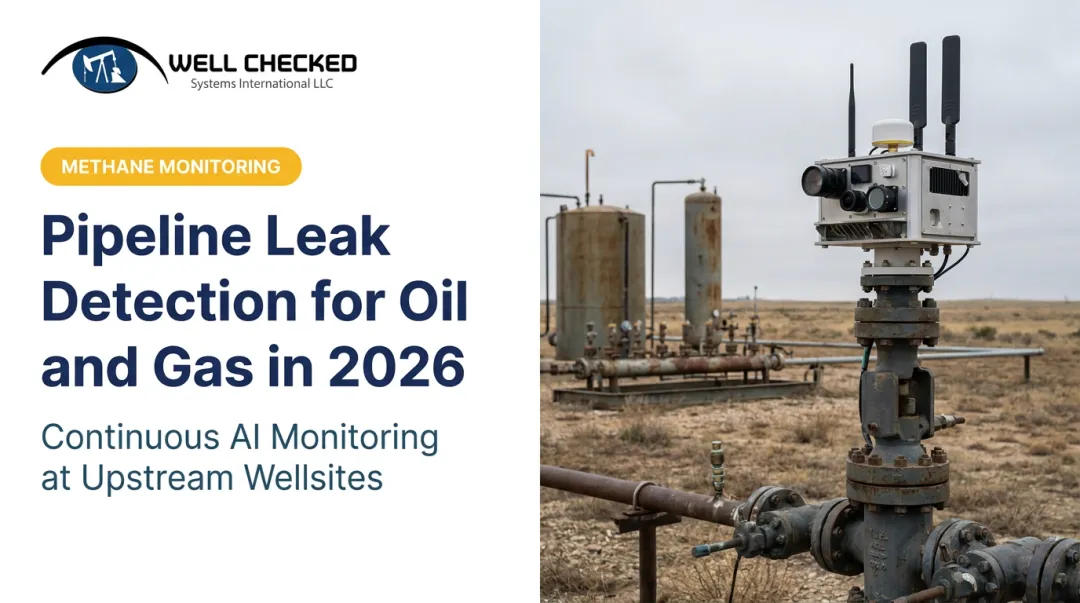
Multi-sensor, context-aware alerting is gaining ground fast, particularly in industrial and remote-site settings. Instead of relying on one data stream, these systems fuse video, acoustic signals, and gas or chemical detection into a single picture — catching things that no individual sensor would flag on its own. Well Checked Systems' Zensory.ai™ platform is one example, pairing video, acoustic anomaly AI, and optical gas imaging to catch fugitive methane at remote wellsites that a single sensor would miss.

What's New in Automated Alerting for 2026
Three shifts define automated alerting heading into 2026, and none of them are subtle.
AI and agentic reasoning are layering onto alert engines. Rather than forwarding every raw notification, newer systems correlate related alerts, pull in historical context, and add a "why this matters" explanation automatically. IBM describes this as triage using service dependencies and operational context rather than treating each alert in isolation.
Gartner has cautioned, though, that more than 40% of agentic AI projects will likely be canceled by 2027 due to unclear ROI. Bounded permissions and human review still matter.
Multi-sensor fusion is moving alerting into the physical world. Sight, sound, and gas or infrared imaging are increasingly combined in industrial and OT/IoT settings, extending alerting beyond logs and metrics into equipment and environmental conditions that were previously invisible between inspections.
Edge computing is becoming the default for remote and industrial alerting. Detection and triage now happen on-site, without depending on a stable connection back to a central server. Global edge spending was projected to hit $261 billion in 2025, according to LF Edge's 2025 year-in-review report, driven largely by real-time AI and lower-latency requirements.
For a wellsite three hours from cell coverage, that's the only way alerting works at all.
Best Practices for Building Trustworthy Automated Alerts
An alerting system nobody trusts is worse than no system at all. A few practices separate the ones teams rely on from the ones they mute.
- Filter and deduplicate aggressively. If the same underlying issue keeps re-triggering, merge those events into one alert instead of paging someone five times.
- Tier by severity. Not every condition deserves a 2 a.m. text. Reserve urgent channels for genuinely urgent conditions.
- Make every alert actionable. Include location, context, and next steps — a bare "anomaly detected" message forces the recipient to go investigate from scratch. Well Checked's Zentinal Core™ follows this principle, filtering false alarms so operators see only true fugitive emissions events.
- Set delivery and escalation SLAs. Define how fast an alert should reach someone, and what happens if it doesn't get acknowledged.
- Test the pipeline itself, regularly. An alerting system that silently fails is more dangerous than having none, because everyone assumes it's working.
That last point trips up more teams than it should. It's easy to test whether a rule fires correctly and forget to test whether the notification actually reaches a phone.
Automated Alerting in Action: Methane and Emissions Monitoring in Oil and Gas
Traditional Leak Detection and Repair (LDAR) inspections and pumper-route site visits are manual monitoring applied to physical infrastructure. A technician drives out, checks the site, and leaves. For everything that happens between visits, the operator is blind. Mid-sized to large operators typically spend $1 million to $5 million or more annually on these route-based visits alone.
Well Checked Systems built its Zensory.ai™ platform to close that gap. It fuses three sensor modalities into one continuous monitoring system:
- Video: high-resolution cameras with AI object detection, analyzing 1,500+ videos per site, per day
- Acoustic anomaly AI: detects abnormal sound signatures from equipment malfunctions before a leak becomes visible (Well Checked has a USPTO provisional patent filing covering its acoustic anomaly detection technology)
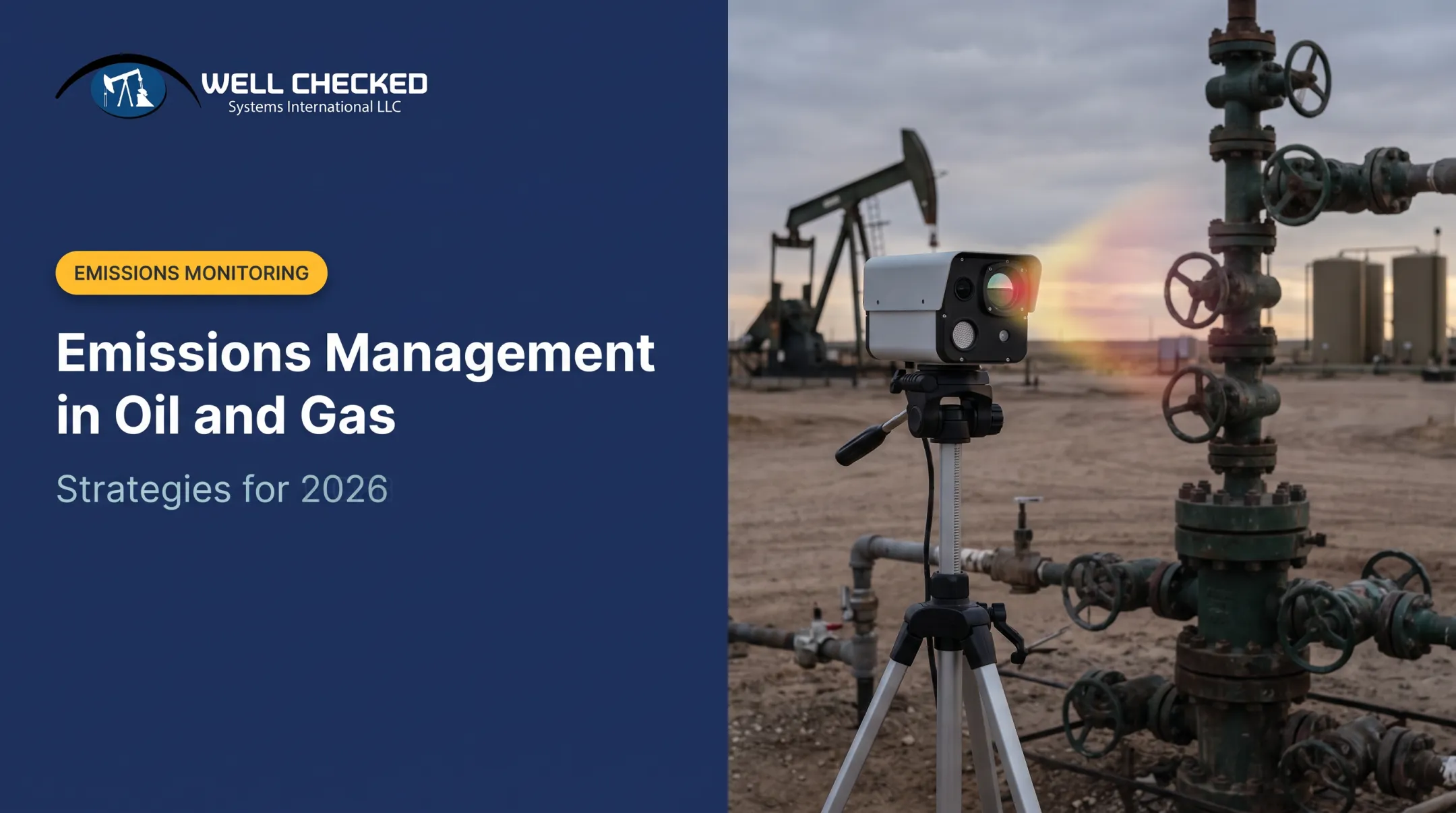
- Long-Wave Infrared Optical Gas Imaging (OGI): continuous day/night methane and volatile organic compound (VOC) detection, at roughly one-third the cost of traditional mid-wave IR systems. Well Checked has a USPTO provisional patent filing for Detecting and Quantifying Fugitive Methane and Vapor Emissions Using Infrared Imaging and Machine Learning.
A Three-Tier Alerting Architecture
The platform splits detection from reporting across three sequential tiers, which mirrors the closed-loop design discussed earlier in this article:
- Zentinal Ops™ delivers visual and acoustic equipment intelligence: high-resolution video, object recognition, acoustic anomaly detection, and actionable alerts.
- Zentinal Core™ monitors continuously and, after a roughly 2-day AI site-learning period, establishes what "normal" looks like at that specific location. It filters out routine process emissions and known operational noise, alerting only on validated fugitive events; supports OGMP 2.0 Level 3.
- Zentinal IQ™ activates only after Core validates a real event. It quantifies volume, duration, and rate using AI-refined plume analysis, producing compliance-ready reports aligned with EPA Subpart OOOOb, OGMP 2.0 Level 4/5, SASB, and TCFD frameworks.

Because Zentinal IQ™ never fires on a false positive, operators avoid quantifying and reporting events that never happened.
This "operate by exception" model is the same principle behind good alerting anywhere: discern true anomalies from normal operations, then route only the real ones to a human.
This model has been applied across multi-sites in the Appalachian Basin. Alerts reach field teams through the Well Checked dashboard, email, SMS, or a read-only SCADA API, triggering an acknowledge-dispatch-mitigate response within 24 hours. Field teams say that speed helps limit EPA fine exposure on validated events.
Frequently Asked Questions
What are automated alerts?
Automated alerts are system-generated notifications triggered by predefined rules or AI models, delivered without someone actively watching a dashboard. They combine detection, notification, and often an action step into one workflow.
What are the types of automated alerts?
The four main types are threshold-based, anomaly detection, composite/correlated event, and automated action alerts. Each suits different conditions, from fixed limits to complex multi-signal incidents.
What is the new automated alerting system?
The newest systems layer AI and agentic reasoning onto alert engines for context-aware triage, while fusing multiple sensor types (video, acoustic, gas imaging) for physical-world detection beyond IT logs and metrics.
How does automated alerting reduce alert fatigue?
It filters duplicate or low-value signals, groups related events, and routes alerts by severity so only genuinely urgent conditions reach a person immediately. This keeps teams responsive instead of desensitized.
Is automated alerting the same as AIOps?
No. Automated alerting detects a condition and routes or triggers a response. AIOps is the broader discipline that correlates cross-domain data, identifies incidents, and augments remediation. Alerting is one component of it.
What industries rely most on automated alerting?
IT/DevOps, security operations, healthcare, manufacturing, and oil and gas all depend heavily on it. In oil and gas specifically, it now extends to continuous methane and fugitive emissions detection at remote wellsites.