
NSPS OOOOb applies to new, modified, and reconstructed sources built after December 6, 2022.
This guide breaks down who's covered, what the numeric limits actually require, how the Super-Emitter Program changes your risk profile, and where continuous monitoring platforms like Zensory.ai™ fit into a defensible compliance strategy.
Key Takeaways
- OOOOb applies to new/modified/reconstructed sources after Dec. 6, 2022
- Tank batteries, compressors, pneumatic controllers, and pumps face specific group-level emission limits
- Super-Emitter Program (100 kg/hr) adds third-party satellite detection; SEP applicability is deferred until January 2027
- 2025–2026 amendments extended flaring windows and revised NHV monitoring requirements
- Continuous multi-sensor monitoring outperforms periodic LDAR for alternative-monitoring and reporting requirements
What Is the OOOOb Final Rule and Who Must Comply
EPA finalized NSPS OOOOb (40 CFR Part 60, Subpart OOOOb) on December 2, 2023, publishing the full text on March 8, 2024. OOOOb applies to sources constructed, modified, or reconstructed after December 6, 2022. That date reaches back before finalization, so operators often discover existing sites already fall under new-source standards.
Affected facility types include:
- Wells (including associated-gas wells)
- Compressors (centrifugal and reciprocating)
- Storage vessels and tank batteries
- Process controllers and pumps
- Fugitive emissions components
- Sweetening units
Modification or reconstruction can pull an older facility into OOOOb's scope even if it was originally built years before December 2022. Replace a compressor, expand a tank battery, or make other qualifying changes, and you may now face new-source standards on old infrastructure.
A Moving Deadline
Applicability is only half the picture; the compliance calendar has shifted too. EPA's July 2025 interim final rule extended several compliance deadlines, and a December 2025 final action reaffirmed those extensions. A separate April 2026 reconsideration finalized narrower technical amendments (including flaring and monitoring changes) effective June 8, 2026.
Treat OOOOb as living rules: re-check EPA actions before you lock monitoring plans, capital projects, or compliance calendars.
Core Emission Standards Operators Must Meet
OOOOb sets numeric thresholds and control requirements for storage vessels, compressors, pneumatics, and associated gas. These are the limits operators need on the compliance checklist.
Tank Batteries and Storage Vessels
Storage vessel affected facilities trigger applicability at 6 tons per year potential VOC or 20 tons per year potential methane. Once covered, operators must achieve a 95% control efficiency reduction.
After 12 consecutive months of compliance, operators may switch from potential to actual emission rates. That path stays open only if actual VOC stays below 4 tpy and actual methane below 14 tpy, tracked on a rolling 12-month basis.
Compressor Leak Thresholds
Compressor rules set specific volumetric leak limits:
- Wet seal centrifugal compressors: 3 scfm per seal
- Dry seal centrifugal compressors: 10 scfm per seal (a new source category)
- Reciprocating compressor rod packing: 2 scfm per cylinder

Measurement intervals run no later than every 8,760 operating hours, and rod-packing repairs after an exceedance are generally due within 90 calendar days.
Zero-Emission Controllers and Pumps
Starting January 22, 2027 (or at startup, if later), new natural gas pneumatic controllers must be designed for zero methane and VOC emissions. Limited exceptions exist for Alaska sites without electrical power access. Pumps face the same zero-emission design mandate at sites with electrical power, and at sites without power when three or more natural-gas-driven diaphragm pumps operate.
Flaring Phase-Out
OOOOb phases out routine flaring. Associated-gas wells must route gas to sales, recovery, on-site use, or reinjection. The 2026 reconsideration extended the temporary flaring allowance from 24 to 72 hours in specified situations, with limited extra time only for exigent circumstances.
Across the full rule, EPA's regulatory impact analysis projects 58 million short tons of cumulative methane reductions and 16 million short tons of VOC reductions from 2024–2038, plus $97 billion in net monetized benefits at a 3% discount rate.
The Super-Emitter Response Program: A New Compliance Risk
A super-emitter event is any methane release detected by remote sensing at 100 kg/hr or greater. Certified third parties (using satellite, aerial, or mobile monitoring) submit notifications through an EPA-mediated process within 15 calendar days of detection.
Here's where it gets uncomfortable for operators:
- EPA notifies you if your facility sits within 50 meters of the reported coordinates
- You investigate within 5 calendar days of notification
- You report findings within 15 days, identifying the source and corrective action
- If the event is ongoing, you must update the report with an end date/time within 5 business days after it stops

Note: EPA's 2025 interim final rule deferred Super-Emitter Response Program applicability until January 22, 2027, so this isn't live enforcement yet, but the clock is running.
Why Reactive Investigation Is a Bad Position
Waiting for a satellite notification means you're already on the back foot: investigating a public data point instead of your own operational intelligence. That's a reputational risk on top of a compliance one.
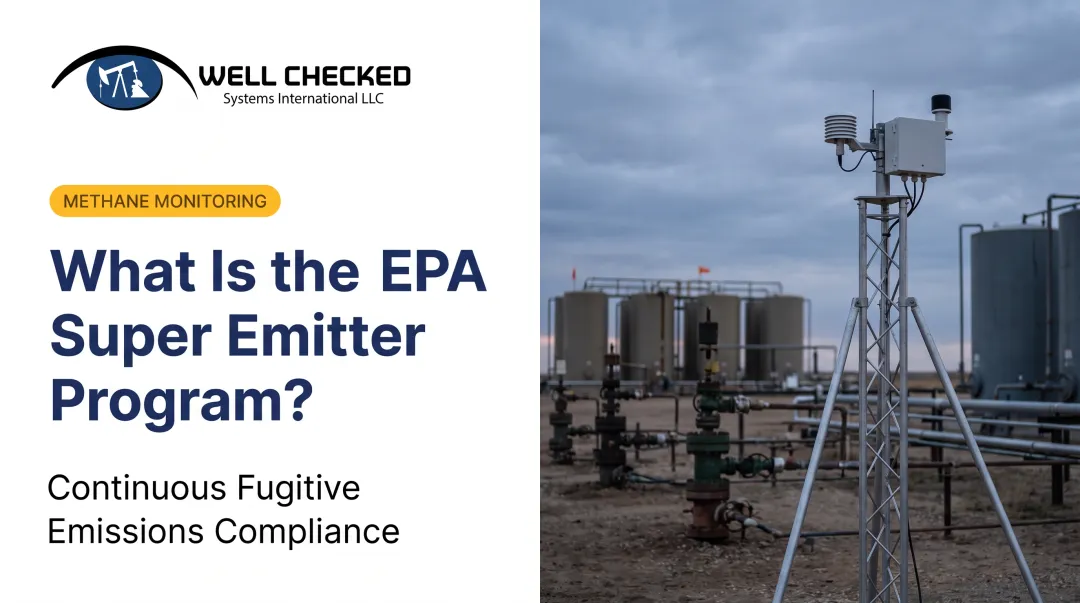
This is the gap that continuous multi-sensor monitoring is built to close. Zensory.ai™ combines video, LWIR optical gas imaging, and acoustic detection to flag fugitive events at the wellsite level, before a third-party overflight turns your leak into an EPA notification. Instead of reacting to someone else's data, operators get their own timestamped record of what happened and when.
Recordkeeping, Reporting, and Alternative Monitoring Pathways
Annual reports go through EPA's CEDRI electronic system, due 90 days after the end of each compliance period. A 2025 amendment clarified that no annual report is due before November 30, 2026.
Reporting deadlines are only half the picture. Operators that want to use non-standard detection methods still need a separate EPA approval path.
The Equivalence Trap
OOOOb allows alternative monitoring technologies in place of standard OGI/Method 21 surveys, but approval isn't automatic. Per EPA's compliance guide, operators must demonstrate detection performance based on a 90% probability of detection, and continuous systems specifically must:
- Detect at least 0.40 kg/hr (0.88 lb/hr) of methane
- Confirm device health twice every six-hour block
- Transmit valid data at least once every 24 hours
- Maintain rolling 12-month downtime at or below 10%
Vendor spec sheets alone won't cut it. EPA requires an independent equivalence demonstration with supporting data, standard operating procedures, and field verification. Complete submissions are reviewed within 270 days.

Why Continuous Data Wins the Audit Trail
Quarterly LDAR gives you snapshots. Continuous, timestamped multi-sensor data gives you a running record.
That trail supports OOOOb compliance and the measurement-based disclosures OGMP 2.0 Level 4/5, SASB, and TCFD increasingly expect.
Building a Compliance Strategy: From Detection to Defensible Data
A phased approach beats a big-bang rollout:
- Inventory your facilities against OOOOb source categories — wells, compressors, tank batteries, controllers, pumps
- Prioritize tank batteries and compressors first — they carry the most specific numeric thresholds
- Layer in continuous monitoring rather than trying to retrofit compliance after an inspection finding
The Acknowledge-Dispatch-Mitigate Model
A documented 24-hour response window (acknowledge the alert, dispatch a team, mitigate the source) gives operators an evidenced account of how each validated event was handled. Reacting fast, and having the record to prove it, matters as much as the fix itself.
Well Checked's Zensory.ai™ platform is built around this workflow through a three-tier architecture:
- Zentinal Ops™ — visual and acoustic site intelligence, the first layer of detection
- Zentinal Core™ — multi-sensor fugitive-event validation that filters false alarms and alerts only on genuine anomalies
- Zentinal IQ™ — quantifies validated events by volume, duration, and rate for regulatory-defensible reporting

Operators can start with detection alone and add reporting capacity as OOOOb enforcement escalates.
That same stack already runs across remote US onshore sites. This is production software in the basins where OOOOb applicability actually bites.
Frequently Asked Questions
What facilities are subject to the OOOOb final rule?
OOOOb covers new, modified, or reconstructed sources built after December 6, 2022, including wells, compressors, storage vessels/tank batteries, and process controllers/pumps. Modifications to older equipment can also trigger coverage.
What counts as a super-emitter event under OOOOb?
Any methane release detected by certified remote sensing (satellite, aerial, or mobile) at 100 kg/hr or greater. EPA notifies nearby operators, who must investigate and report. Super-Emitter Program applicability is deferred until January 2027.
How can operators use alternative monitoring technology for OOOOb compliance?
Operators must demonstrate their technology meets EPA's detection-performance standards, including a 90% probability of detection for periodic screening or specific thresholds for continuous systems. Vendor specs alone are not enough; independent validation is required.
Has the OOOOb rule changed since it was finalized in 2023?
Yes. A 2025 interim final rule extended multiple compliance deadlines and deferred the Super-Emitter Program to January 2027. A 2026 reconsideration extended flaring windows and revised NHV monitoring requirements.
How does continuous monitoring help with OOOOb compliance compared to quarterly LDAR?
Continuous monitoring produces timestamped, ongoing records rather than periodic snapshots, supporting faster response times and a stronger audit trail for EPA and ESG-framework reporting. It also shifts operators from reactive to proactive fugitive-event detection.