
Introduction
A methane leak at a remote wellsite can go unnoticed for weeks between scheduled inspections, costing an operator thousands in lost product and regulatory exposure. Now compare that to a leak flagged the moment it starts, with a response team dispatched within hours.
That gap between "eventually" and "instantly" is the entire premise behind real-time event monitoring.
Businesses that rely on periodic checks, daily log reviews, or quarterly site visits often don't find out something went wrong until the damage is already done.
In cybersecurity, the median dwell time between a breach and its detection reached 14 days globally in 2025, up from 11 days the year before, according to Mandiant's M-Trends 2026 report. That's two full weeks of unmonitored exposure.
This article breaks down what real-time event monitoring actually is, how the technology works, and how it plays out across industries, from IT security to e-commerce to oil and gas emissions compliance.
Key Takeaways
- Real-time event monitoring analyzes data the instant an event occurs, not in scheduled batches
- It unites data capture, streaming, processing, and alerting into one continuous pipeline
- IT security, e-commerce, and industrial teams use it to cut risk, cost, and response time
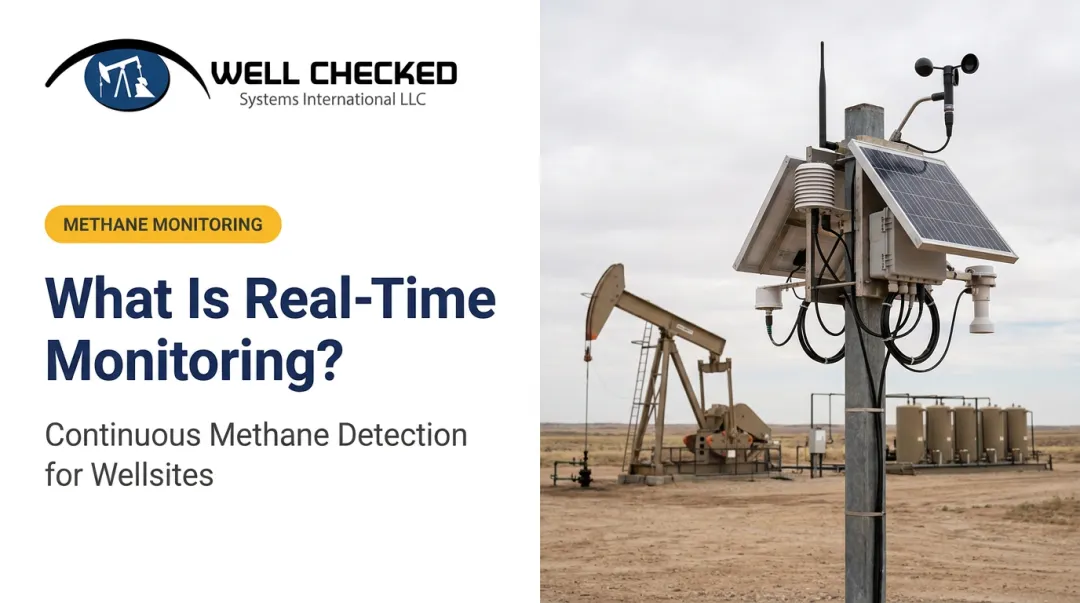
- In oil and gas, Well Checked's Zensory.ai™ replaces periodic site visits with continuous methane detection
What Is Real-Time Event Monitoring?
Real-time event monitoring is the continuous capture, transmission, and analysis of data at the moment an event occurs. Instead of waiting for a scheduled report to surface a problem, the system flags it as it happens, giving teams immediate visibility instead of delayed batch updates.
The distinguishing factor is latency. Real-time systems aim for near-zero delay between an event occurring and it being detected. Traditional monitoring, by contrast, runs on hourly, daily, or quarterly review cycles, meaning something could go wrong on a Monday and not surface until Friday's report.
What Counts as an "Event"?
An event is any discrete occurrence worth tracking. That could be:
- A user clicking "add to cart" on an e-commerce site
- An unusual login attempt on a corporate network
- Sensor readings crossing a safety threshold
- Gas plumes rising at an industrial wellsite
Real-time event monitoring spans several domains: IT and application performance, cybersecurity and user activity tracking (think audit-log streaming), business and product analytics, and industrial or operational technology (OT) sensor monitoring.
Why the Shift to Real-Time Is Happening Now
Delayed detection windows have historically left organizations exposed longer than they realize. Mandiant's research found a striking split: intrusions detected internally had a median dwell time of just 5 days, while those requiring external notification stretched to 26 days. Internal visibility, in other words, is the difference between catching a problem in days versus nearly a month.
How Real-Time Event Monitoring Works
Nearly every real-time event monitoring system, regardless of industry, runs on the same four-stage pipeline: capture, stream, process, and alert.
Data Capture: Sensors and Data Sources
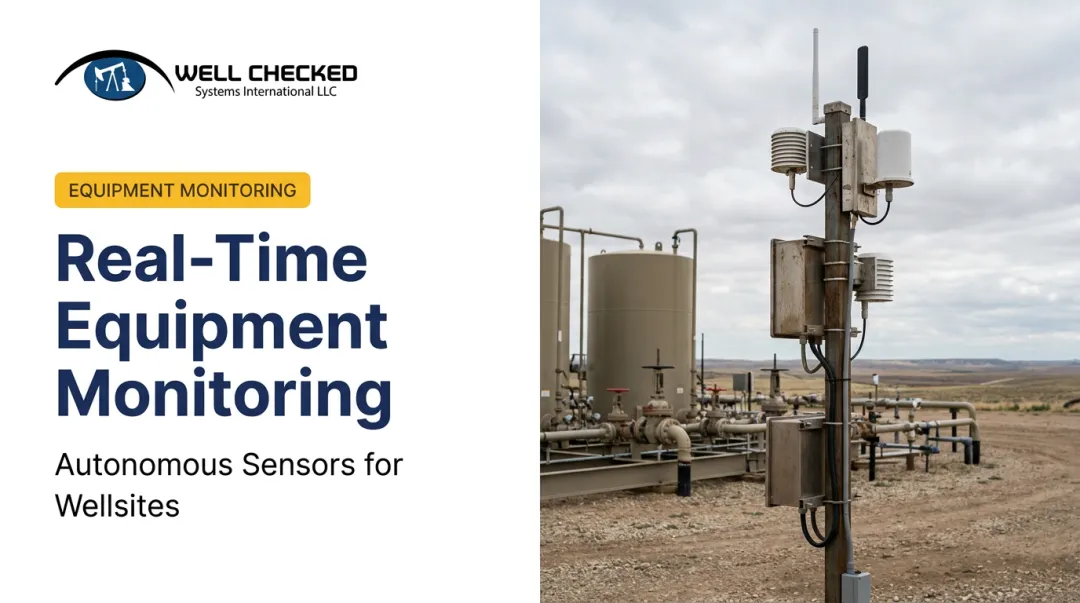
Events get captured from whatever source fits the use case. In digital systems, that means software logs, API calls, and user clicks. In industrial environments, it means physical sensors: cameras, gas detectors, and acoustic equipment monitors picking up real-world conditions on the ground.
Streaming and Processing: Making Sense of Data in Motion
Once captured, data has to move somewhere for analysis. Streaming technologies, message queues, and event brokers transport that data with minimal delay from source to analysis engine.
This is also where the real intelligence happens. AI models and rules engines filter signal from noise, catching false positives before they ever reach a human. Without this filtering layer, teams drown in alerts and stop trusting the system altogether.
Alerting and Response: Closing the Loop
The final stage triggers action, whether that's an automated alert or a policy update, but only once analysis confirms a genuine anomalous event. This lets teams act within minutes or hours instead of days.

Mature systems go a step further by separating two distinct functions:
- Detection — flagging that something happened
- Quantification/validation — confirming the severity and defensibility of the data
This distinction matters more as regulatory-grade use cases grow. A flagged anomaly and a court-defensible data point are not the same thing, and treating them as interchangeable creates real liability.
Well Checked Systems built this separation directly into its Zensory.ai™ platform: Zentinal Core™ handles detection and false-alarm filtering, while Zentinal IQ™ quantifies confirmed events for EPA and OGMP 2.0-grade reporting.
Real-Time Event Monitoring vs. Traditional Periodic Monitoring
Traditional monitoring checks in on a schedule:
- Daily log reviews
- Quarterly site inspections
- Monthly audits
Real-time monitoring never stops checking.
The gap between these two approaches is the detection lag, and it compounds. A security breach, equipment failure, or emissions event can persist undetected for the entire interval between checks. A quarterly leak detection and repair (LDAR) inspection, for example, means up to three months where a leak could run unnoticed, driving up cost, safety risk, and liability exposure.
| Factor | Periodic Monitoring | Real-Time Event Monitoring |
|---|---|---|
| Detection lag | Hours to months | Seconds to minutes |
| Record type | Point-in-time snapshot | Continuous, timestamped log |
| Audit defensibility | Limited to inspection dates | Ongoing, verifiable trail |
| Cost driver | Scheduled labor/travel | Exception-based response |
Beyond speed, real-time monitoring produces continuous records, a difference that matters greatly for compliance-heavy industries. A snapshot from a single site visit can't prove what happened between visits, but a continuous log can. This is the shift Well Checked's Zensory.ai™ platform enables for upstream operators.
Real-World Examples of Real-Time Event Monitoring
Theory is one thing. Here's how this plays out in practice across three very different fields.
IT and Cybersecurity
Platforms like Salesforce's Event Monitoring stream user activity logs, including login events, API calls, and report exports, in near real time to detect suspicious access patterns and enforce security policies within seconds. That said, not every part of the system moves at the same speed.
Salesforce's own documentation notes that while events generate log data instantly, the hourly log files used for deeper analysis typically aren't available for 3 to 6 hours, and daily files not until the next day. Streamed security events and batch log delivery are two different clocks.
Digital Product and E-Commerce Analytics
Companies track user clicks, cart behavior, and feature usage through event-streaming pipelines to make immediate product decisions.
BigCommerce's real-time data platform, built on Kafka, processes more than 1.6 billion messages per day across visits, product views, cart additions, checkouts, and orders. That volume of live event data is what lets product teams react to a shopping trend the same day it starts, not the following quarter.
Industrial and Field Operations
Industrial environments face a different challenge: physical, remote, and often unmonitored sites.
Here, continuous multi-sensor monitoring, combining video, gas imaging, and acoustic equipment sensors, detects physical events like equipment malfunctions or gas leaks at locations that would otherwise only see a technician a few times a year. This category sets the stage for one of the most demanding applications of real-time event monitoring: upstream oil and gas.
Key Benefits of Real-Time Event Monitoring — and How It Works for Oil & Gas Operators
Across industries, real-time event monitoring delivers the same core wins: faster response, reduced risk exposure, lower operating costs from eliminating manual checks, and stronger audit trails.
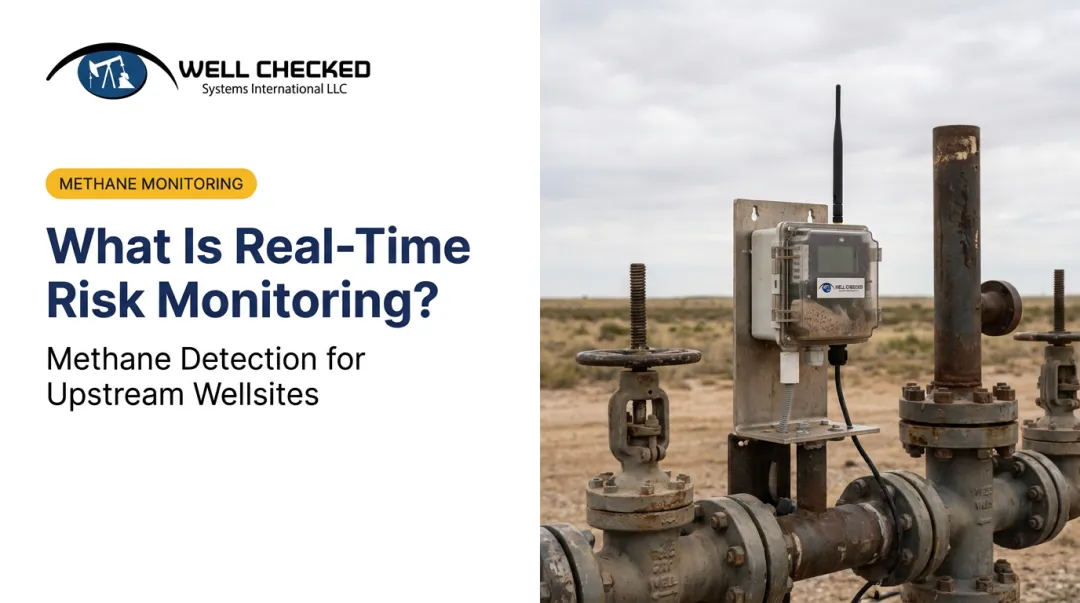
For upstream oil and gas operators specifically, the stakes are sharper. Methane and volatile organic compound (VOC) emissions must be identified and mitigated quickly to avoid regulatory fines and to satisfy frameworks including the EPA methane rule (40 CFR Part 60 Subpart OOOOb), OGMP 2.0, and ESG disclosure standards like SASB and TCFD.
How Zensory.ai™ Applies This in the Field
Well Checked Systems built its Zensory.ai™ platform around exactly this problem. It combines three sensor modalities at each wellsite:
- Sight — high-resolution cameras with AI object detection, providing 360° coverage
- Sound — acoustic anomaly AI that flags abnormal equipment noise before it becomes a failure
- Gas imaging — Long-Wave Infrared (LWIR) optical gas imaging for continuous day/night methane and VOC detection
Each new site goes through roughly a 2-day AI learning cycle, during which the system builds a site-specific baseline of normal operations. That baseline is what separates routine process emissions from a true fugitive leak, the "needle in stacks of needles" that older, cruder systems tend to miss or over-flag.
Detection and Validation as Two Distinct Steps
Zensory.ai™ splits that separation work across two purpose-built layers. Zentinal Core™ handles detection, filtering out false alarms in real time and confirming genuine anomalies. Zentinal IQ™ then quantifies confirmed events, producing regulatory-defensible data suitable for EPA, OGMP 2.0, and ESG reporting.
Once Zentinal Core™ validates an event, the response clock starts. Operators are alerted through the dashboard, email, SMS, and SCADA integration, and standardized runbooks guide the acknowledge-dispatch-mitigate workflow within 24 hours. That timing matters for supporting a documented, timely response on a validated event.
Scale in Practice
Well Checked operates this at production scale. The platform currently monitors remote wellsites, including a multi-site continuous deployment across the Appalachian Basin, processing 1,500+ videos analyzed per site per day.
That throughput lets operators shift away from routine pumper-route visits, which can run $1M to $5M+ annually for mid-sized to large operators, toward operating by exception instead.

Frequently Asked Questions
What is a real-time event?
A real-time event is any discrete occurrence, digital or physical, that's captured and processed the instant it happens. The key feature is near-zero delay between when it occurs and when it's detected.
What is an example of real-time event monitoring?
Examples include security login tracking that flags suspicious access within seconds, e-commerce platforms tracking cart activity as it happens, and continuous methane detection at oil and gas wellsites.
What is the difference between real-time monitoring and real-time event monitoring?
Real-time monitoring broadly tracks ongoing system or site status. Real-time event monitoring specifically focuses on detecting and acting on discrete triggering occurrences the moment they happen.
What industries use real-time event monitoring?
IT and cybersecurity, e-commerce and SaaS, financial services, and industrial sectors like oil and gas all use it, each for a different driver, whether that's security, performance, or compliance risk.
How does real-time event monitoring support regulatory compliance?
Continuous, timestamped event records create a defensible audit trail that periodic snapshot reporting simply can't match. This is increasingly required under frameworks like the EPA methane rule and ESG disclosure standards.
What technology powers real-time event monitoring systems?
The common building blocks are data capture (sensors or logs), a streaming/event pipeline, AI-based processing that filters out noise, and automated alerting through dashboards or notifications.