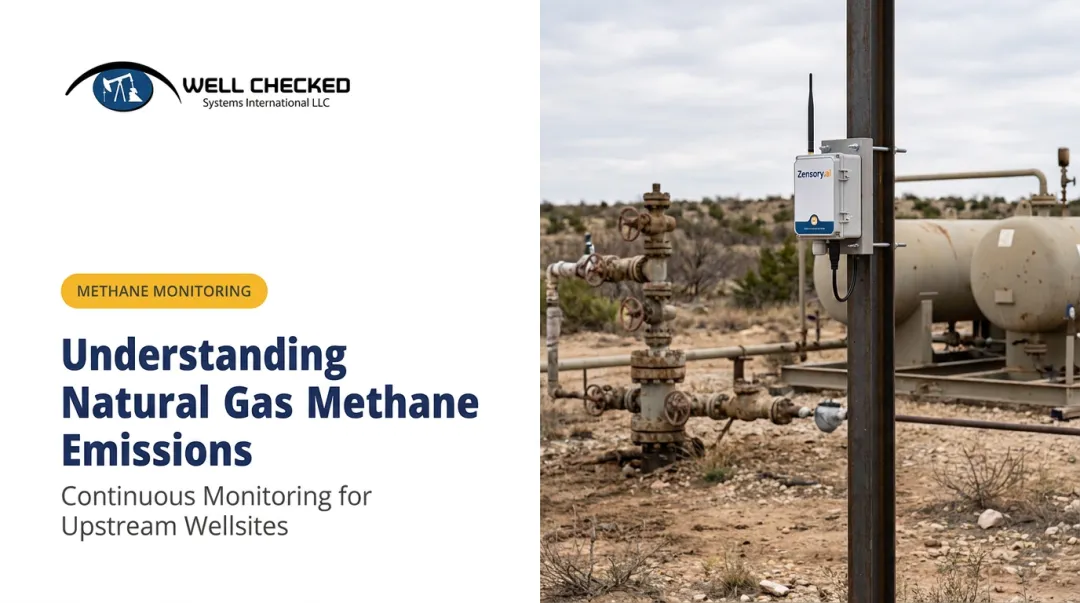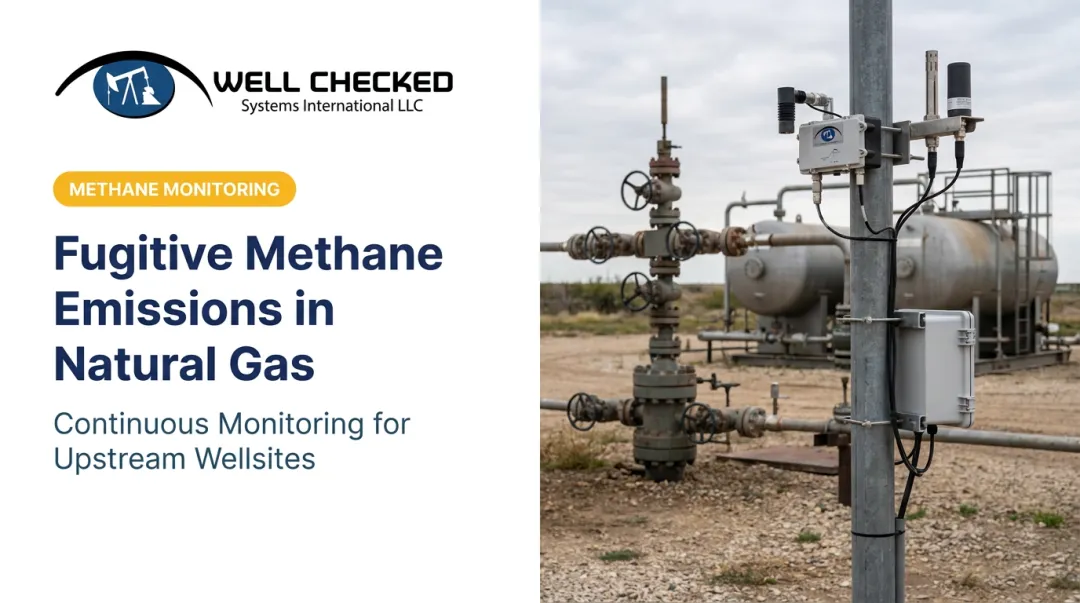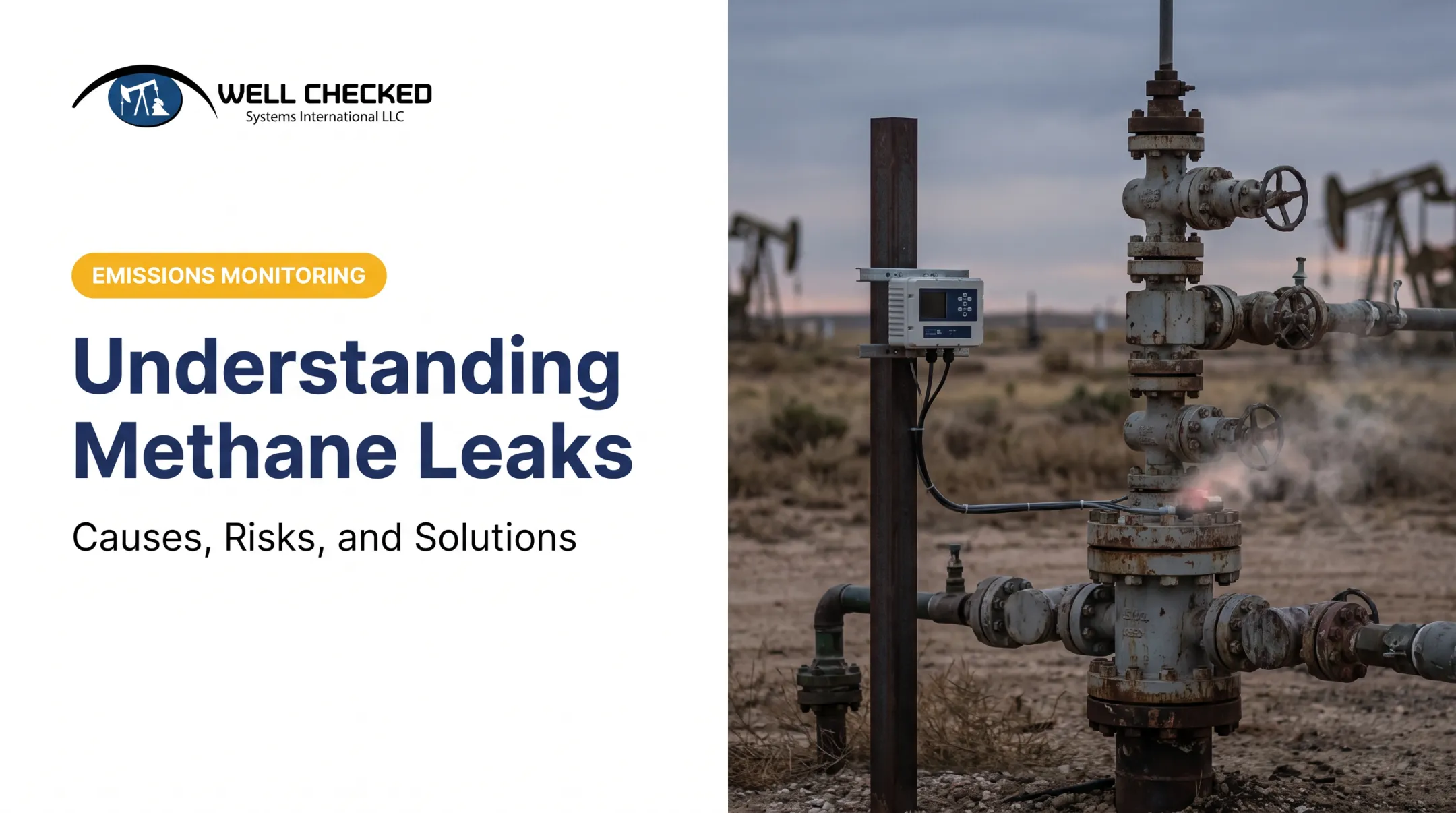

Methane isn't just another greenhouse gas. For upstream operators, even small leaks translate into real financial exposure: regulatory penalties, lost saleable product, and safety risk.
This article breaks down what causes fugitive methane, what happens when it goes unaddressed, the warning signs to watch for, and how modern monitoring is changing prevention.
Key Takeaways
- Fugitive methane escapes unintentionally from equipment, not through controlled stacks or vents.
- Most releases come from equipment leaks, venting, incomplete combustion, and human or process error.
- Ignoring it risks EPA scrutiny, safety incidents, and lost product revenue.
- Continuous autonomous monitoring is replacing periodic LDAR walks as the standard.
- Long-term control pairs technology with training and defensible documentation.
Common Causes of Fugitive Methane Emissions
Fugitive emissions are unintended, diffuse releases, distinct from planned point-source venting. The EPA identifies leaks stemming from connectors, valves, open-ended lines, pressure-relief valves, and storage tank thief hatches, according to its Natural Gas STAR program. These releases stem from equipment wear, operational practices, or process gaps across the gas lifecycle.
Equipment Leaks (Valves, Seals, Connectors)
Aging seals, corroded fittings, and pressure swings cause slow, chronic leaks. Common locations include compressor stations, wellhead connections, and storage tank hatches. A 2022 peer-reviewed study of 15 West Virginia production sites found total measured emissions of 57.5 kg CH4/hour, or about 68 mcf/d, with tanks alone contributing roughly 25% of that total, per research published in ScienceDirect.

Venting and Blowdowns
High-bleed pneumatic controllers release gas continuously during normal operation, and maintenance blowdowns add larger intermittent volumes. In that same West Virginia study, pneumatic devices contributed about 61% of measured emissions, making them the single largest source category identified.
Incomplete Combustion or Flaring Malfunctions
Faulty flares or lost pilot lights let unburned methane escape instead of converting to CO2. Remote flare stacks are especially vulnerable since a lost pilot light can go unnoticed for days.
Human Error and Deferred Maintenance
Quarterly operator routes miss leaks and malfunctions that develop between visits. A leak that starts three days after inspection can run undetected for weeks under a route-based model, wasting product the entire time.
What Happens If Fugitive Methane Is Ignored
Regulatory exposure has shifted. The Waste Emissions Charge tied to the Inflation Reduction Act was disapproved by Congress in May 2025. It was removed from federal code and is no longer in effect, per EPA's current status page. That doesn't mean operators are off the hook.
Subpart OOOOb still sets binding monitoring requirements by site type:
| Site Type | AVO Frequency | OGI/Method 21 Frequency |
|---|---|---|
| Single-wellhead sites | Quarterly | Not required |
| Multi-wellhead sites | Quarterly | Semiannual |
| Sites with major equipment | Bimonthly | Quarterly |
| Compressor stations | Monthly | Quarterly |

Beyond compliance, ignoring fugitive methane means:
- Lost product revenue: every leaked cubic foot is gas that never reaches sale
- Safety hazards: combustible gas accumulation near equipment or personnel
- ESG scoring damage: investors and partners increasingly scrutinize methane intensity
Warning Signs of a Developing Methane Event
Watch for these precursors:
- Unusual hissing or acoustic anomalies: near compressors and wellheads
- Unexplained pressure drops: inconsistent production volumes
- Visual haze or shimmer: detectable only through optical gas imaging, invisible to the naked eye
EPA's Appendix K standard requires OGI cameras capable of detecting 19 grams/hour of methane under controlled test conditions, per the eCFR standard. That's a sensitivity benchmark most naked-eye inspection can't match.
How to Prevent Fugitive Methane Emissions
Prevention works as a layered system: continuous detection, smart verification, fast response, and routine equipment upgrades.
Continuous Multi-Sensor Monitoring
What to do: Deploy always-on sensing that combines visual, acoustic, and optical gas imaging instead of relying solely on quarterly LDAR walks.
Why it matters: A 2025 peer-reviewed modeling study found that even monthly OGI surveys caught at most 40% of intermittent leaks within a year, assuming perfect detection (ACS ES&T Air research). Continuous scanning catches intermittent leaks within days.
Well Checked's Zensory.ai™ platform applies this approach across remote monitored sites. It combines LWIR optical gas imaging, acoustic anomaly detection, and video into one continuous feed rather than a periodic snapshot.

When to implement: At high-leak-risk equipment — compressors, tanks, wellheads.
AI-Based False Alarm Filtering
What to do: Use machine learning to separate normal process emissions (venting, flaring) from genuine fugitive anomalies.
Why it matters: Without filtering, alert fatigue sets in and teams start ignoring real leaks. Well Checked's Zentinal Core™ addresses this with a site-learning approach: the system establishes a normal operating baseline in roughly two days, then flags only what deviates from it.
When to implement: During onboarding of any new monitoring site.
Rapid Acknowledge-Dispatch-Mitigate Workflows
What to do: Set a defined response protocol once a validated leak alert fires.
Why it matters: Speed of response directly limits volume lost and regulatory exposure. One operator using Well Checked's system acknowledged, dispatched, and mitigated a confirmed fugitive-gas event within 24 hours of alert.

When to implement: As a standard operating procedure tied to every monitoring alert.
Routine Equipment Upgrades and Maintenance
What to do: Replace high-bleed pneumatic devices, upgrade aging seals and valves.
Why it matters: This lowers your baseline leak rate independent of how good your detection is.
When to implement: During scheduled maintenance cycles, or immediately after repeated anomaly flags at the same component.
Tips for Long-Term Prevention and Control
Long-term methane control depends on a system that documents events, trains crews, and adapts as sites change.
- Keep continuous, quantified records that support OGMP 2.0 Level 4/5, SASB, and TCFD better than snapshot reports
- Log duration and volume for every event so repair-versus-replace ROI decisions rest on real loss data
- Train field staff to spot early acoustic and visual leak indicators
- Standardize escalation so alerts become work orders, not backlog
- Deploy edge-computing sensor networks that keep monitoring running when remote wellsite connectivity drops
Platforms such as Well Checked's Zentinal IQ™ turn validated events into quantified emissions logs and EPA-format compliance data, so operators hold disclosure-ready records instead of unfiltered alerts.
Conclusion
Fugitive methane isn't a mystery. It has identifiable, addressable causes across the natural gas supply chain, from worn seals to high-bleed controllers to inspection gaps between quarterly visits.
Prevention is achievable when operators lock in three practices:
- Continuous multi-sensor monitoring
- Disciplined maintenance
- Fast response workflows
Proactive detection lowers regulatory exposure, cuts safety incidents, and stops product loss before it compounds. For operators weighing continuous monitoring against the cost of missed leaks, getting ahead of the problem is the clearer economic choice.
Frequently Asked Questions
What are fugitive methane emissions?
They're unintended, diffuse methane releases from equipment like valves, seals, and tanks across the natural gas supply chain. This is distinct from controlled stack emissions like flaring.
How significant are fugitive methane emissions from natural gas compared to other sources?
Natural gas and petroleum systems rank as the second-largest US methane source, behind agriculture, per EPA's methane overview and the current Greenhouse Gas Inventory.
How often should oil and gas sites be inspected for methane leaks?
Traditional LDAR programs use quarterly inspections at minimum. Continuous monitoring technology now enables real-time detection, catching leaks in days rather than months.
Can fugitive methane emissions be eliminated completely?
No. Complete elimination isn't realistic given the number of components involved. Continuous monitoring and rapid repair can cut the volume and duration of leaks that do occur.
What regulations govern fugitive methane emissions in the US?
EPA's methane rule (40 CFR Part 60 Subpart OOOOb) sets fugitive-component monitoring requirements. State-level rules and voluntary frameworks like OGMP 2.0 add further layers.
How does methane detection technology work?
Modern platforms combine optical gas imaging, acoustic sensing, and AI-based anomaly detection. Together they flag true leaks—gas plumes and pressure-escape sounds—while filtering out normal operations.