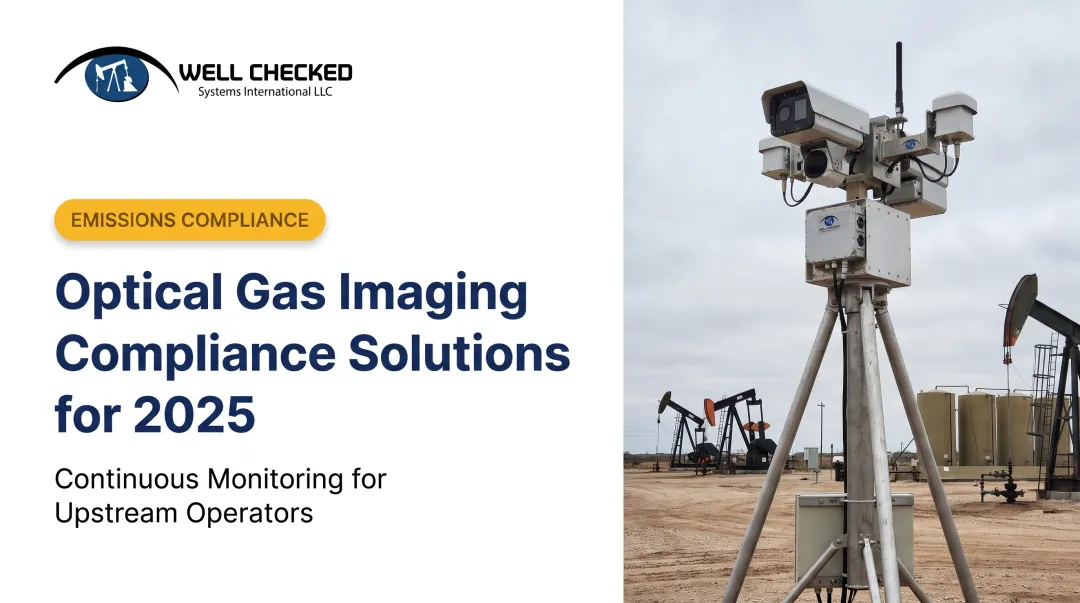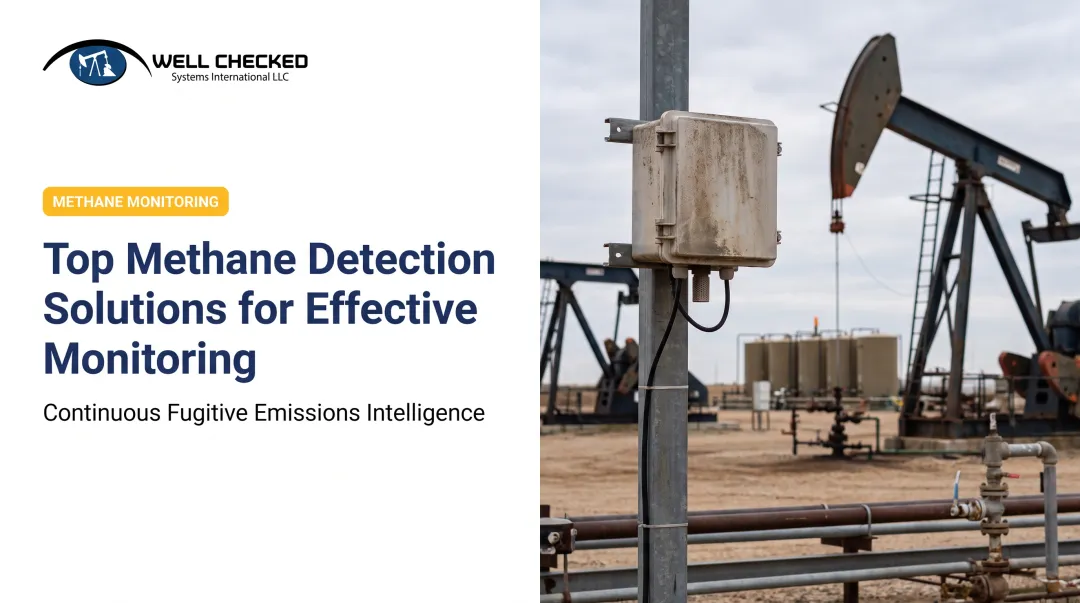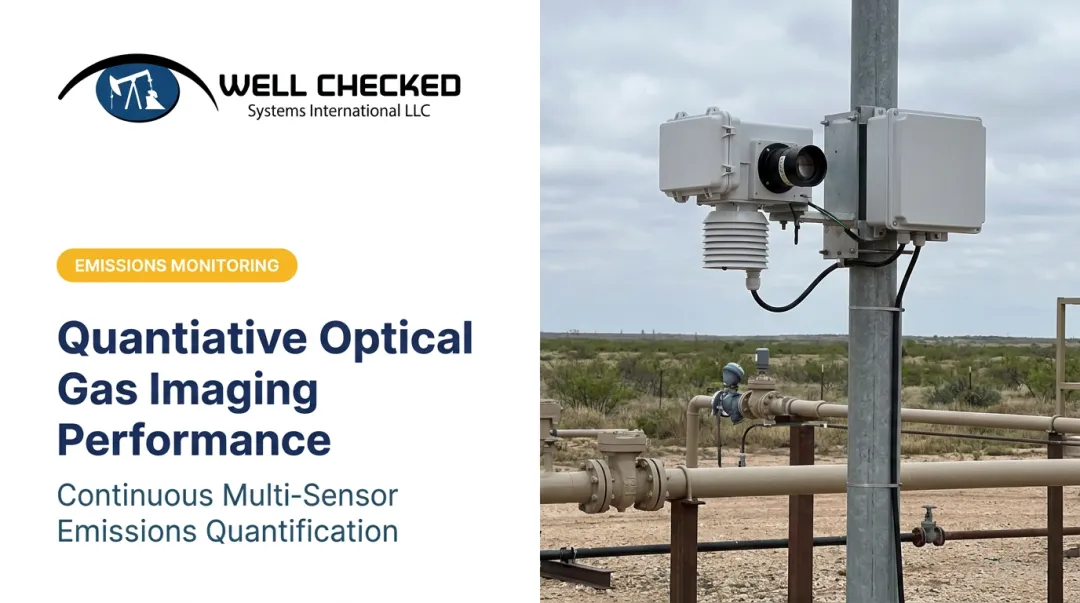

The stakes are real. Fugitive methane emissions trigger EPA penalties, waste product, and generate the kind of headlines no operator wants. Meanwhile, route-based operator visits cost mid-sized to large operators $1 million to $5 million or more annually — a number that's hard to justify when better options exist.
This guide compares the top OGI systems available to US operators today, from fixed continuous platforms to drone-mounted cameras, so you can match a system to both your compliance exposure and your operations.
Key Takeaways
- OGI cameras use infrared imaging to make invisible methane plumes visible in real time
- EPA's Subpart OOOOb is pushing operators toward continuous, defensible monitoring instead of quarterly LDAR surveys alone
- The strongest systems pair LWIR or MWIR imaging with AI-based false-alarm filtering and regulatory-grade quantification
- LWIR based OGI reduces costs by roughly two-thirds versus traditional mid-wave IR systems
- This guide ranks the top providers and outlines what actually matters: sensitivity, deployment model, compliance alignment, and cost
Overview of Optical Gas Imaging in US Oil & Gas
OGI, in plain terms, is an infrared camera tuned to the wavelengths where methane and hydrocarbon gases absorb light — turning an invisible leak into a visible plume on a screen.
The regulatory backdrop is what's forcing the upgrade. EPA's methane rule (Subpart OOOOb for new, modified, and reconstructed sources) sets the core bar:
- Monitoring frequencies from quarterly to semiannual, depending on site configuration
- Repair attempts required within 15 to 30 days of a detected leak
- EPA's Appendix K protocol camera benchmark of 19 grams/hour at 2 meters under calm conditions
Appendix K is a useful baseline, not a guarantee of real-world detection at your site. Layer on OGMP 2.0's push toward Level 4/5 measurement-based reporting and state LDAR rules in Colorado, New Mexico, and Texas, and the case for continuous, layered monitoring is clear.
Here's how the leading OGI systems serving US operators stack up.
Top Optical Gas Imaging Systems for Methane Detection in the US
Systems below are ranked on four criteria:
- Detection sensitivity
- Deployment flexibility (fixed, portable, or drone)
- Regulatory alignment
- False-alarm filtering
Well Checked Systems (Zensory.ai™)
Oklahoma-based Well Checked has spent 13+ years building autonomous wellsite intelligence and runs continuous monitoring across remote sites, including a deployment in the Appalachian Basin.
Zensory.ai™ does not rely on gas imaging alone. It fuses LWIR OGI with acoustic and video AI across a three-tier architecture:
- Zentinal Ops™ — visual and acoustic site intelligence
- Zentinal Core™ — multi-sensor detection that filters false alarms and flags true fugitive anomalies
- Zentinal IQ™ — quantifies validated emissions for EPA, OGMP 2.0, SASB, and TCFD-ready reporting
Zentinal Core establishes a site-specific baseline of normal operations in roughly two days. That baseline helps distinguish routine process emissions from actual leaks and cuts the false-alarm noise common in single-sensor systems.
| Feature | Details |
|---|---|
| Detection Technology | LWIR OGI fused with acoustic and video AI, roughly one-third the cost of traditional mid-wave IR-only systems |
| Deployment Model | Fixed, continuous, edge-computed monitoring that runs without depending on connectivity |
| Compliance Output | Structured for Subpart OOOOb alternative-monitoring submissions and OGMP 2.0 Level 4/5 reporting, with CSV/JSON exports and SCADA integration |

FLIR/Teledyne Optical Gas Imaging Cameras
FLIR's G-Series is a cooled MWIR handheld camera used by many LDAR contractors, with published documentation and an established service network.
FLIR states its models are OOOOa certified. That certification is tied to a specific rule generation, so confirm current model-specific evidence before assuming blanket OOOOb acceptance.
| Feature | Details |
|---|---|
| Detection Technology | Cooled MWIR camera (3.2–3.4 μm), 320x240 or 640x480 resolution |
| Deployment Model | Primarily handheld/portable for scheduled inspections |
| Compliance Output | Built around Appendix K survey protocol requirements |
Vision Aerial SwitchBlade-Elite with OGI Scout Payload
For corridor and elevated-equipment surveys, this drone-based system pairs a medium-lift UAS with a Sierra-Olympia MWIR OGI payload so crews can inspect pipeline routes and flare stacks without putting a person underneath the work area.
| Feature | Details |
|---|---|
| Detection Technology | MWIR core with Gas Enhancement Mode (GEM) colorization, less than 50 mK sensitivity, 640x512 resolution |
| Deployment Model | Airborne survey: payload up to 2.0 kg, flight time up to 50 minutes |
| Compliance Output | Documentation via MarkPoint event-capture software for LDAR programs |

LYNRED OGI Sensor Modules (EOLE MW / PICO640S)
LYNRED does not sell finished cameras. It supplies the sensor cores that integrators build into fixed and portable systems. The manufacturer publishes sensitivity figures against the EU's 2024 methane detection threshold. Those are EU benchmarks rather than US certifications, so integrators should confirm performance against the US rule their programme is measured under.
| Feature | Details |
|---|---|
| Detection Technology | Cooled MWIR and uncooled broadband LWIR sensor cores |
| Deployment Model | OEM component for integrators building fixed or portable cameras |
| Compliance Output | Engineered to exceed EU thresholds; supports US regulatory-grade detection when integrated into a finished system |
Ecotec Integrated OGI & Laser Detection Solutions
Ecotec pairs OGI with tunable diode laser absorption spectroscopy (TDLAS) tools: cheaper, faster handheld devices for screening between formal OGI surveys. It is less a standalone camera manufacturer and more a layered-workflow provider.
| Feature | Details |
|---|---|
| Detection Technology | MWIR/LWIR OGI plus TDLAS laser devices |
| Deployment Model | Portable handheld units for routine screening and confirmation |
| Compliance Output | OGI documents LDAR; laser tools boost screening frequency between surveys |

How We Chose the Best OGI Systems
The most common mistake operators make: picking a camera based on price or resolution without confirming it's tuned to the right wavelength band and matches their actual deployment model.
A gorgeous 640x480 image is useless if it's calibrated for SF6 instead of methane, or if it sits in a truck instead of on the wellhead that needs watching.
We weighed five factors:
- Detection sensitivity and range — tested against Appendix K's 19 g/hour benchmark, not marketing claims
- Regulatory alignment — maps to Subpart OOOOb and OGMP 2.0 reporting needs
- False-alarm intelligence — separates real leaks from steam, sun glint, and normal process venting
- Deployment flexibility — fixed, portable, or aerial, matched to site risk
- Total cost of ownership — camera cost versus current spend on route-based inspections
Conclusion
The right OGI system is the one that fits your basin footprint, compliance exposure, and monitoring cadence. Well Checked's handheld LWIR unit might be exactly right for a small multi-wellhead site doing semiannual surveys. A high-risk tank battery might need continuous fixed monitoring instead.
Before committing, evaluate total cost of ownership, false-alarm rates, and whether the system scales across a multi-basin portfolio. Spec-sheet resolution alone is not enough.
For operators ready to move from periodic LDAR routes to continuous, AI-filtered, regulatory-defensible monitoring, Well Checked's Zensory.ai™ platform is built for exactly that transition. Contact the team for a site assessment.
Frequently Asked Questions
What gases can optical gas imaging cameras detect?
OGI cameras detect gases based on infrared absorption wavelength. Methane and other hydrocarbons appear in the MWIR/LWIR bands (roughly 3.2–3.4 μm). Gases like SF6 or ammonia need different filter configurations.
Can laser methane detection replace OGI cameras?
No. Laser detection complements OGI rather than replacing it. OGI remains the EPA-recognized visual documentation standard, while laser tools like TDLAS offer faster, lower-cost screening between formal surveys.
How much does an optical gas imaging camera cost?
Camera costs generally run $25,000 to $120,000+, depending on cooling, optics, and quantification features. Continuous AI-monitoring platforms can offer lower total cost of ownership than route-based inspections at scale.
What is the EPA's methane rule and how does it affect OGI use?
Subpart OOOOb sets monitoring frequency from quarterly to semiannual based on site configuration. It also pushes operators toward continuous-monitoring options beyond periodic OGI surveys alone.
How far away can an OGI camera detect a methane leak?
Detection range varies widely with lens, leak size, wind, and camera sensitivity. EPA's Appendix K test is conducted at just 2 meters, though some systems claim usable range out to 150+ meters under ideal conditions.
Is a fixed or portable OGI system better for oil and gas sites?
Most mature programs use both: fixed or continuous systems watch high-risk points around the clock, while portable units handle scheduled, component-level inspections.