
Introduction
A single midstream operator can manage pipelines and compressor stations spread across several states, with individual wellsites separated by miles of unpaved road. Checking every gauge and valve by hand simply becomes operationally impossible at that scale.
That's the problem Supervisory Control and Data Acquisition (SCADA) was built to solve. For decades, SCADA has given energy, water, and oil & gas operators a way to watch and control distributed equipment from one control room, without a technician standing at every valve.
This guide covers what SCADA is, the hardware and software that make it run, and how field data actually travels to a dispatcher's screen. It also looks at where SCADA's usefulness hits a hard limit in oil & gas operations, particularly around methane emissions.
Key Takeaways
- SCADA is a system architecture that centralizes monitoring and control of industrial processes across wide geographic areas
- RTUs, PLCs, HMIs, and networked communications move field data to the control room
- Architectures have evolved from monolithic mainframes to distributed, networked, and now web/cloud-connected systems
- SCADA tracks pressure, flow, and tank levels reliably but can't see fugitive methane leaks on its own
- Pairing SCADA with dedicated gas-imaging and AI monitoring closes that gap without replacing existing infrastructure
What Is Supervisory Control and Data Acquisition (SCADA)?
SCADA is a system of hardware and software that collects real-time data from field equipment and gives operators centralized monitoring and control. The National Institute of Standards and Technology defines SCADA around exactly this function: controlling assets spread across a wide area, where centralized data acquisition matters as much as the control itself.
SCADA combines several layers of hardware and software working together as a single architecture:
- Field devices that sense conditions and take local action
- Networked communications that carry that data over distance
- A central server that processes and stores incoming information
- Graphical software that puts it all in front of an operator
A Brief History Worth Knowing
Utilities started replacing manual push-button and relay panels with early industrial control computers back in the 1960s. The term "SCADA" itself came into common use in the mid-1970s, once digital communications matured enough to support networked telemetry rather than one-off electromechanical switching. By the early 1980s, remote terminal units (RTUs) were standard equipment at pipeline stations and substations, marking a shift from experimental technology to core infrastructure. This reflects a decade-long evolution from manual rounds to computer-based oversight.
Why SCADA Matters for Industrial Operations
Instead of relying on manual rounds, operators get real-time visibility that supports faster response and fewer surprises. An appropriately configured SCADA system reduces unplanned downtime and improves safety by surfacing problems, such as a pressure drop or unusual vibration, as they happen, not hours later during a scheduled walkthrough.
Industries that depend on SCADA include:
- Electric transmission and distribution
- Water and wastewater systems
- Manufacturing
- Rail and transportation networks
- Oil and gas, across upstream, midstream, and pipeline operations
How SCADA Systems Work: Components and Data Acquisition Methods
Every SCADA deployment follows roughly the same cycle:
- Field sensors acquire data from equipment and processes.
- That data travels over a communication network to a central server.
- The server processes the data while operators exercise supervisory control through software.
- The system keeps monitoring continuously, repeating the cycle in real time.

Break any link in that chain and the whole picture goes dark.
Major Components of a SCADA System
- RTUs and PLCs sit at the field level. RTUs gather sensor data as remote control points where wired links aren't practical, while PLCs handle timing, counting, and PID control at the equipment.
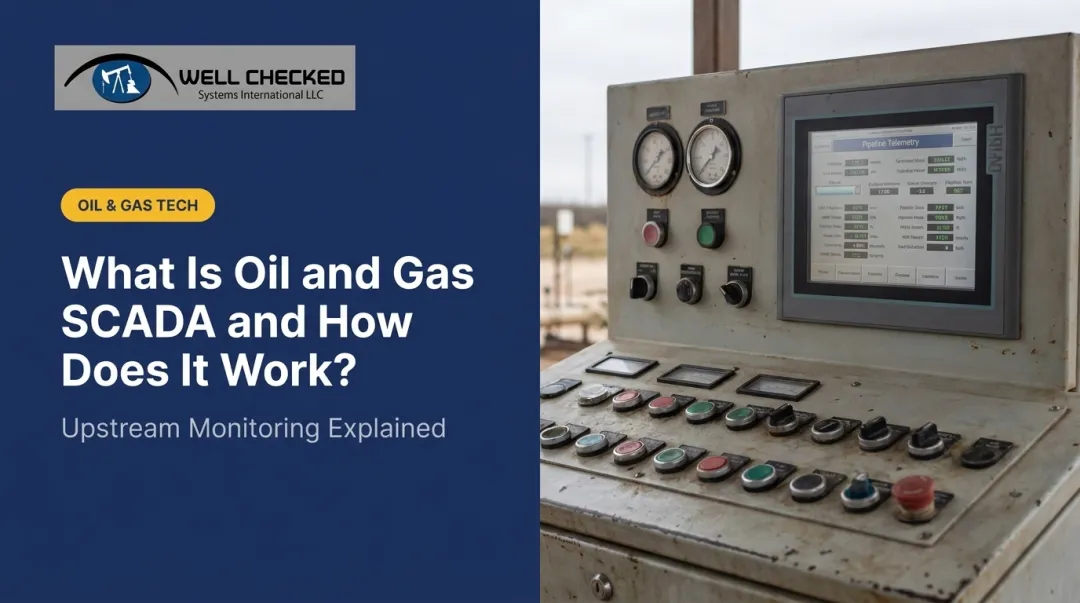
- The HMI (Human-Machine Interface) gives operators a window into the system, displaying live and historical data, alarms, and mimic diagrams while allowing set-point adjustments.
- Communication infrastructure links field sites to the central server over cable, fiber, or radio, running on legacy protocols like Modbus (introduced by Modicon in 1979) and DNP3, built for interoperability among substation devices.
Common Methods of Data Acquisition Used in SCADA
Three acquisition methods show up across most SCADA deployments:
- Hardwired sensor inputs, direct connections between field instruments and controllers
- Wireless telemetry, using radio, cellular, or satellite links where cable isn't feasible
- Polling-based communication, where the master station queries RTUs at set intervals rather than waiting for continuous streams
Remote industries lean hard on that second method. Oil & gas sites frequently sit far from fixed infrastructure, and connectivity gaps are real.
As of December 2022, fixed terrestrial broadband at the 100/20 Mbps benchmark hadn't reached roughly 7% of Americans, and almost 28% of rural Americans, according to the FCC's Section 706 report. That's a population-level figure, not a wellsite-specific one, but it explains why cellular, licensed radio, and satellite backhaul remain standard choices for field data acquisition in remote basins.
Types of SCADA Architectures
SCADA systems have gone through four rough generations, each solving problems the last one couldn't.
| Architecture | Description | Limitation |
|---|---|---|
| Monolithic | First-generation, standalone mainframes with no real networking | Poor scalability, single point of failure |
| Distributed | 1980s–90s systems using smaller computers, LANs, and PC-based HMIs | Proprietary protocols limited cross-vendor compatibility |
| Networked | Open architectures adopting Ethernet and non-proprietary protocols | Requires more sophisticated network security |
| Web/cloud-connected | SQL databases, browser and mobile access, workloads running partly in the cloud | Depends on reliable internet connectivity |

Monolithic systems worked fine when a facility ran in isolation, but they hit a wall the moment operators needed to add sites or integrate hardware from different vendors. Distributed and networked architectures solved compatibility issues by moving to LANs and open protocols like Ethernet.
Modern web-based SCADA takes it further, linking dashboards, field controllers, and mobile alerts in one system.
Key characteristics include:
- Browser-based dashboards accessible from any internet-connected device
- Field controllers that stay on-site, running local control independent of the network
- Remote status checks from a phone or tablet
This convenience doesn't eliminate the need for solid local control. Field controllers still have to keep running if the network connection drops.
SCADA in Oil & Gas: Applications, Benefits, and a Critical Blind Spot
Upstream and midstream operators lean on SCADA for a long list of dispersed assets:
- Wellhead pressure and flow monitoring across hundreds of individual sites
- Tank level gauging and inventory tracking
- Compressor station control and alarm management
- Pipeline telemetry, including valve control and leak-detection alarms
The payoff is centralized visibility. Instead of sending a pumper to physically check every wellhead, a control room team can watch status across an entire field, spot anomalies faster, and cut back on unnecessary site visits. For portfolios with hundreds of remote locations, that's the difference between reactive firefighting and proactive management.
The Methane Blind Spot
Here's where SCADA runs into a hard boundary. SCADA reports the process variables it's wired to measure — pressure, temperature, flow, tank level. It was never built to detect unplanned fugitive emissions escaping between scheduled inspections. A wellhead can show perfectly normal operating pressure on the SCADA screen while methane vents from a leaking valve nobody's looking at.
That gap matters more than it used to. EPA's methane rule under 40 CFR Part 60 Subpart OOOOb requires AVO inspections and optical gas imaging or Method 21 surveys on a defined schedule. Requirements range from quarterly checks at simple well sites to monthly AVO inspections at compressor stations.
OGMP 2.0's Level 5 reporting goes further still, requiring independent site-level measurement reconciled against reported estimates. Pressure and flow telemetry alone doesn't satisfy either standard.
Closing SCDA's Gaps
This is exactly where multi-sensor AI monitoring platforms earn their place alongside SCADA rather than in competition with it. Well Checked Systems' Zensory.ai™ platform layers three sensing modalities SCADA was never designed to include:
- Long-Wave Infrared Optical Gas Imaging for continuous, day-and-night methane and volatile organic compound (VOC) detection
- High-resolution video with AI object detection for 360-degree site awareness
- Acoustic anomaly AI that flags abnormal equipment sounds tied to malfunctions or leaks
Zentinal Core™ runs an AI baseline-learning cycle, roughly two days per site, to tell normal process emissions apart from true fugitive events, filtering out the false alarms that make continuous monitoring impractical at scale. Once Core validates an event, Zentinal IQ™ quantifies the volume, duration, and rate, producing the defensible data EPA and OGMP 2.0 reporting actually require.
The platform connects into an operator's existing SCADA environment through a read-only API, pushing validated alerts and emissions data straight into control room dashboards without replacing anything already in place.

Operators using this layered approach can acknowledge, dispatch, and mitigate a validated methane event within 24 hours, a response window built specifically to support a documented, timely response.
SCADA vs. PLC vs. DCS: Understanding the Differences
These three terms get used interchangeably, but they solve different problems.
| System | Scope | Best fit |
|---|---|---|
| PLC | Physical hardware running local, real-time control logic | A single machine, skid, or wellhead process |
| SCADA | Software-driven supervisory layer aggregating data across many PLCs/RTUs | Wide-area, geographically dispersed assets like pipelines and wellfields |
| DCS | Tightly integrated, continuous control across a single facility | Refineries and gas-processing plants operating in one location |
A PLC is a piece of hardware doing deterministic, millisecond-level control at one piece of equipment. SCADA sits above dozens or hundreds of PLCs and RTUs, aggregating their data for supervisory-level decisions across a wide footprint.
DCS coordinates many local controllers within a single plant, built for continuous process control rather than wide geographic reach.
Choosing between them comes down to scale and speed requirements:
- Single skid or machine: A PLC alone usually suffices for local, real-time control
- One facility, tightly coordinated: DCS fits refineries where every subsystem needs continuous, integrated control
- Scattered assets across a basin: SCADA is the right layer for centralized visibility, often working with PLCs and RTUs handling the local work underneath
Frequently Asked Questions
What is supervisory control and data acquisition?
SCADA is a system architecture combining hardware and software to give operators centralized, near-real-time monitoring and control of industrial processes spread across large or remote areas.
What are the major components of supervisory control and data acquisition?
The core building blocks are RTUs and PLCs at the field level, an HMI for operator interaction, and a communication network connecting everything to a central server.
What are the common methods of data acquisition used in SCADA?
SCADA typically relies on hardwired sensor inputs, wireless telemetry over radio, cellular, or satellite links, and polling-based communication where the master station queries RTUs at set intervals.
What is the difference between SCADA and DCS?
DCS suits tightly integrated, continuous process control within one facility, like a refinery. SCADA is built for wide-area, geographically dispersed assets such as pipelines and wellfields.
Is SCADA used in oil and gas operations?
Yes. SCADA is standard across upstream and midstream operations for wellhead pressure and flow monitoring, tank level gauging, compressor station control, and pipeline telemetry.
Can SCADA detect methane emissions or gas leaks?
Not reliably on its own. Standard SCADA monitors predefined process variables like pressure and flow, so operators pair it with dedicated monitoring layers, such as optical gas imaging, acoustic abnormal-sound detection, and AI-enabled platforms like Zensory.ai™, to catch fugitive emissions SCADA telemetry can't see.