
The stakes run two directions. On safety, NIOSH lists methane's explosive range at 5-15% concentration in air, and OSHA treats 10% of the lower explosive limit as hazardous in confined spaces. On compliance, EPA's Subpart OOOOb rule and frameworks like OGMP 2.0 are pushing operators toward measurement-based reporting, not estimates.
This article breaks down the core detection technologies, how they're deployed in the field, and how operators are choosing the right combination for their sites.
Key Takeaways
- Methane detection relies on four core technologies: infrared/OGI, laser (TDL) spectroscopy, catalytic sensors, and acoustic sensing
- Deployment spans handheld devices, drones, satellites, and fixed continuous monitoring
- No single method covers everything. Layering technologies produces the most defensible data
- EPA Subpart OOOOb and OGMP 2.0 push operators toward continuous, measurement-based monitoring
Core Methane Detection Technologies
Four technology families dominate field methane detection. Each solves a different part of the leak-finding problem, and each has limits operators should weigh before they buy or deploy.
Optical Gas Imaging (OGI) and Infrared Sensing
Methane absorbs infrared light in specific bands: 3.2-3.55 µm (MWIR), 7.2-8.3 µm (LWIR), and 2.31-2.39 µm (SWIR). OGI cameras exploit this by visualizing gas plumes that would otherwise be invisible.
EPA's Appendix K test protocol requires an OGI camera to detect 19 grams per hour of methane at a distance of 2 meters, under controlled conditions of 5°C thermal contrast and wind near 1 m/s.
That figure is a lab benchmark, not a guaranteed field performance number. Real-world results shift with distance, wind, and operator skill.
Long-wave infrared (LWIR) cameras matter here because they enable day-and-night detection at roughly one-third the cost of traditional mid-wave IR systems. That cost gap makes continuous OGI deployment far more economical across large site counts.
Tunable Diode Laser (TDL) Spectroscopy
TDL systems tune a narrow-band laser to methane's absorption line, offering high sensitivity and fast, precise leak-point identification.
One commercial ambient-air module specifies detection down to 1 ppm, with an accuracy of roughly ±(5 ppm + 2% of reading). These specs vary by product and platform (handheld versus aircraft versus fence-line), so don't treat one unit's spec sheet as an industry standard.
Catalytic (Pellistor) Sensors
Pellistor sensors detect combustible gas through heat-based oxidation. They're inexpensive and common in basic safety alarms, but they have real limits:
- Limited gas selectivity: they respond to combustibles broadly, not methane specifically
- Prone to "poisoning" from silicone and sulfur compounds
- Erratic readings in high humidity or abnormal oxygen conditions
- Best suited for immediate safety alarms, not emissions quantification
Acoustic Anomaly Detection
Acoustic sensing listens for the sound signature of pressurized gas releases, such as a hissing valve or a compressor starting to fail. One commercial ultrasonic detector picks up frequencies to 28 meters away.
It's fast and doesn't depend on a visible gas cloud, but sound alone doesn't confirm methane identity or concentration. Pair it with a gas-specific method.
| Technology | Strength | Limitation | Best Use Case |
|---|---|---|---|
| OGI/Infrared | Visual confirmation, day/night with LWIR | Distance and wind sensitive | Component-level leak surveys |
| TDL Laser | High sensitivity, fast readout | Product specs vary widely | Precise leak-point ID |
| Catalytic (Pellistor) | Low cost, simple | Sensor poisoning, poor selectivity | Basic safety alarms |
| Acoustic | Cloud-independent, rapid alert | No gas ID or concentration alone | Compressor/valve monitoring |

How Can You Detect Methane?
Since human senses can't perceive methane, detection depends entirely on specialized sensors. Each reads a different physical signature: light absorption, heat of oxidation, or sound.
- Infrared/OGI cameras
- Laser spectroscopy
- Catalytic sensors
- Acoustic monitors
Are There Methane-Specific Detectors?
Yes. Detectors range from basic residential combustible-gas alarms to industrial-grade instruments.
Portable safety detectors flag dangerous concentrations quickly. Precision measurement instruments (like TDL or OGI systems) quantify leak rate and location for compliance. They're not interchangeable.
Will a CO2 Detector Pick Up Methane?
No. CO2 absorbs infrared light near 4.26 micrometers, while methane's absorption bands sit at 3.2-3.55 µm (MWIR), 7.2-8.3 µm (LWIR), and 2.31-2.39 µm (SWIR). A sensor tuned to one wavelength simply won't respond reliably to the other. Detecting methane requires a sensor built and calibrated for methane specifically.
Deployment Methods: From Handheld to Satellite
How you deploy methane detection shapes coverage, response speed, and compliance value. Most operators combine several of the approaches below.
Portable/handheld detectors handle spot checks, LDAR inspections, and confined-space safety. They verify leaks at a point in time but do not provide continuous coverage.
Aerial detection (drones) covers large areas quickly. A 2023 Permian Basin case study used automated UAS flights with a methane sensor to quantify and prioritize leaks across production sites in minutes. That survey used a drone-mounted methane sensor, not drone-based OGI—an important distinction when comparing methods.
Satellite monitoring from missions like Sentinel-5P maps methane globally every day, but its 7 x 5.5 km pixel resolution can flag a plume without pinpointing the source. Satellites are screening tools, not site-level compliance instruments.
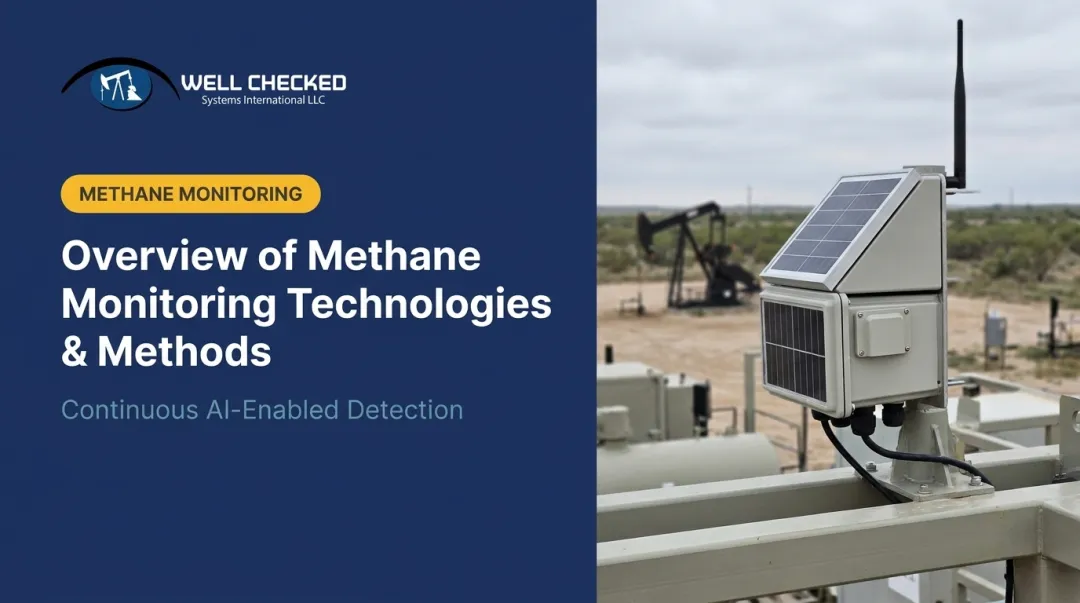
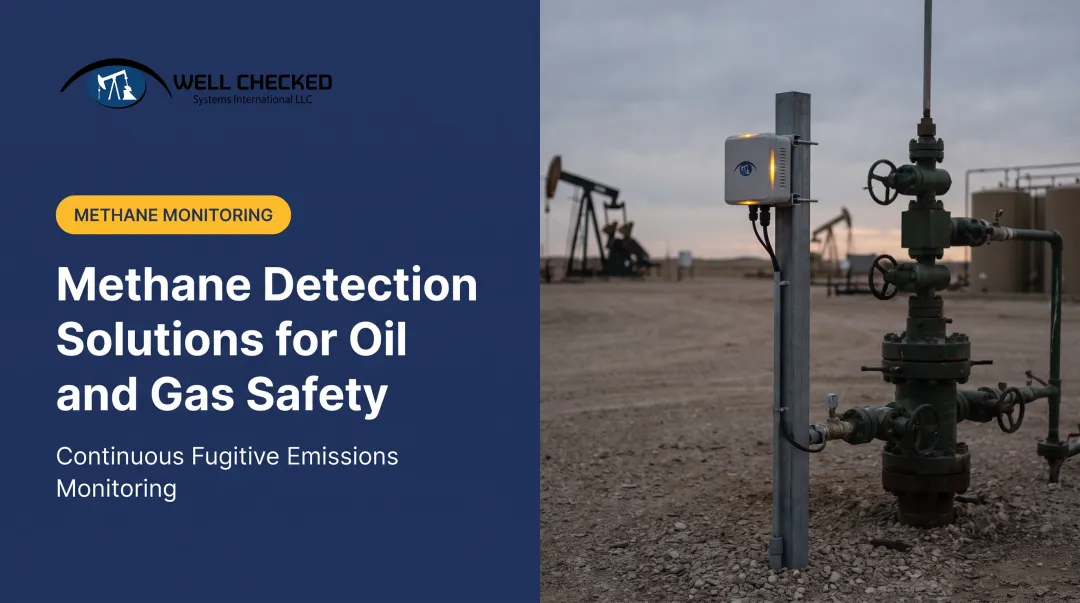
Fixed/continuous ground-based monitoring uses always-on sensor networks to catch emissions as they happen. Instead of a quarterly snapshot, operators get continuous records that support faster response and LDAR compliance.

Choosing the Right Method for Oil & Gas Operations
Quarterly LDAR inspections and traditional pumper routes leave gaps. A leak that starts the day after an inspector leaves can run undetected for weeks. That's real product loss and real regulatory exposure sitting in the blind spot between visits.
Combining sensing modalities (visual, gas-specific, and acoustic) cuts down false positives. It also helps distinguish normal process emissions (a routine vent, a flare cycling) from genuine fugitive leaks that need a maintenance crew dispatched.
A Multi-Sensor Example in the Field
Well Checked Systems' Zensory.ai™ platform layers three sensing types at the wellsite:
- Sight — high-resolution cameras with 360° coverage and AI object detection
- Sound — acoustic AI that flags abnormal equipment noise, such as an early-stage compressor issue
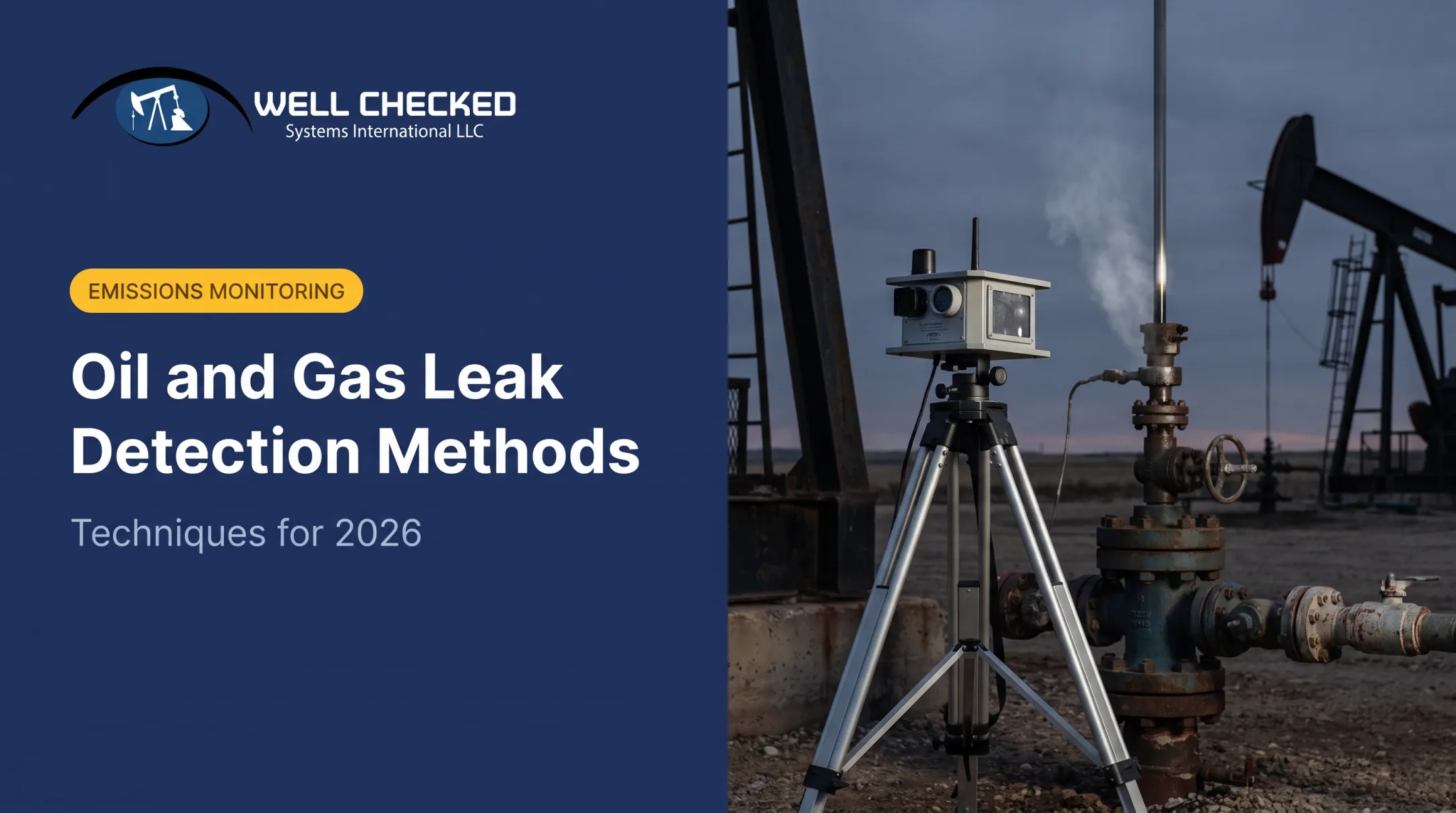
- Gas imaging — LWIR-based OGI for continuous methane and VOC detection
The three-tier architecture builds on this stack. Zentinal Ops™ handles visual and acoustic intelligence. Zentinal Core™ fuses the sensor streams and filters false alarms. Zentinal IQ™ quantifies validated events for regulatory-defensible reporting.

The AI Site Learning Cycle
Rather than alerting on every anomaly, the system spends roughly two days per site learning what "normal" looks like: a flare cycling, a compressor's typical hum, routine venting. Once that baseline is set, it flags what deviates from it. That's the difference between a system that cries wolf constantly and one that crews actually trust.
The payoff is operating by exception: maintenance teams get dispatched to validated events, not routine drive-bys. Route-based site visits can run $1 million to $5 million or more annually for mid-sized to large operators. Cutting unnecessary trips while catching real leaks faster is where the economics land.

Regulatory and Reporting Considerations
EPA's OOOOb rule package, effective May 7, 2024, is pushing new, modified, and reconstructed sources toward measurement-based emissions accounting rather than engineering estimates. OGMP 2.0's Level 4 and 5 reporting tiers follow the same logic: Level 5 requires reconciling inventory estimates against independent site-level measurement.
This matters beyond EPA filings:
- SASB's Oil & Gas E&P standard (effective for periods after January 1, 2024) requires disclosure of gross Scope 1 emissions and the methane percentage of that total
- TCFD-aligned disclosures (now continued under IFRS oversight) ask publicly traded E&Ps to report emissions metrics tied to climate risk
- Defensible quantification, specifically duration and volume of loss, is increasingly the evidence operators need to justify repair-and-maintenance spending
That evidence has to be continuous and audit-ready, not a quarterly snapshot. Zentinal IQ™ produces quantified emissions logs (volume, duration, and rate), EPA-format compliance reports, and CSV/JSON exports for SCADA and ESG reporting systems.
The Future of Methane Detection
AI and machine learning are not replacing sensor hardware. They extract more signal from the data hardware already produces. DOE's 2024 workshop on AI for the methane cycle points to anomaly detection, noise filtering, and data fusion as the near-term payoff, not new sensing physics.
ESA's Sentinel-5P program already runs this way: machine learning flags candidate plumes and estimates emission rates from concentration plus wind data.
The broader trend is integration across scales:
- Satellite screening for wide-area coverage
- Aerial triage for targeted follow-up
- Fixed ground monitors for continuous site-level detection
Fusing those layers into one analytics stack, instead of separate silos, is what turns raw detections into records ops and compliance teams can defend. The platforms that matter filter false alarms first, then quantify only validated events.
Frequently Asked Questions
How can you detect methane?
Since methane is invisible and odorless, you need specialized sensors: infrared/OGI cameras, laser (TDL) spectroscopy, catalytic sensors, or acoustic monitors. Each targets a different physical signature of a leak.
Are there methane gas detectors?
Yes. Industrial options include portable handhelds and fixed continuous monitors. Compliance-grade instruments differ significantly from basic combustible-gas safety alarms in sensitivity, logging, and data quality.
Will a CO2 detector detect methane?
No. CO2 sensors are tuned to a different infrared wavelength (around 4.26 micrometers) than methane's absorption bands (3.2-3.55 µm (MWIR), 7.2-8.3 µm (LWIR), and 2.31-2.39 µm (SWIR)). Detecting methane requires a dedicated methane sensor.
What is the difference between fixed and portable methane detectors?
Fixed detectors provide continuous, site-wide monitoring that catches events as they happen. Portable detectors are used for spot checks and inspections at a single point in time.
How often should oil & gas sites be monitored for methane leaks?
US operators are moving beyond quarterly LDAR surveys toward continuous or near-continuous monitoring under tightening EPA methane rules. That shift closes the gap between scheduled site visits when leaks would otherwise go unseen.
What is OGMP 2.0 and how does it relate to methane detection?
OGMP 2.0 is a voluntary framework with reporting tiers that reward measurement-based data over estimates. Level 5 requires reconciling inventories with independent site-level measurement, so detection technology choice directly affects your compliance tier.