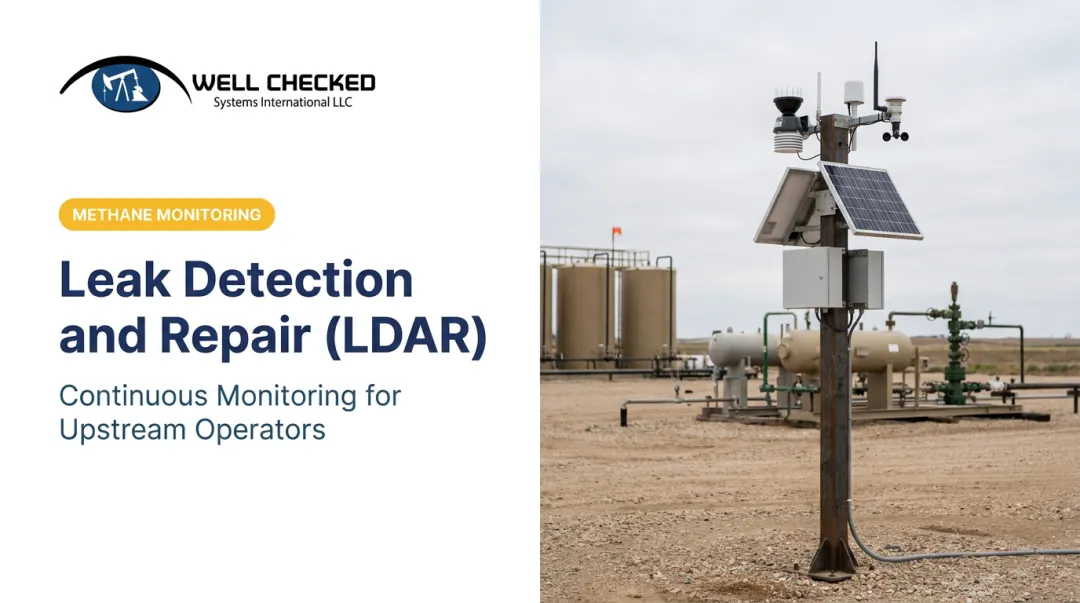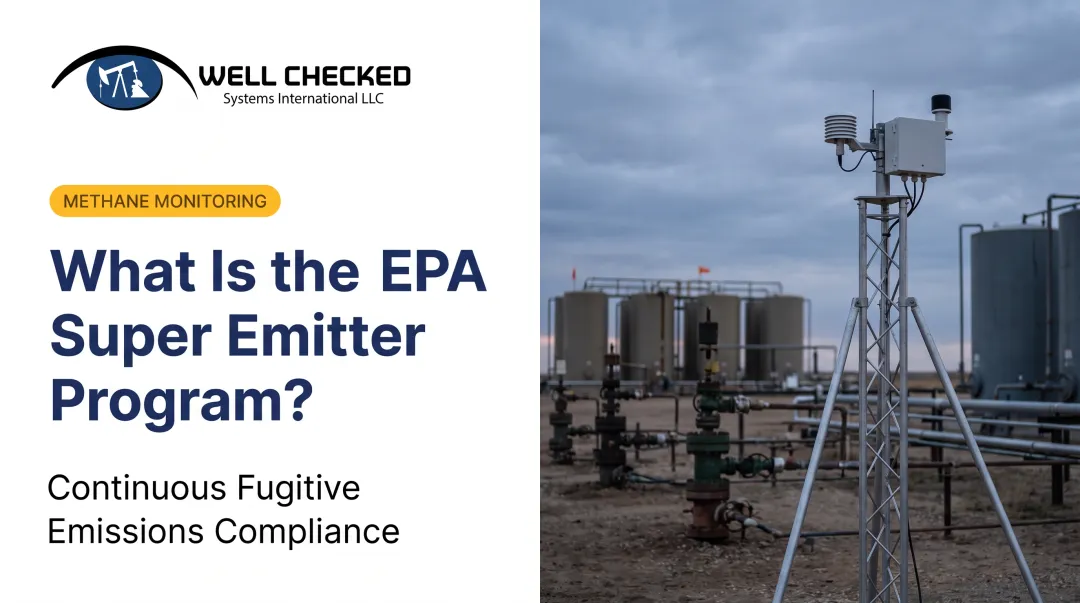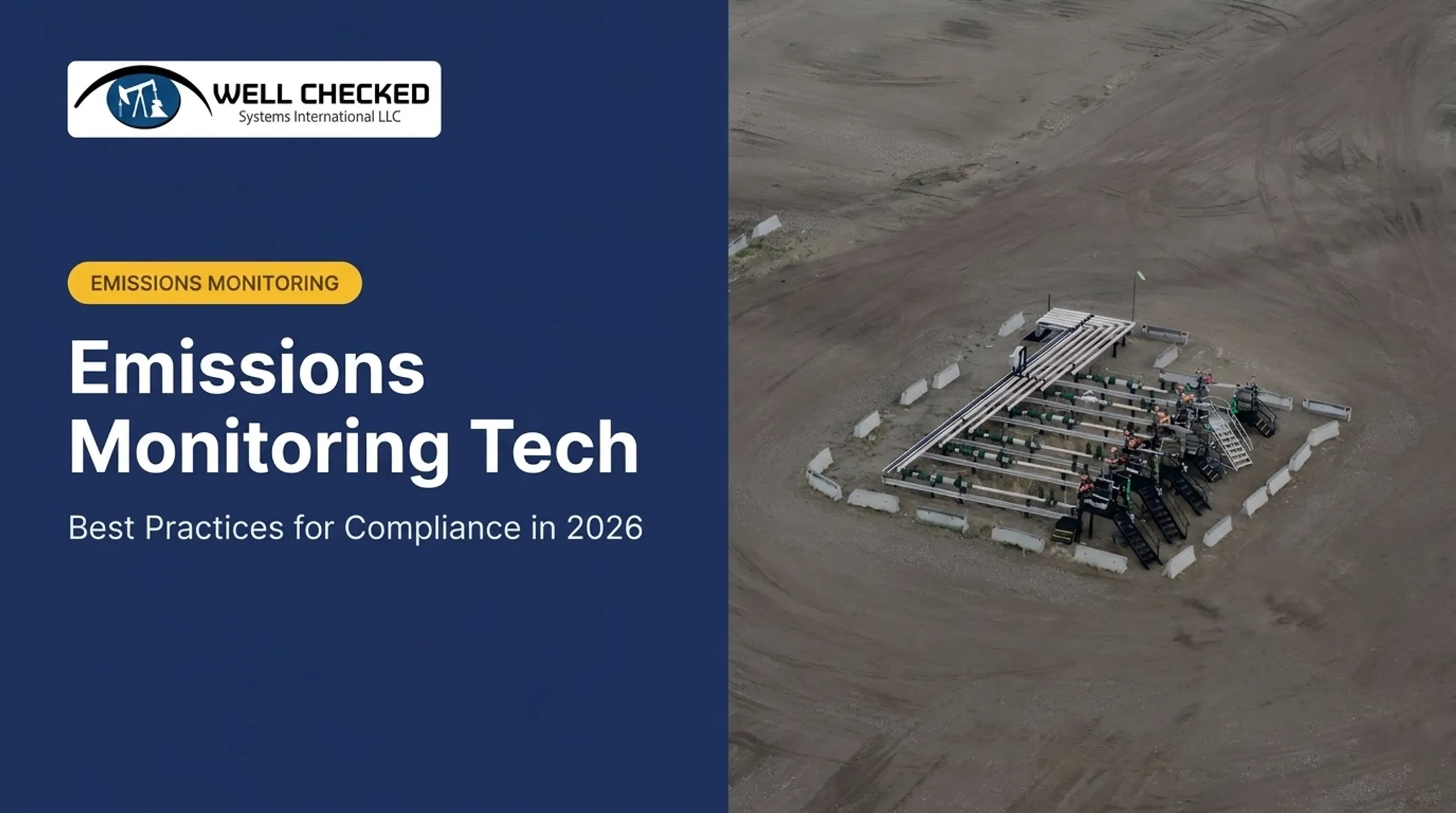

EPA's methane rule (40 CFR Part 60 Subpart OOOOb), the super-emitter program, and state-level requirements now reach even single-wellhead sites. The 2020 exemption for sites producing under 15 barrels of oil equivalent per day is gone — removed under the 2024 rule, meaning virtually every well site now carries fugitive-monitoring obligations through closure.
The core problem: traditional quarterly or periodic LDAR inspections leave gaps. A leak that starts and stops between survey windows can go entirely undetected, and operators are still on the hook for it.
This guide breaks down what LDAR compliance actually requires — monitoring cadence, repair timelines, recordkeeping, financial exposure — and how continuous monitoring is reshaping how operators close the gap.
Key Takeaways
- Under OOOOb, monitoring frequency, leak thresholds, repair windows, and recordkeeping now vary by facility type
- Site obligations apply regardless of production volume — the 15 BOED exemption no longer exists
- Non-compliance carries real financial exposure through Clean Air Act penalties and future methane fees
- Continuous, AI-enabled monitoring closes the temporal gaps periodic inspections leave behind
What Is LDAR Compliance?
LDAR — Leak Detection and Repair — is the EPA-mandated system for finding and fixing fugitive emissions of volatile organic compounds (VOCs) and methane from oil and gas equipment. It is an ongoing program that covers detection methods, repair timelines, and reporting — not a one-time inspection.
EPA recognizes three detection methods:
- Method 21 — portable instrument readings, action level of 500 ppmv or higher
- OGI (Optical Gas Imaging) — infrared cameras that visualize gas plumes
- AVO (Audio, Visual, Olfactory) — trained personnel checking for sound, sight, and smell indicators
Which method you use — and how often — depends on the rule that applies to your sources. That framework changed substantially from OOOOa to OOOOb. EPA published the final rule on March 8, 2024, and it removed the low-production exemption entirely. Small stripper wells that were previously exempt now carry the same fundamental monitoring duty as large centralized facilities — just at a different cadence.
If you operate an oil or gas well site in the US, you almost certainly have an active LDAR obligation today.
Core Requirements of an LDAR Compliance Program
Monitoring Frequency by Facility Type
Requirements scale with site complexity. EPA's OOOOb baseline frequencies break down as follows:
| Facility Type | AVO Frequency | OGI/Method 21 Frequency |
|---|---|---|
| Single-wellhead site | Quarterly | Not required |
| Multi-wellhead site | Quarterly | Semiannual |
| Centralized production facility | Bimonthly | Quarterly |
| Compressor station | Monthly | Quarterly |

Alaska North Slope sites get an exception: annual OGI, with an optional annual Method 21 pathway at the 500 ppm action level, reflecting the operational realities of that region.
State rules can be stricter. California's Oil and Gas Methane Regulation mandates quarterly LDAR surveys regardless of facility type, and Colorado's Regulation 7 layers its own reporting requirements on top. Always apply whichever standard (federal or state) is more conservative for your site.
Leak Definition and Repair Timelines
Operators typically set an internal leak definition tighter than the regulatory floor, applied consistently across component types. This avoids ambiguity during inspections and audits.
Repair clocks depend on detection method:
- AVO-detected leaks: first attempt within 15 days, final repair within 15 days after that
- OGI or Method 21-detected leaks: first attempt within 30 days, final repair within 30 days after that
When a component can't be fixed on that schedule (for example, a compressor that needs a full shutdown), it goes on a Delay of Repair list. That list is a documented exception with a hard backstop: repair is still due at the next shutdown opportunity or within two years of detection, whichever comes first.

Recordkeeping and Reporting Obligations
Audit-ready programs run on documentation, not memory. Core requirements include:
- Electronic data logging for every survey event
- Component tagging and ID tracking across the site
- QA/QC review of monitoring data before it's finalized
- Records retained onsite (or at the nearest field office) for at least five years
Reporting obligations don't stop at OOOOb. Facilities emitting 25,000 metric tons CO2e or more annually also report under Subpart W of the Greenhouse Gas Reporting Program, a separate system with its own boundaries and calculation methods.
State emissions inventories add another layer. Treat each program as distinct, even where the underlying measurements overlap: that documentation is what regulators and auditors pull first.
Understanding Super-Emitter Events and Financial Risk
A super-emitter event is remote detection of methane emissions at or above 100 kg/hour near a covered facility. When the program is active, the process runs on a tight clock:
- Certified third party notifies EPA within 15 days of detection
- EPA reviews and forwards notice to the operator
- Operator begins investigation within 5 days of notice
- Operator submits investigation results within 15 days
The program is paused through January 22, 2027, but the framework and timelines stay on the books.
The financial exposure is real, even where some fees are currently suspended:
- Waste Emissions Charge (IRA): Originally $1,500/ton above 0.2% of gas sent to sale. The 2024 implementing rule was revoked; statutory start is now 2034.
- Clean Air Act §113(b): Civil penalties top out at $124,426 per day per violation after the latest inflation adjustment. That figure is a ceiling, not a guaranteed fine.

EPA projects its 2024 oil-and-gas rule package will avoid 58 million tons of methane and 16 million tons of VOC emissions from 2024 through 2038. The total is sector-wide, not LDAR alone, but it shows regulators expect leak programs to carry real weight.
More frequent inspection cuts time-at-leak and lowers exposure to these penalties. Closing the gap between survey cycles is the practical way to reduce that risk.
Why Periodic LDAR Inspections Leave Compliance Gaps
Quarterly and semi-annual inspections are snapshots. A 2025 peer-reviewed study found that most intermittent emissions go undetected during the first year of periodic inspection, regardless of how often you survey. The mechanism is simple: a short-duration leak can start and stop entirely between compliant rounds.
There's also an operational cost problem. Route-based pumper visits for mid-sized to large operators commonly run into the millions annually. That spend buys you a picture outdated the moment the truck leaves the site.
Continuous, multi-sensor monitoring closes those gaps. Platforms like Well Checked Systems' Zensory.ai™ combine video, acoustic sensing, and Optical Gas Imaging for 24/7 site awareness instead of point-in-time snapshots.
The workflow that closes the gap:
- Zentinal Core™ validates a fugitive-gas event and filters false alarms.
- Near-real-time notification hits the dashboard, email, SMS, or SCADA.
- The operator acknowledges the event.
- Dispatch protocols send the right personnel.
- Mitigation completes within 24 hours of the validated notification.

That "acknowledge-dispatch-mitigate" sequence directly limits EPA fine exposure. A leak found and fixed inside a day looks very different in an audit than one discovered three months later.
Building a Defensible, Audit-Ready LDAR Program
Detection is only half the job. The other half is proving your data holds up.
Internal and third-party QA/QC audits catch data inconsistencies and compliance gaps before they become violations — a far cheaper place to find problems than during an EPA inspection.
AI-driven analytics and automated recordkeeping reduce human error in ways manual logs simply can't match.
Zentinal Core™, for instance, runs a site-specific AI learning cycle (roughly two days per site) to establish a normal operating baseline, then continuously distinguishes routine process emissions from genuine fugitive anomalies. That's the layer that keeps false alarms from flooding your compliance team's inbox.
Once an event is validated, quantification becomes the priority. Regulators, OGMP 2.0, SASB, and TCFD frameworks increasingly expect regulatory-defensible quantification: not just "we saw something," but volume, duration, and rate backed by a documented method.
Zentinal IQ™ closes that gap. It quantifies emissions only after Core has validated an event, using LWIR OGI-based volumetric estimation, and outputs formats aligned with:
- EPA compliance logs
- State-agency inventories
- OGMP 2.0 Level 4/5 measurement-based reporting
For operators reporting to SASB or TCFD frameworks, that same validated event data becomes reusable evidence, provided you preserve each program's distinct boundaries and retention rules rather than treating them as interchangeable.
Frequently Asked Questions
What is LDAR compliance?
LDAR (Leak Detection and Repair) is the EPA-regulated system of procedures for identifying and repairing fugitive VOC and methane emissions from oil and gas equipment. It covers detection, repair timelines, and reporting on an ongoing basis.
What are the requirements for an LDAR compliance program?
A compliant program needs component identification, a documented leak definition, facility-appropriate monitoring frequency, defined repair timelines, and thorough electronic recordkeeping. Requirements scale based on facility type and applicable federal or state rules.
How often do I need to complete an LDAR inspection?
It depends on facility type and jurisdiction. Under OOOOb, single-wellhead sites need quarterly AVO checks, while compressor stations require monthly AVO plus quarterly OGI, and some states impose stricter schedules.
What is an AVO inspection?
AVO stands for Audio, Visual, Olfactory: a manual inspection method where trained personnel check equipment by listening, looking, and smelling for signs of a leak. It's one of three EPA-accepted detection methods, alongside OGI and Method 21.
What happens if a facility fails to comply with LDAR regulations?
Non-compliance can trigger Clean Air Act civil penalties up to $124,426 per day per violation. Future methane fees under the Inflation Reduction Act remain on a delayed timeline, but reputational and operational risk apply regardless of fee status.
Can technology replace traditional LDAR inspections?
Continuous, AI-based monitoring supplements periodic inspections rather than fully replacing prescribed survey methods under current EPA rules. It closes detection gaps between cycles while operators still confirm findings through approved methods like OGI or Method 21.