
That gap between what operators report and what's actually leaking has real consequences. Every uncaptured molecule of methane is unsold natural gas. It's also growing regulatory exposure as EPA's Subpart OOOOb rule tightens control requirements and enforcement expectations across the sector.
Here's the encouraging part: methane is frequently called the "low-hanging fruit." Unlike many industrial emissions problems, much of it can be fixed with equipment and monitoring technology that already exists today.
This article breaks down how methane emissions actually build up across operations, what drives them, and the concrete best practices operators are using — from procurement decisions to continuous monitoring to infrastructure planning.
Key Takeaways
- Methane emissions stem mainly from fugitive leaks, venting, and flaring across the value chain
- Inaction risks compliance exposure under EPA Subpart OOOOb, wasted saleable gas, and investor/ESG scrutiny
- Best practices span equipment decisions, active monitoring, and infrastructure investment
- Many abatement measures pay for themselves through recovered gas revenue
How Methane Emissions Build Up Across Oil & Gas Operations
Methane loss rarely looks like one dramatic event. Instead, it accumulates through small, often invisible leaks scattered across thousands of well sites.
Aerial screening of roughly 8,000 production sites across seven US basins found observable high-emission plumes at only about 4% of sites, yet those sites carried most of the volume (Alvarez et al., 2018). Liquid-storage tank hatches and vents accounted for 90% of those sightings.
This is the "super-emitter" phenomenon: a small share of sites drive a disproportionate share of emissions.
- A 2022 Nature Communications study found the top 15% of low-production well sites emit more than 32% of their category's methane
- Roughly 5% of sites (an estimated 28,000 nationally) qualify as super-emitters
- Low-production wells collectively account for 37-75% of US oil-and-gas well-site methane

Leaks are only part of the picture. Flaring and venting behave differently: they're more episodic, tied to equipment failures, pressure releases, or a lack of pipeline capacity when gas is produced.
The common thread: without continuous monitoring, none of this shows up until an aerial survey, satellite pass, or regulatory audit catches it. By then, the gas is long gone.
Key Drivers of Methane Emissions in Oil & Gas Operations
Most US upstream methane comes from a handful of operational weak points—not from every valve on the pad. Three drivers show up again and again across producing basins.
Aging and Poorly Maintained Equipment
Pneumatic controllers, compressor seals, and storage tanks are frequent sources of fugitive emissions.
A 2023 peer-reviewed study found pneumatic-controller emissions made up 53% of total petroleum-system methane emissions in EPA's 2018 inventory (PMC, 2023). That single equipment category drove over half the reported number.
Flare Reliability
Flares are widely assumed to destroy 98% of methane they burn. That figure is an assumption, not a universal measurement.
A field study across three major US basins (responsible for over 80% of US flaring emissions) measured actual destruction efficiency at just 91.1%. Researchers estimated flare methane could account for 4–10% of total US oil and gas methane emissions, roughly five times prior assumptions (OGCI, 2022).

Unlit or malfunctioning flares are the worst offenders, releasing raw methane instead of combusting it.
Infrastructure Gaps
In remote or fast-growing basins, gas-gathering pipeline capacity often lags behind drilling activity. Operators without a pipeline connection are left with two options: flare it or vent it. Neither is ideal, and neither is always the operator's fault.
Driver significance still varies by basin, asset age, and operator scale. A legacy Anadarko field and a new Permian pad face different root causes—and different fixes.
Best Practices for Reducing Methane Emissions
Effective methane reduction isn't a single fix. It requires action across three layers: the decisions made before a well is even drilled, how operations are actively managed day-to-day, and the broader infrastructure context an operator doesn't fully control.
Best Practices That Start With Better Decisions
Getting equipment specification right upfront prevents years of avoidable leaks.
- Specify zero-emission or low-bleed pneumatic controllers instead of natural-gas-driven devices during design and procurement
- Connect new wells to gas-gathering pipelines before production starts, avoiding routine flaring from day one
- Set internal leak-rate targets during project planning to guide which equipment gets specified
- Evaluate vendors against OGMP 2.0 Level 4/5 measurement-based standards rather than self-reported estimates
Under current EPA OOOOb requirements, process-controller affected facilities must operate with zero methane and VOC emissions to atmosphere starting January 22, 2027, or at startup — whichever comes later (eCFR, 60.5390b). Decisions made at the procurement stage now directly affect compliance timelines.
Best Practices That Improve How Operations Are Managed
Traditional leak detection relies on quarterly inspections and operator routes. That snapshot approach misses leaks that start and stop between visits. Federal rules still allow monitoring as infrequent as quarterly for single-wellhead sites, with alternative approaches requiring EPA approval under 60.5398b.
Continuous, autonomous monitoring closes the gap. Instead of a technician driving out once a quarter, sensors watch the site every hour of every day.
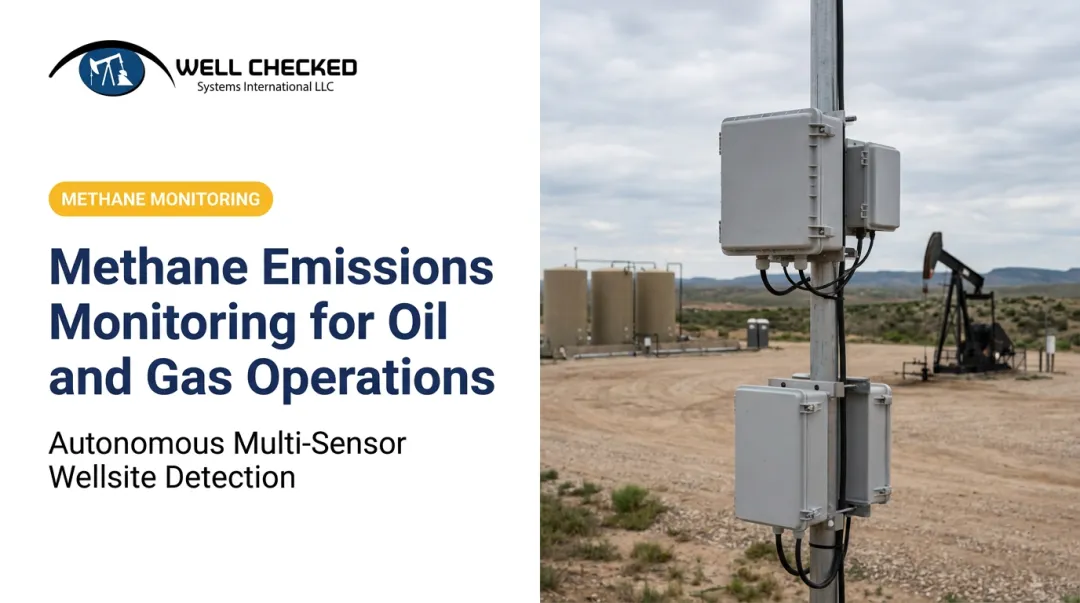
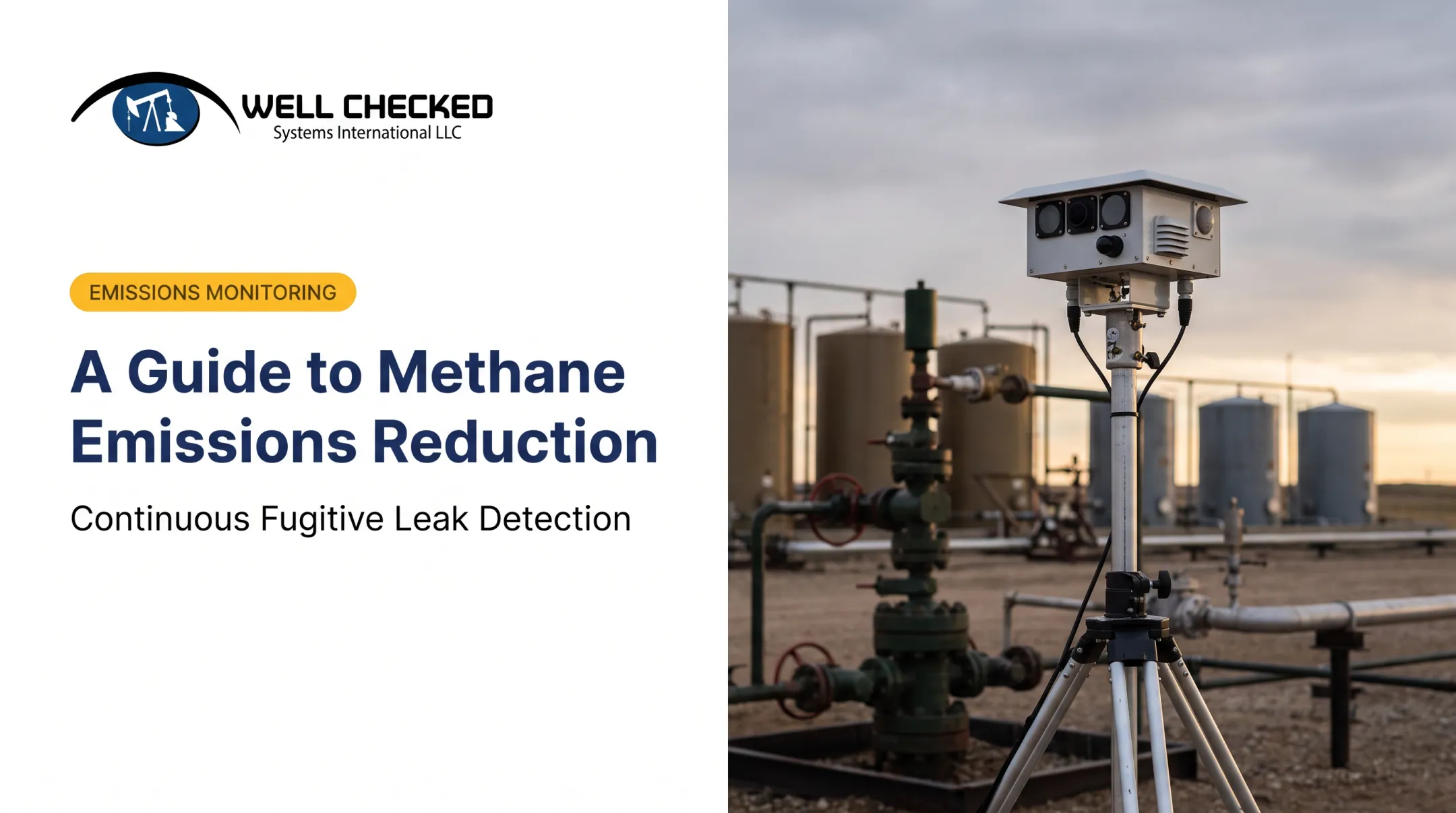
AI-enabled multi-sensor monitoring goes further by combining optical gas imaging, acoustic sensing, and visual AI to separate true fugitive emissions from normal process activity. That is the core of Well Checked's Zensory.ai™ platform. The system learns a site's normal operating pattern in roughly two days, then flags only what deviates from it. False alarms drop, and field teams can work by exception instead of chasing every alert.

A practical workflow that is gaining traction:
- Acknowledge a validated event with a real-time alert
- Dispatch a technician to the specific issue, not a routine sweep
- Mitigate the leak within a defined window (commonly 24 hours) to limit exposure

Faster response caps both gas lost and regulatory risk. EPA fugitive-component rules require first repair attempts within 15 days for AVO detections and 30 days for OGI or Method 21 detections (eCFR, 60.5397b). An internal 24-hour target keeps operators well ahead of those deadlines.
Beyond detection, continuous monitoring builds the defensible data trail Subpart OOOOb, state agencies, and OGMP 2.0 increasingly expect: time-stamped events, quantified volumes, and audit-ready records rather than a quarterly checkbox.
Field staff training on rapid-response repair for common leak sources (valves, connectors, compressor seals) rounds out the operational side.
Best Practices That Address the Broader Operating Context
Some drivers sit outside any single operator's control.
- Invest in regional gas-gathering infrastructure so captured gas reaches market instead of being vented or flared
- Participate in industry satellite-monitoring collaborations (such as OGCI or Carbon Mapper) to identify basin-level super-emitter hotspots
- Standardize monitoring and reporting across multi-basin portfolios for consistent compliance and easier data aggregation
- Account for midstream capacity limits in high-growth or remote basins, where missing takeaway often drives flaring and venting
This last point deserves emphasis. A well operator can do everything right and still flare gas because no pipeline exists to take it. Solving that requires infrastructure investment and coordination, not just better equipment at the wellhead.
Conclusion
Cutting methane emissions starts with correctly diagnosing the root cause. Is it equipment choice, operational oversight, or an infrastructure gap? Each demands a different fix, and treating them interchangeably wastes time and money.
The right fix only sticks when you can see the problem in time. Continuous, defensible monitoring is no longer a nice-to-have bolted onto compliance reporting; it is the foundation for cost-effective abatement. Operators who replace quarterly snapshots with ongoing measurement can prioritize real leaks, document repairs, and defend compliance with a complete record—not a single site visit.
Frequently Asked Questions
How can the oil and gas industry reduce methane emissions?
Operators can cut emissions by replacing high-bleed pneumatic equipment, shifting from periodic inspections to continuous monitoring, repairing validated leaks quickly, and reducing routine flaring/venting through better pipeline infrastructure.
What is the biggest source of methane emissions in oil and gas operations?
Fugitive leaks from valves, connectors, and pneumatic devices are typically the largest contributors, alongside unlit or inefficient flares that fail to fully combust methane before release.
Is reducing methane emissions cost-effective for operators?
Many abatement measures pay for themselves through recovered natural gas revenue. Many abatement measures pay for themselves through recovered natural gas revenue. RMI reports over three-quarters of mitigation measures are cost-effective at 2022 gas prices. Costs rise sharply once reductions exceed 60-80%.
What regulations govern methane emissions from oil and gas in the US?
The primary framework is EPA's methane rule, 40 CFR Part 60 Subpart OOOOb, finalized in March 2024. The Inflation Reduction Act's waste emissions charge was also finalized but is currently not in effect following a Congressional Review Act disapproval in March 2025.
How does continuous monitoring differ from traditional LDAR inspections?
Traditional LDAR relies on periodic snapshots, often quarterly. Continuous monitoring detects leaks in near real time, enabling faster repair response and producing a defensible, ongoing compliance record instead of point-in-time data.
What is OGMP 2.0 and why does it matter for methane reporting?
OGMP 2.0 is a UN-backed, measurement-based methane reporting framework launched in 2020. As of October 2025, it covers 153 companies representing 42% of global oil and gas production, and operators increasingly use it to demonstrate credible, verifiable emissions data.