
Wellsite operators need to know about leaks feet away, not miles away. A cracked fitting or a slowly failing seal rarely produces enough methane to register on a satellite pass, but it adds up over weeks and months. Chronic small leaks — the kind aerial and satellite screening typically miss — often account for a disproportionate share of total site emissions.
This article breaks down the core close proximity technologies operators use today: camera-based optical gas imaging, acoustic and ultrasonic sensors, point and open-path detectors, and the multi-sensor AI platforms now tying them together. We'll also cover how AI is changing detection accuracy and where these ground-level tools fit alongside wide-area monitoring.
Key Takeaways
- OGI/infrared cameras, acoustic sensors, point/ultrasonic sensors, and multi-sensor AI platforms form the close-proximity detection toolkit
- Video, acoustic, and infrared sensing each have blind spots — layered approaches close the gaps single sensors leave open
- AI-based multi-sensor systems cut false alarms and enable continuous, defensible monitoring instead of periodic manual inspections
- Satellites and aircraft generally flag emissions above roughly 100 kg/hr; ground sensors catch far smaller, chronic leaks
What Is Close Proximity Methane Leak Detection?
Close proximity detection means monitoring at or near the equipment itself — fixed cameras, handheld OGI units, acoustic sensors, point detectors — as opposed to wide-area satellite or aircraft screening that covers entire regions from above.
The distinction matters because of scale. A 2022 study of U.S. low-production wellsites found detection limits as low as 0.01 to 0.036 kg/hr, with 75% of sites showing detectable emissions up to 5 kg/hr. The top 5% of emitters accounted for roughly half of cumulative site-level emissions (Omara et al., Nature Communications, 2022).
Most satellites operate closer to a 1,000–1,500 kg/hr detection floor. That gap puts satellite screening in an entirely different leak category from site-level work.
Close proximity monitoring serves three practical purposes:
- Compliance monitoring — supporting EPA and state LDAR requirements
- Safety — catching hazardous conditions before they escalate
- Repair prioritization — helping crews decide which leaks to fix first, based on real quantification rather than guesswork
Core Close Proximity Detection Technologies
Close-proximity methane detection relies on several sensor types—optical, acoustic, and contact-based—each with clear strengths and blind spots. Understanding those trade-offs is what makes multi-sensor stacks practical in the field.
Optical Gas Imaging (OGI) and Infrared Cameras
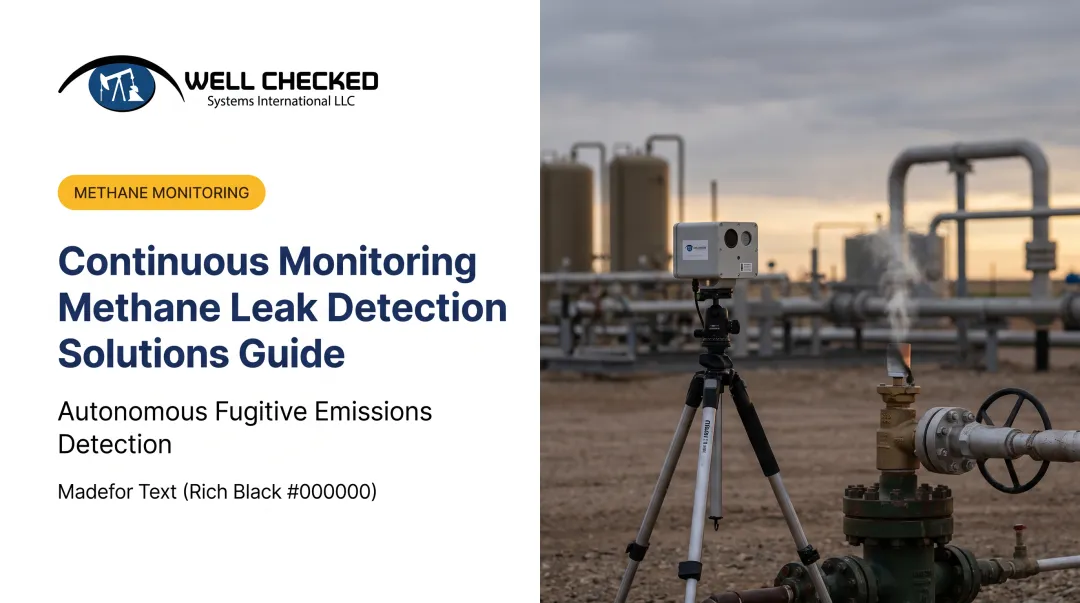
Long-Wave Infrared (LWIR) cameras visualize methane and VOC plumes because the gas absorbs infrared light. The camera renders that absorption as a visible plume on screen, day or night.
Fixed OGI cameras running continuously eliminate the need for periodic handheld inspection rounds. No more waiting for the quarterly pumper visit to catch a leak that started three weeks ago.
There's a real cost trade-off in camera selection. Manufacturer comparisons note that cooled mid-wave IR cameras deliver at least fivefold better sensitivity than uncooled units, but cooling systems raise purchase price and maintenance burden.
LWIR-based systems, by contrast, typically cost roughly one-third what traditional mid-wave IR cameras do. That gap matters when you're covering 200 sites instead of two.

Acoustic and Ultrasonic Sensors
Ultrasonic detectors "listen" for the high-frequency sound generated by pressurized gas escaping through a valve, fitting, or seal. They're a solid option for pressurized leaks specifically.
Their limitation is real:
- Ambient noise from wind, compressors, and machinery can trigger false positives
- Low-pressure or diffuse emissions often produce a sound signature too weak to register
- Coverage typically maxes out around 20 meters, and the sensor still needs to distinguish a leak from background noise at the alarm-setting stage
That's why acoustic sensing works best as one input among several, not a standalone system.
Point (Sniffer) and Open-Path Detectors
Point detectors are the traditional first line of defense. Gas has to physically drift into contact with the sensor before it registers, so wind direction and sensor placement determine whether a leak gets caught at all.
Open-path detectors use a beam between a transmitter and receiver, flagging gas that crosses the path. They can cover more ground than a point sensor, but weather (fog, heavy rain, dust) and beam alignment are ongoing operational headaches.
Multi-Sensor AI Platforms
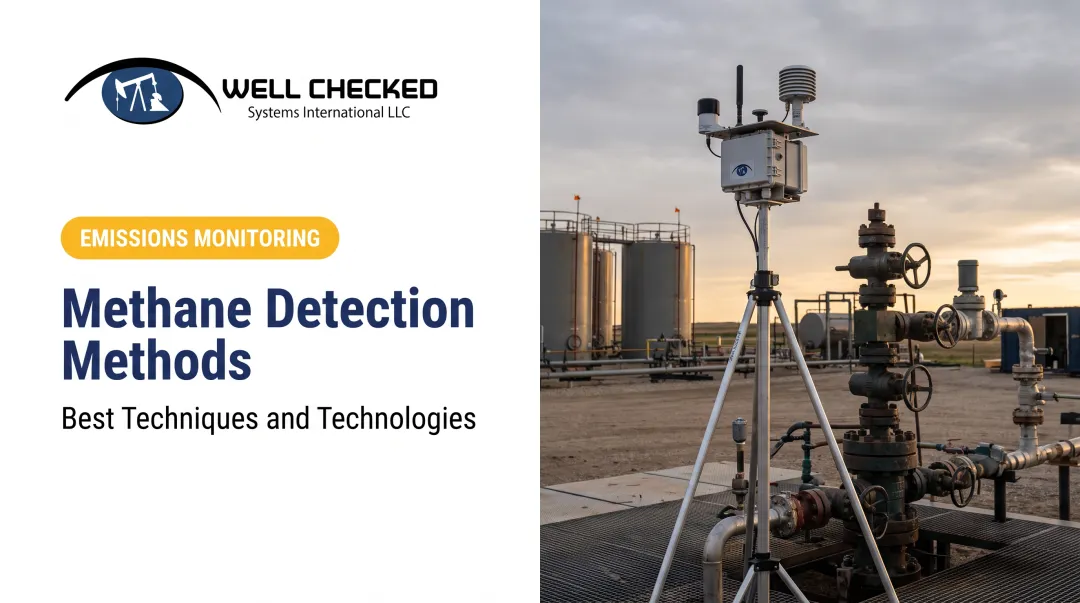
Combining video object recognition, acoustic anomaly detection, and OGI closes the blind spots any single sensor leaves open. A camera alone might miss a low-pressure hiss. An acoustic sensor alone can't see a plume. Put them together with AI filtering, and you get a system that cross-checks itself.
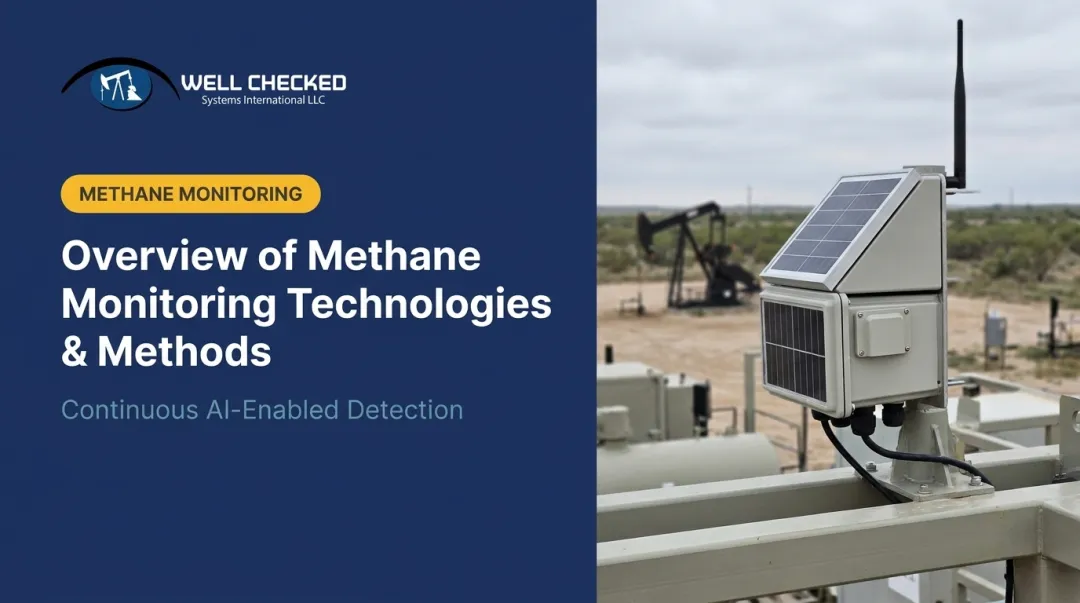
Well Checked Systems' Zensory.ai™ platform is built on this idea: combining high-resolution video, LWIR-based OGI, and acoustic AI into one monitoring stack. The system runs an AI Site Learning cycle, roughly two days per site, to establish what "normal" operations look like before flagging anything as abnormal. That baseline is what lets the platform tell the difference between a compressor doing its job and a compressor that's starting to fail.

Why "Layered" Detection Outperforms Single-Sensor Approaches
No single sense — sight, sound, or smell — catches every leak type. Stack the sensing modes together, and the gaps in one get covered by the strengths of another.
Single-sensor blind spots show up quickly in the field:
- A camera misses leaks obscured by equipment geometry
- An acoustic sensor misses quiet, low-pressure seeps
The catch: more sensors mean more data streams, and more data streams mean more noise. This is where AI-based filtering earns its keep.
Well Checked's Zentinal Core™ approach applies multi-sensor validation on top of the site-specific baseline. It cross-references video, acoustic, and OGI signals so operators see the "needle" of a genuine anomaly rather than every blip across three sensor feeds. The platform processes over 1,500 videos per site per day, filtered down to alerts that actually warrant a response.
Close Proximity vs. Satellite and Aerial Detection
These approaches answer different operational questions.
| Platform | Typical detection floor | Monitoring cadence |
|---|---|---|
| Satellite | ~1,000–1,500 kg/hr | Revisit every 1–3+ days |
| Aircraft | Below 100 kg/hr, sometimes below 10 kg/hr | Periodic flyover |
| Close proximity sensors | Sub-5 kg/hr range | Continuous, real-time |

Satellites and aircraft excel at portfolio-level screening, flagging the biggest emitters across a basin fast. But they run on revisit cycles measured in days, and they simply can't see the smaller, chronic leaks that make up a large share of total site emissions.
Close proximity systems fill that gap with continuous, real-time coverage. The strongest emissions programs use both: wide-area screening for prioritization, ground-level sensors for the granular, day-to-day picture.
Choosing the Right Close Proximity Technology for Your Site
Before picking a technology, weigh these factors:
- Site remoteness — remote sites benefit most from autonomous monitoring since manual inspection routes are expensive and time-consuming
- Equipment density — more components generally means more sensor coverage needed, or a fixed multi-sensor system instead of scattered point detectors
- Budget — LWIR-based OGI at roughly a third of MWIR cost can make continuous coverage viable at scale
- Regulatory requirements — EPA Subpart OOOOb and OGMP 2.0 Level 4/5 reporting both call for measurement-backed, defensible data, not spot checks
For operators still running quarterly pumper routes, the shift is toward "operate by exception": continuous autonomous monitoring that only requires a site visit when something is actually wrong.
Well Checked's three-tier Zentinal architecture mirrors that progression:
- Zentinal Ops™ for visual and acoustic intelligence
- Zentinal Core™ for multi-sensor detection and false-alarm filtering
- Zentinal IQ™ for regulatory-defensible quantification once an event is validated

Operators can start with a fixed-fee pilot before a full deployment. That model already runs across sites.
Frequently Asked Questions
What type of camera can detect gas leaks?
Optical Gas Imaging (OGI) cameras, particularly Long-Wave Infrared (LWIR) models, visualize methane and VOC plumes by detecting infrared absorption. They work day or night, unlike standard visual cameras.
How close do sensors need to be to detect a methane leak?
Close proximity sensors (fixed cameras, acoustic units, point detectors) typically monitor within feet to a few hundred feet of equipment. Satellites, by contrast, cover entire regions from orbit.
Can acoustic sensors detect all types of methane leaks?
No. Acoustic and ultrasonic sensors work best on pressurized leaks with a clear sound signature. Low-pressure or diffuse emissions often go undetected, so pairing acoustic sensing with OGI or video is recommended.
How is AI improving close proximity methane detection?
AI models learn a site's normal operating patterns (Well Checked's system takes about two days), then flag deviations as potential anomalies. This filters out routine process activity and reduces alert fatigue from false positives.
What is the difference between point detectors and open-path detectors?
Point detectors need gas to physically contact the sensor, so placement and wind direction matter a lot. Open-path detectors use a beam across an area, covering a wider area but facing weather and alignment challenges.
Why do operators use close proximity detection instead of relying only on satellites?
Satellites miss smaller, chronic leaks below roughly 1,000 kg/hr and only revisit sites every 1–3 days. Close proximity systems provide continuous, site-level monitoring that catches leaks satellites simply can't see.