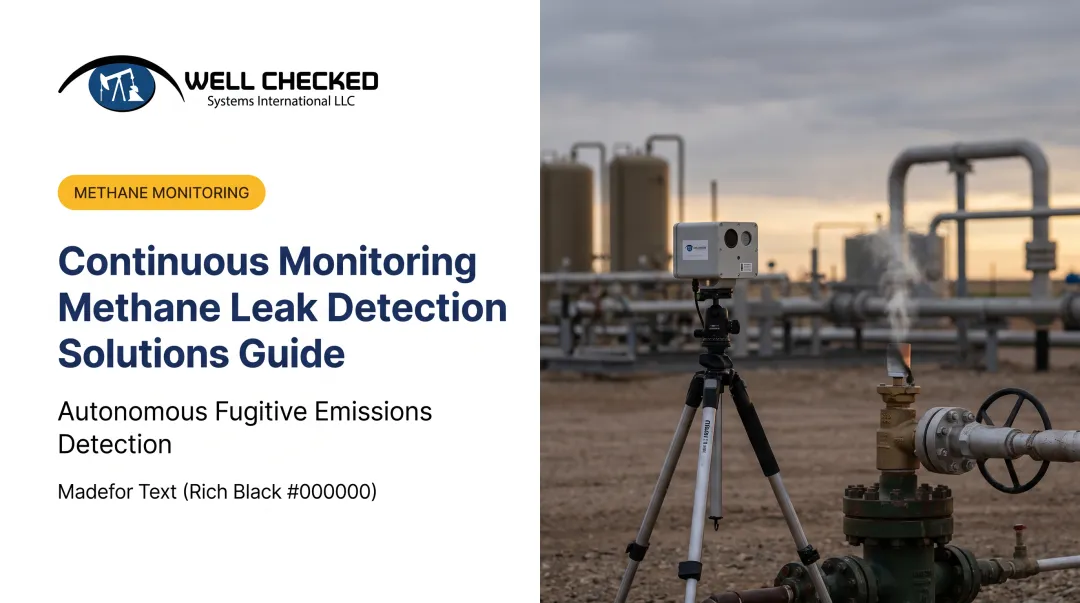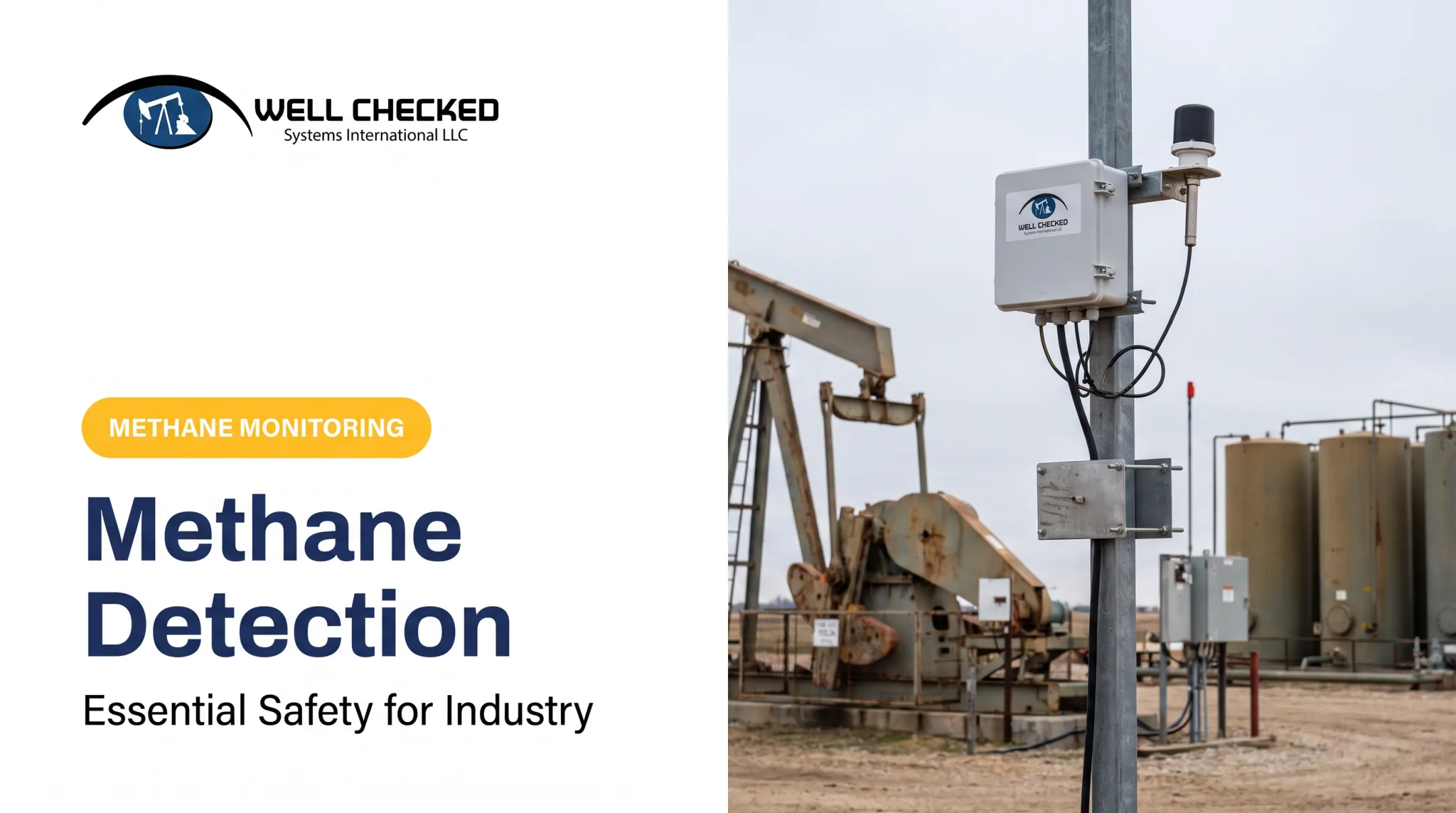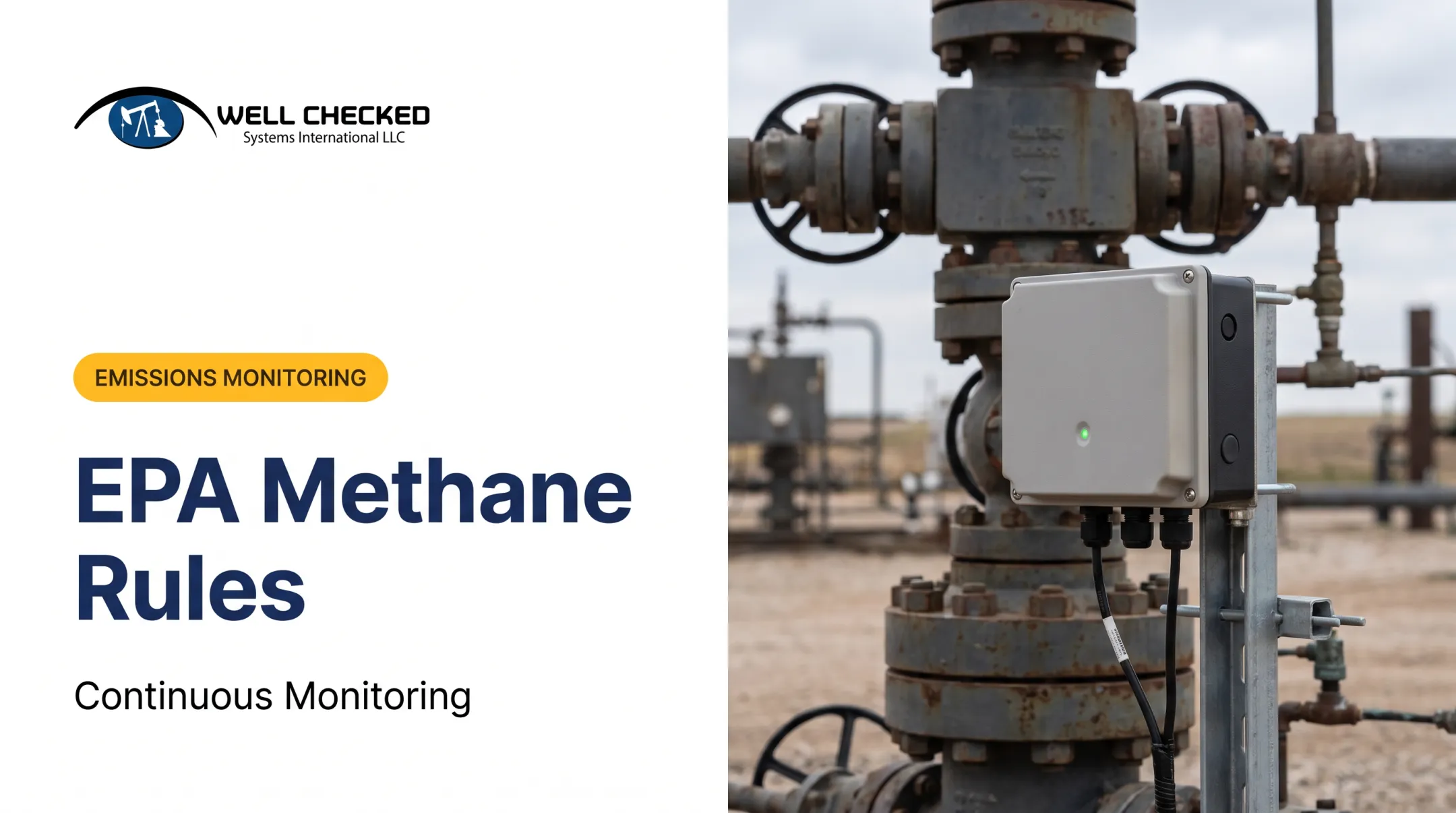

The regulatory pressure has intensified too. EPA's OOOOb rule took effect May 7, 2024, and the monitoring and repair clock for affected sources is already running. Add OGMP 2.0's measurement-based reporting expectations, and operators face a real question: are point sensors enough anymore?
This guide covers what CH4 detectors are, how the underlying sensor technologies work, what they cost, and why many upstream operators are shifting toward continuous, AI-based monitoring instead of relying solely on periodic checks.
Key Takeaways
- Rely on instruments, not senses — methane is odorless and colorless, and is treated as explosive at every level above 10% LEL, which is where detectors alarm
- Weigh sensor tradeoffs carefully: catalytic bead, NDIR, and semiconductor options differ on accuracy and cost
- Point detectors alone rarely deliver the continuous, defensible data EPA and OGMP 2.0 now expect
- Budget across a wide band — under $200 handhelds to $100,000+ optical gas imaging systems
What Is CH4 and Why Does It Need a Dedicated Gas Detector?
Methane is colorless and odorless, with a relative vapor density of 0.6 (air = 1), meaning it's lighter than air and rises toward ceilings and confined high points. Its flammable range sits between 5% and 15% methane by volume in air, the lower explosive limit (LEL) and upper explosive limit (UEL) respectively, according to the NIOSH International Chemical Safety Card. Because 100% LEL corresponds to that 5% by-volume floor, fixed and portable detectors are normally set to alarm well below it, commonly at 10% LEL.
That creates a dual hazard:
- Explosion/fire risk when concentrations climb within the LEL-UEL band near an ignition source
- Asphyxiation risk in enclosed or confined spaces where methane displaces breathable oxygen
Unlike distributed natural gas, which utilities odorize with mercaptan, raw wellhead methane carries no warning smell. Workers can't detect a leak by nose. That's why dedicated sensing, not human perception, has to be the first line of defense.
Where This Matters Most
CH4 detection is critical across several industries:
- Oil & gas upstream and midstream operations
- Mining
- Wastewater treatment and landfill gas management
- Chemical processing facilities
Beyond worker safety, methane leaks are a product-loss and reporting problem. EPA reports that methane made up 12% of all US greenhouse gas emissions from human activity in 2022, with natural gas and petroleum systems ranking as the second-largest source after agriculture (EPA Methane Emissions).
Methane is the principal component of natural gas, so every undetected leak carries both a safety cost and a direct product loss.

How Does a CH4 Gas Detector Work?
Different sensor technologies detect methane through different physical mechanisms, and each comes with real tradeoffs.
Catalytic Bead (Pellistor) Sensors
These sensors oxidize methane on a heated catalytic bead, producing a measurable temperature change relative to a paired inert bead. They're affordable and widely used.
The tradeoff: they depend on ambient oxygen to function and are vulnerable to "poisoning" from silicones or other contaminants, which can cause inaccurate readings without obvious warning.
NDIR (Non-Dispersive Infrared) Sensors
NDIR sensors detect methane by measuring infrared absorption at specific wavelengths. They're more stable and resistant to poisoning than catalytic bead sensors, but they cost more and draw more power, which matters for battery-operated field equipment.
Semiconductor (MOS) Sensors
Metal-oxide-semiconductor sensors offer a lower-cost alternative, common in consumer-grade and budget industrial detectors. They trade some precision for affordability.
Across these sensor types, readings come in two formats that matter for compliance: %LEL for flammability alarms and ppm for lower-concentration leak detection. Knowing which metric your use case demands changes how you configure alarms.
Beyond Single-Point Sensing
Newer approaches extend detection past a single fixed point:
- Long-Wave Infrared Optical Gas Imaging (OGI) visualizes gas plumes across a wider field of view, day or night
- MEMS-based spectrometry offers another path to area-level detection
Well Checked's Zensory.ai™ platform builds on that shift. Instead of one point sensor watching one spot, it combines LWIR optical gas imaging with acoustic and visual sensing to monitor an entire site.
The camera-based OGI approach runs at roughly one-third the cost of traditional mid-wave infrared systems, making site-wide coverage economically viable where it wasn't before.

Types of CH4 Gas Detectors and Where to Use Them
Detector selection depends heavily on what you're protecting and how much ground you need to cover.
- Portable/handheld detectors for personal worker safety, confined space entry, and manual leak surveys. OSHA's confined-space standard requires testing oxygen, flammable gases, and toxic contaminants, in that order, before entry.
- Fixed-point detectors for continuous monitoring at known leak sources: valves, compressors, tanks, and separator units.
- Area or wide-coverage systems for entire wellsite perimeter monitoring, replacing scattered point sensors with unified coverage.
Placement Best Practices
Where you mount detectors matters as much as which type you choose:
- Mount sensors close to likely leak sources, where air currents concentrate gas
- Since methane rises, place detectors near ceilings or high points in enclosed spaces
- There's no universal formula; placement should be facility-specific, following established sensor-placement guidance
CH4 Gas Detector Pricing: What Affects the Cost?
Detector pricing spans a wide range depending on technology and scope.
| Detector Type | Approximate Price Range |
|---|---|
| Portable single-gas (LEL) | Under $200 |
| Multi-gas handheld kits | $3,000+ |
| Fixed-point systems | ~$1,000 to $10,000+ |
| Handheld OGI cameras | $40,000-$60,000 (up to $100,000+ for advanced) |

These figures are indicative manufacturer estimates, not a live market benchmark.
What drives cost:
- Sensor technology (catalytic vs. NDIR vs. laser/OGI)
- Certification requirements (intrinsically safe, Class I Division 1/2, UL/CSA)
- Calibration and bump-testing cadence
- Monitoring scope: single point versus site-wide coverage
The Maintenance Cost Operators Underestimate
Point sensors aren't a one-time purchase. OSHA guidance recommends a bump test before each day's use, and a failed test means full recalibration or removal from service.
Multiply that across dozens of sensors on a multi-well pad, and maintenance labor adds up fast. Over a device's lifetime, that labor often exceeds the original hardware cost. Continuous multi-sensor monitoring shifts spend away from daily per-sensor checks toward exception-based response, which changes how operators should compare lifetime cost.
On ROI: weigh detector cost against the alternative. One EPA enforcement action against an operator resulted in a $5.5 million penalty plus over $10 million in corrective measures across 22 facilities for monitoring and recordkeeping failures (EPA enforcement announcement,
2024).
A single undetected leak or missed inspection cycle can cost far more than the equipment meant to catch it.
Beyond Point Sensors: Why Continuous, Autonomous Monitoring Matters
Point sensors and periodic LDAR checks both leave coverage gaps. A published ACS study simulating OGI surveys found that for five-minute checks, median first-year leak capture was just 23% monthly and dropped to 2% for annual surveys. Even two-hour surveys left roughly half of emissions undetected in many scenarios. Leaks between visits simply go unnoticed.
Continuous, autonomous monitoring closes that window by watching sites around the clock and alerting when conditions change. Well Checked's Zensory.ai™ platform runs a three-tier detection-to-quantification workflow, and operators select the tier that fits each site:
- Zentinal Ops™ — visual and acoustic equipment intelligence: high-resolution video, object recognition, and acoustic anomaly detection with actionable alerts
- Zentinal Core™ — multi-sensor detection across video, audio, and IR, filtering false alarms and validating true fugitive events against a site-specific AI baseline learned in about two days; supports OGMP 2.0 Level 3
- Zentinal IQ™ — quantifies only Core-validated events for methane volume, duration, and rate, producing regulatory-ready reporting

Operate by Exception
This model underpins Well Checked's continuous monitoring deployment in the Appalachian Basin. Validated events can be acknowledged, dispatched, and mitigated within 24 hours — instead of waiting weeks for the next scheduled operator route.
That responsiveness, combined with Zentinal IQ™ quantification, supports regulatory-defensible reporting aligned with EPA's 40 CFR Part 60 Subpart OOOOb, OGMP 2.0, and SASB/TCFD frameworks.
Frequently Asked Questions
What is CH4 in a gas detector?
CH4 is the chemical formula for methane, the target gas most industrial detectors are calibrated to identify. Readings are typically reported in %LEL for flammability alarms or ppm for lower-level leak detection.
How do you detect CH4?
Common methods include catalytic bead, NDIR, and laser/optical gas imaging sensors. For wellsite-scale coverage, operators increasingly use continuous multi-sensor monitoring rather than relying on scattered point sensors alone.
How much does a CH4 gas detector cost?
Prices range from under $200 for basic portable units to $10,000+ for fixed systems and up to $100,000+ for advanced OGI cameras. Sensor type, certification, and monitoring scope all drive the final cost.
Where should a methane sensor be installed?
Sensors should sit close to likely leak sources such as valves or compressors. Because methane is lighter than air, detectors in enclosed spaces should be mounted near ceilings or other high points.
How often do CH4 detectors need calibration?
OSHA guidance recommends a bump test before each day of use, with full calibration if that test fails. Continuous AI-based monitoring platforms cut that burden by moving checks to fixed sensor arrays with centralized upkeep.
Can CH4 gas detectors help with EPA compliance?
Yes. Continuous monitoring platforms like Zentinal IQ™ can support EPA Subpart OOOOb alternative-monitoring submissions and state-agency emissions inventories. The same data also maps to OGMP 2.0 and SASB/TCFD disclosure needs.