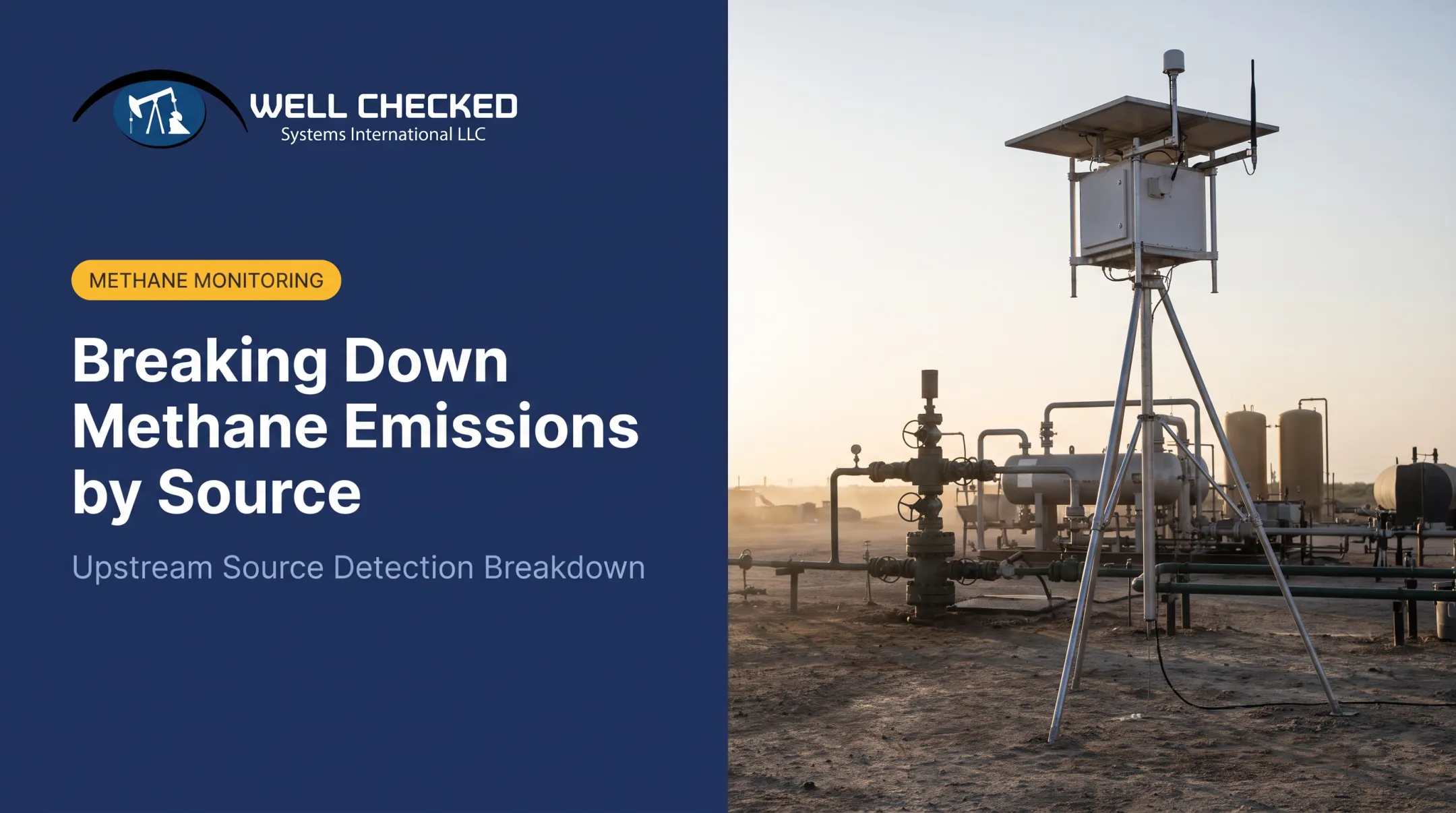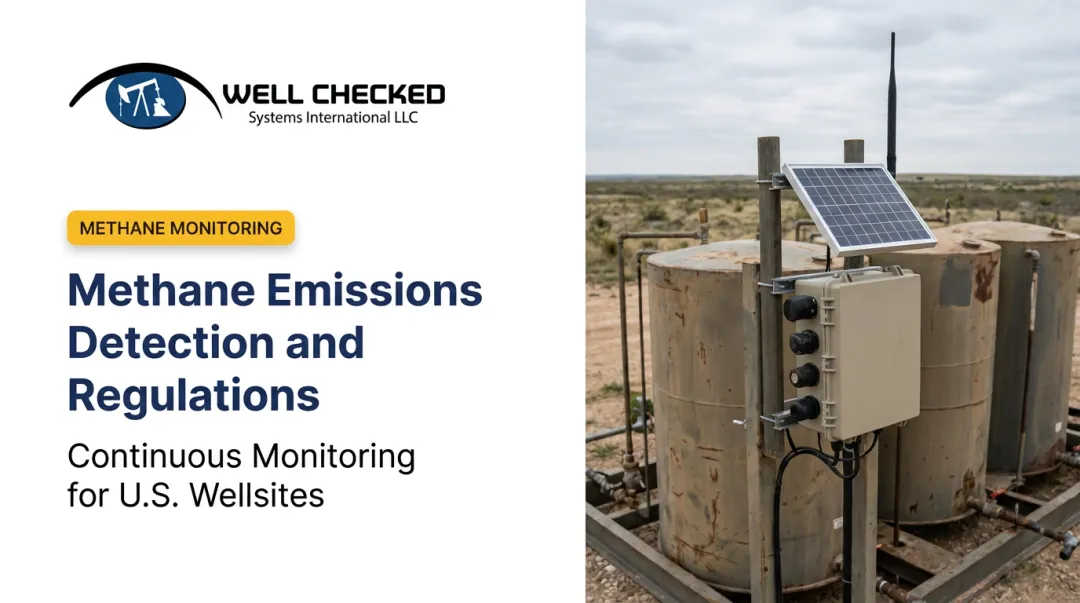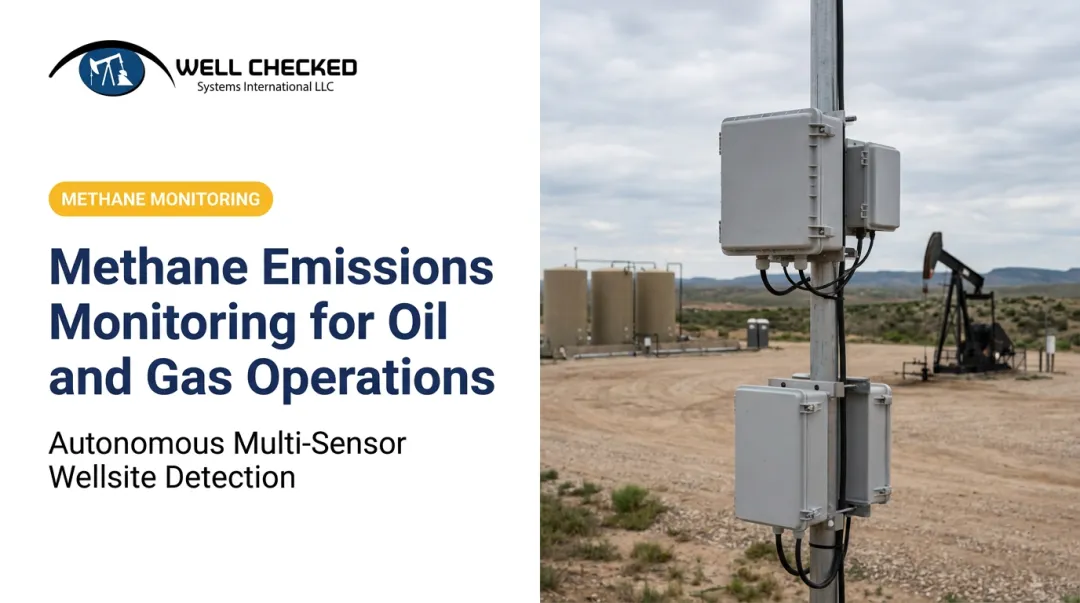

Operators who can't pinpoint where methane is coming from face real consequences: EPA fines, ESG reporting gaps, and gas that's lost before it ever reaches a pipeline. This article breaks down the common causes of upstream methane emissions, what happens when they go undetected, and how operators are shifting from periodic inspections to continuous monitoring.
Key Takeaways
- Tanks, pneumatic devices, flares, and equipment leaks are the primary emission sources
- Field measurements show actual emissions often run well above bottom-up inventory estimates
- Prevention combines equipment upgrades with continuous monitoring
- OGMP 2.0 and EPA rules are pushing operators toward measurement-based reporting
Common Causes of Upstream Methane Emissions
Upstream methane losses fall into three buckets: fugitive leaks (unintentional), vented emissions (by design), and combustion-related losses (incomplete burning). These happen during exploration, drilling, and production.
Here's the uncomfortable part: a landmark 2018 study found actual US oil-and-gas methane emissions ran about 60% higher than EPA's bottom-up inventory estimated, at roughly 13 million metric tons annually. That gap exists because emission factors miss intermittent, high-rate events that only field measurement catches.

Most losses don't come from one dramatic blowout. They come from aging infrastructure, design quirks, and day-to-day operational inefficiency.
Storage Tanks and Thief Hatches
Pressure changes, worn seals, and improperly closed thief hatches let methane escape intermittently. A hatch that pops open during a pressure surge might reseal before the next site visit, so quarterly LDAR surveys never catch it.
Continuous monitoring closes that gap by logging intermittent releases between scheduled visits.
Pneumatic Devices and Venting
Gas-driven pneumatic controllers and pumps vent methane as a normal part of operation. EPA's own review estimated these devices contributed 775 kilotons of methane in a single reference year, based on 2012 data (EPA pneumatic controller review).
The industry is responding. Major operators are replacing high-bleed controllers with low- or no-bleed alternatives. In the Permian Basin, controller methane intensity dropped 60% between 2015 and 2022, from 16 to 6 grams per megajoule, per S&P Global.
Flares and Combustion Inefficiency
Flares aren't always doing their job. A 2022 peer-reviewed study sampling active flares found real destruction efficiency of just 91.1%, well below the 98% typically assumed. Unlit flares showed up in nearly 5% of Permian samples surveyed (Science, 2022).
Ineffective flaring alone may account for 4-10% of total US oil-and-gas methane. The industry's Zero Routine Flaring by 2030 initiative, backed by governments and over 100 corporate endorsers, targets this directly.
Equipment Leaks and Rotating Equipment
Valves, flanges, connectors, wellhead vents, and compressor seals all leak. These events are often:
- Short-duration (minutes to hours)
- Intermittent, not constant
- Invisible to scheduled site visits
That combination makes rotating equipment leaks the hardest category to catch with route-based inspections. If your operator drives by twice a month, a two-hour leak has a low chance of being witnessed.

What Happens If Methane Emissions Go Undetected
Undetected emissions carry three layers of risk: regulatory, financial, and ESG.
Regulatory exposure. Under EPA's methane rule (40 CFR Part 60 Subpart OOOOb), a "super-emitter" event is defined as a release of 100 kg of methane per hour or more. Once EPA notifies the owner or operator, they must investigate within five days and file a report within 15 days.
Financial cost. Beyond potential fines, there's lost saleable gas and the ongoing cost of manual inspection programs. Route-based site visits typically run mid-to-large operators $1 million to $5 million or more annually — and that's before accounting for the gas volume walking out the thief hatch.
ESG risk. Operators reporting under OGMP 2.0, SASB, or TCFD frameworks need defensible, measurement-based data. Estimates built on assumptions don't hold up well under investor or regulator scrutiny.

Warning Signs Operators Are Missing Emissions
Watch for these patterns:
- Recurring high-bleed readings on pneumatic devices during routine checks
- Repeated "emergency" repairs on the same flare or tank hatch
- Noticeable gaps between your reported inventory and third-party satellite or aerial survey estimates
Any of these suggests your detection cadence isn't keeping pace with your actual emissions profile.
How to Prevent Methane Emissions in Upstream Operations
Prevention isn't about scheduling more manual inspections. It's about combining equipment upgrades with smarter detection.
Upgrade High-Emitting Equipment
Priority upgrades include:
- Replace high-bleed pneumatic controllers with low/no-bleed or electric alternatives
- Retrofit wet seals to dry seals on compressors
These changes block routine venting and combustion slip at the source. Schedule them during planned maintenance windows rather than as emergency fixes.
Strengthen LDAR Programs
Structured leak detection and repair at high-risk components (valves, flanges, connectors) reduces how long fugitive leaks persist between inspection cycles. OGMP 2.0 Level 4/5 guidance increasingly expects this to run continuously, not just quarterly.
Deploy Continuous Autonomous Monitoring
Periodic operator-route visits miss what happens between stops. Well Checked's Zensory.ai™ platform closes that gap with three sensor types across a wellsite:
- High-resolution video for continuous visual coverage and object detection
- Acoustic AI to catch abnormal equipment sounds before they become failures
- Optical gas imaging (LWIR) for day/night methane and VOC detection
The system runs a roughly two-day AI Site Learning cycle per location, building a baseline of what "normal" looks like at that specific site.
That baseline lets Zentinal Core™ separate routine process activity from genuine fugitive events. False alarms drop, so field teams respond to real issues instead of noise.

Operators typically deploy this ahead of EPA compliance deadlines, or when scaling monitoring across multiple basins at once.
Improve Flare and Combustion Efficiency
Upgrading flare tips or engines, or transitioning to electric drivers, cuts both combustion slip and unlit-flare risk in one move. Pair this with routine flare performance audits rather than relying on "it's listed as operating" as your only check.
Tips for Long-Term Prevention and Control
Long-term methane control depends on process, not just technology:
- Build an acknowledge-dispatch-mitigate workflow. Move validated methane events from detection to resolution within 24 hours to minimize fine exposure.
- Train field and HSE teams to distinguish normal process emissions from true anomalies. Without this, alert fatigue sets in fast and real leaks get buried in noise.
- Maintain continuous, defensible documentation aligned with EPA, OGMP 2.0, SASB, and TCFD requirements, not periodic snapshots that leave gaps between inspections.
- Use AI-enabled sensor technology that learns each site's normal signature. Site-specific learning separates genuine leak alerts from false positives triggered by routine operations.
Conclusion
Upstream methane emissions aren't mysterious. They come from identifiable sources — tanks, pneumatics, flares, rotating equipment — and each has a documented path toward reduction.
The shift across the industry is from reactive, route-based site visits to proactive, always-on awareness.
Combining equipment upgrades with continuous monitoring — like Well Checked’s Zensory.ai platform — gives operators regulatory-defensible data and fewer surprises. That’s a better position than learning about a leak from a satellite report three weeks after it started.
Frequently Asked Questions
Which country has the highest methane emissions?
For oil and gas specifically, the US ranks as the top emitter globally, closely followed by Russia, according to the IEA Global Methane Tracker. Across all energy sectors combined, China leads, with the US and Russia close behind.
What is the difference between fugitive and vented methane emissions?
Fugitive emissions are unintentional leaks from equipment like valves, flanges, and seals. Vented emissions are intentional, by design releases: gas escaping from pneumatic controllers during normal operation.
How often should upstream sites be inspected for methane leaks?
Quarterly LDAR surveys remain the regulatory baseline for many site types. However, OGMP 2.0 Gold Standard and evolving EPA expectations are pushing operators toward continuous monitoring to catch leaks between inspection cycles.
What is the EPA methane rule for oil and gas operators?
Subpart OOOOb sets performance standards for new, modified, and reconstructed sources. It pushes operators toward optical gas imaging and alternative detection methods for compliance.
Can methane emissions be eliminated entirely from oil and gas operations?
Near-zero methane is achievable through combined equipment redesign, mitigation, and monitoring. Full elimination is still a long-term industry goal, not a present-day standard.
How does continuous monitoring compare to satellite or aerial methane surveys?
Satellites offer wide-area screening but have revisit gaps (sometimes two weeks between passes). Continuous ground-based monitoring catches short-duration leaks that occur between those flyovers, making the two approaches complementary rather than interchangeable.