
Introduction
A pumper drives out to a wellsite, logs a routine reading, and moves on. Three months later, an EPA inspector finds a leak that's been venting methane since the last visit.
What started as a missed reading is now a notice of violation, a corrective action order, and a line item in next quarter's budget.
That gap between "we checked" and "we caught it in time" is exactly what environmental compliance monitoring is supposed to close.
People often confuse this term with general environmental monitoring, which tracks broad conditions like regional air quality trends. Compliance monitoring is narrower and more specific: it ties measurements directly to a permit condition or legal requirement.
This article covers what environmental compliance monitoring is, its main types, and how it works in practice. It also looks at how technology, including continuous autonomous monitoring, is changing the way oil and gas operators meet their obligations.
Key Takeaways
- Environmental compliance monitoring confirms a facility meets its permit, statute, and regulatory requirements
- It covers air, water, waste, and noise using methods from inspections to continuous sensors
- EPA sets the federal framework, while states and local agencies handle daily enforcement
- Non-compliance carries financial, legal, and reputational costs that exceed prevention
- Continuous sensor-based monitoring is complementing periodic inspections in oil and gas
What Is Environmental Compliance Monitoring?
Environmental compliance monitoring is the set of on-site and off-site activities that regulators, and increasingly facilities themselves, use to determine and document whether operations meet applicable environmental laws and permit conditions. The EPA describes it as encompassing "all of the means used to make a compliance determination," from field inspections to paperwork reviews.
That definition matters because it's broader than most people assume. It's not just an inspector with a clipboard. It includes self-reported sampling data, continuous emissions monitors, and even record requests sent to a facility's compliance office.
Why EPA Runs Compliance Monitoring Programs
EPA's compliance monitoring programs exist to serve five specific goals:
- Assess and document compliance with permits and regulations
- Support enforcement by collecting usable evidence
- Track compliance with existing orders and consent decrees
- Create deterrence against future violations
- Feed implementation issues back to the people who write permits and rules
That last goal is often overlooked. Monitoring isn't just a check on facilities. It also shows regulators whether a rule actually works in the field.
Compliance Monitoring vs. General Environmental Monitoring
The two get lumped together constantly, but they answer different questions.
| Monitoring Type | What It Measures | Regulatory Connection |
|---|---|---|
| Ambient/general monitoring | Atmospheric or water conditions across a region, compared to historical trends | Characterizes surroundings; doesn't prove any single source is in compliance |
| Compliance monitoring | Emissions or discharges tied to a specific permit condition | Directly supports a legal compliance determination |
A regional air-quality sensor telling you ozone levels rose 8% this summer is general monitoring. A facility's continuous emissions monitor showing it stayed under its permitted SO2 limit is compliance monitoring. Same instruments, in some cases, but different legal weight.

Who Oversees It
EPA sets the federal statutory floor through laws like the Clean Air Act, Clean Water Act, and RCRA. In practice, though, states and local agencies run most of the show. For RCRA specifically, EPA delegates the bulk of compliance-monitoring responsibility to states, with EPA providing oversight rather than direct enforcement.
That layered structure means requirements vary by jurisdiction. A facility operating across state lines may face different reporting formats, inspection frequencies, and documentation standards from one state to the next, even under the same federal statute.
That inconsistency is one reason operators increasingly turn to continuous, technology-based monitoring. Platforms like Well Checked Systems' autonomous wellsite system, deployed across sites in the Appalachian and Permian basins, help keep documentation consistent regardless of which state agency is asking.
Main Types of Environmental Compliance Monitoring
Compliance monitoring breaks down two ways: by the environmental medium it covers, and by the method used to collect the data.
By Environmental Media
- Air quality monitoring: tracks emissions, volatile organic compounds (VOCs), and particulate matter under the Clean Air Act
- Water quality monitoring: covers discharge, stormwater, and contaminant levels under the Clean Water Act and NPDES permits
- Waste and land monitoring: governs hazardous waste handling, storage, and soil impacts under RCRA
- Noise monitoring: addresses major noise sources under the Noise Control Act, though primary responsibility rests with state and local governments
Each medium carries its own permit structure, sampling frequency, and reporting format. A facility handling multiple media, say, a chemical plant with air permits and wastewater discharge, is managing several parallel compliance programs at once, not one unified system.
By Monitoring Method
- Self-monitoring and continuous monitoring: facility-operated sensors and sampling required under permits like NPDES, where the permittee reports its own data
- On-site inspections: EPA's Full Compliance Evaluations (FCEs) review all regulated pollutants and units, while Partial Compliance Evaluations (PCEs) focus on a subset
- Off-site record reviews: regulators request records, reports, and data without visiting the site
- Third-party or regulatory audits: independent verification of self-reported compliance data
EPA organizes these programs under specific statutes: the CAA, CWA, RCRA, SDWA, TSCA, CERCLA, and FIFRA each have their own compliance monitoring framework. That's why a water permit's self-monitoring schedule looks nothing like an air permit's continuous monitoring requirement. Each law was written with a different pollution pathway in mind.
How Environmental Compliance Monitoring Works: Key Steps
Building a working compliance monitoring program follows a fairly consistent sequence, regardless of industry.
- Identify applicable obligations. Location, materials handled, and emissions or discharge points all determine which permits and regulations apply.
- Develop a monitoring plan. Define what gets measured, how often, and by what method, including which technology will collect the data.
- Deploy data collection tools. This is where the biggest shift has happened in recent years. Manual, periodic sampling is giving way to IoT sensors, optical gas imaging, and AI-enabled continuous monitoring platforms that don't rely on someone driving a route.
- Document and retain records. Inspection logs, sampling results, and training records all matter because regulators want proof of action, not just a claim of good outcomes.
- Report findings on required timelines. Deviations get routed into corrective action and root-cause tracking, not just noted and filed away.
- Review and adapt the program. Regulations change, equipment ages, and operations shift. A monitoring plan built in 2019 probably needs updating today.

That third step, deploying the right tools, is where most of the recent innovation is concentrated. Route-based inspections and quarterly sampling produce a snapshot: accurate for the moment it's taken, blind to everything that happens between visits. Platforms like Well Checked Systems' Zensory.ai close that gap, analyzing 1,500+ videos per site every day to flag true anomalies instead of periodic noise.
Example: Environmental Compliance Monitoring in Oil & Gas Operations
Upstream oil and gas offers one of the clearest illustrations of how compliance monitoring is evolving, largely because the stakes (and the regulatory scrutiny) are high.
The Traditional Model
For decades, the standard approach combined quarterly Leak Detection and Repair (LDAR) inspections with routine pumper visits. A technician drives to each wellsite, checks equipment, and moves to the next.
Under current EPA rules, the exact frequency varies by facility type. Single-wellhead sites may only need quarterly visual and olfactory surveys, while sites with major production equipment require more frequent checks combined with periodic optical gas imaging.
This model technically complies, but it only captures conditions at the single moment of inspection. A leak that starts the day after a technician leaves can run undetected for weeks.
The Continuous Monitoring Alternative
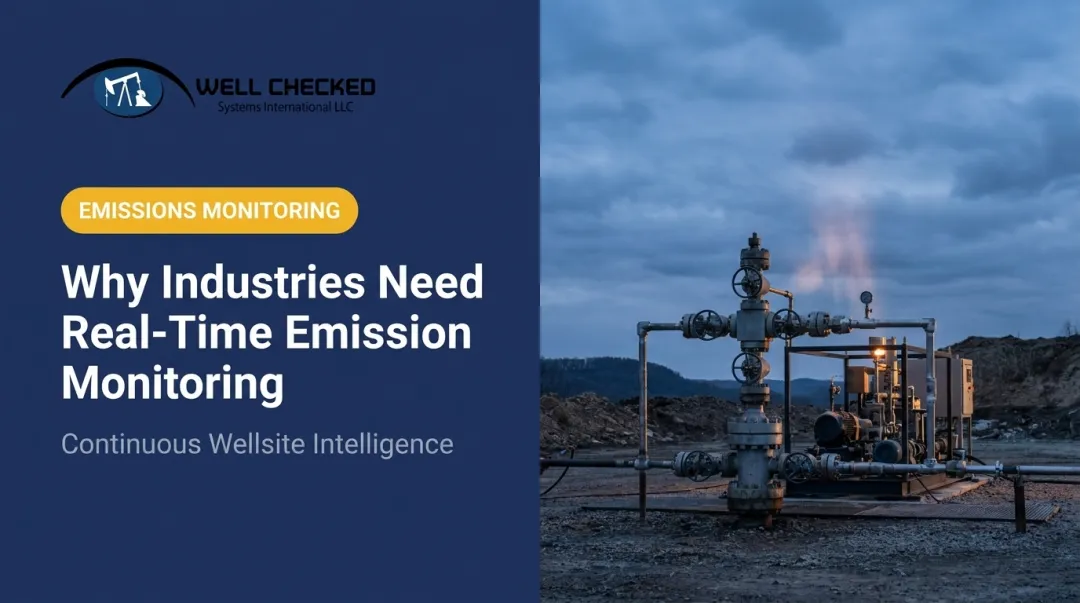
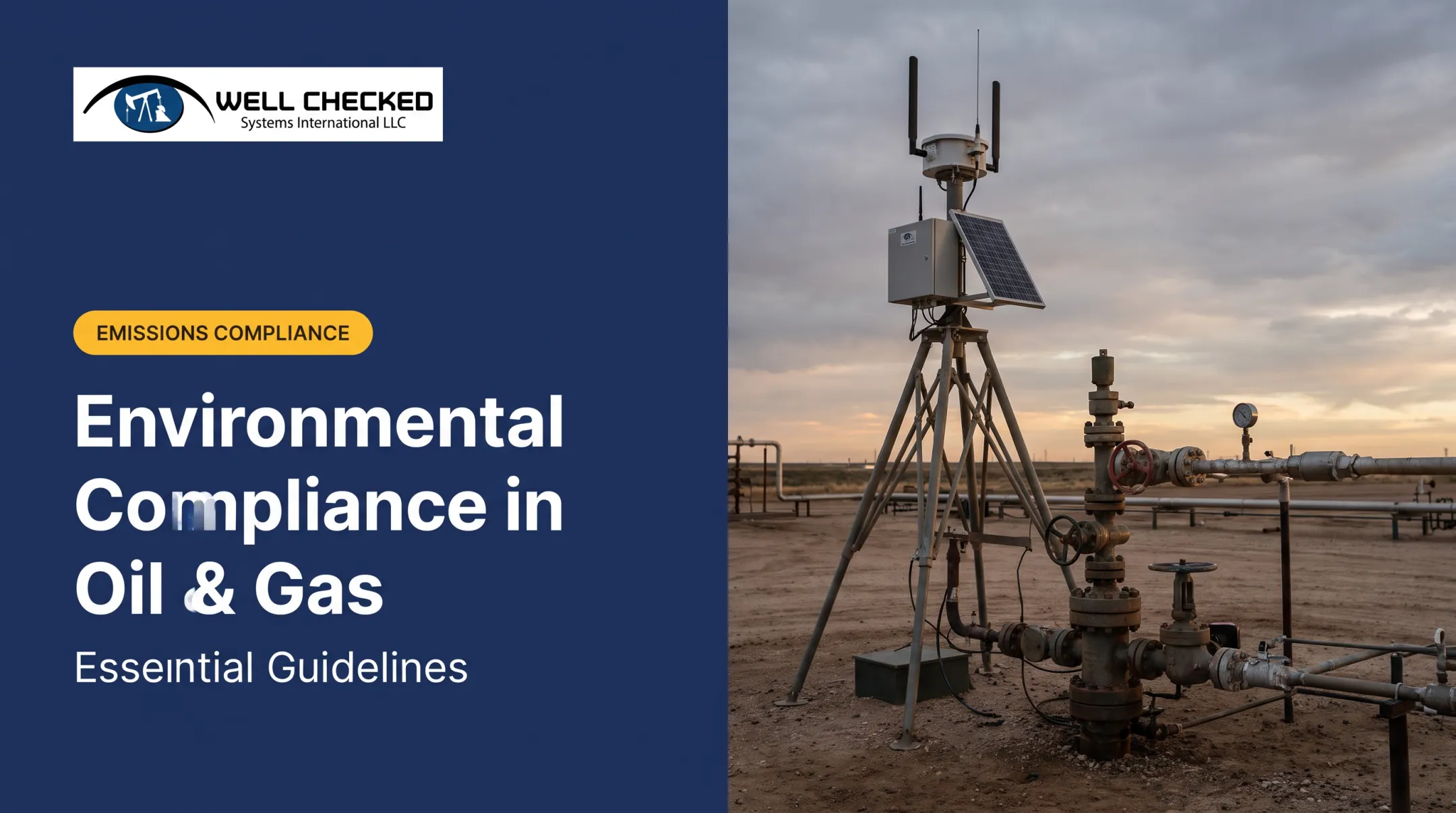
Continuous, multi-sensor autonomous monitoring flips that model. Instead of periodic snapshots, sensors watch wellsites around the clock. Video, acoustic abnormal-sound detection, and Long-Wave Infrared Optical Gas Imaging work together to flag genuine fugitive emission events rather than routine venting or normal process activity. Well Checked has a USPTO provisional patent filing for Detecting and Quantifying Fugitive Methane and Vapor Emissions Using Infrared Imaging and Machine Learning.
This is the approach Well Checked Systems has built into its Zensory.ai™ platform. The system separates visual intelligence, detection, and quantification across three tiers:
- Zentinal Ops™ delivers visual and acoustic equipment intelligence: high-resolution video, object recognition, acoustic anomaly detection, and actionable alerts. Well Checked has a USPTO provisional patent filing covering its acoustic anomaly detection technology.
- Zentinal Core™ handles multi-sensor detection, filtering out false alarms so operators only get alerted to true anomalies, described internally as finding "the needle in stacks of needles"
- Zentinal IQ™ quantifies validated events for regulatory-defensible reporting, only activating after Core has confirmed a real event
The platform runs an AI Site Learning cycle, roughly two days per site, to establish what normal operations look like before it starts flagging deviations. At scale, this means analyzing more than 1,500 videos per site per day across a deployment, including a multi-site continuous monitoring program in the Appalachian Basin.

How This Maps to Real Compliance Frameworks
Continuous monitoring data doesn't exist in a regulatory vacuum. It's built to support specific pathways:
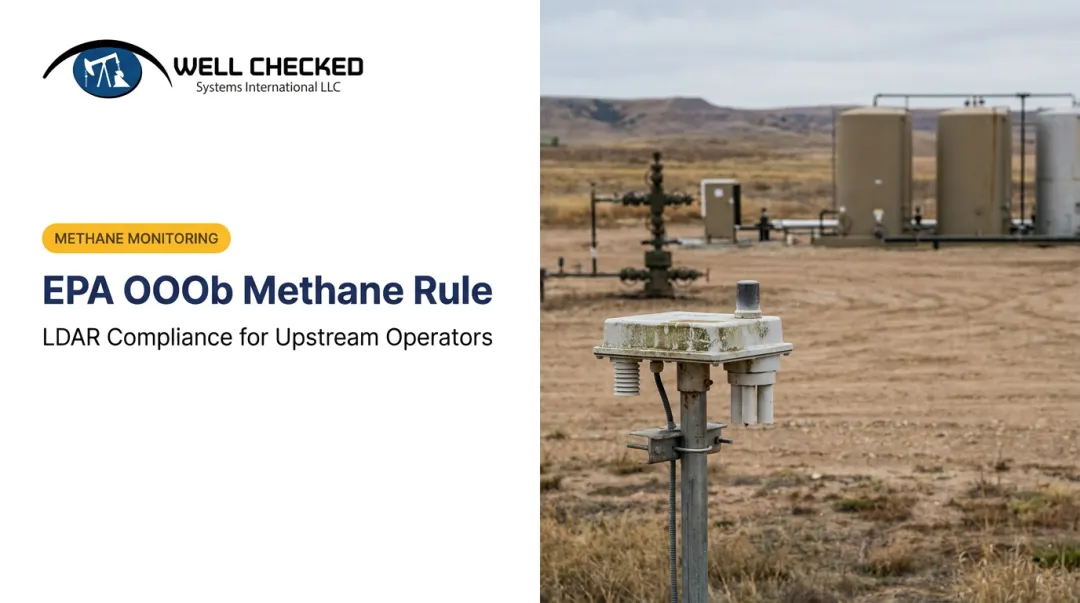
- EPA's methane rule under 40 CFR Part 60 Subpart OOOOb includes an alternative-monitoring pathway (the Methane Alternative Test Method process) for technologies used in periodic screening, continuous monitoring, and super-emitter detection
- OGMP 2.0 Level 4/5 reporting requires measurement-based data rather than estimates, which continuous sensor networks are positioned to supply
- ESG frameworks like SASB and TCFD ask companies to disclose emissions data and mitigation strategy, which quantified, timestamped event data supports directly
The practical payoff shows up in response time. Once Zentinal Core™ validates a fugitive event, operators can acknowledge, dispatch, and mitigate within 24 hours. Operations leaders describe that window as the difference between having a documented response to show and having none.
Why Environmental Compliance Monitoring Matters
Good monitoring does three things at once: it creates accountability, keeps operations running without disruption, and catches problems before they become fines.
The financial risk is real and growing. EPA's FY2024 enforcement results show:
- Administrative and judicial penalties totaling $1.7 billion in FY2024, up sharply from $299 million the prior year, with civil cases concluded climbing from 1,579 to 1,851
- Oil and gas enforcement specifically totaled 19 cases producing nearly $72 million in civil penalties, including settlements over well-completion emissions
For mid-sized to large operators, the math on prevention is straightforward:
- Route-based inspection programs typically run $1 million to $5 million or more annually
- A single validated methane event caught within 24 hours can avoid fines that would dwarf a year of monitoring costs
- Continuous records replace snapshot data, giving operators defensible documentation instead of gaps regulators can question

Beyond the dollar figures, reputational exposure is harder to price but no less real. Violations become part of the public record through systems like EPA's Enforcement and Compliance History Online, visible to investors, customers, and communities alike. Unlike a fine, that kind of exposure doesn't get resolved with a settlement check.
Frequently Asked Questions
What is environmental compliance monitoring?
It's the process regulators and facilities use to verify adherence to environmental permits, statutes, and regulations. EPA describes it as encompassing every activity used to make a compliance determination, from inspections to self-reported data.
What are the main types of environmental compliance monitoring?
They break down by media (air, water, waste, and noise) and by method (on-site inspections, self-monitoring, off-site record reviews, and third-party audits). Most facilities manage several of these simultaneously across different permits.
What is an example of environmental compliance monitoring?
Oil and gas methane monitoring is a clear one. Traditional quarterly LDAR checks are giving way to continuous, autonomous monitoring, like Well Checked Systems' Zensory.ai platform, which watches wellsites around the clock instead of relying on periodic site visits.
Who is responsible for environmental compliance monitoring?
Responsibility is shared. EPA and state or local agencies handle oversight, permitting, and enforcement, while facility owners are responsible for self-monitoring, recordkeeping, and timely reporting.
What happens if a company fails environmental compliance monitoring requirements?
Consequences range from notices of violation and fines to corrective action orders. In serious or repeated cases, agencies can restrict permits or force operational shutdowns until issues are resolved.
How is technology changing environmental compliance monitoring?
Manual, periodic inspections increasingly rely on IoT sensors, optical gas imaging, and AI-based continuous monitoring instead. These platforms catch issues between traditional inspection cycles, not just during them, and produce more defensible compliance records.