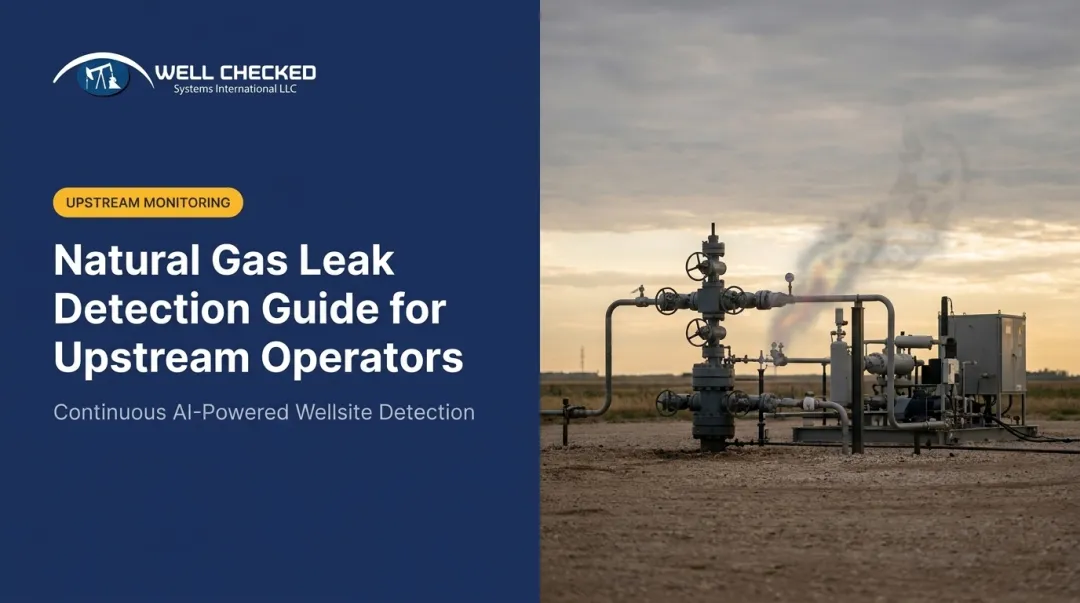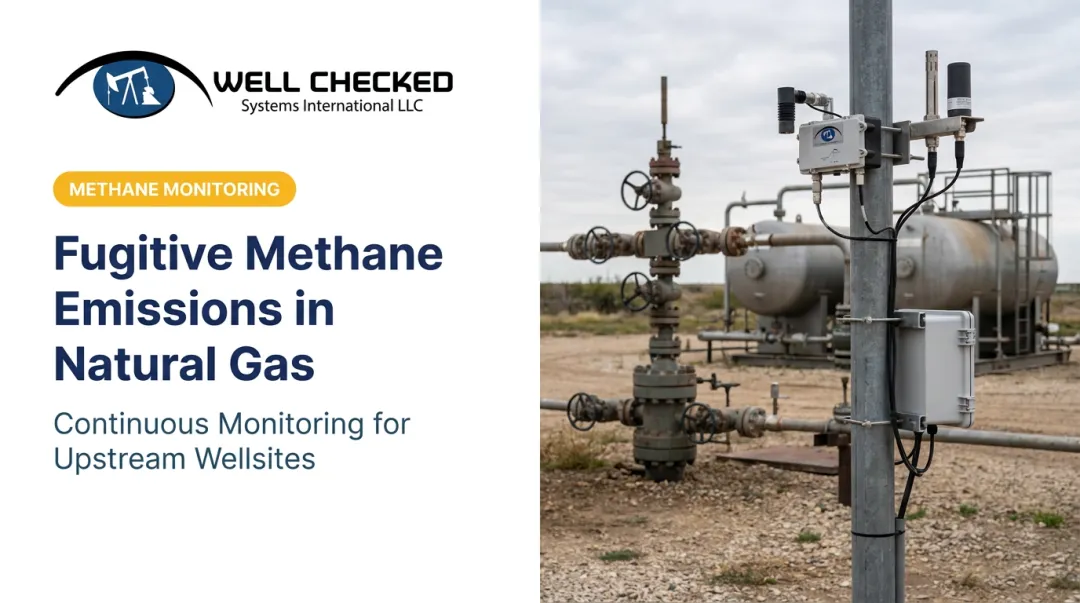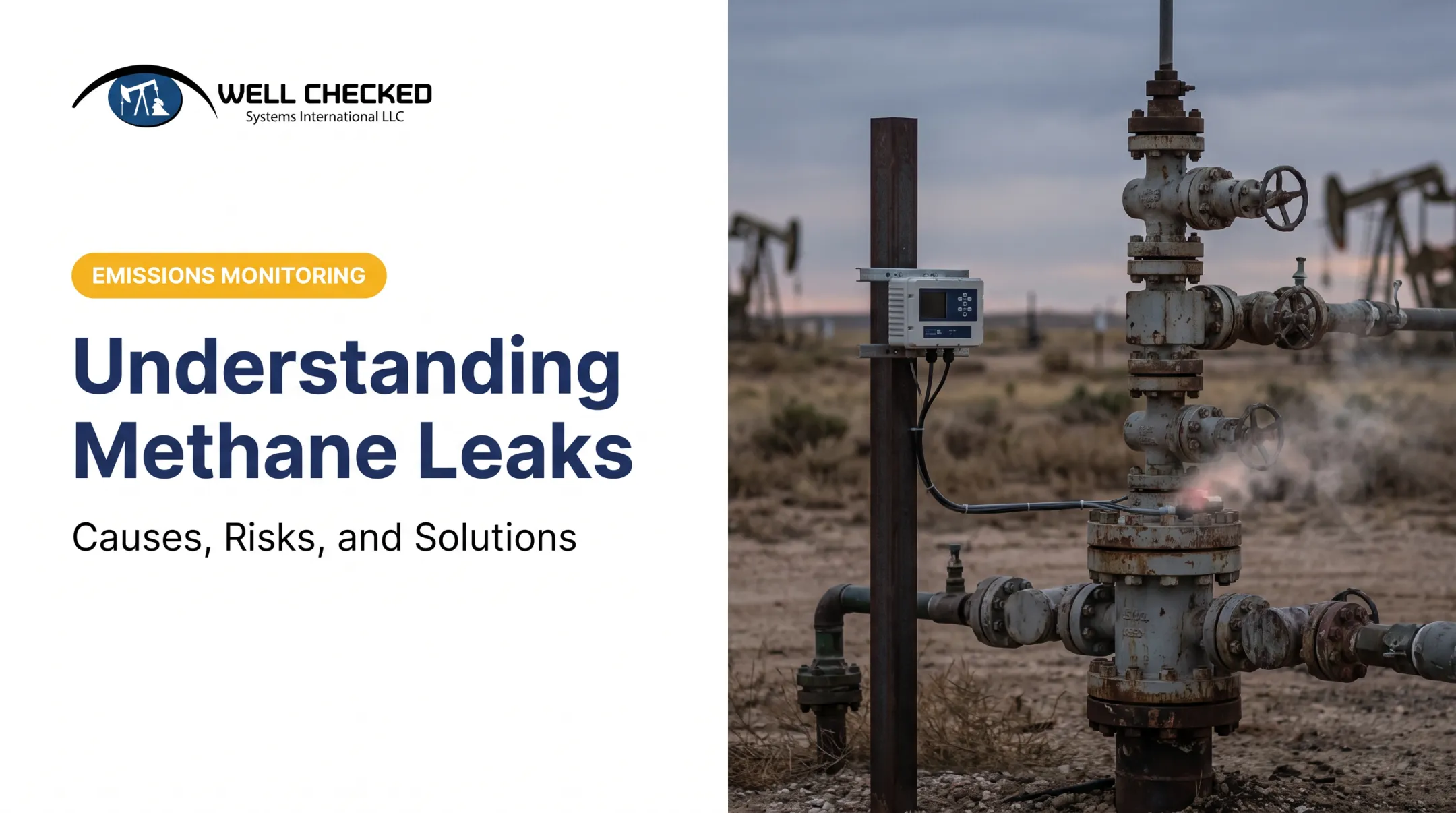

The primary target for any production-site detection program is methane — the main component of natural gas, an explosion hazard, and the bulk of the product value walking off location — along with the associated volatile organic compounds (VOCs) that accompany it. Together they create risk for field personnel, regulatory exposure under EPA 40 CFR Part 60 Subpart OOOOb, and measurable financial loss from unrecovered product.
This guide covers the root causes operators encounter most, how to detect leaks before they become incidents, and what a defensible prevention program actually looks like.
Key Takeaways
- Corrosion, pressure upsets, flare failures, and aging infrastructure are the most common leak triggers — rarely a single cause in isolation
- Unrecovered methane is lost salable product — leak duration, not just leak presence, determines the financial impact
- optical gas imaging (OGI) surveys are periodic — leaks between inspection cycles can go undetected for months
- Continuous autonomous monitoring closes the gap between OGI snapshots and generates the defensible data EPA alternative-monitoring pathways require
- A 24-hour acknowledge-dispatch-mitigate response on validated events may help reduce potential compliance exposure
Common Causes of Well Site Gas Leaks
A well site gas leak is any unintended release of hydrocarbon gas — primarily methane and associated VOCs — from wellheads, storage tanks, pipelines, compressors, or processing equipment at a production site. Leaks rarely trace back to a single failure. They typically arise from a combination of mechanical degradation, process upsets, and operational gaps that compound over time.
Equipment Corrosion and Seal Degradation
Produced fluids and gas streams are chemically aggressive, and corrosion is a leading root cause of fugitive leaks. It attacks metal seals, tank hatches, valve packing, and pipeline joints — causing progressive failure even in equipment that looks intact from the outside. According to EPA's equipment leak guidance, documented fugitive sources include:
- Connectors and open-ended lines
- Pressure relief valves (PRVs) and thief hatches
- Worn valve-stem seals and damaged gaskets
- Loose fittings damaged by compressor vibration or temperature cycling
What makes this category particularly difficult is that external inspection often misses internal corrosion. By the time a seal visibly fails, the degradation has usually been underway for months — well before any surface symptom appears.
Pressure Fluctuations and Process Upsets
Sudden pressure surges — from slugging wells, water hammer in pipelines, or separator upsets — can exceed the rated capacity of valves, flanges, and gaskets, causing releases at connection points. EPA inspectors have documented this pattern extensively: in a foundational compliance alert, they observed that inadequate vapor-control-system design, sizing, and maintenance was among the most common causes of controlled storage vessel emissions. Flash gas released when pressurized separator liquids enter atmospheric tanks accounted for the majority of those tank emissions.
Pressure relief devices (PRDs) that are improperly sized or poorly maintained compound the problem. Instead of routing gas safely to a flare or capture system, they vent directly to atmosphere.
Process upsets are also where monitoring gaps compound. A mechanical failure at an unattended facility can vent continuously until someone physically arrives, and point detectors that are present but improperly signal-routed may never raise an alarm at all. The release keeps running; the record of it never starts.
Flare System Failures
Unlit or extinguished flares are a leading source of uncontrolled gas venting on production sites. Pilot outages, bird nests blocking spark mechanisms, and interrupted fuel supply can all take a flare offline — releasing raw methane and associated VOCs directly to atmosphere for extended periods before anyone notices.
Flare performance in the field also tends to fall short of the destruction efficiency assumed on paper. EPA's Natural Gas STAR program treats incomplete combustion and venting as recoverable losses rather than unavoidable ones. A flare that is lit but combusting inefficiently still passes a visual drive-by check while routing unburned product to atmosphere, which is why flare status is worth instrumenting rather than eyeballing.
On remote sites with infrequent manual inspections, a flare outage can vent undetected through an entire shift — or longer — with no automated alert to trigger a response.
Aging Infrastructure and Marginal Wells
EPA data shows roughly 70% of more than 900,000 US onshore wells were low-producing in 2021 — and these wells accounted for about 60% of natural-gas-production methane emissions.
The same EPA program data shows how concentrated the problem is: a small share of low-production sites accounts for a disproportionate share of the emissions from that population — which is precisely why blanket inspection schedules are an inefficient way to spend a monitoring budget.
The operational risk at these sites is structural: equipment was often designed for oil production and not engineered to manage gas streams. Tight operating margins defer maintenance — corroded tanks, degraded gaskets, worn valve stems accumulate until failure occurs. Understanding where these failures originate is the first step; the harder challenge is detecting them before they escalate.

What Happens When a Well Site Gas Leak Goes Undetected
Immediate Safety Consequences
Methane's flammable range in air is roughly 5–15% by volume. Accumulations in enclosed or low-lying areas — tank batteries, equipment housings, pits — can reach that range with no visible or audible warning to personnel arriving on site.
Raw wellsite gas carries no added odorant, either. Mercaptan is injected downstream at distribution, not at the wellhead, so field personnel cannot rely on smell to warn them of a developing release. That is the core argument for instrumented detection over human observation.
Warning Signs of an Active Gas Leak
Don't wait for a formal survey to find a problem. These indicators suggest an active leak:
- Audible hissing or ultrasonic signature near pressurized connections — or personal gas monitors alarming during routine site visits
- Visible flame disturbance at a flare tip — irregular burn pattern or no visible flame at all
- Unexplained pressure drops in pipeline segments, abnormal separator liquid levels, or compressor surges
- Dead or stressed vegetation in a localized area downwind of equipment
Regulatory and Financial Consequences
When those warning signs go unaddressed, EPA enforcement follows. Undetected leaks create OOOOb violations — in one 2024 settlement, an operator in New Mexico agreed to a substantial civil penalty for alleged air violations that included leak-inspection and repair failures. Beyond penalties, unrecovered methane is lost product with direct commodity value. For mid-sized operators running dozens of remote wellsites, that lost revenue compounds quickly across a portfolio.
How to Detect Gas Leaks at a Well Site
No single detection method covers all leak scenarios. Effective programs layer complementary technologies based on speed, coverage, and regulatory purpose.
Fixed-Point Gas Detectors
Permanently installed electrochemical and catalytic sensors provide real-time point-source monitoring at high-risk locations — tank battery areas, compressor skids, confined spaces — triggering immediate alarms when concentrations exceed threshold levels.
Their limitation: fixed detectors only cover the precise location where they are installed. A release that develops a few meters outside a detector's sensing radius produces no alarm at all — and even where detectors are present, signal-routing or panel failures can stop an alarm from reaching personnel in time.
Optical Gas Imaging (OGI) and Leak Detection and Repair (LDAR) Surveys
Infrared OGI cameras visualize methane and VOC plumes invisible to the naked eye, enabling inspectors to scan large equipment areas quickly. Under EPA Subpart OOOOb, monitoring schedules vary by facility type:
| Facility Type | Minimum Schedule |
|---|---|
| Single-wellhead and small wellsites | Quarterly audio, visual, olfactory (AVO) surveys |
| Other wellsites and centralized production facilities | Bimonthly AVO + quarterly OGI or Method 21 |
| Compressor stations | Monthly AVO + quarterly OGI or Method 21 |
The critical gap: OGI surveys are periodic. EPA's advanced methane technology program recognizes continuous monitoring as a separate approach that can improve visibility between scheduled surveys when used under an approved method and monitoring plan.
EPA-hosted controlled testing has found OGI can miss a substantial share of releases, with performance varying by flow rate, wind, viewing distance, and plume-background temperature contrast.

Continuous Autonomous Monitoring
Continuous multi-sensor platforms close the gap that periodic surveys cannot fill. Well Checked's Zensory.ai™ platform combines Long-Wave Infrared (LWIR) cameras, acoustic equipment sensors, and AI-powered video analysis to provide around-the-clock detection without requiring personnel on site. Well Checked has a USPTO provisional patent filing for Detecting and Quantifying Fugitive Methane and Vapor Emissions Using Infrared Imaging and Machine Learning.
Zensory.ai™ is offered in two service tiers, and operators select the tier that fits each site. Both tiers monitor continuously, alarm on anomalies, and record every event — what separates them is detection versus quantification:
- Zentinal Core™ — the detection tier. It identifies emissions, reduces false alarms using a site-specific AI baseline learned in approximately 2 days, and focuses alerts on system-validated fugitive anomalies, discarding normal process noise to surface higher-confidence events
- Zentinal IQ™ — the quantification tier. Alongside continuous detection and alerting, it measures duration, volume, and rate per event through LWIR OGI-based volumetric estimation with AI-refined plume analysis
Detection is less expensive to deliver than quantification, so Core is the more economical tier. Operators typically run Core where validated alerting and a time-stamped event record are sufficient, and select IQ at sites where quantified volumes are needed for reporting or repair prioritization.
The system analyzes 1,500+ videos per site per day across continuous monitoring in the Appalachian Basin. LWIR cameras deliver this capability at a substantially lower cost than traditional mid-wave IR solutions.
Operators pursuing EPA alternative-monitoring compliance should note that Section 60.5398b requires EPA approval before an advanced or continuous system substitutes for prescribed work practices — autonomous monitoring is not an automatic replacement without that approval pathway.
How to Prevent Well Site Gas Leaks
Effective prevention stacks multiple controls — because any single measure leaves gaps. The sections below cover the four areas where operators see the most measurable reduction in leak frequency and consequence severity.
Scheduled Equipment Inspection and Integrity Testing
A proactive inspection program should include:
- Regular torque checks on flanges and valve packing
- Seal and hatch inspections on storage tanks
- Pressure testing of pipeline segments and wellhead connections on a defined cycle — not a complaint-response basis
- Increased frequency for equipment handling corrosive produced-gas streams or operating near rated pressure ceilings, where corrosion rates accelerate

Flare System Maintenance and Monitoring
Reliable flare operation requires active maintenance, not just periodic checks:
- Verify pilot fuel supply integrity on a regular schedule
- Confirm spark igniter function before and after severe weather
- Install bird-exclusion measures on flare tips
- Deploy flame-sensing instruments that trigger automatic alerts when a pilot extinguishes
Flares require continuous monitoring, not just pumper-route spot-checks. An unlit flare can vent salable product for hours — or an entire shift — before a site visit detects it.
Pipeline and Vessel Integrity Management
A formal pipeline integrity management program addresses corrosion at the root cause level. Key elements:
- Corrosion inhibitor injection in gathering lines
- Cathodic protection for buried segments
- Scheduled internal inspection tools where applicable
Integrity management documentation also creates defensible records for EPA and state agency compliance, which matters when enforcement inquiries arise.
Operator Training and Emergency Response Planning
Core training requirements for any production site with gas-release exposure:
- Flammable-gas hazard recognition and lower-explosive-limit thresholds
- Personal monitor use and calibration verification
- Evacuation routes and shelter-in-place criteria
- Emergency shutdown procedures and buddy-system protocols for confined-space entry
Emergency response plans should define pre-set thresholds for shelter-in-place versus evacuation, communication protocols for notifying downstream personnel and regulators, and post-incident documentation requirements.
Long-Term Monitoring and Control Best Practices
Continuous monitoring delivers its strongest returns when it replaces reactive field operations with a disciplined, data-driven exception-based model.
From Route-Based to Exception-Based Field Operations
Mid-sized to large operators running route-based pumper programs spend an estimated $1M–$5M+ annually on site visits — direct labor, vehicle costs, unproductive travel, adverse-weather risk, and vehicle-mile fuel costs combined.
Well Checked's Zensory.ai™ platform is designed to replace that model: field personnel are dispatched only when a validated anomaly is confirmed, not on a fixed route schedule.
That speed matters for compliance. Acknowledging, dispatching, and mitigating within 24 hours of a validated event may help reduce potential compliance exposure on methane survey events. One Director of Operations using the platform put it directly:
"If all our sites are continuously monitored, when a Fugitive Gas Event occurs, which it will, we are proactively alerted and our team can acknowledge, dispatch, then mitigate within 24 hours."
Maintain Time-Stamped Event Records
Every detected emission event should be documented with:
- Time of detection and event duration
- Estimated volume and rate of release
- Corrective action taken and repair completion date
This record can support operator reporting under an EPA-approved alternative method and applicable monitoring plan, as well as broader OGMP 2.0 or SASB workflows when their additional requirements are met. Zentinal IQ™ generates configurable multi-year event logs and CSV/JSON exports designed to support applicable EPA and state-agency reporting workflows.
Use Quantified Methane Loss Data to Prioritize Repairs
Traditional quarterly LDAR inspections confirm a leak exists at the moment of inspection. They cannot tell you how long it has been running or how much product has been lost. Without that information, repair spending is reactive and poorly prioritized.
Per-event duration and volume data from Zentinal IQ™ allows operators to:
- Calculate methane loss value per leak (volume × commodity price)
- Rank repairs by financial impact rather than by inspection order
- Justify maintenance expenditures with defensible, quantified data for committee-driven capex approval

Maintenance budgets directed by volume data go to the highest-impact leaks first — cutting both methane losses and repair costs simultaneously.
Conclusion
Well site gas leaks have identifiable, manageable causes — equipment corrosion, pressure control failures, flare outages, and aging infrastructure at marginal sites. Most incidents are preventable with proactive maintenance, integrity programs, trained personnel, and detection methods that close the gaps between inspections.
For operators under EPA methane rule (40 CFR Part 60 Subpart OOOOb) requirements and ESG reporting obligations, continuous autonomous monitoring has moved from optional to operationally necessary. The question is no longer whether to make the shift — it's how quickly.
Operators who move early gain measurable advantages:
- Lower site-visit costs by replacing routine pumper routes with exception-based dispatch
- Faster incident response that reduces regulatory exposure on validated methane events
- Defensible compliance records for EPA, OGMP 2.0, SASB submissions
- Repair prioritization grounded in actual emissions duration and volume — not guesswork
Frequently Asked Questions
What happens when a producing well leaks gas?
Methane accumulations create explosion and fire risk in enclosed or low-lying areas, with a flammable range of roughly 5–15% by volume and no odorant present in raw wellsite gas to warn personnel. Operators also face potential EPA penalties, ongoing product loss, and remediation liability from uncontrolled releases.
What exactly does mercaptan smell like?
Mercaptan (ethanethiol) is deliberately added to odorless natural gas as a safety odorant. Most people describe it as rotten cabbage, sulfur, or skunk spray. Its odor threshold is low enough that small concentrations are detectable well before levels become hazardous.
What are the most common gases that leak from oil and gas wells?
Methane is the main target of production-site leak detection — it is both an explosion hazard and the bulk of the lost product value. Associated VOCs such as benzene also appear in many leak plumes and carry their own health and regulatory implications.
How is gas detected at a well site?
Three main approaches are used across the industry:
- Fixed-point sensors — electrochemical and catalytic detectors placed at high-risk locations
- Periodic OGI/LDAR surveys — infrared camera inspections conducted on a scheduled basis
- Continuous autonomous monitoring — multi-sensor platforms that provide around-the-clock detection without requiring on-site personnel for each inspection cycle
What regulations govern gas leak detection at well sites?
US onshore upstream operators fall primarily under EPA 40 CFR Part 60 Subpart OOOOb (new, modified, and reconstructed sources). State-level rules and commission requirements add further obligations depending on operating region.
How quickly can a well site gas leak become dangerous?
Methane can reach explosive concentrations in enclosed or low-lying areas with little visible warning, and raw wellsite gas carries no odorant to signal a developing release. Because a leak that starts the day after an inspection can run until the next scheduled visit, automated continuous detection is far more reliable than waiting for a site visit to catch it.