
That's the problem remote monitoring solves.
Remote monitoring has quietly become the backbone of operations across IT, healthcare, manufacturing, and energy. As companies scale beyond what in-person oversight can realistically cover, sensors and software have stepped in to fill the gap.
This article breaks down what remote monitoring actually means, how the underlying technology works, where it differs from terms people often confuse it with (like remote access), and a real-world look at how it's applied in one of the most demanding environments there is: upstream oil & gas field operations.
Key Takeaways
- Remote monitoring uses sensors, connectivity, and software to track equipment, people, or environments from a distance
- It's distinct from remote access, which allows active control, not just observation
- Four layers make up every system: sensors, connectivity, a centralized platform, and alert logic
- Benefits span cost reduction, improved safety, and continuous visibility instead of periodic snapshots
- In oil & gas, AI-driven multi-sensor platforms enable autonomous, regulatory-defensible monitoring of remote wellsites
What Is Remote Monitoring?
Remote monitoring is the practice of tracking the status, performance, or condition of equipment, systems, patients, or environments from a location physically separate from the asset. Sensors and networks relay data back to a centralized platform, giving teams visibility without ever setting foot on site.
The National Institute of Standards and Technology defines monitoring generally as continual checking or observation used to identify a change from an expected performance level. Remote monitoring simply adds distance to that equation, using network connections to move the observation point away from the asset itself.
Rather than a single product, remote monitoring is a layered combination of hardware and software that shows up in wildly different contexts:
- Factory floors tracking machine utilization
- Power plants watching grid stability in real time
- Pipelines spanning hundreds of miles
- Spacecraft relaying telemetry back to mission control
- Patients managing chronic conditions from home
The goal across every one of these settings is the same: know what's happening at a site without traveling there.
Core Components of a Remote Monitoring System
Every remote monitoring setup, regardless of industry, relies on four building blocks:
- Sensors and data-capture devices: IoT sensors, cameras, gas detectors, acoustic equipment monitors, and similar hardware collecting raw information at the source
- Connectivity and communication networks: cellular, satellite, Wi-Fi, or edge computing that carries collected data from the field to a destination
- A centralized software or cloud dashboard: where data gets stored, analyzed, and turned into something a human can actually read
- Alerting and notification logic: the rules that flag anomalies so someone, or something automated, can respond
Remove any one of these layers and you don't have remote monitoring anymore. You have raw data sitting somewhere unused.
What Remote Monitoring Is Not
By itself, remote monitoring is passive. It observes and reports. It does not give anyone the ability to reach in and adjust a valve, restart a server, or reconfigure equipment remotely.
That distinction matters, and it's where a lot of confusion starts, particularly when people conflate monitoring with remote access. More on that shortly.
How Does Remote Monitoring Work?
Nearly every remote monitoring system, whether it's watching a patient's heart rate or a wellhead's methane output, follows the same basic workflow. The details differ by industry, but the sequence doesn't.
The Data Journey: From Sensor to Decision
- Data capture — Sensors installed at the asset or site collect information continuously or at set intervals.
- Transmission — That data moves securely to a cloud or on-premise server. When connectivity is unreliable, edge computing processes information locally first, which matters most at wellsites where cellular or satellite service can drop out.
- Analysis — Software or AI compares incoming data against an established baseline, separating normal variation from a genuine anomaly.
- Alerting — Dashboards and automated notifications flag the responsible team, letting them respond "by exception" rather than manually combing through every data point.

That last step is where a lot of programs break down. Collecting data is easy. Filtering it intelligently is not.
Splunk's 2025 State of Observability study, which surveyed 1,855 ITOps and engineering professionals across 15 industries and nine countries, found that 73% had experienced outages caused by ignored or suppressed alerts. Teams get so buried in low-value notifications that the real ones get lost in the noise.
This is why alert quality, not raw data volume, separates a functional monitoring program from one that generates dashboards nobody trusts.
Remote Monitoring vs. Related Concepts
"Remote monitoring" gets used loosely, and it often gets tangled up with a handful of adjacent terms. Here's how they actually differ.
| Term | What it does | Key distinction |
|---|---|---|
| Remote monitoring | Observes status from a distance | Visibility and alerting, not control |
| Remote access | Connects to a system from an external network | Enables interaction and intervention |
| Condition monitoring | Tracks specific health/performance parameters of an asset | Can happen on-site or remotely |
| RMM | Combines monitoring with IT administration | A specialized subset used by MSPs |
Remote Monitoring vs. Remote Access
Remote monitoring only observes and reports on equipment status. Remote access, by contrast, lets authorized personnel actively control, configure, or intervene with a system from a distance.
The National Institute of Standards and Technology defines remote access as reaching a system through an external network — that's an interactive connection, not a passive observation feed. A monitoring system can sit on top of a remote access connection, but the two aren't interchangeable.
Remote Monitoring vs. Condition Monitoring
Condition monitoring tracks specific performance or health parameters of an asset, such as vibration, temperature, or wear, often at the equipment level. It can happen entirely on-site with no network involved. Remote monitoring is about where the observation happens, not what is being observed. Condition monitoring can absolutely be delivered remotely, but the terms describe different things.
Remote Monitoring vs. RMM (Remote Monitoring and Management)
RMM is an IT-specific term used heavily by managed service providers. The Cybersecurity and Infrastructure Security Agency describes RMM as endpoint software that continuously monitors system health and also enables administration, meaning patching, backups, and troubleshooting. RMM is a specialized subset of remote monitoring built specifically for network and device management, not the broader concept itself.
Applications & Benefits of Remote Monitoring Across Industries
Where Remote Monitoring Is Used
- IT and managed service providers monitoring networks, servers, and endpoints for health and performance issues
- Healthcare providers using remote patient monitoring to track vitals and chronic conditions between office visits
- Manufacturing and Industry 4.0 environments watching machine utilization and shop-floor conditions in real time
- Energy, utilities, and oil & gas operators monitoring pipelines, equipment, and wellsites spread across enormous, hard-to-reach geography
Core Benefits Common Across Use Cases
Regardless of industry, the same core advantages show up again and again:
- Reduced travel and site-visit costs: fewer trips to physically check on assets that can be observed remotely
- Improved worker safety: less exposure to hazardous, remote, or weather-affected conditions. Vehicle crashes remain oil and gas's leading cause of worker death, and NIOSH data shows workers often drive long distances to reach remote well sites
- Continuous visibility instead of periodic snapshots — faster issue detection and stronger compliance recordkeeping, since data isn't limited to whatever a quarterly inspection happens to catch

That safety data point isn't abstract. It's the reason a growing number of operators are rethinking how often people actually need to drive out to a site at all.
Remote Monitoring in Oil & Gas: The Well Checked Systems Approach
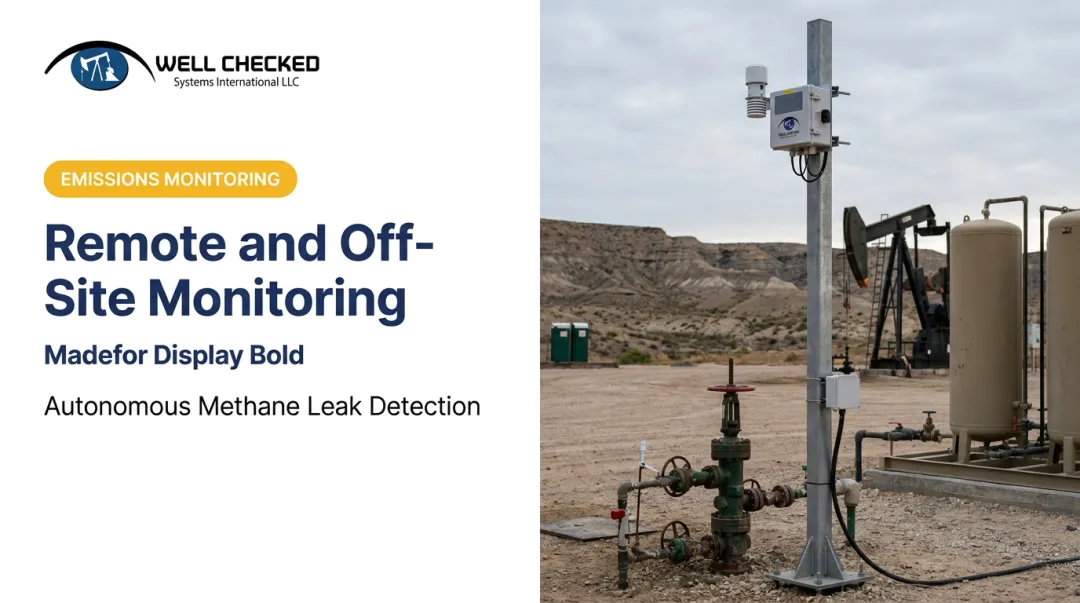
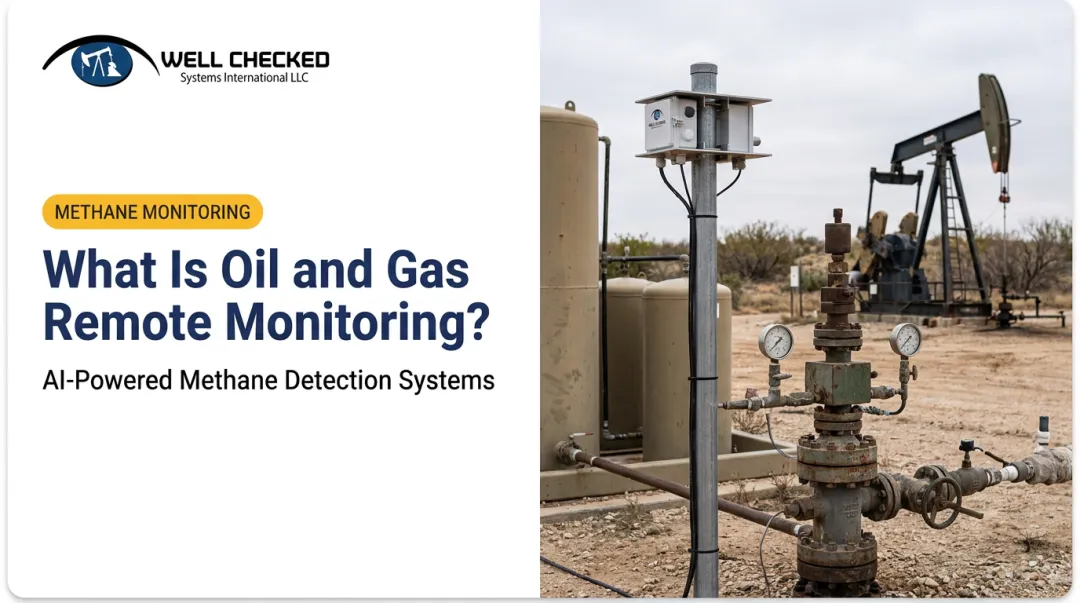
Upstream oil & gas is one of the toughest environments for remote monitoring, and one of the sectors where it matters most. Wellsites often spread across vast, difficult-to-access geography. Traditional "pumper route" inspections mean sending a person to drive between sites, often on rural roads, to check equipment by video, acoustic, and infrared sensing.
Traditional compliance methods, like quarterly leak detection and repair (LDAR) inspections, only capture a snapshot in time. A leak that starts the day after an inspection can run undetected for months. Continuous remote monitoring flips that model, supporting an "operate by exception" approach where field crews get dispatched only when something actually needs attention.
The cost of the old model is significant. Mid-sized to large operators typically spend $1 million to $5 million or more annually on route-based site visits, covering labor, fuel, vehicles, and the logistics of managing scattered field teams.
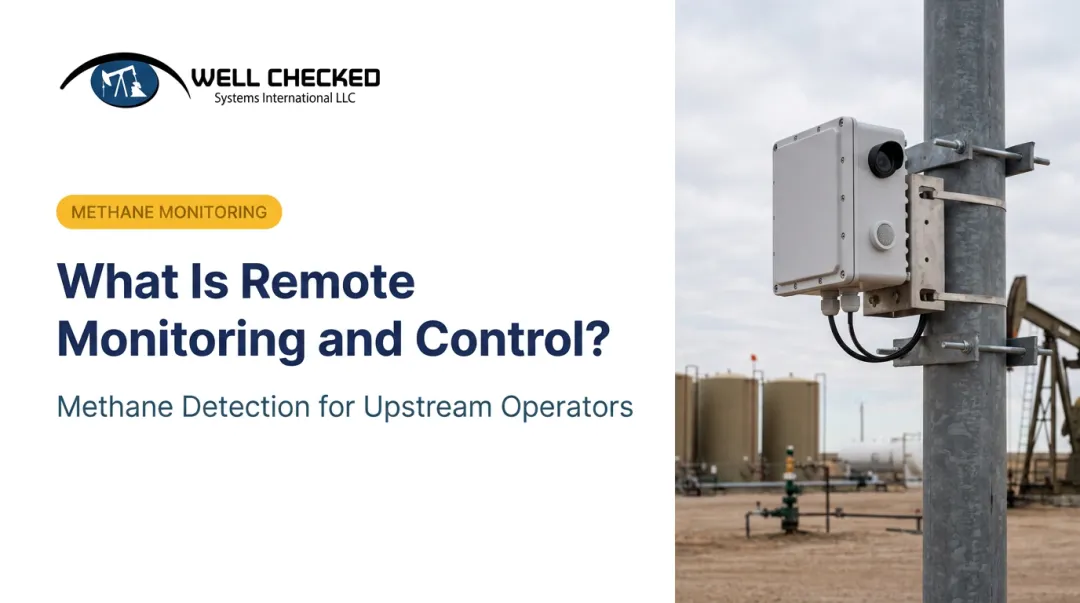
Well Checked Systems built its Zensory.ai™ platform specifically to address this. It's a multi-sensor AI monitoring stack that gives a wellsite three simultaneous senses:
- High-resolution video with 360° coverage and AI object detection, processing over 1,500 videos per site per day
- Long-Wave Infrared Optical Gas Imaging for continuous, day-and-night methane and volatile organic compound (VOC) detection, at roughly one-third the cost of traditional mid-wave IR systems
- Acoustic anomaly AI monitoring that listens for abnormal sound patterns signaling equipment malfunction before it becomes a failure. Well Checked has a USPTO provisional patent filing covering its acoustic anomaly detection technology.
The system learns each site's normal operational baseline in about two days, distinguishing routine process emissions from genuine fugitive leaks rather than flagging everything as suspicious.
Three-Tier Architecture: From Detection to Defensible Data
The platform splits its work across three tiers:
- Zentinal Ops™ delivers visual and acoustic equipment intelligence: high-resolution video, object recognition, acoustic anomaly detection, and actionable alerts.
- Zentinal Core™ is the multi-sensor detection layer. It filters out false alarms and flags only validated fugitive emissions anomalies, the "needle in stacks of needles" problem; supports OGMP 2.0 Level 3.
- Zentinal IQ™ takes over once Core validates an event, quantifying it and producing regulatory-defensible data structured for the EPA methane rule, OGMP 2.0, SASB, and TCFD reporting frameworks.
This proof point isn't theoretical. Well Checked Systems runs a multi-site deployment in the Appalachian Basin, part of a broader remote-monitoring footprint processing 1,500+ videos per site per day — over 330,000 videos daily across that single program.
None of this depends on a stable internet connection. Onsite edge computing means AI analysis happens locally at the wellsite, so the system keeps working even when connectivity drops out entirely. That reliability is exactly what makes autonomous monitoring viable in the remote, often connectivity-starved basins where oil & gas operations actually happen.

Frequently Asked Questions
What is meant by remote monitoring?
Remote monitoring is the use of sensors, connectivity, and software to observe the status or condition of equipment, people, or environments from a distance. It doesn't require anyone to be physically present at the site.
What is an example of remote monitoring?
Examples include IT teams tracking server health across multiple data centers, healthcare providers monitoring a patient's blood pressure remotely, and AI systems detecting methane emissions at oil & gas wellsites without requiring an on-site technician.
What is the difference between remote monitoring and remote access?
Remote monitoring only observes and reports on a system's status. Remote access goes further, letting authorized personnel actively control, configure, or intervene with the system from a distance.
Is remote monitoring the same thing as IoT?
No. IoT refers to the connected devices and sensors themselves. Remote monitoring is the broader practice or system that uses IoT devices, among other technologies, to observe assets from a distance.
What industries rely most on remote monitoring?
IT and managed service providers monitor networks and endpoints, healthcare tracks patient vitals remotely, manufacturing watches shop-floor equipment, and energy/oil & gas monitors pipelines and wellsites across large geographies.
How does remote monitoring help oil & gas operators meet EPA methane compliance?
Continuous, AI-validated monitoring creates complete, defensible emissions records instead of relying on periodic LDAR snapshots. Platforms like Zentinal Core™ and Zentinal IQ™ support alternative-monitoring pathways under the EPA's evolving methane rules where recognized by the applicable state plan.