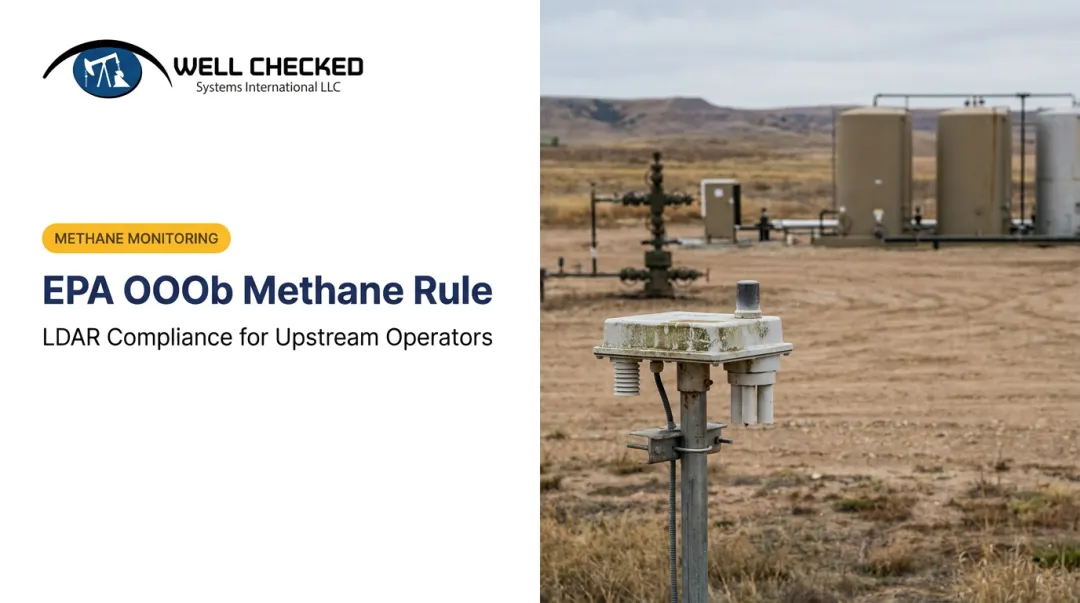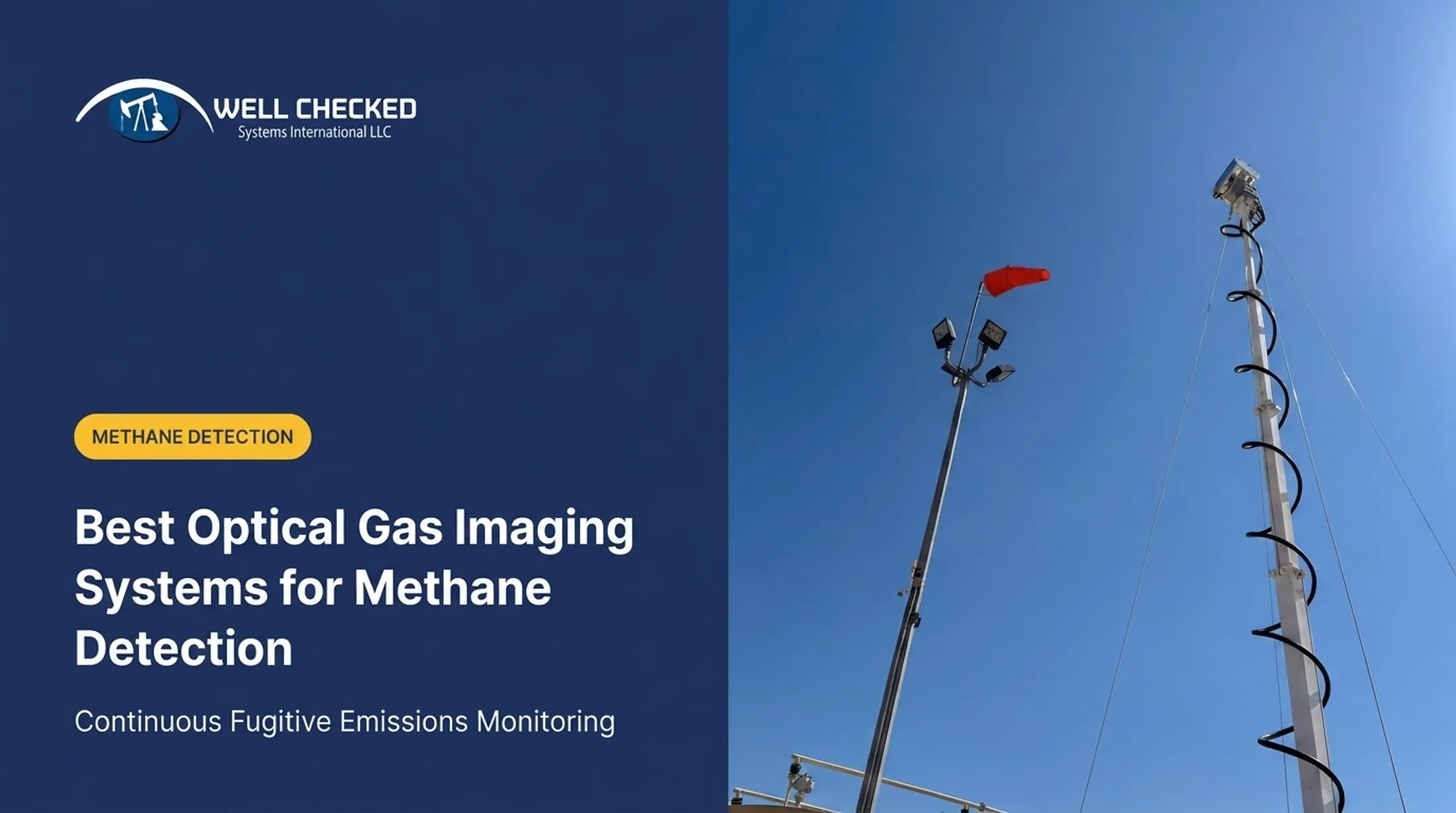

The problem: most operators still rely on handheld optical gas imaging (OGI) cameras during quarterly LDAR walks. That's a snapshot, not a movie. Between inspections, leaks start, grow, and sometimes stop again — completely undetected.
This guide breaks down OGI technology basics, what 2025 compliance actually requires, and why continuous autonomous monitoring is closing the gaps that handheld inspections leave wide open.
Key Takeaways
- OGI cameras reveal methane and VOC leaks the eye cannot see; EPA has recognized them as an Alternative Work Practice since 2008
- Subpart OOOOb sets monitoring frequencies by site type and raises defensibility standards for alternative methods
- Periodic OGI surveys leave gaps between cycles; continuous multi-sensor monitoring closes them
- Effective compliance stacks demand accurate detection, defensible quantification, and OGMP 2.0, SASB, and TCFD alignment
What Is Optical Gas Imaging and How Does It Support Compliance?
OGI is infrared thermography that makes invisible gas plumes visible. Cameras detect methane and VOCs based on how these gases absorb infrared light at specific wavelengths, mainly 3.2-3.55 µm (MWIR), 7.2-8.3 µm (LWIR), and 2.31-2.39 µm (SWIR).
Two sensor types dominate the market:
- Cooled MWIR cameras: higher sensitivity, better suited to source-level detection and quantification, but pricier due to the cooling hardware
- Uncooled LWIR cameras: no active cooling required, enable day/night detection, and cost much less while still supporting long-duration operation
A 2026 peer-reviewed comparison found cooled MWIR roughly 7.5 times more methane-sensitive in that specific study — a useful data point, not a universal ratio.
EPA has recognized OGI as a compliance tool since December 2008, when it finalized the Alternative Work Practice amending 40 CFR Parts 60, 63, and 65. That framework has since evolved into today's OOOOb monitoring structure, with EPA's proposed Appendix K protocol governing OGI procedure specifics.
Handheld vs. Fixed/Continuous OGI Deployment
Handheld OGI means a technician walks a route, points a camera, and moves on. It's effective in the moment, but the moment is all you get.
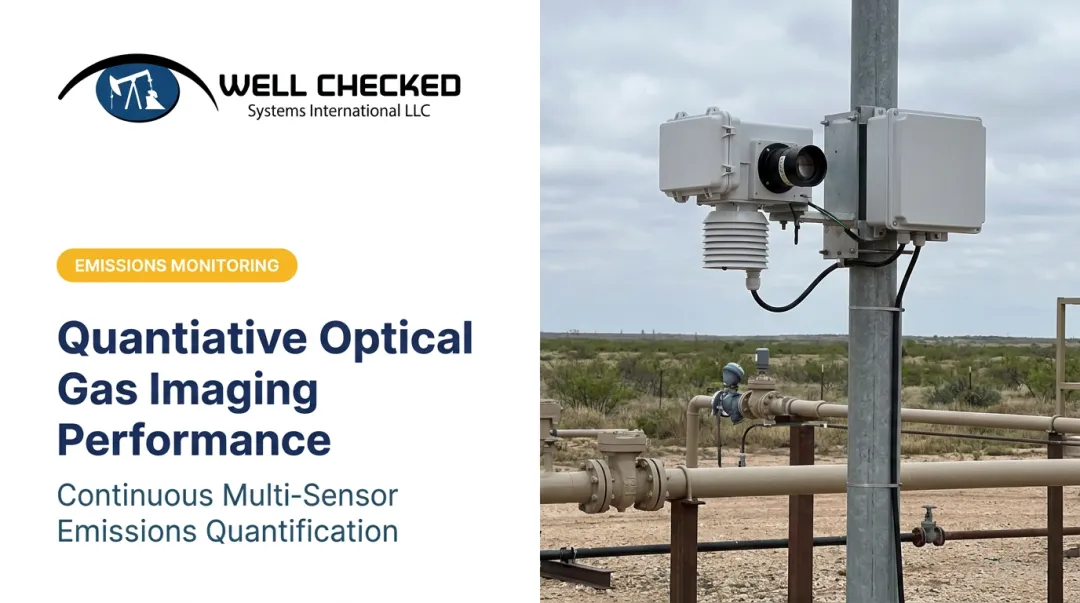
Fixed or continuous deployment flips that model. Cameras stay on-site, watching around the clock. Instead of four data points a year, you get a running record. For sites with intermittent or short-duration leaks (exactly the kind that slip through quarterly inspections), that difference is the whole compliance story.

2025 Regulatory Landscape: What Operators Must Comply With
EPA’s methane rules under 40 CFR Part 60 Subpart OOOOb set how often operators must inspect sites—and how fast they must repair what they find. Baseline monitoring frequencies break down by facility type:
| Site type | AVO | OGI/Method 21 |
|---|---|---|
| Single-wellhead-only | Quarterly | Not required |
| Multi-wellhead-only | Quarterly | Semiannual |
| Major equipment/centralized production | Bimonthly | Quarterly |
| Compressor stations | Monthly | Quarterly |
Repair timelines follow detection: 15 days for first attempt after AVO detection, 30 days after OGI/Method 21 detection.
Note on 2025 deadlines: EPA’s December 2025 interim final rule moved several OOOOb compliance dates for control devices, storage vessels, and covers/closed-vent systems to January 2027. Some flare-monitoring deadlines now fall in June 2026.
Leak inspection and 30-day repair obligations for covers and closed-vent systems did not change.

Continuous Monitoring Requires an Alternative Pathway
Continuous monitoring doesn't automatically satisfy OOOOb. It qualifies through the Section 60.5398b alternative-standard pathway, which requires:
- An EPA-approved technology with documented detection thresholds
- 90% uptime on a rolling annual basis
- A 0.4 kg CH4/h above-background minimum leak threshold
- Full data lineage, QA/QC records, and annual CEDRI reporting
Beyond EPA: OGMP 2.0, SASB, and TCFD
For operators managing investor-facing ESG disclosures, OOOOb is only one layer of the reporting stack:
- OGMP 2.0 Level 4/5 requires measurement-based reporting, reconciling bottom-up estimates against site-level measurements
- SASB Oil & Gas E&P metrics call for gross Scope 1 emissions and methane percentage disclosures
- TCFD disclosure recommendations cover emissions under its metrics and targets pillar
Those disclosure expectations sit alongside real enforcement risk. Recent EPA settlements with oil and gas operators have ranged from roughly $4 million to $64.5 million (OOOa/OOOOa allegations, not OOOOb specifically). Methane compliance scrutiny is still rising.
That is why the acknowledge-dispatch-mitigate window matters. Responding to a validated leak within 24 hours, instead of waiting for the next quarterly walk, cuts regulatory exposure and documented emission duration.
Why Periodic OGI Inspections Leave Compliance Gaps
Quarterly or route-based pumper inspections capture a single moment in time. A leak that starts on day two and stops on day 45 of a 90-day cycle? Never observed.
Those blind spots drive real cost and safety exposure.
Cost: Route-based site visits cost mid-sized to large operators an estimated $1 million to $5 million or more annually. That figure covers repeated travel, technician time, and inspection overhead across dozens or hundreds of sites.
Safety: OSHA identifies highway crashes as the leading cause of fatalities in oil and gas extraction. A CDC surveillance study found vehicle incidents accounted for 126 of 470 industry deaths between 2014 and 2019 (26.8% of the total).
Every unnecessary route drive is a mile of exposure that continuous monitoring removes.
How Autonomous Multi-Sensor Monitoring Delivers Regulatory-Defensible Data
Continuous monitoring goes further than point-in-time OGI by combining multiple sensor types into one always-on system. Well Checked's Zensory.ai™ platform is built on three layers:
- Zentinal Ops™ — visual and acoustic site intelligence, using high-resolution cameras and abnormal-sound detection
- Zentinal Core™ — multi-sensor detection paired with false-alarm filtering, flagging only true fugitive anomalies
- Zentinal IQ™ — quantifies validated emissions (volume, duration, rate) for regulatory-defensible reporting

The AI Site Learning Cycle
Every site behaves differently. A compressor humming normally at one location might sound abnormal somewhere else. Zensory.ai™ addresses this with a roughly 2-day AI Site Learning cycle per site. During that window, the system builds a site-specific normal-operations baseline across video, LWIR OGI, and acoustic data.
Once that baseline exists, the platform stops treating every process emission as a threat. It alerts only when something deviates. That "needle in stacks of needles" problem is solved through discernment, not raw sensitivity.
Built for Remote, Disconnected Wellsites
The platform's edge computing processes and stores data locally, so it keeps running even when connectivity drops. Data syncs automatically once communications are restored, which matters in the remote wellsite environments where most upstream operations happen.
Production-scale proof from Well Checked deployments:
- 13+ years of operating experience
- 1,500+ videos analyzed per site, per day

Instead of periodic-snapshot LDAR reports, operators get continuous, timestamped records. That data lineage is what EPA's alternative-monitoring guidance actually asks for.
Choosing the Right OGI Compliance Solution for 2025
Independent testing shows continuous monitoring systems are far from equal. A 2023 controlled study of 11 continuous systems found true-positive detection rates ranging from 0.3% to 87.7%, with false-positive rates from 0% to 79.1%.
When evaluating a solution, assess:
- Detection sensitivity: validated against controlled field releases, not just lab specs
- Quantification accuracy: can it define leak duration and volume, not just presence?
- Reporting-framework compatibility: does output map to EPA, OGMP 2.0, SASB, and TCFD formats?
- Total cost of ownership: compared honestly against current route-based inspection spend
Operators also need to decide their entry point. Some only need detection today. Others already face OGMP 2.0 Level 4/5 or SASB disclosure pressure and need a scalable path to full quantification.
Well Checked structures its offering around that decision: purchase, lease, subscription, or a fixed-fee pilot. Operators can start with detection through Zentinal Core™ and add Zentinal IQ™ quantification as compliance demands grow.
Frequently Asked Questions
What is an OGI (optical gas imaging) sensor?
An OGI sensor is an infrared camera tuned to wavelengths where methane and VOCs absorb light, making otherwise invisible gas plumes visible on screen. It's the core detection technology behind EPA-recognized leak inspections.
What is the typical cost of an OGI optical gas imaging camera?
Handheld camera prices vary widely based on cooling type and certification, with cooled MWIR units costing considerably more than uncooled LWIR models. Continuous monitoring shifts spend from upfront hardware cost to ongoing operational ROI.
How often must operators conduct OGI inspections to remain EPA compliant in 2025?
Subpart OOOOb sets frequencies by site type — semiannual for multi-wellhead sites, quarterly for major-equipment and compressor sites. Continuous monitoring exceeds any of these minimums by design.
Can OGI cameras detect all types of gas leaks?
No. OGI is wavelength-specific, detecting hydrocarbons like methane and VOCs. It won't detect gases such as hydrogen or oxygen that don't absorb infrared light in the same bands.
What is OGMP 2.0 and how does it relate to OGI compliance?
OGMP 2.0 is a voluntary reporting framework, with Levels 4 and 5 requiring measurement-based emissions data rather than estimates. Continuous, quantified OGI monitoring directly supports reaching Gold Standard status.
How does continuous monitoring reduce compliance risk compared to periodic OGI surveys?
Continuous monitoring enables an acknowledge-dispatch-mitigate response within 24 hours of a validated leak, versus waiting until the next quarterly inspection. That speed reduces both emissions volume and regulatory exposure.