
Introduction
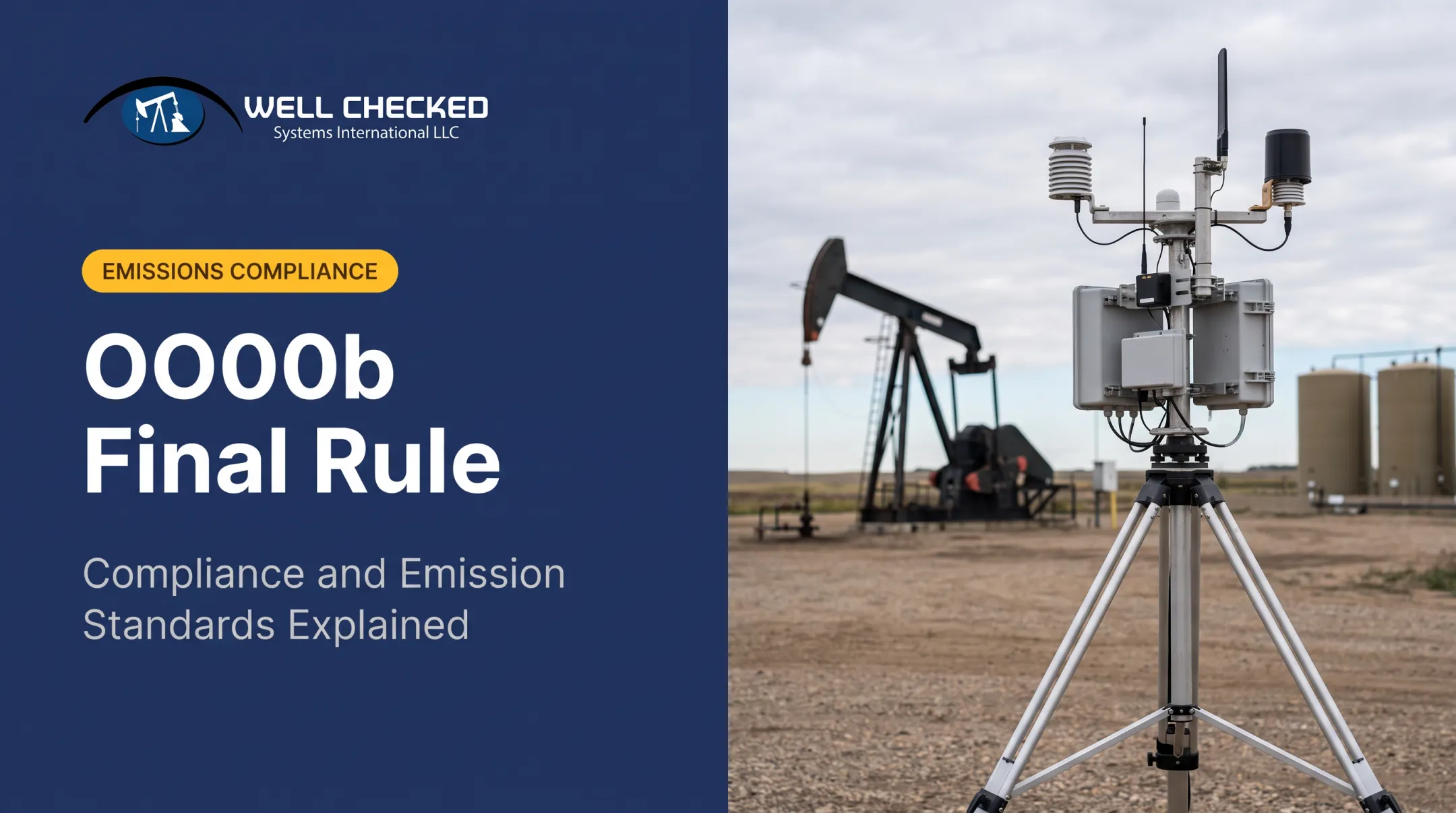
In December 2023, EPA announced its most significant methane and volatile organic compound (VOC) regulation for the oil and gas sector to date. It was published in the Federal Register as Subpart OOOOb on March 8, 2024, and took effect May 7, 2024.
Two years later, many operators still struggle with the basics. Which facilities does OOOOb cover? Is quarterly optical gas imaging (OGI) still mandatory, or can an automated monitoring system satisfy the requirement?
This guide breaks down what OOOOb is, the specific emission sources and deadlines operators must track, and where automated monitoring technology fits into a compliance strategy.
Key Takeaways
- OOOOb covers new, modified, or reconstructed facilities built after December 6, 2022.
- New regulated sources include super-emitter events, dry seal centrifugal compressors, and well closures
- §60.5398b allows automated Periodic Screening as an alternative to quarterly OGI/Method 21 surveys; qualifying systems must meet the detection-sensitivity criteria specified in §60.5398b
- Compliance deadlines vary by equipment type, with several extended through 2025-2026 amendments
What Does "OOOOb" Mean?
"OOOOb" refers to 40 CFR Part 60, Subpart OOOOb, the New Source Performance Standard covering crude oil and natural gas facilities for which construction, modification, or reconstruction commenced after December 6, 2022. The full rule package was published as Standards of Performance for New, Reconstructed, and Modified Sources at 89 FR 16820, with OOOOb's codified regulatory text beginning at 89 FR 17043.
The naming isn't random. EPA's methane standards for this source category have iterated over three decades:
- Subpart OOOO: original 2012 standards
- Subpart OOOOa: 2016 update, added methane limits
- Subpart OOOOb: 2024 update, the current standard for new/modified sources
Each letter marks a new construction-date threshold. Facilities built under an earlier subpart stay governed by that version; later letters don't retroactively apply to them.
What OOOOb Actually Regulates
Per §60.5360b, the rule establishes GHG (methane) emission limitations plus VOC and SO2 standards for affected facilities in the crude oil and natural gas source category. Explicitly covered facility types include:
- Well completions and associated gas wells
- Liquids unloading operations
- Centrifugal and reciprocating compressors (including dry seal units)
- Storage vessels
- Process controllers and pumps
- Fugitive emissions components
- Sweetening units and process unit equipment at gas plants
One notable exemption: facilities inside, or including, the Local Distribution Company custody transfer station fall outside OOOOb's scope.
Compliance Date Structure
Most affected facilities had to comply by May 7, 2024, or upon startup, whichever came later. Equipment-specific exceptions are detailed in §60.5370b, and, as covered below, several of those specific dates have since shifted through 2025 and 2026 amendments. Operators should treat the original 2024 rule text as an evolving baseline, since several of its dates have already shifted.
Key Emission Sources and Requirements Operators Must Track Under OOOOb
OOOOb introduced genuinely new compliance obligations alongside carried-over, tightened requirements from OOOOa. Here's what changed and what didn't.
Super-Emitter Events
Section 60.5371b creates an entirely new category: detection of methane emissions at 100 kg/hour or greater near a covered facility, identified by an EPA-certified third-party notifier using satellite, aircraft, or mobile monitoring. Once EPA notifies an operator through the Super-Emitter Program Portal, the clock starts:
- 5 calendar days to begin an investigation
- 15 days to complete it and report findings
- If the event is ongoing, an update is due within 5 business days after it ends
There's no quarterly grace period here. This is a fast-moving obligation with no equivalent under prior rules.
Storage Tank Battery Limits
Under §60.5395b, the threshold is measured at the tank-battery level, not per individual tank. A battery exceeding 6 tpy VOC or 20 tpy methane triggers a 95% control efficiency requirement.
Operators can alternatively demonstrate actual emissions stay below 4 tpy VOC and 14 tpy methane over 12 consecutive months to avoid the control mandate. Crossing either threshold, however, locks in the 95% standard.
Fugitive Emissions Monitoring Frequency
Section 60.5397b sets a tiered monitoring schedule based on site type:
| Site Type | AVO | OGI / Method 21 |
|---|---|---|
| Single-wellhead-only site | Quarterly | Not required on a recurring basis |
| Multi-wellhead-only site | Quarterly | Semiannual |
| Well site/centralized facility with major equipment | Bimonthly | Quarterly |
| Compressor station | Monthly | Quarterly |
AVO stands for audible, visual, and olfactory inspection, the baseline requirement across nearly every tier.
The Alternative Monitoring Pathway: Automated Periodic Screening
Here's where things get interesting for operators looking beyond traditional route-based inspections. Section 60.5398b allows substituting EPA-approved alternative test methods — specifically, automated Periodic Screening — for quarterly OGI/Method 21 surveys, provided the technology meets minimum thresholds:
- Systems must meet the detection-sensitivity criteria specified in §60.5398b to qualify for the alternative test method pathway without also requiring a manual OGI survey
An important distinction: although a qualifying automated system operates continuously at the site — providing 24/7 data collection, faster leak prioritization, and near-real-time alerts — the regulatory compliance screening cadence under §60.5398b is quarterly. The rule governs automated Periodic Screening performed on a quarterly basis, not a continuous regulatory monitoring obligation. Operators benefit from the continuous operational data, but the formal compliance check under OOOOb runs on the same quarterly rhythm as the OGI/Method 21 surveys it replaces.
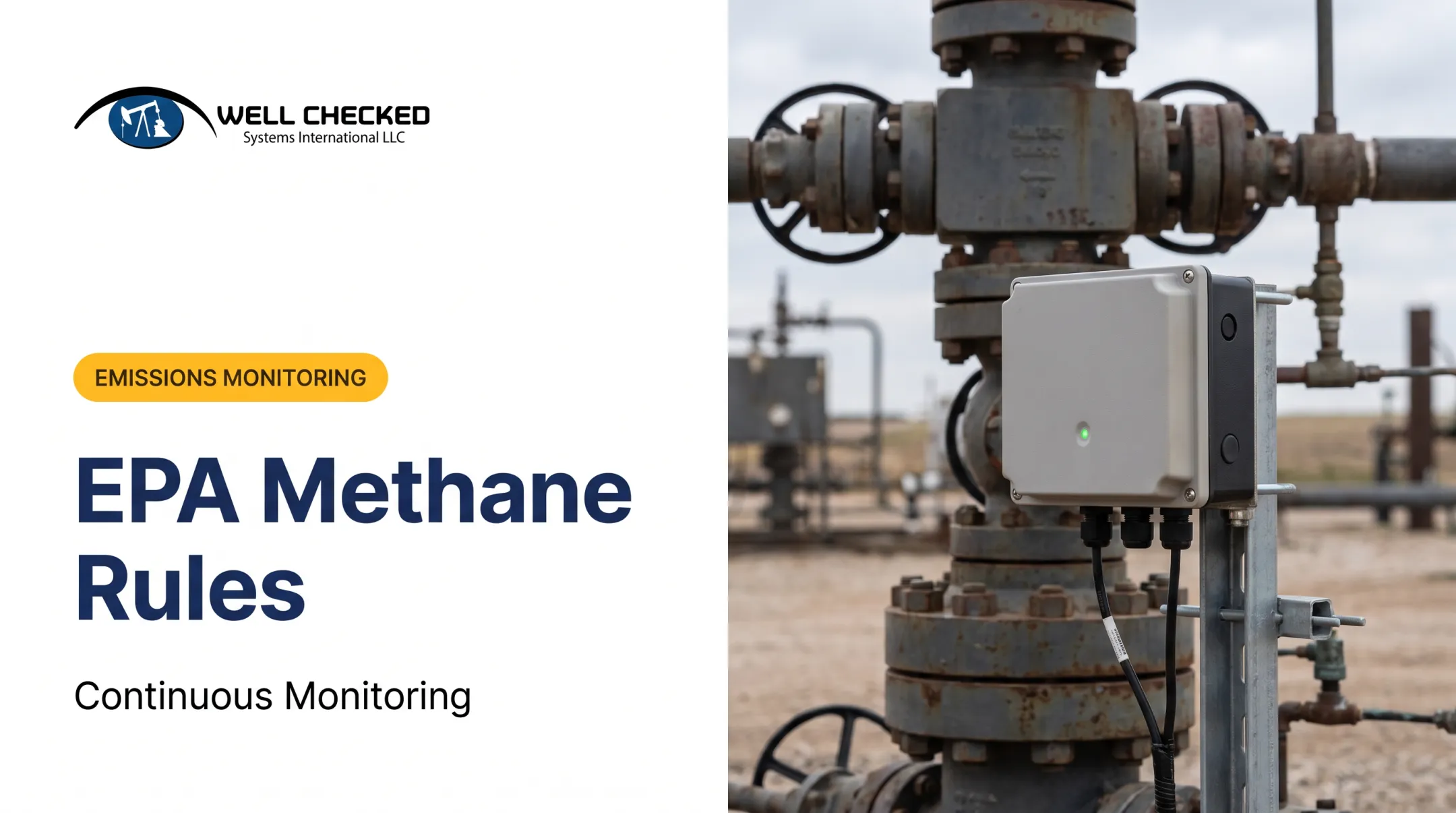
This is the regulatory pathway that enables multi-sensor automated monitoring platforms, including Well Checked Systems' Zensory.ai™ (which combines OGI-class Long-Wave Infrared imaging, video, and acoustic abnormal-sound detection), to serve as an alternative to route-based quarterly leak detection and repair (LDAR) inspections where the applicable state plan recognizes the pathway.
Well Closure and Associated Gas
Also new to OOOOb: a well closure requirement under §60.5397b(l). Operators must submit a closure plan within 30 days after cessation of production, notify EPA 60 days before closure work, and conduct an OGI leak survey over the site and each closed well afterward.
Associated gas routing (§60.5377b) requires gas be sent to a sales line, used as onsite fuel, reinjected, or controlled at 95% efficiency, with venting capped at 24 hours per calendar year.
Genuinely new to OOOOb: super-emitter response, dry seal centrifugal compressors, gas-well liquids unloading, associated gas from oil wells, and well closure plans. Everything else (wet-seal compressors, pneumatic controllers, pumps, storage vessels) carries forward from OOOOa with tightened limits.

Compliance Deadlines and Recent Rule Updates
The original 2024 rule text is no longer the full picture. EPA has amended deadlines twice since finalization, and operators relying solely on the March 2024 Federal Register text risk working off outdated dates.
| Deadline | Requirement |
|---|---|
| May 7, 2024 | General compliance date, or startup if later |
| June 1, 2026 | NHV continuous monitoring for covered flares/ECDs |
| January 22, 2027 | Zero-emission process controller phase-in, no-identifiable-emissions standards |
What changed and when:
- July 31, 2025: EPA issued an interim final rule (90 FR 35966) extending select deadlines
- December 3, 2025: EPA finalized a rule responding to comments, confirmed at 90 FR 55671, retaining the June 1, 2026 and January 22, 2027 dates above
- April 9, 2026: A further amendment (91 FR 18056, effective June 8, 2026) extended temporary flaring windows to 72 hours per incident and broadened NHV monitoring exemptions for flares and ECDs
Correction: the cumulative venting cap for qualifying safety or testing situations remains 24 hours per calendar year and hasn't changed. Only the temporary flaring allowance was extended to 72 hours per incident.
Given the pace of amendment activity, operators should treat the current eCFR text as the source of truth rather than the original 2024 rule language.
How Continuous Autonomous Monitoring Supports OOOOb Compliance
The operational math here is unforgiving. A super-emitter notification gives operators just 5 calendar days to begin investigating. Traditional quarterly operator-route inspections weren't built for that pace — a leak that starts the day after a route visit can run undetected for months.
Well Checked Systems built its three-tier Zensory.ai™ platform around this exact gap:
- Zentinal Ops™ delivers visual and acoustic equipment intelligence: high-resolution video, object recognition, acoustic anomaly detection, and actionable alerts.
- Zentinal Core™ provides continuous multi-sensor detection, using a two-day AI site-learning cycle to distinguish normal process activity from genuine fugitive anomalies: the "needle in stacks of needles"; supports OGMP 2.0 Level 3.
- Zentinal IQ™ quantifies only Core-validated events, producing volume, duration, and rate data for EPA, state-agency, OGMP 2.0 Level 4/5, SASB, and TCFD reporting.
The cost case is equally clear: route-based site-visit programs cost mid-sized to large operators an estimated $1M–$5M+ annually. Autonomous monitoring replaces that spend with 24/7 data collection and an acknowledge-dispatch-mitigate workflow that runs within 24 hours of a validated alert. That's well inside the regulatory super-emitter window, and far faster than waiting for the next scheduled route.
To be precise about the regulatory framing: under §60.5398b, the formal compliance mechanism is automated Periodic Screening performed on a quarterly basis — not a continuous regulatory monitoring requirement. The platform runs continuously at the site, which is what enables the faster response times and operational benefits described above. But the OOOOb compliance credit comes from the quarterly Automated Periodic Screening cycle the system supports, not from the continuous data stream itself.
Well Checked's multi-site Appalachian Basin deployment illustrates automated monitoring operating at scale under this evolving framework. Data outputs are structured to serve as evidentiary support for alternative-monitoring submissions where recognized by the applicable state plan. That caveat matters: §60.5398b approval flows through the operator's own submission, not the technology vendor.
Operators approaching their next compliance deadline should evaluate whether an alternative-monitoring pathway under §60.5398b fits their fleet before defaulting to another year of quarterly LDAR contracts.

Frequently Asked Questions
What does "OOOOb" mean?
OOOOb is EPA's 40 CFR Part 60 Subpart OOOOb — the New Source Performance Standard finalized in 2024 regulating methane, VOC, and SO2 from new, modified, or reconstructed oil and gas facilities built after December 6, 2022.
When did the OOOOb rule take effect, and are the deadlines still the same?
The rule took effect May 7, 2024. Several equipment-specific deadlines have since shifted through 2025-2026 amendments, so operators should confirm current dates via EPA's official rule page or eCFR.
What counts as a "super-emitter event" under OOOOb?
It's a methane detection of 100 kg/hour or greater, identified via satellite, aircraft, or mobile remote sensing by an EPA-certified third party. Notified operators must begin investigating within 5 calendar days.
Can operators use technology other than OGI cameras to comply with OOOOb monitoring requirements?
Yes. Section 60.5398b permits EPA-approved alternative test methods — specifically automated Periodic Screening — as substitutes for quarterly OGI/Method 21 surveys where the pathway is approved. To qualify for the alternative test method pathway without also requiring a manual OGI survey, the system must meet the detection-sensitivity criteria specified in §60.5398b. Multi-sensor platforms like Well Checked's Zensory.ai™ that meet this threshold can support an operator's §60.5398b submission. Note that while the system operates continuously at the site, the regulatory compliance screening cadence under OOOOb remains quarterly.
Does OOOOb apply to existing wells drilled before 2022?
No. OOOOb applies to facilities whose construction, modification, or reconstruction commenced after December 6, 2022. Existing wells that have not been modified or reconstructed are not covered by OOOOb.