
Introduction
A traditional street camera just records. Someone has to watch the footage, rewind it, or wait for a crime to happen before it's useful.
Today's AI-powered cameras work differently. They recognize faces, flag unusual behavior, and identify objects the moment they appear, all without a human staring at a monitor.
This shift has sparked real debate. AI surveillance now shows up in several very different settings:
- Governments deploy it for policing and border security
- Employers use it to track workers
- Retailers rely on it to catch shoplifters
- Industrial sites use it to monitor equipment and emissions, not just people
This guide breaks down what AI surveillance actually is and how the technology works. It also covers where it's deployed today, which countries rely on it most, and how to weigh its benefits against its risks.
Key Takeaways
- AI surveillance pairs sensors (cameras, microphones, other feeds) with machine learning to flag patterns without human review
- Vision-Language Models have made surveillance tools cheaper, more capable, and more accessible than a decade ago
- Applications span government tracking, workplace monitoring, retail loss prevention, and industrial safety monitoring
- Not all AI monitoring targets people — exception-based industrial systems represent a lower-risk category entirely
What Is AI Surveillance?
AI surveillance is the use of machine learning, computer vision, and natural language processing to automatically monitor and analyze video, audio, or data streams, flagging relevant patterns without requiring someone to watch every frame. Instead of a security guard scanning ten monitors at once, the system does the scanning and only escalates what matters.
The Shift from Rule-Based Systems to Self-Learning Models
Early video analytics were rule-based: "alert if motion is detected after 6 p.m." These systems couldn't recognize anything they weren't explicitly told to look for. That's changing fast.
A 2025 academic survey on video understanding documents an industry-wide shift from CNN-based feature extraction toward Vision Transformers and video-language models. These newer architectures can generalize, recognizing objects or behaviors they were never directly trained on.
This is a research and product-development trend, not a claim that every deployed system has already switched over. But the direction is clear.
Core technologies powering these systems include:
- Computer vision and object detection
- Facial recognition
- Natural language processing for text and social media analysis
- Acoustic analysis for sound-based anomaly detection
- Multi-sensor data fusion, combining several inputs into one picture
Compute costs have also dropped substantially, which is part of why these tools have spread so quickly. Stanford's AI Index reports that GPU computation costs fell more than 99% between 2006 and 2024. That's an enabling factor behind cheaper AI processing generally, though it isn't a direct price tag for analyzing an hour of footage.
That falling cost curve explains why AI-driven monitoring now shows up everywhere, from retail cameras to industrial sensors watching equipment and pipelines. Not every application carries the same stakes.
One distinction matters more than any other here: surveillance monitors people and their behavior, raising privacy questions. Monitoring watches equipment, environments, or conditions, a very different risk profile, which we'll return to below.
How AI Surveillance Technology Works
AI surveillance systems follow a fairly consistent three-step pipeline, whether they're watching a parking lot or a pipeline.
- Data ingestion: Cameras, microphones, license plate readers, or other IoT sensors continuously capture raw video, audio, or environmental data.
- AI/ML analysis: The system processes that raw data using one of two approaches: rule-based analytics (pre-programmed conditions) or behavioral analytics, where the system learns a baseline of "normal" and flags deviations from it.
- Alerting and output: Only when a threshold or anomaly is met does the system generate an alert, a bounding box, searchable metadata, or a full incident dossier.

Why Automation Replaces Constant Human Monitoring
Humans simply aren't built for sustained visual monitoring. Research on general human vigilance shows that target-detection performance can drop by roughly 15% within just 30 minutes of monotonous watching. That's not a study of security control rooms specifically, but the implication holds: nobody stays sharp watching a static feed for hours.
Newer vision-language models let operators configure alerts using plain-language commands ("alert me if someone loiters near the loading dock after hours") instead of rigid rule menus. That's a real usability win. It also means misconfiguration, or misuse, takes far less technical skill than it used to.
Where AI Surveillance Still Falls Short
That usability gain doesn't make these systems infallible, though. Independent benchmark testing has documented real gaps:
- VIDHALLUC (2025) found wide swings in accuracy across models on video hallucination tasks: one model scored 81% on an action-recognition task while another scored just 27% on the same test
- Video-MME (2024) found accuracy drops noticeably as video length increases, with one leading model falling from 82% on short clips to 68% on long ones
- Spatial reasoning benchmarks show many models perform close to random chance on tasks requiring spatial visualization
The takeaway: accuracy depends heavily on the specific model, task, and footage length. That's why consequential decisions still need human review before action is taken.
Types & Real-World Applications of AI Surveillance
AI surveillance today splits into four broad categories, each carrying very different privacy stakes.
Government & Public Surveillance
Law enforcement and border agencies use facial recognition, automated license plate readers, and social media monitoring at meaningful scale. A GAO survey of 42 federal law enforcement agencies found that 20 of them owned or used facial recognition systems.
Beyond individual tools, a growing concern is data aggregation: platforms that combine public and private records into searchable profiles. EFF's Atlas of Surveillance has documented third-party investigative tools like CrimeTracer and Accurint Virtual Crime Center, which mine law-enforcement and commercial data together, expanding what agencies can search well beyond their own camera networks.
Workplace & Corporate Monitoring
Employee monitoring tools now track keystrokes, screen activity, and in some cases facial expressions. There's no comprehensive U.S. federal law requiring employers to disclose this monitoring, leaving workers largely dependent on state-level protections.
In commercial fleets, AI-based driver-monitoring cameras flag distracted or unsafe driving in real time. Driver approval of these systems rose sharply, by 87% in one industry study, when carriers used footage specifically for proactive safety coaching rather than punitive tracking.
Consumer & Retail Surveillance
Retailers use AI video analytics for loss prevention and foot-traffic heat-mapping, though adoption is still uneven. A 2024 survey of retailers across 20 countries found average deployment across dozens of video-analytics use cases sat around just 7%, with another 18% planned or in trials.
On the consumer side, smart-home cameras now use AI person and object detection for security alerts. Roughly 30% of U.S. internet households own a smart camera or video doorbell, though that measures ownership, not whether AI features are actually turned on.
Industrial & Environmental Safety Monitoring
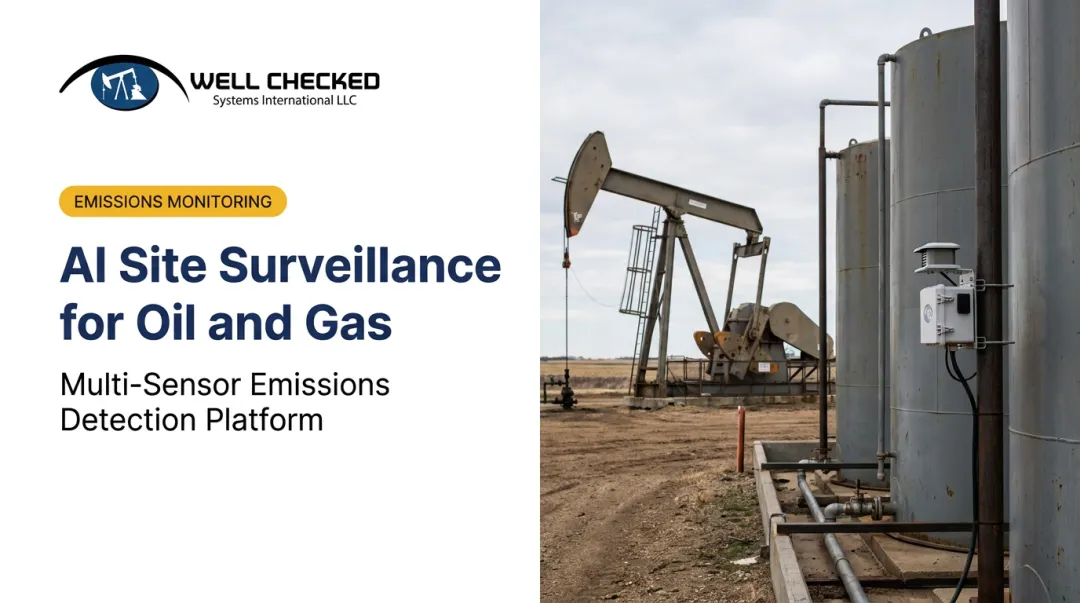
Not every AI monitoring system tracks people at all. A growing application applies the same multi-sensor approach (vision, acoustic, and infrared gas imaging) to equipment, emissions, and site conditions instead.
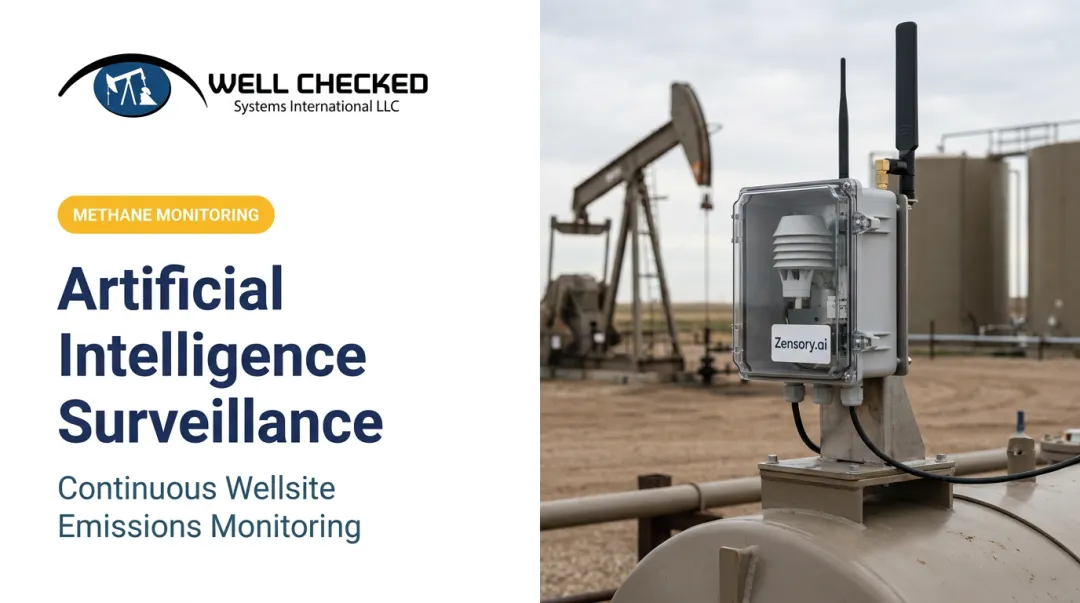
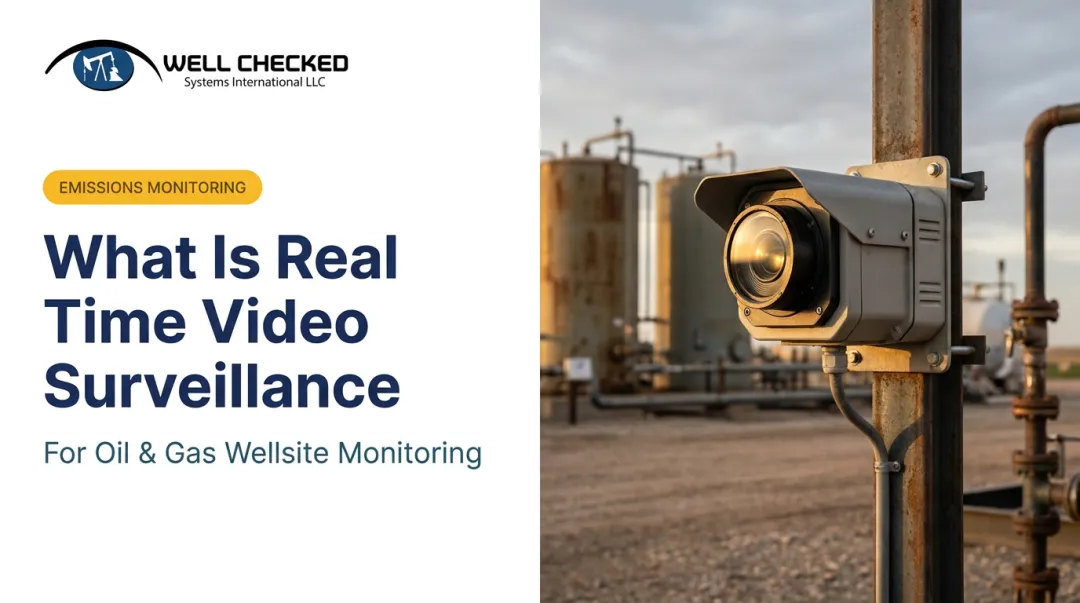
Well Checked Systems' Zensory.ai™ platform is a working example. Deployed across a confirmed multi-site program in the Appalachian Basin, it combines high-resolution video, Long-Wave Infrared Optical Gas Imaging, and acoustic abnormal-sound detection to autonomously detect methane leaks and equipment anomalies.
The system's Zentinal Core™ tier filters out false alarms during a roughly two-day AI site-learning period, so operators only get alerted on validated events: what the platform describes as finding "the needle in stacks of needles." Its Zentinal IQ™ tier then quantifies confirmed emissions for EPA and ESG reporting.
This "operate by exception" model replaces routine pumper-route site visits, which typically cost mid-sized to large operators $1 million to $5 million or more annually. Continuous monitoring takes over instead, demanding human attention only when something genuinely needs it, without the privacy trade-offs tied to person-tracking surveillance.

Which Countries Use AI Surveillance the Most?
China remains the most-cited example of nationwide AI surveillance. Its "Sharp Eyes" program, launched nationally in 2015, set an official target of 100% public-space camera coverage by 2020 — though independent verification of whether that target was fully achieved remains limited.
The United States is expanding fast, too. Beyond the federal facial-recognition use noted earlier, automated license plate reader networks have grown substantially. More than 3,900 agencies conducted over 12 million searches of one major ALPR network between December 2024 and October 2025 alone. U.S. Border Patrol trialed access to that same network during an early-2025 pilot.
Globally, Carnegie's AI Global Surveillance Index found active AI-surveillance use in at least 75 of 176 countries studied. The index breaks down by capability and supplier:
- 64 countries use facial-recognition systems
- 52 countries use smart-policing systems
- Chinese-linked suppliers served 63 of those countries
- U.S. companies supplied technology to 32 countries
That data measures documented adoption, not intensity or effectiveness, but it confirms this isn't a China-only phenomenon.
Is AI Surveillance Ethical? Benefits, Risks & Regulation
The Case for Legitimate Benefit
AI surveillance can genuinely improve safety outcomes:
- Faster crime and incident detection compared to purely manual review
- Quicker public safety response times
- In industrial contexts, faster identification of environmental or safety hazards than routine human inspection alone allows
The Core Risks
The same capabilities that make these systems useful also make them risky:
- Privacy erosion: Pew research found majorities expect police facial recognition to help solve crimes, but also expect it to come at the cost of personal privacy
- Chilling effects: Civil liberties groups argue that pervasive face recognition can discourage free speech and public protest
- Demographic bias: NIST testing of nearly 200 facial recognition algorithms found false-positive rates varying 10x to more than 100x across demographic groups, with the highest error rates for African, Asian, and female faces

The Regulatory Gap
The U.S. has no comprehensive federal privacy law governing AI surveillance. What exists instead is a patchwork: Illinois' Biometric Information Privacy Act requires written consent before collecting biometric data, and Portland has banned both government and certain private facial recognition use. Congress has floated broader frameworks, but nothing comprehensive has passed.
That regulatory gap is exactly why context matters: person-tracking surveillance without consent or oversight carries real risk. Purpose-specific, transparent industrial monitoring (like methane detection systems that watch equipment rather than people) sits in a fundamentally different, lower-risk category. Ethical use hinges on purpose and transparency, backed by real accountability for how the system is deployed.
Frequently Asked Questions
What is AI-powered surveillance?
AI-powered surveillance uses machine learning to analyze video, audio, or data feeds automatically, detecting and flagging relevant patterns or events in real time without requiring constant human review.
What countries are using AI surveillance?
China is the most prominent example, with a nationwide camera and facial-recognition network. The United States and dozens of other countries are also rapidly expanding adoption for policing and border security.
Is it ethical to use AI for surveillance?
It depends on context. Public or personal surveillance raises serious privacy and bias concerns, while transparent, purpose-specific monitoring, such as safety or environmental compliance systems, is generally viewed as lower-risk.
What's the difference between AI surveillance and AI monitoring?
Surveillance tracks people and their behavior, raising privacy questions. Monitoring watches equipment, environments, or conditions, such as methane leaks or machine malfunctions, for safety and compliance purposes.
Can AI surveillance systems make mistakes?
Yes. Documented issues include false positives, hallucinated details, and facial recognition misidentification, especially with long videos or complex real-world conditions.
Is AI surveillance legal in the United States?
There's no comprehensive federal privacy law governing AI surveillance. Instead, a patchwork of state and local regulations, including Illinois' BIPA and Portland's facial recognition bans, fills the gap.