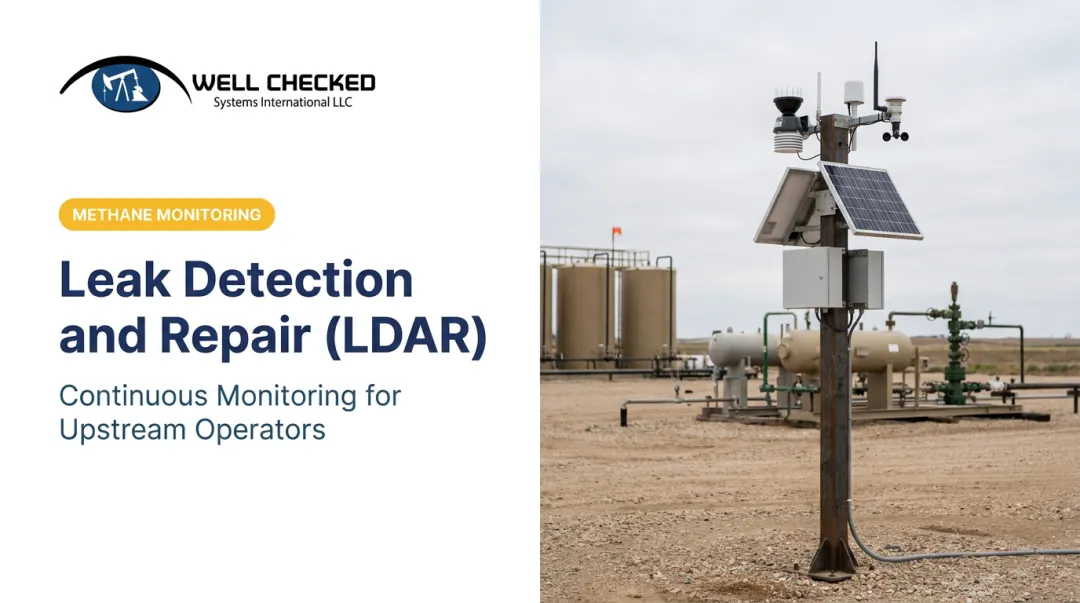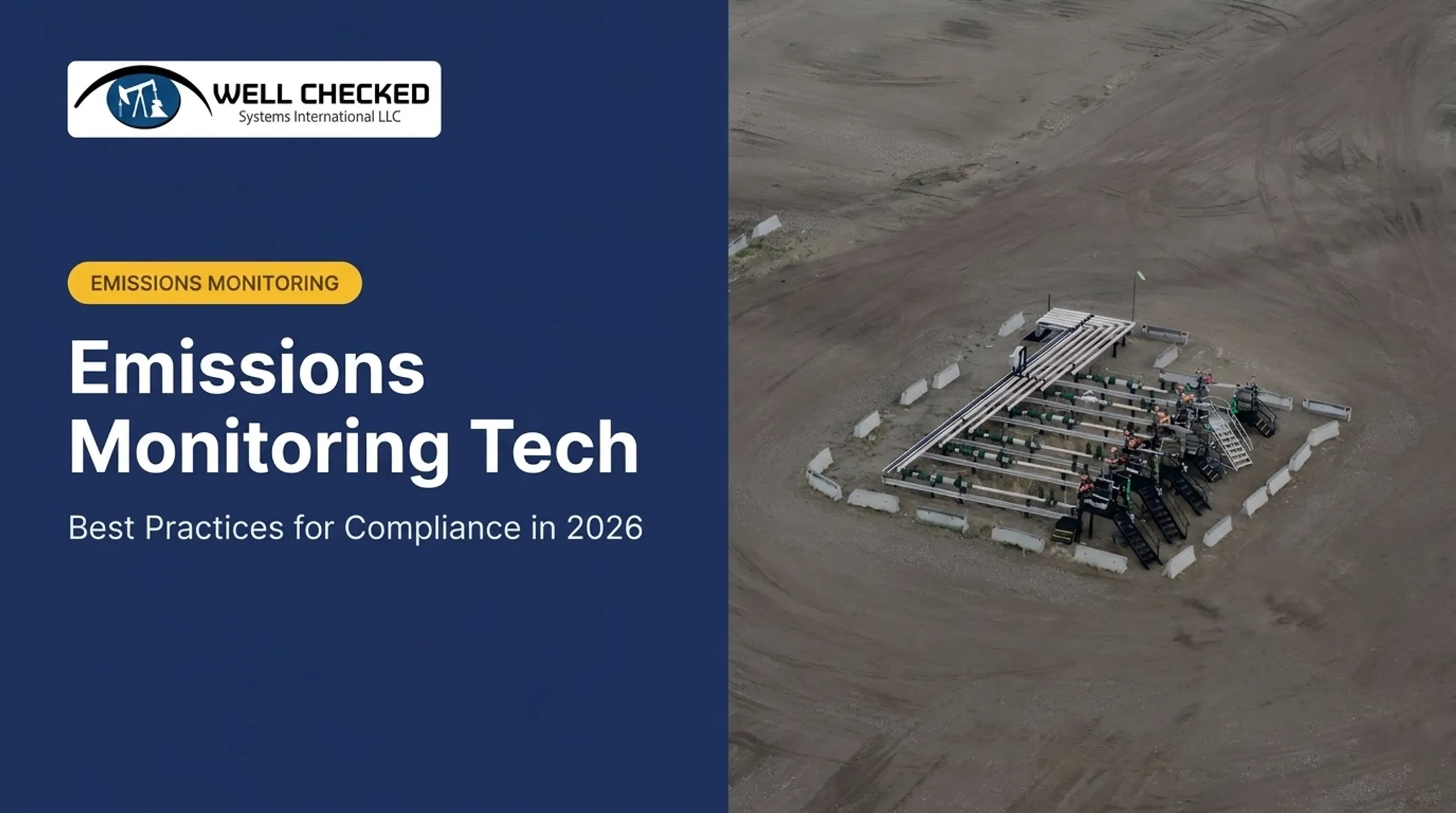

Meanwhile, most operators still rely on periodic LDAR surveys and pumper routes. Quarterly or even monthly inspections leave gaps between visits, and those gaps are where compliance risk, fines, and safety exposure live.
This article breaks down what "reliable" and "defensible" actually mean under current regulations, compares the monitoring technologies available today, and explains why combining sensors with AI closes the detection gap that periodic checks can't.
Key Takeaways
- EPA rules and OGMP 2.0 now favor measurement-based evidence over estimate-based emissions reporting
- Not all monitoring technologies are equally defensible: sensitivity, continuity, and false-alarm filtering all matter
- Moving from route-based visits to exception-based monitoring cuts cost and safety exposure
- Well Checked's Zensory.ai™ platform connects raw detection to regulatory-grade quantification
What Reliable Emissions Monitoring Means for Regulatory Compliance
"Reliable" in a compliance context means four things:
- Continuous coverage
- Source-level accuracy
- Defensible documentation
- Reconciliation of top-down estimates with bottom-up measurements
A snapshot from last quarter's inspection doesn't hold up if a leak started the day after.
EPA's alternative-monitoring pathway. Under 40 CFR § 60.5398b, continuous systems must:
- Detect at least 0.40 kg CH4/h
- Generate a valid rate every 12-hour block
- Transmit data daily
- Keep downtime at or below 10%
Periodic screening methods need Administrator approval and fast turnaround: results generally within five days, repairs and resurveys within 30 days.
OGMP 2.0's measurement bar. Level 4 relies on company-specific, source-level estimation methods. Level 5 goes further, reconciling that inventory against independent site-level measurements with documented uncertainty. Top-tier operators are moving toward source-level quantification, not just better estimates.
SASB and TCFD add disclosure structure. SASB's Oil & Gas E&P standard requires gross Scope 1 emissions, methane percentage, and a breakdown between flaring, combustion, process, and fugitive sources. TCFD frames climate risk disclosure around governance, strategy, and metrics (voluntary, but increasingly expected by investors).
The gap is real and well-documented. Peer-reviewed research in Science estimated 2015 US oil-and-gas methane emissions at 13 Tg/year, about 60% higher than EPA's inventory at the time. That gap is exactly what continuous, source-level measurement is meant to close.

Comparing Emissions Monitoring Technologies
No single technology covers every compliance need. Here's how the main categories stack up.
| Approach | Best for | Main limitation |
|---|---|---|
| Fixed continuous | Site-level compliance data, OOOOb alternative monitoring | Higher upfront infrastructure cost |
| Aerial / satellite | Basin-scale screening, large-emitter flagging | Intermittent coverage; high detection floors |
| Portable / handheld | LDAR verification and repair confirmation | Requires a person on site with the instrument |

Fixed Continuous Monitoring Systems
Fixed sensor networks (optical gas imaging, tunable diode laser absorption spectroscopy, acoustic sensors) deliver 24/7 site-level visibility. They're the strongest fit for continuous compliance data because they produce an unbroken measurement record.
The trade-off is higher upfront infrastructure cost compared to a periodic survey. Well Checked removes that barrier with a low-cost, fee-for-service structure that eliminates the upfront capital cost of fixed monitoring. For sites facing OOOOb alternative-monitoring obligations, that cost buys the continuity regulators actually want.
Aerial and Satellite Monitoring
Drones and satellites are useful for large-scale screening across a basin. They can flag major emitters quickly across hundreds of sites.
Their limitation is intermittency:
- Satellites like Sentinel-2 revisit every 2–5 days and generally only catch sources above 1–2 metric tons/h
- Even higher-resolution commercial platforms have detection floors around 100 kg/h
- Weather, cloud cover, and daylight further restrict usable passes
Periodic snapshots simply can't meet OGMP 2.0 Level 5's expectation of continuous, site-level measurement. They're a screening tool, not a compliance backbone.
Portable/Handheld Gas Analyzers
Portable OA-ICOS and NDIR analyzers support LDAR verification surveys: confirming a leak once it's flagged, or backing a repair-verification walk. They complement continuous systems well. They don't replace them, because someone still has to be at the component with the instrument.
Why Multi-Sensor, AI-Driven Monitoring Outperforms Single-Technology Approaches
Here's the real operational headache: distinguishing a genuine fugitive leak from a normal process emission, like a routine tank vent or a pneumatic controller doing its job. Single-sensor systems often can't tell the difference, which floods field teams with false alarms.
This is where sensor fusion matters. Controlled-release testing of eleven commercial continuous monitoring systems found false-positive rates ranging from 0% to 79%, with quantification errors also varying widely. One sensor type alone rarely tells the full story.
The Zensory.ai™ Approach
Well Checked's platform is built around three tiers:
- Zentinal Ops™: visual and acoustic intelligence, using high-resolution video and object detection plus acoustic AI for abnormal equipment sounds
- Zentinal Core™: combines video, LWIR Optical Gas Imaging, and acoustic sensing into 360° detection, filtering false alarms before anything reaches a human
- Zentinal IQ™: quantifies only Core-validated events for regulatory submission
Each site goes through an AI Site Learning cycle of roughly two days, during which the system builds a baseline of what "normal" looks like at that specific location. Compressors, flares, and venting all have their own acoustic and thermal signatures. Once the system knows the baseline, it can flag deviations with far more confidence than a static sensor threshold ever could.
Combining video, acoustic, and infrared sensing in one platform (instead of managing separate vendor tools for cameras, microphones, and gas imaging) also simplifies operations. LWIR cameras enable day/night detection at roughly one-third the cost of mid-wave IR alternatives, making continuous OGI more attainable at scale.

Well Checked currently monitors remote sites, analyzing more than 1,500 videos per site per day. Those figures come from continuous, production-scale operation in the field.
Turning Detection into Defensible Compliance Data
A continuous record beats a periodic-snapshot LDAR report every time an auditor asks "what was happening at 3 a.m. on a Tuesday?"
With route-based inspections, the honest answer is: nobody knows. With continuous monitoring, there's a timestamped record.
The acknowledge-dispatch-mitigate workflow turns a validated alert into action:
- Acknowledge — the dispatch team receives a near-real-time alert via dashboard, email, text, or SCADA
- Dispatch — personnel are sent using pre-built response templates and runbooks
- Mitigate — the event is addressed, ideally within a 24-hour window, with the action recorded

Response closes the event; quantification makes it defensible. Once Zentinal Core™ validates an event, Zentinal IQ™ measures its volume, duration, and rate using LWIR-based plume analysis.
That record serves two jobs:
- Feeds OGMP 2.0, SASB, and TCFD reporting with audit-ready figures
- Gives operations teams real methane-loss numbers so repairs are prioritized by impact, not guesswork
Cost and Operational Benefits Beyond Compliance
Compliance is the headline reason to upgrade monitoring, but it's not the only one. Three operational gains stack on top of the compliance case:
- Route-based site visits cost mid-sized to large operators $1M–$5M+ annually. Autonomous monitoring shifts field teams from routine drive-bys to exception-based dispatch, sending people only when something needs attention.
- Pumper routes expose crews to traffic, weather, and hazardous site conditions. Fewer unnecessary trips mean less time on the road. Land transport remains a material industry safety issue: IOGP reported 501 land-transport fatalities globally between 1991 and 2012.
- Fewer vehicle miles mean fewer truck emissions, adding a smaller transport footprint on top of the primary methane reduction goal.
Frequently Asked Questions
What is the best software for environmental monitoring?
It depends on whether you need detection-only or defensible regulatory quantification. Multi-sensor AI platforms like Zensory.ai™ are built to scale from basic detection to full compliance reporting as needs grow.
What are the four main types of environmental monitoring?
Fixed continuous monitoring, aerial/drone survey, satellite monitoring, and portable/handheld analyzers. Each has a different role in a complete monitoring strategy.
What is the purpose of CEMS?
Continuous Emissions Monitoring Systems provide ongoing, real-time measurement of pollutant concentrations. EPA uses this data for compliance and exceedance determinations, and operators use it for process optimization.
How often should oil and gas sites be monitored for methane leaks?
Regulatory trends favor continuous or near-continuous monitoring over quarterly inspections, particularly for operators targeting OGMP 2.0 Level 5. Periodic checks simply can't catch what happens between visits.
Can AI-based monitoring reduce false alarms compared to traditional sensors?
Yes. Multi-sensor fusion plus a short site-specific AI learning cycle filters normal process emissions and alerts only on true fugitive anomalies, cutting the noise that overwhelms single-sensor systems.
What happens if a facility fails to comply with EPA methane monitoring rules?
Consequences can include civil penalties, mandated corrective action, and increased ESG reporting scrutiny. In one 2024 EPA settlement, an operator agreed to a $4M penalty plus over $5.5M in remediation projects across hundreds of well pads.